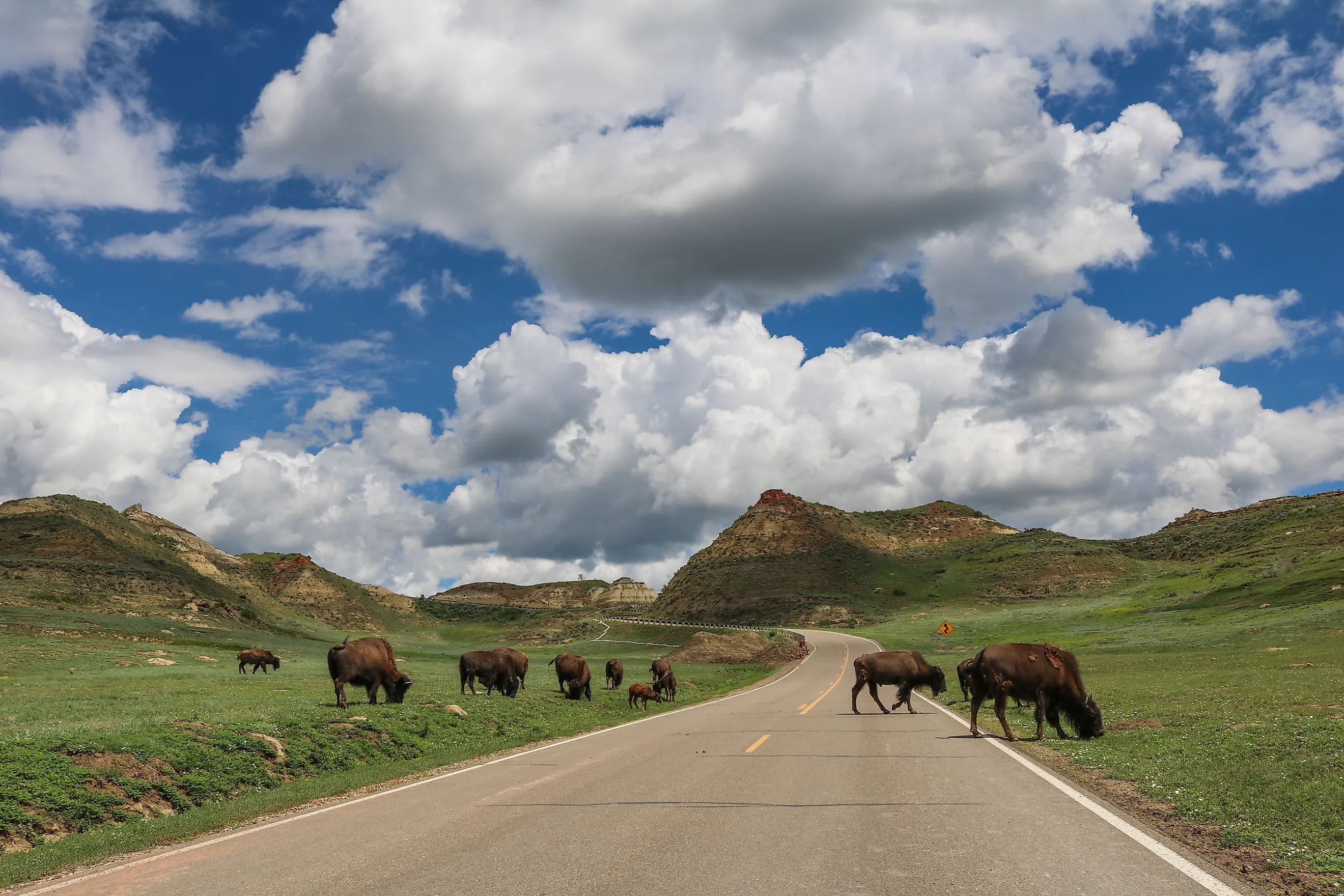
The National Parks Where Bison Block The Road
There's a unique American traffic phenomenon known as a bison jam, a term used by rangers. It occurs when a two-thousand-pound bison decides to stand in the middle of the road, creating a queue that can last up to forty minutes with no way to move it. The bison isn't confused; it’s making a logical choice. Roads in these areas are flat, maintained, warmer than the surrounding terrain, and free of snow or sagebrush, making cross-country travel costly. In six national parks with large free-roaming herds, this situation happens regularly, and in each case, bison have the right of way due to policies and physics.
Here is where it happens, which roads specifically, and what to do when you are third in line.
Yellowstone National Park

Yellowstone remains the central hub for the bison population, housing about 5,300 bison in 2025—making it the largest public land herd and the only place where the species has survived continuously since prehistoric times. Key spots include Hayden Valley, situated on the Grand Loop Road between Canyon and Fishing Bridge, and Lamar Valley in the northeast, which stays accessible during winter. These areas are large grassland basins with a road running through their centers, providing ideal and easily accessible habitats for the herds. Interestingly, scale plays a key role: a 2025 study in the Journal of Heredity found that what were once considered two separate Yellowstone herds now function as a single, interbreeding population. This suggests that the bison migrate across the entire park rather than staying within fixed territories.
Grand Teton National Park

The Grand Teton herd borders Yellowstone and behaves similarly, but a key difference is the road situation: US 26/89/191 passing through the park is a functional highway rather than a scenic loop. As a result, behind a crossing herd, the line typically consists of commuters and freight heading to Jackson, and the delay carries a cost that a park loop road does not. Common crossing points include Antelope Flats Road and the Kelly area on the eastern side of the valley. While the sagebrush flats here are famous for their iconic photographs, they also present a danger: cars pulling over on the shoulder of a 55 mph highway shift the risk from the bison to the traffic.
Theodore Roosevelt National Park

This experience is the most focused on the list since Theodore Roosevelt directs nearly all traffic to just two routes: the Scenic Loop Drive in the South Unit and the scenic drive in the North Unit. As these are essentially the only accessible paths, seeing a herd on the road is inevitable. Bison often wander into campgrounds and visitor center parking lots too. This herd is one of the few on public land not affected by cattle gene introgression, giving it significant genetic value for its size.
Badlands National Park

South Dakota's Badlands protect about 1,200 plains bison, making it one of the largest herds managed by the National Park Service outside Yellowstone. These bison graze along the Badlands Loop Road. The best spot to see them is Sage Creek Rim Road, an unpaved road along the northern edge of the wilderness where the herd mostly stays. This area also offers a greater chance to have a quiet experience since its gravel surface prevents large crowds from gathering like on the paved loop. Bison frequently cross the road and the overlooks here, so it's useful to keep this in mind if you take a short walk from a nearby pullout.
Wind Cave National Park

Wind Cave manages a herd of about 250 to 400 animals, smaller than others on this list but especially significant. It is believed to be one of only around seven free-roaming, genetically pure bison herds on public land in North America. The herd was reconstructed with 14 bison donated by the New York Zoological Society and six from Yellowstone, highlighting how close the species came to extinction. By the late 1880s, the bison population had plummeted from tens of millions to near extinction. US 385 and South Dakota 87 both run through the park's mixed-grass prairie and frequently stop for animals descended from those original twenty founders.
Grand Canyon National Park

Few people expect to see this: a herd of bison inhabiting the North Rim's meadows around the road from Jacob Lake, Arizona. This herd originates from an early 20th-century failed crossbreeding experiment between bison and cattle. Their descendants migrated to the Kaibab Plateau and into the park, where they face no natural predators but have a significant appetite. The Park Service has been working for years to control the herd by capturing and transferring some animals to tribal nations, as their grazing was impacting high-elevation meadows and water sources. For drivers, this often results in a bison jam at 8,000 feet amidst a ponderosa forest—certainly not the experience most expect on a Grand Canyon trip.
Why They Use The Road

It's energy, not stubbornness. A bison trudging through deep snow or heavy sage expends much more energy than one on cleared asphalt. During a Yellowstone winter, this energy difference can be critical in shaping the year's outcome. Groomed roads become vital travel corridors from December onward, a longstanding management challenge for the park. Warmth also influences this; asphalt retains heat after sunset, which explains why sightings often occur around dawn and dusk. Additionally, open roads tend to have fewer biting insects than tall grass in midsummer. Since nothing in these parks needs to fear a bison, standing in the middle of the road is simply the easiest way to reach a destination.
What To Actually Do

Stay inside your car and wait—that's the entire advice, and it works because animals Keep moving. Some important points: avoid honking, as advised by the Park Service, since startling a bison in a confined space can lead to worse outcomes than a slow retreat. Don't try to squeeze past on the shoulder; keep the windows up if animals are walking beside your vehicle, as bulls may rub against cars. If you're outside the vehicle, stay at least 25 yards away—measure by holding your thumb at arm's length to see if it covers the entire animal. Bison can run about 35 miles per hour, roughly three times faster than a human, and they injure more visitors in Yellowstone than any other park animal—most incidents involve someone leaving their car.