The Largest National Park East Of The Mississippi
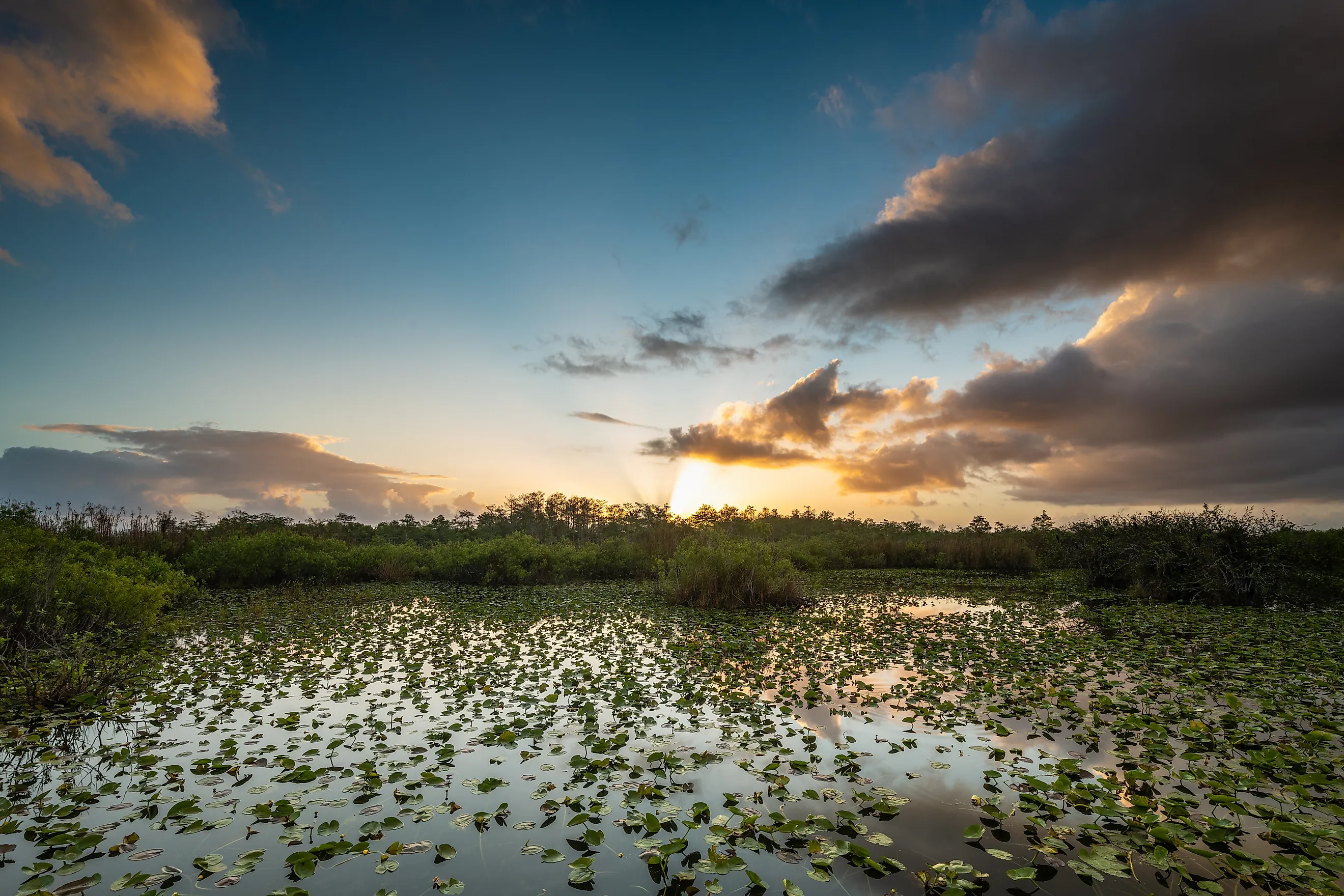
The Everglades National Park is the largest national park east of the Mississippi River at 1,542,526 acres. Overall, it is the 10th largest national park and is more than 300,000 acres larger than the Grand Canyon National Park. Located in Miami-Dade, Monroe, and Collier Counties in Florida, this park is very low in elevation, with an average elevation of 6 feet above sea level. It also experiences large amounts of rain at 60 inches per year, providing moisture to the vast numbers of wetlands, marshes, and other environments within the park. These environments in turn support various forms of aquatic and semi-aquatic wildlife, including alligators.
History

At the turn of the 20th century, Florida leaders and the birding Audubon Society came together to attempt to protect the wildlife of the Everglades. Their initial effort was a ban on plume hunting in 1900. However, locals often relied on hunting for their livelihood, leading to violent encounters with bird wardens and locals, including the murder of bird warden Guy Bradley in 1905.
Another concern was the draining of the swamps and marshes and the destruction of the hammock habitat, tropical woodlands made of hardwood trees sitting above the wetter areas of the Everglades. In the early 1900s, the Florida Federation of Women's Clubs began lobbying the state government to protect the Everglades. In 1916, the state of Florida designated 960 acres as part of the Royal Palm State Park to the women's organization.
Within 5 years, the park had been expanded to 4,000 acres. The Women's Club would manage this property, building the Royal Palm Lodge to accommodate visitors. They were even able to maintain the park during the Great Depression.
Meanwhile, landscape architect Ernest Coe began petitioning Congress for a Tropical Everglades National Park in 1928. Six years later, Congress approved his request, establishing the Everglades National Park in 1934. Over the next 13 years, the national park would slowly acquire land, including Royal Palm State Park in 1947. The park officially opened on December 6, 1947, with a dedication offered by President Harry Truman.
Habitats

One of the primary reasons for establishing the Everglades National Park was its variety of habitats that support many types of flora and fauna. There are nine specific habitats in the Everglades.
The first, as mentioned above, is the hardwood hammock, which tends to sit at the highest elevation in the park, featuring hardwood trees such as red maple, hackberry, and cocoplum. They have often been described as tree islands, which are protected by acids from decaying plants around the hammock, which creates a moat around the island. These hammocks are often surrounded by freshwater sloughs, which are low-lying areas that remain flooded year-round and provide water to the rest of the Everglades at a slow pace of 100 feet per day.
Another tree habitat is pinelands, made of slash pine trees. Fires play a crucial role in this environment, as it burns away the larger trees that would steal sunlight from seedlings. Some trees in the Everglades can survive in water, such as cypresses, a deciduous conifer tree that can grow in standing water. In poorer soil, smaller cypress trees known as dwarf cypresses grow.
Freshwater marl prairies are similar to sloughs, but they are drier and are built over thin soil over limestone bedrock. This habitat, along with the coastal lowlands, has sturdy vegetation that is resistant to salt, flooding, and winds.
The Everglades' most iconic habitat is mangroves. These consist of red, black, and white mangroves that can withstand brackish waters in the coastal channels and rivers. This habitat is the largest contiguous mangrove forest in the Western Hemisphere.
One of the lesser-known habitats in the Everglades is the 800 square miles of marine bottom within the Florida Bay. Here, seagrass, algae, mollusks, and fish live.
Wildlife

The Everglades National Park has 350 species of birds, 40 mammal species, and many reptiles and fish. The park is best known for its bird population, including wading birds like the spoonbill, with its pink wings. There are 16 wading birds in the park, with the most common being the white ibis, which eats crayfish.
The mammals in the park have adapted to survive in the semi-aquatic environment, such as gray foxes, which cling to the hardwood hammocks, or bobcats that hunt and forage in the mangroves.
The most endangered mammal in the Everglades is the Florida panther, of which fewer than 100 are believed to still live in southern Florida. These cats eat hogs, deer, raccoons, and at times baby alligators.
Speaking of alligators, the Everglades is home to a large population of American alligators, which are the apex predators of the environment. Some estimate that there are up to 200,000 or more alligators in the Everglades. These creatures can grow up to 15 feet long and tend to favor the freshwater sections of the Everglades, although they can travel through brackish waters for a short time.
The Everglades is one of the few environments on Earth where crocodiles can be found alongside alligators. The American crocodile is similar to the American alligator, but has a few differences. For one, it belongs to a different genus, Crocodylus as opposed to Alligator, so it cannot crossbreed with alligators. In addition, it has a triangular snout and is more accustomed to salt or brackish environments.
Things to do

One of the best ways to explore the Everglades is out on a boat or in a kayak. The Everglades National Park has many types of paddling trails for beginners or advanced paddlers. One is the Flamingo Paddling Trails, such as the short and twisting Noble Hammock Trail, or the Hell's Bay Trail that goes through mangrove creeks. Today, the trail is well marked to help paddlers navigate, as the trail used to be known as "hell to get into and hell to get out of."
Hikers can also get out and about in the Everglades, traversing through the drier part of the park, such as the Mahogany Hammock Trail, the Pine Lands Trail, or the Gumbo Limbo Trail, named after the gumbo limbo trees viewable from this short 0.4-mile loop.
For those with a fishing license, the Everglades provides plenty of species such as sea trout, bass, bluegill, and many others. However, in Florida there are separate licenses for freshwater and saltwater fishing. Hence, depending on the environment, fishers will need to make sure they have the proper paperwork.
Staying safe in the Everglades National Park
Visitors to the Everglades National Park can stay safe while visiting this park by staying aware of each environment. For example, one should pack a lot of water and sunscreen, especially when visiting during the hot and humid months of the summer. Pets should be kept at home, as they are not allowed on most trails, and they can attract the attention of alligators. In order to stay safe from alligators, guests should avoid swimming in the water and stay more than 15 feet away from any alligators and crocodiles. If either of these creatures begins to hiss, guests should move farther away. Lastly, one should never touch any of the animals in the park, especially predators.