The Forbidden Mountains Of The World
Mountains have inspired and awed people for thousands of years, and many cultures weave religious and spiritual meaning into the peaks that surround them. Most of the world's mountains welcome climbers and hikers, but a handful are off-limits, closed to the summit by law, by custom, or by sacred tradition. The peaks below are among the most notable mountains where reaching the top is forbidden.
Ball's Pyramid

Ball's Pyramid is the eroded remnant of an ancient shield volcano, standing about 12 miles southeast of Lord Howe Island in the Pacific Ocean. At 1,844 feet (562 m) above the waves, it is the tallest volcanic sea stack in the world. Climbers first reached its summit in 1965, but in 1982 the Lord Howe Island Act banned the ascent outright. The rules eased in 1990, and climbing is now allowed only with special permission from the New South Wales state minister.
Mount Omine
Mount Omine, officially called Mount Sanjo, rises 5,640 feet (1,719 m) in the Omine range within Yoshino-Kumano National Park on Honshu, Japan. It is one of the holiest sites of Shugendo, a mountain-ascetic faith, and the Ominesan-ji monastery at its summit serves as the religion's headquarters. The mountain is also known for a rule that has nearly vanished elsewhere in the country: women are still barred from its sacred upper reaches. The prohibition has its roots in old beliefs about ritual purity, and although most Japanese sacred mountains dropped such rules in the 1870s, Mount Omine has kept its ban on women to this day, even as it sits within a UNESCO World Heritage Site.
Kangchenjunga

Kangchenjunga straddles the border between India and Nepal, and at 28,169 feet (8,586 m) it is the highest mountain in India and the third highest on Earth. The peak is sacred to the people of Sikkim, who traditionally will not climb it, and out of respect many mountaineers stop a few steps below the true summit. Outsiders have reached the top since the first successful ascent in 1955, led by a British team, but by long-standing custom the actual highest point is left untouched.
Gangkhar Puensum
Gangkhar Puensum, whose name roughly means "White Peak of the Three Spiritual Brothers," is the tallest mountain in Bhutan at 24,836 feet (7,570 m), and it is widely regarded as the highest unclimbed peak in the world. Bhutan restricted mountaineering on its high peaks in 1994 and banned it entirely in 2003, citing respect for the mountains' spiritual importance. The highest point anyone has reached on the massif is a subsidiary summit called Liankang Kangri, at about 7,535 meters (24,720 ft); the main peak itself has never been climbed.
Spider Rock

Spider Rock is a slender sandstone spire in Apache County, Arizona, rising 750 feet (229 m) from the floor of Canyon de Chelly National Monument. It is the canyon's most striking feature, and in Navajo tradition it is the home of Spider Grandmother, a central figure in the Diné creation story. Climbing the spire is forbidden, part of the Navajo Nation's complete ban on rock climbing across its lands.
Shiprock

Shiprock, in San Juan County, New Mexico, is a monadnock, an isolated rock that juts from an otherwise flat plain, with a summit elevation of 7,177 feet (2,188 m). The Navajo call it Tsé Bit'a'í, or "rock with wings," for its winged silhouette. Climbers summited it several times in the mid-20th century, but a fatal fall in 1970 prompted the Navajo Nation to ban all climbing on the rock, which holds deep significance in Diné belief.
Machhapuchhre

Machhapuchhre, whose name means "fishtail" for its twin-pronged summit, stands 22,943 feet (6,993 m) in the Annapurna range of Nepal. Revered as sacred to the god Shiva, it is closed to climbing. The only serious attempt came in 1957, when a British expedition climbed to within about 150 feet of the top and then, by prior agreement, turned back without setting foot on the summit. No one is recorded as having stood on the peak, and it remains officially unclimbed.
Kawagarbo

Kawagarbo, also written Kawa Karpo, rises 22,113 feet (6,740 m) on the border of Yunnan province and the Tibet Autonomous Region of China, the highest point in Yunnan and the centerpiece of the Meili Snow Mountains. It is one of the holiest peaks in Tibetan Buddhism, and pilgrims walk a circuit of more than 90 miles around its base rather than up its slopes. In 1991, a joint Chinese and Japanese expedition was wiped out by an avalanche here, killing all 17 climbers in one of mountaineering's worst disasters, an event many local people understood as the mountain's answer to the intrusion. China banned climbing across the range in 2001, and Kawagarbo has never been summited.
Mount Banahaw

Mount Banahaw is an active volcano in the Philippines, straddling Laguna and Quezon provinces, that reaches 7,120 feet (2,170 m). Pilgrims have long revered it as a holy mountain, and it was once a popular climb as well. Heavy use left its trails badly polluted and eroded, so in 2004 the authorities closed it to let the slopes recover. The shutdown was meant to be temporary, but it has been extended again and again, and most of the mountain remains off-limits today, with only a few lower pilgrimage sites open under permit.
Mount Kailash

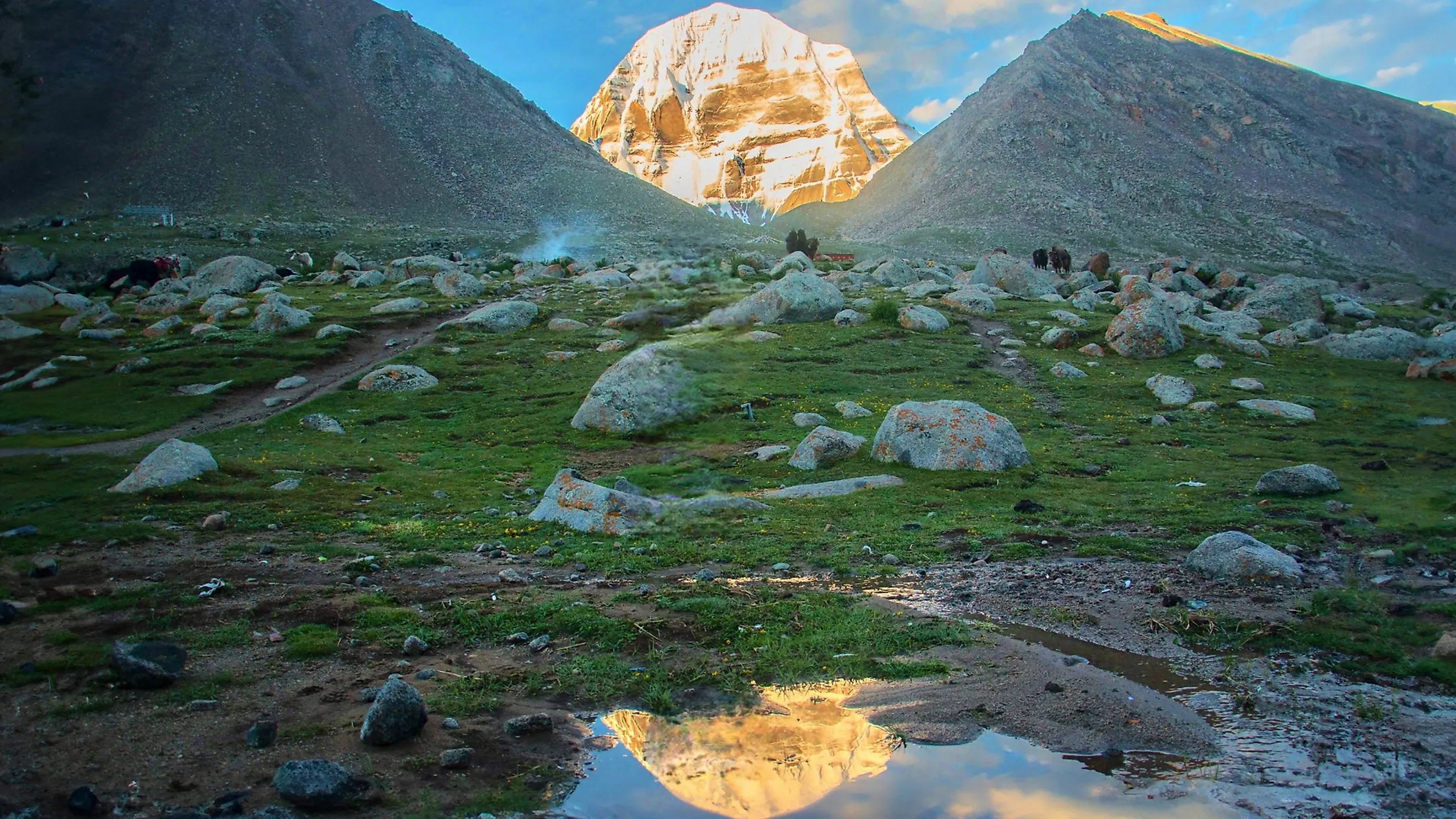
Mount Kailash, in the Transhimalaya of Tibet, China, rises to 21,778 feet (6,638 m) near the headwaters of several of Asia's great rivers, including the Indus, the Sutlej, the Brahmaputra, and a major tributary of the Ganges. Four religions hold it sacred: Buddhism, Hinduism, Jainism, and the Tibetan Bön faith. Out of respect for that significance, China has never allowed anyone to climb it, leaving Kailash one of the most prominent unclimbed mountains on Earth. Pilgrims instead circle its base on foot, a circuit known as the kora.
Mountains That Stay Off-Limits
What keeps these peaks closed varies widely. Some, like Kailash, Kawagarbo, and Machhapuchhre, are guarded by religious devotion. Others, like Spider Rock and Shiprock, are protected by Indigenous law. A few, like Ball's Pyramid and Banahaw, are restricted to shield fragile environments from too many visitors. In an age when nearly every great summit has been reached, these mountains are a reminder that some places are still meant to be looked at rather than climbed.