The Longest Causeway In America
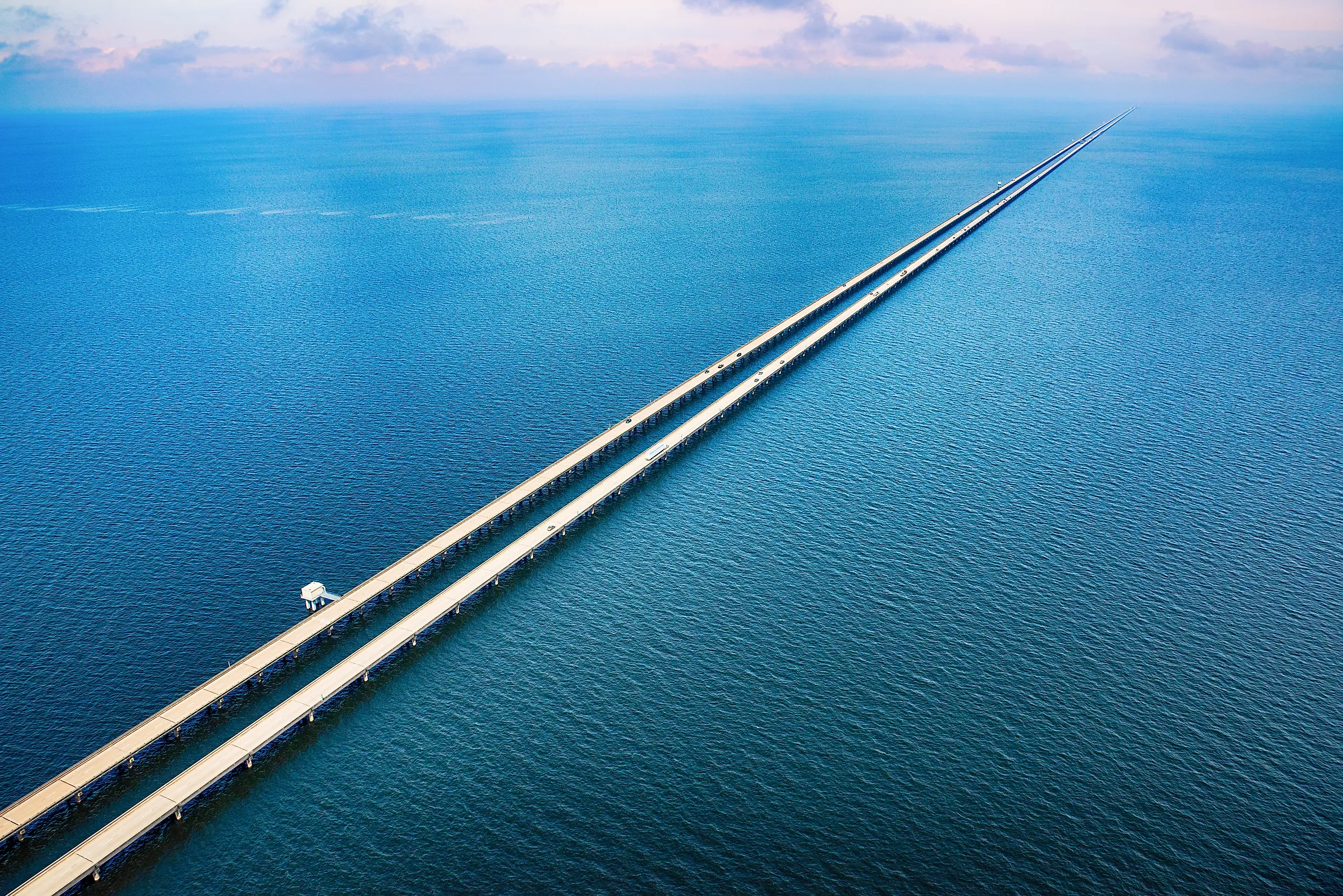
Around the 8-mile mark on America's longest causeway, drivers lose sight of land in all directions. The fog that commonly rolls in during the winter months, unsurprisingly, results in panic and requests for assistance. The Lake Pontchartrain Causeway in Louisiana is 23.87 miles (38.42 kilometers) long, and holds the Guinness World Record for the longest continuous bridge (causeway) over water.
The Lake Pontchartrain Causeway Is One Of A Kind

Before the causeway existed, it took around an hour and a half to drive around Lake Pontchartrain. After it was built, the two straight spans across the water cut the traveling time down to around 23 minutes. The spans are measured without embankments and approach roads, handing the title fairly and squarely to the Lake Pontchartrain Causeway.
Under different definitions, other causeways or bridges would make the cut (for runner-up at least). For instance, if the criteria included elevated viaducts built over wetlands or swamps, the 22.8-mile (36.69-kilometer) Manchac Swamp Bridge carrying Interstate 55 would be second on the list. This bridge is followed closely by the 18.2-mile (29.29-kilometer) Atchafalaya Basin Bridge on Interstate 10. If the definition includes shore-to-shore bridges with underwater tunnels, the Chesapeake Bay Bridge-Tunnel is also brought into contention with 17.6 miles (28.32 kilometers) in length.
Building The Country's Longest Causeway In Just Fourteen Months

The growing population of New Orleans found it time-consuming to get around Lake Pontchartrain between the 1940s and 1950s. Pressure mounted on local government to provide a solution, and as such, the Greater New Orleans Expressway Commission was established. The Commission was instructed to build the Lake Pontchartrain Causeway, and the original southbound bridge opened to traffic in August 1956. The parallel span opened in May 1969.
The building process included mass-production methods used for the first time, as well as other technologies. Dr. Maxwell Upson came up with the idea to use smaller pile segments, completely overhauling the pile manufacturing process. He also created a new method of manufacturing that saw the concrete piles achieve a concrete strength of around 10,000 psi. A layout of two piles sitting below a bent cap was repeated (mass production), and a concrete casting plant at the north end of the bridge saw prefabricated components barged out on the lake to the workers. Because of these innovations, the causeway was completed in fourteen months.
A Bridge That Brought A Much-Needed Boost

Aside from reducing travel times, the Lake Pontchartrain Causeway also helped build suburbs like Covington and Mandeville. Shorter drives meant commerce could expand, and businesses could provide their services in new areas. And, as an added bonus, the causeway became a major tourist attraction over the decades. People come from all over America and even abroad to experience the drive over Lake Pontchartrain.
Keeping The Causeway In Top Condition

In 1969, an average of two million vehicles crossed the causeway every year. By 2018, that figure topped 12 million vehicles annually and an incredible average of 40,000 to 43,000 cars every single day. To keep traffic flowing and help prevent accidents, constant inspection and restoration are needed.
In 2018, it was announced that the causeway would receive a huge upgrade that would cost around $100 million. $40 million was set aside for taller guardrails on the southbound span. $60 million was allocated to add six shoulder sections to both spans. The project was completed in 2021, and in 2022 it was reported that the upgrades have resulted in 25% fewer accidents as well as fewer injuries.
Assistance For Nervous Drivers

Many people today cannot wait to experience the drive over the causeway. But for some, the experience turns into a nightmare when they realize they can no longer see the shore on either side. It also does not help when the fog rolls in, most often between October and March. Fortunately, the bridge has its very own police force, known as the Causeway Police. Officers are available for assistance when drivers become stressed or panicked while traveling on the causeway. They are also on standby for accidents and emergencies.
Other Contenders To Consider

The Lake Pontchartrain Causeway is technically and structurally a trestle bridge. It is referred to as a causeway because it is a low-level highway across a shallow lake. As mentioned above, there are some other contenders when it comes to long causeways or bridges. The Manchac Swamp Bridge is the longest bridge built entirely over a swamp, while the Atchafalaya Basin Bridge is the second-longest bridge on the US Interstate Highway System. Both of these bridges are in Louisiana.
The Chesapeake Bay Bridge-Tunnel in Virginia is the longest bridge-tunnel complex in the country (and formerly in the world). The title of longest flood-control spillway bridge belongs to the 11-mile (17.70-kilometer) Bonnet Carre Spillway Bridge, also in Louisiana. The longest bridge in California is the San Mateo-Hayward Bridge, spanning 7 miles (11.3 kilometers) across San Francisco Bay. And the longest marine bridge in the Florida Keys is the Seven Mile Bridge, which stretches 6.79 miles (10.93 kilometers) across the open channel in the Keys as part of U.S. Route 1.
Bridging Lake Pontchartrain
Spanning nearly 24 miles of open water, the Lake Pontchartrain Causeway erased the gap that separated New Orleans from the towns along the Northshore. The small communities thrived, and businesses grew. Today, thousands of drivers make their way across the causeway, without truly realizing how storied its history is and what a feat its construction really was.