Where Rattlesnakes And Coral Snakes Overlap
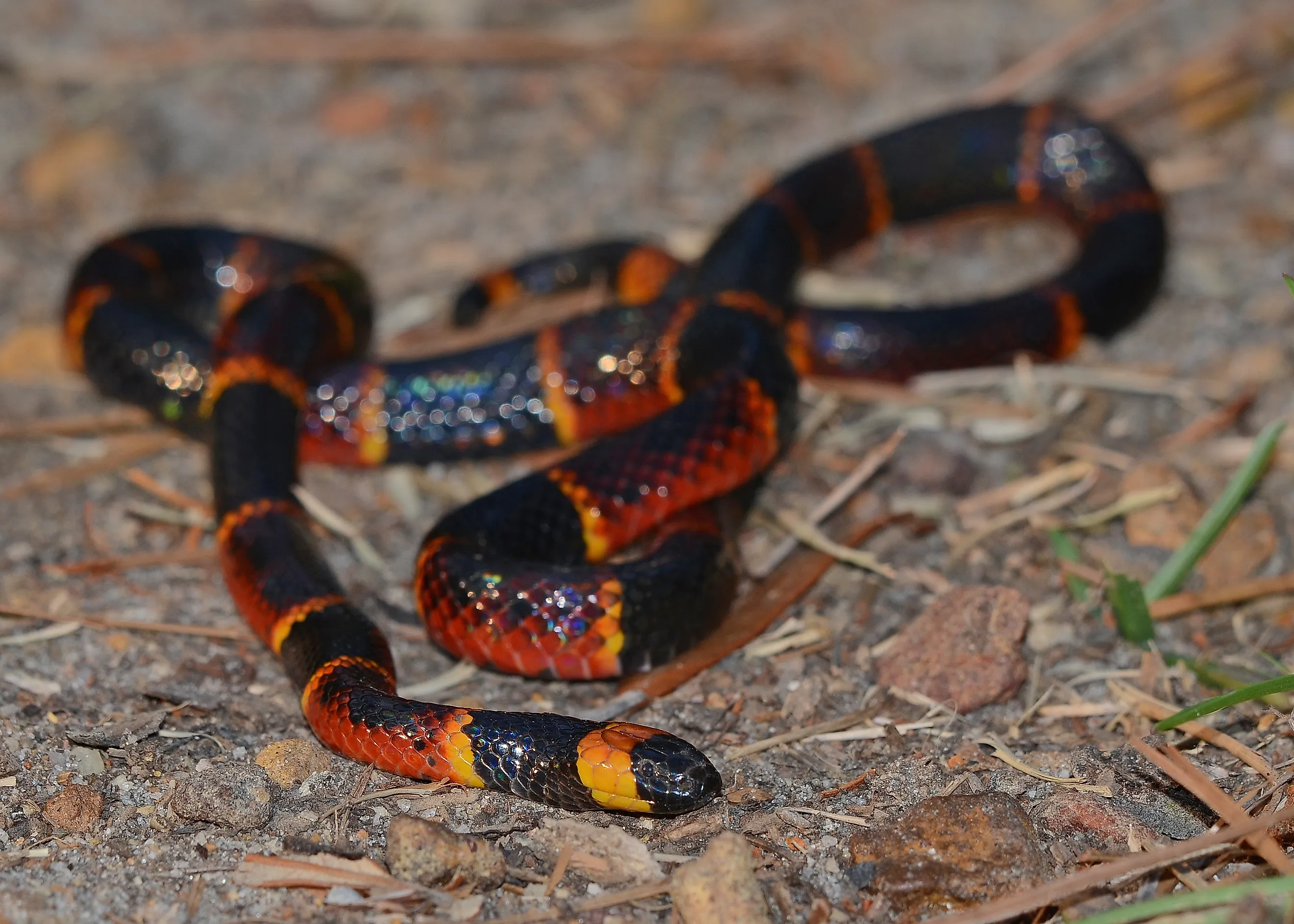
Georgia's wildlife agency publishes a fact sheet for each venomous species in the state, and two of them describe the same piece of ground in nearly identical words. The eastern coral snake runs from southeastern North Carolina to extreme eastern Louisiana, in longleaf pine stands, sandhills and pine flatwoods. The eastern diamondback rattlesnake runs from southeastern North Carolina to extreme eastern Louisiana, in open longleaf pine woods. Same range, same habitat, and as it turns out, frequently the same hole in the ground.
The Ranges Are Effectively Identical

Most overlap pairs in this series share part of a range. This pair shares almost all of it.
Both species occupy the southeastern coastal plain from southeastern North Carolina through South Carolina, Georgia, Florida, Alabama and Mississippi to extreme eastern Louisiana. In Georgia both are mainly confined to the Coastal Plain, south of the Fall Line.
The coral snake extends further into peninsular Florida and the diamondback has lost more ground to development, but on paper the two maps are the same shape.
Both Want Longleaf Pine

The habitat descriptions converge as tightly as the ranges do.
Coral snakes want well-drained sandy soil with open ground, in longleaf pine stands, sandhills and pine flatwoods. Diamondbacks are closely associated with longleaf pine ecosystems including pine flatwoods, sandhills, scrub and coastal dunes, relying on fire-maintained habitat with an open understory.
The historical distribution of the eastern diamondback is described as largely congruent with the historical distribution of the longleaf pine. The same is broadly true of the coral snake.
They Share The Same Burrows

This is where the overlap stops being a map and becomes a physical address.
Georgia's coral snake sheet notes that animal burrows, particularly those of gopher tortoises, along with rotten logs and stump holes, may be used as refuge. The diamondback sheet says the species is commonly found in association with gopher tortoises and uses their burrows as refuge.
Florida's wildlife commission lists the eastern diamondback among the priority gopher tortoise commensals, species that may be encountered when tortoises are relocated. Both snakes are tenants of the same landlord.
The Tortoise Builds For Everybody

Understanding why that matters means understanding what a gopher tortoise burrow actually provides.
The burrows sit at the center of tortoise feeding, breeding and sheltering, and they offer refuge from extreme temperatures, predators and fire. In a fire-maintained ecosystem, a hole that survives a burn is enormously valuable.
Diamondbacks also use armadillo burrows and fire-burned pine stump holes. Coral snakes, being fossorial, can work soil and decaying wood as well. The tortoise burrow is simply the best available.
One Hides And One Does Not

Sharing ground does not mean behaving alike, and the difference determines which one people actually meet.
The eastern diamondback is the largest venomous snake in North America, reaching 78 inches with records claimed to 96, and it is a conspicuous ambush predator that holds position in the open understory.
Coral snakes spend most of their time underground or under litter, and though often described as nocturnal they can be active on the surface at any hour. One species is hard to miss and the other is hard to find.
Different Families, Different Bites

The venom difference between two animals sharing a burrow is as wide as the snake world offers in North America.
The diamondback is a pit viper with long hinged fangs and tissue-destroying venom that announces itself immediately. The coral snake is an elapid, related to cobras and mambas, with short fixed fangs and neurotoxic venom whose symptoms can be delayed for hours.
Two snakes, one tortoise burrow, and two completely different medical problems.
Arizona Has Its Own Version

The southeastern pairing is the main event, but a second overlap exists 1,500 miles west.
The Sonoran coral snake, Micruroides euryxanthus, occurs in the Atascosa Highlands west of Nogales near the Mexican border, in Coronado National Forest. At 13 to 21 inches it is smaller than its eastern relative.
That is rattlesnake country at a density found nowhere else, with western diamondbacks, Mojave, tiger, blacktail and sidewinder among the species present. The desert version of this overlap involves one coral snake and a long list of pit vipers.
Texas Is The Third Zone

Between the two sits a third pairing that gets less attention.
The Texas coral snake occupies Texas, Louisiana and parts of Arkansas, including Sam Houston National Forest. Western diamondbacks and timber rattlesnakes both occur across much of that ground.
So all three American coral snake species overlap with rattlesnakes somewhere, which makes this the broadest pairing in the whole set.
They Are Declining Together

Shared habitat means shared vulnerability, and both species are losing the same ground for the same reasons.
Eastern diamondbacks have experienced severe declines from habitat loss, road mortality, fire suppression and deliberate killing, with the loss of longleaf pine ecosystems described as particularly detrimental. Coral snakes face human persecution and habitat destruction, and Georgia notes gaps in the documented range where the habitat looks ideal.
Both agencies make the same observation: the well-draining upland that suits these snakes also makes good farmland.
The Short Answer

Rattlesnakes and coral snakes overlap across the entire southeastern coastal plain from the Carolinas to eastern Louisiana, in Texas and Arkansas, and in the Arizona borderlands. The eastern coral snake and eastern diamondback share a range description so similar that the same agency uses nearly the same sentence for both.
They also share gopher tortoise burrows, longleaf pine sandhills and a declining habitat. What they do not share is a family, a hunting method, or a venom. One is a cobra relative the size of a pencil and the other is the largest pit viper on the continent, and they shelter in the same hole.