10 Best Places To Live In Hawaii In 2026
Picking a place to live in Hawaii starts with picking the right island. The ten towns below each suit a different kind of life. Kailua and Kihei lean into the laid-back coastal lifestyle. Wailuku and Lihue offer an urban pace with easy access to services. From active downtowns to quiet family-oriented communities, here are ten of the best places to live in Hawaii in 2026.
Mililani

Mililani sits in the mid-range of Oahu’s housing market. While the costs are steep by national standards, they represent better value per square foot than comparable neighborhoods in Kailua, Hawaii Kai, or the Honolulu urban core. Rentals for a two-bedroom unit average around $2,400 to $2,800 per month. Residents benefit from a dense cluster of grocery options, reducing the per-trip cost of stocking a kitchen. The population is a blend of military families, long-term residents, and mainland transplants, with a strong culture of civic participation.
The Mililani Farmers Market at Mililani High School draws consistent crowds on weekend mornings, and Mari’s Gardens, Hawaii’s largest aquaponic and hydroponic farm, offers public tours. Town Center of Mililani Mauka is central to its retail scene with many dining options and a mix of more than 70 national and local shops, as well as the Consolidated Theaters Mililani 14. The rush-hour commute to downtown Honolulu via Highway 2 runs 35 to 50 minutes, which is important to know for daily office commuters.
Kailua

Kailua home prices are in the million-dollar range, and one-bedroom rentals range from $2,300 to $3,000 per month. Despite being one of the pricier communities on Oahu, many residents claim they are paying for a lifestyle that is genuinely hard to replicate elsewhere on the island. Kailua has evolved from a quiet local town into one of Oahu’s most desirable residential communities while still retaining a strong sense of neighborhood identity. It draws a mix of military families, longtime residents, professionals, and creative types.
Kailua offers a rare combination of beach access, a walkable town core, and a substantial residential scale that avoids a suburban feel. For those who can afford it, it consistently ranks among the most livable communities in the state. Kailua Beach Park and Lanikai Beach are two widely celebrated Windward Oahu beaches, both within walking distance for most Kailua residents. A farmers' market runs regularly in the town center, fostering community engagement among residents and local producers alike.
Kaneohe

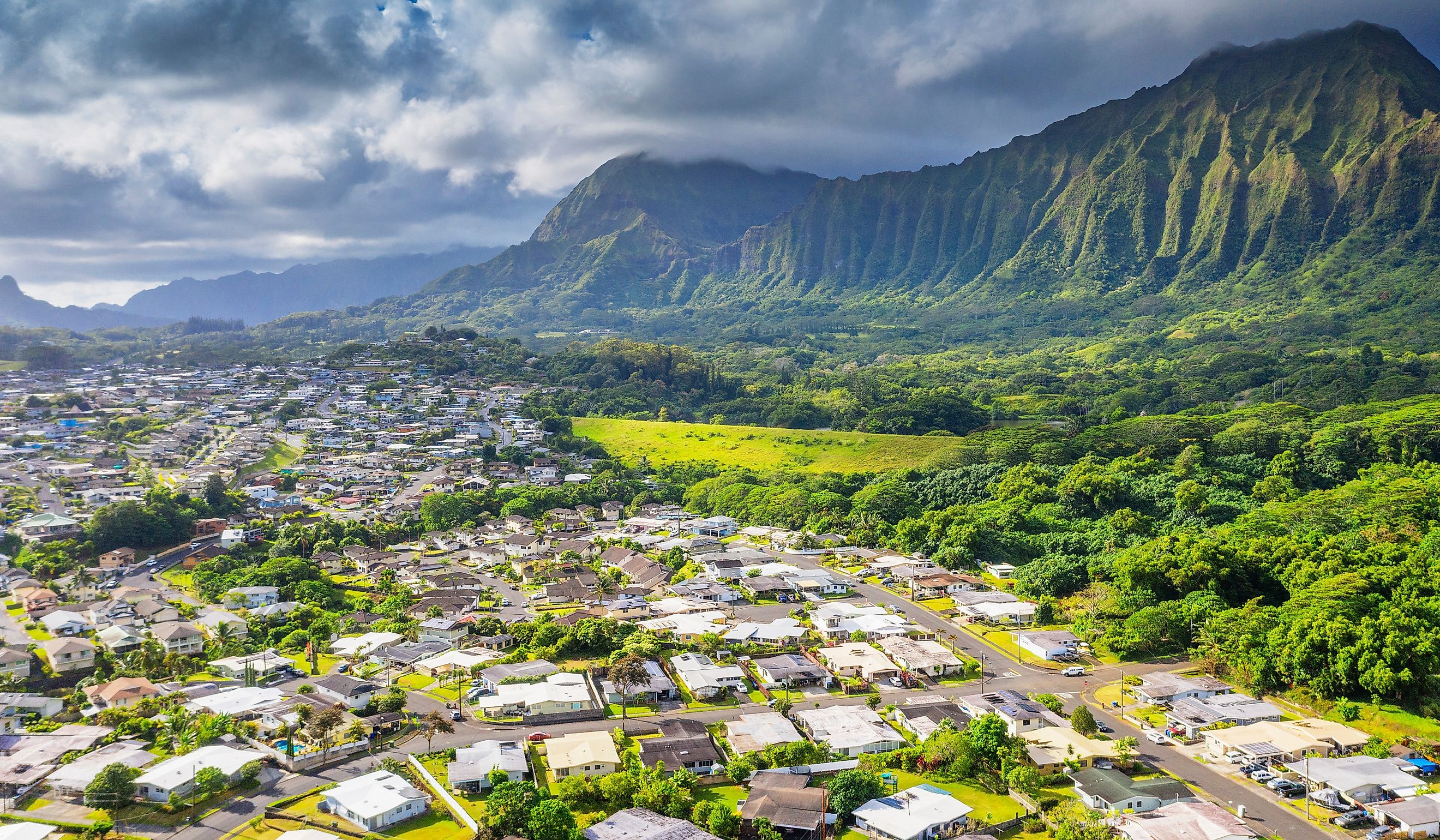
Kaneohe is a more affordable option than its neighbor, Kailua, offering a more attractive space-to-cost ratio and larger lot sizes than many comparable Oahu communities (depending on how close you are to the bay). Marine Corps Base Hawaii is the dominant local employer. Still, beyond the base, many Kaneohe residents commute to Honolulu via the Likelike or Pali Highway, a 25 to 35-minute drive under normal conditions.
Kaneohe has a deep-rooted local character shaped by generations of Oahu families and military personnel. It’s considered a working community first, less focused on appearances than some of its neighbors, and more family and community-oriented. Ho’omaluhia Botanical Garden spans 400 acres of lush, free-to-visit grounds with dramatic mountain backdrops, making it one of the most photogenic parks in the state. Kayaking to the Kaneohe Bay Sandbar, a shallow reef flat that emerges at low tide, is another local tradition emphasizing that community feel. Families, military people, and anyone who values recreational space, community, and scenery without the resort-town price tag consistently find that Kaneohe delivers.
Kapolei

Kapolei has been actively developed as Oahu’s 'Second City,' with a growing base of retail, healthcare, and service-sector employment. Ko Olina Resort is at the center of the town’s hospitality and tourism economy. Joint Base Pearl Harbor-Hickam is approximately 20 minutes away, making Kapolei a popular choice for military families. As the Skyline rail continues its expansion in Honolulu, connectivity to the core job market will improve even further. Kapolei’s population is diverse, drawing in families relocating for affordability, military personnel, and first-time buyers priced out of central Oahu.
Ko Olina’s four stunning lagoons are accessible to residents and offer a protected beach experience that rivals anything on the island. The area hosts growing farmers' market activity and community events year-round. Aulani, A Disney Resort & Spa, brings world-class facilities to a usually quiet suburban town.
Kihei

Kihei’s appeal is inseparable from its beach culture. Kamaole Beach Parks are all within walking distance of much of the community, offering swimming, snorkeling, and sunset-watching from three distinct stretches of public white sand. Makena State Park and the Big Beach are a short drive south for those seeking Maui’s wilder coastline. While Maui’s housing market ranks among the highest in the state, Kihei is one of the more accessible communities on Maui.
While tourism shapes much of the commercial culture, the residential neighborhoods have a distinct sense of community separate from the visitor economy. Kihei offers the South Maui lifestyle with beach access, warm, dry weather, and a relaxed coastal community, at a lower per-unit cost than Wailea to the south. For those committed to living on Maui, it combines practical infrastructure with genuine beach proximity and a neighborhood personality that makes it a livable community.
Wailuku

Wailuku offers housing prices notably below Maui’s resort-area benchmark. Wailuku is one of the most authentically local communities in the state, a working town with deep Hawaiian, Filipino, and Japanese cultural roots. Residents who want to connect with Hawaii’s actual cultural fabric, rather than its resort version, tend to find Wailuku uniquely grounding. The town is known for tight-knit, multigenerational neighborhoods and a genuine sense of civic identity.
Wailuku sits adjacent to Kahului, making it the best-connected community on Maui. Kahului Airport is minutes away. Maui Bus offers inter-community service, and the compact layout of the Wailuku-Kahului corridor makes short trips on foot or by bicycle more realistic than in most Maui communities. Resort employment on the west or south shores, meanwhile, requires a car. Wailuku is the most affordable community on Maui with real infrastructure, stable employment, and a genuine neighborhood identity. It is the choice for those who want to live sustainably on Maui and value cultural depth over resort proximity.
Hilo

Hilo is the Big Island’s county seat and economic hub. The University of Hawaii at Hilo is central to the town’s education and research employment. Government, agriculture, retail, and small business round out the employment base. With remote work becoming increasingly prominent both nationally and in Hawaii, Hilo attracts professionals who want Hawaii’s lifestyle at a fraction of the cost of Oahu. Tourism-related employment is present but more modest than on Kona or Maui. Groceries and utilities carry the standard Hawaii premium, but lower housing costs materially change what’s possible on a moderate income.
Hilo is the most compelling argument in Hawaii for lifestyle over location. Lower housing costs, a genuine cultural community, extraordinary natural access, and a pace of life that rejects comparisons to anywhere on the mainland combine to make it uniquely attractive, particularly for remote workers and retirees on fixed incomes.
Kailua-Kona

Tourism and hospitality form the backbone of Kona’s economy. The Kohala Coast resort corridor just north, with destinations like the Mauna Kea Beach Hotel, Waikoloa Beach Resort, and Fairmont Orchid, represents one of Hawaii’s most concentrated luxury resort markets and a major source of service-sector employment. Hawaiian cultural heritage is strongly present through historic sites, local organizations, and cultural programming.
Kona offers the Big Island’s most complete lifestyle package, backed by reliable sunshine. The historic core, marine access, cultural calendar, and relative affordability on the Big Island come together to create a community that feels both local and connected. For anyone whose lifestyle revolves around ocean recreation and outdoor access, Kona is hard to match.
Hanalei

In Hanalei, longtime residents and newcomers share a commitment to preserving the north shore’s agricultural character and natural resources. The community is small, relationship-based, and expects newcomers to engage respectfully with its established culture.
Hanalei Bay is consistently cited among the most beautiful settings in the United States. Part of the Hanalei valley, including taro fields, wetland, and surrounding mountains, is federally protected. Na Pali Coast State Wilderness Park, accessible by boat, air, or the 11-mile Kalalau Trail, offers some of the most extraordinary hiking and scenery in all of Hawaii. Tunnels Beach is a world-class snorkel and dive site within easy reach. There is nowhere in Hawaii, and few places in the world, that matches the north shore’s combination of physical beauty, protected landscape, and small-community intimacy. Those who choose it, especially for its laid-back lifestyle, rarely leave voluntarily.
Lihue

Lihue is Kauai’s most practical and accessible community, with median home prices meaningfully below those in the north shore and Poipu resort areas. As the county seat, Lihue concentrates most of Kauai’s government, healthcare, and commercial infrastructure, keeping day-to-day costs more manageable than in more remote island communities. Lihue is the working heart of Kauai, ethnically diverse, multigenerational, and grounded in the rhythms of island governance and everyday commerce. It is more accessible to newcomers than the closely knit north shore, while maintaining the Kauai character of strong 'ohana networks and community pride. The regular events calendar at Kukui Grove keeps community engagement high year-round.
Lihue is the entry point to Kauai for those who want the island’s beauty and culture without the north shore’s price premium or geographic isolation. It offers the best services, jobs, and connectivity on the island, anchored by a genuine community character shaped by Kauai’s history rather than imported from elsewhere.
Your Hawaii Home Awaits
Cost pressure is real in Hawaii and should not be minimized. But the 10 best places to live in Hawaii in 2026 reflect where those costs are most justified by the quality of life that makes Hawaii unlike any other place to settle. Mililani and Kailua make the strongest case for families on Oahu. Hilo makes the strongest case for affordability without sacrificing community. Kihei and Wailuku offer Maui at its most livable cost. Kailua-Kona delivers the Big Island with sunshine and full services. The best place to live in Hawaii is the one that aligns honestly with your income, your lifestyle priorities, and the specific trade-offs you’re willing to make.