The American Lakes Where State Record Fish Set World Records
America's lakes contain the stuff of legend. The fisherman's story about the "catch of the day" may be the ultimate source of the largest tall tale creations in the history of humankind. Oh, the many webs woven on this subject! Usually the truth is a bit less than the tale would suggest. Setting a record, however, means that the fisherman carries the proof of his catch beyond fantasy and can verify the tale through the peers in his community, who bear witness to the feat with measuring tape and a scale. Let's collate some of the biggest catches of the day where truth merges with legend when the fish reeled in from lakes across the US set a state record.
Montgomery Lake, Georgia

Largemouth Bass (Micropterus salmoides) - 22 lbs, 4 oz (10.09 kg)- George Perry - 1932
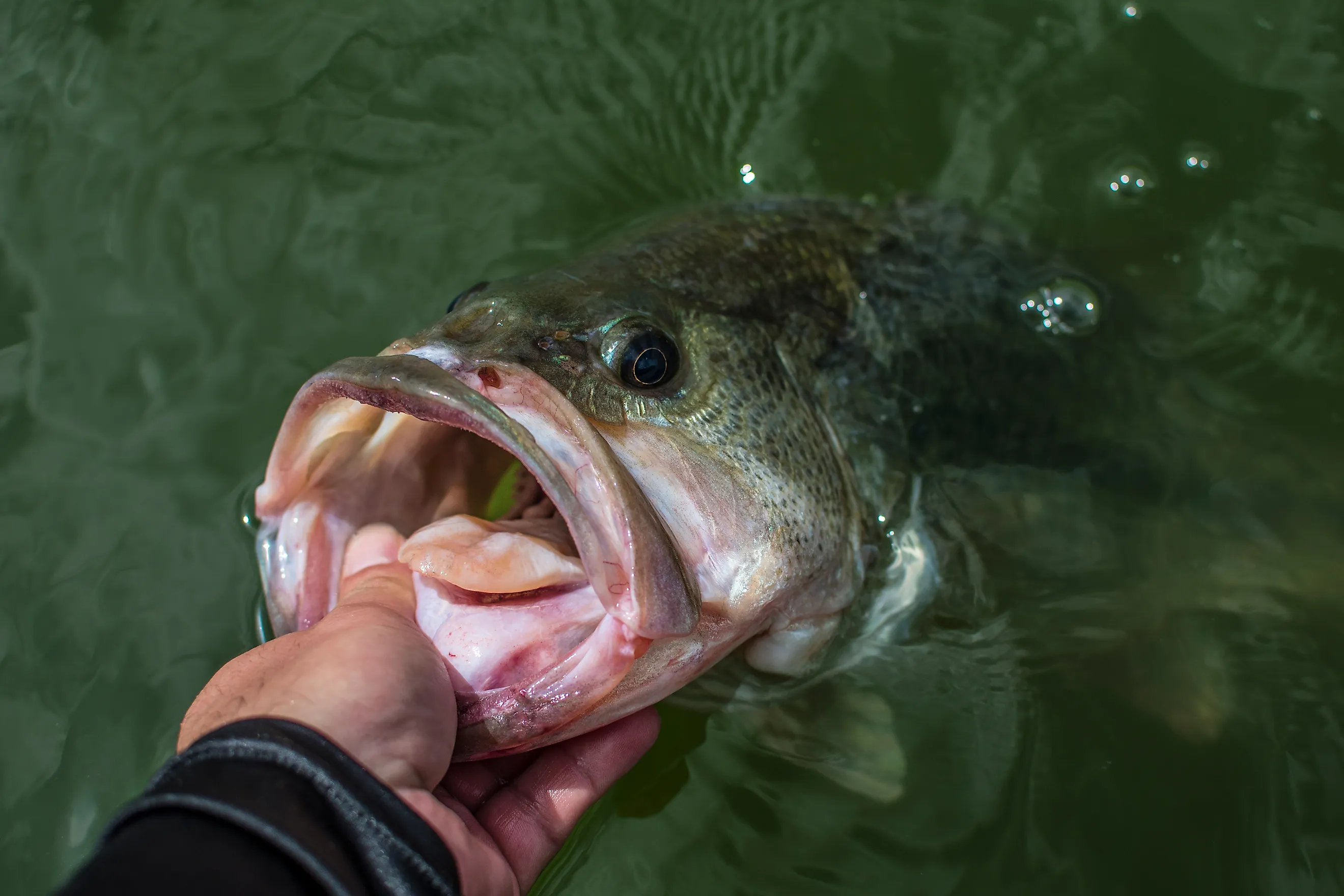
On June 2nd, 1932, George Perry caught a 22 lb, 4 oz largemouth bass in Montgomery Lake, Georgia, setting a state and world record. On July 2, 2009, 77 years later, Perry was tied by Manabu Kurita, who caught a 22 lb, 4 oz largemouth in Japan's Lake Biwa. There was a slight discrepancy since the metric version of Kurita's fish weighed 10.12 kg, technically 22 lbs, 4.97 oz., rounded to 5 oz. in some reports. However, the International Game Fish Association (IGFA), the official world governing body for fish and game records, has a rule that, for records under 25 pounds, a new catch must weigh at least 2 ounces more than the standing record to replace it. Kurita's fish exceeded Perry's by less than that margin, so it was recorded as a tie, and Perry's record continues to stand. The tale is also a classic old school fishing subsistence story during the Great Depression Era. Perry knew a spot on Montgomery Lake, an oxbow formed from a wide bend that got cut off from the nearby Ocmulgee River, that he enjoyed fishing in on a makeshift boat scrapped together from plywood. On a rainy day when he could not hitch his mule to ride over to catch fish to provide for his family, a buddy named Jack Page gave him a ride in his Model T truck. After missing the initial hit with a lucky Creek Chub Fintail Shiner lure, Perry persisted, and on the second strike, he hauled in the "biggin'."
Castaic Lake, California

Largemouth Bass (Micropterus salmoides) - 21 lbs., 12 oz. (9.87 kg) - Michael Arujo - 1991
Not only is the largemouth bass a favorite catch internationally, it is also the most popular freshwater sport fish in the entire US, carrying both east and west coast state records. Next to George Perry's record catch in Georgia, the nearest American contender would set the state record in California and 2nd place in world standings. On March 5, 1991, Michael Arujo caught a 21 lb, 12 oz bass on Castaic Lake, 40 miles north of Los Angeles. Local lore also records that just 1 week later, Bob Crupi, outdid Arujo on the very same 2,200 acre lake, catching a bass documented at 22 lb 1 oz. Exactly why that catch never replaced the record is more complicated than the familiar tale of a fish released before it could be certified. In 2006, Mac Weakley caught a 25 lb (11.34 kg) largemouth in Dixon Lake near Escondido, California, which would have shattered Arujo's state record and Perry's world record, but he chose not to submit the catch because he had "snagged" the fish in the side, which is traditionally considered a fluke. No other fish commands the attention of American anglers quite like the largemouth bass, with 30 million enthusiasts nationwide, hundreds of annual events, and tournaments like the Bass Anglers Sportsmen Society (B.A.S.S.) sponsored Bassmaster Classic, which offers a $300,000 prize for the biggest fish caught.
Elk City Lake, Kansas

Flathead Catfish (Pylodictis olivaris) - 123 lbs (55.79 kg) - Ken Paulie - 1998
The mega catfish the size of a Volkswagen Beetle story is a classic example of how big fish tales get blown way out of proportion. Ever since the Tennessee Valley Authority (TVA) began installing hydroelectric dams and deepening reservoirs across the southeast in the 1930s, stories of catfish growing to gargantuan sizes have multiplied like wildfire. According to a 2018 article from Garden & Gun, professional diver Billy Mitchell, who repairs dams and waterways from the deep South up through Minnesota, claimed that he is asked about whether he has seen a catfish the size of a Volkswagen Beetle about 30 times a year. The truth is more modest but still makes for a good story. The biggest flathead catfish (aka "Mudcat") in the world, making the Freshwater Fish Hall of Fame and setting a state record in Kansas, was caught by Ken Paulie on May 14, 1998 in Elk City Lake, a 4,500 acre reservoir in the southeastern part of the state. The fish weighed 123 lbs, and was 61 in(1.55 m) long with a girth of 42.75 in(1.15 m). This particular fish disappeared not long after it had been caught and was stuck in a freezer for 18 years when someone discovered it and alerted the Kansas Department of Wildlife and Parks (KDWP) authorities in 2016 asking if they wanted to take a look. After dissecting the fish, they found the remains of a 28 in. Buffalo Carp in its stomach, and were also able to determine that the fish was about 22 years old.
Lake Cumberland, Kentucky

Walleye (Sander vitreus) - 21 lbs, 8 oz (9.75 kg) - Abe Black - October 1, 1958
Lake Cumberland is currently known as the "Houseboat Capital of the World" located in south central Kentucky with 1200 miles of shoreline, a popular play lake that advertises exploration and fish such as striped bass, blue gill, crappie, and catfish. But in a previous era, it was the legendary lake of trophy sized walleyes (aka "pikeperch"). The 100+ mile long reservoir was formed by the installation of the hydroelectric Wolf Creek Dam along the Cumberland River, completed in 1952. In those years, the walleye was one of the most popular sport fishes in Kentucky. Prior to the formation of the lake, hundreds of anglers at a time would risk dangerous rapids jetting up the river to chase walleye to their spawning grounds when they were "running" for a brief two week period out of the entire year. On October 1st, 1958, Ohio angler Abe Black reeled in a monster walleye at 21 lbs, 8 oz, establishing an unsurpassed Kentucky state record, standing now for almost 70 years. This was just 6 years after the Wolf Creek Dam had been installed and so the native walleye population was still at close to its peak before the dam's impact on the accumulation of sediment, the alteration of the natural environment, and subsequent heavy fishing would almost wipe them out completely. Today the walleye is making a comeback through the efforts of a restocking program that adds 1.5 million walleye back into the rivers and lakes of Kentucky.
Lake Pend Oreille, Idaho

Gerrard Kamloops Rainbow Trout (Oncorhynchus mykiss) -37 lbs (16.78 kg) Wes Hamlet - Nov. 25, 1947
Bull Trout (Salvelinus confluentus) - 32 lbs (14.52 kg) - Nelson Higgins - 1949
Up in the panhandle of Idaho, Lake Pend Oreille (LPO), known by locals as the "Big Hole," is home to a large variety of exotic fish beloved by anglers, some of which wound up there through unexpected journeys. There is the kokanee, a type of landlocked sockeye salmon which washed into the lake from Montana. Another example is the gerrard kamloops, a highly prized variant of the rainbow trout which hatched from eggs dropped into the lake in 1941, sourced from Lake Kootenay in British Columbia, Canada. On November 25, 1947, Wes Hamlet's wife Henrietta was mad at him because he was late for dinner. He had a good excuse because he was being photographed by everyone with a camera in town after having just caught a 37 lb (16.78 kg) gerrard kamloops during the Lake Pend Oreille fishing derby, setting a world record that remained unbroken for 50 years, and still standing as the uncontested state record for the kamloops trout in Idaho. The big fish made Wes Hamlet an instant celebrity in town. The bull trout, by contrast, is native to Lake Pend Oreille and the wider Clark Fork drainage, running up tributaries like the Clark Fork toward Missoula to reach its spawning grounds. Nelson Higgins caught a 32 lbs Bull Trout on October 27, 1949, setting both a state and a world record that have not yet been broken.
Lake of the Ozarks, Missouri

Paddlefish (Polyodon spathula) - 164 lbs, 13 oz (74.76 kg) - Chad Williams - 2024
The Lake of the Ozarks in central Missouri is fondly called the "Lake of the Dragon" due to its winding, snake-like shape. It was created as a reservoir behind the Bagnell Dam, completed in 1931, which impounds the Osage River, with the Niangua River, Grandglaize Creek, and Gravois Creek forming its tributary arms. Though narrow and fractal the lake contains 54,000 acres of surface area and 1,150 miles of shoreline. It is a huge favorite for regional fishing and many stories and fishing records have emerged from its waters over time. Chad Williams recently set a state and world record when he snagged a 164 lb, 13 oz paddlefish on March 17, 2024. Amazingly, Williams had never even seen a paddlefish before and so it was quite a shock when he pulled in this prehistoric looking monster with its elongated snout and massive torso. Though the catch is qualified as an "alternative method" of fishing where trolling hooks grab a fish by the side, which many traditionalists disregard, the Missouri Department of Conservation still honors the feat as a legitimate take and the record stands. The lake is also the host of the Big Bass Bash, a fishing tournament held twice every year with a grand prize of $100,000, drawing thousands of anglers from beyond Missouri.
Nickajack Reservoir, Tennessee

Freshwater Drum (Aplodinotus grunniens) - 54 lbs, 8 oz (24.72 kg) - Benny Hull - 1972
Sometimes the charismatic personality of a well-known fisherman eclipses even the biggest of fish. Benny Hull was known as "the Ol' Stump Bumper," and was famous as the host of the television show "The Southern Sportsman," where episodes featured his fishing escapades for decades. The show ran for an extraordinary 39 years without missing a single week right up until he passed away in August of 2025. Benny had scored a number of fishing records and one of the most memorable was when he caught a 54 lb, 8 oz Freshwater Drum in the Nickajack Reservoir on April 20, 1972, setting the state and world record. Hull was inducted into the Fishing Hall of Fame in the same year. The Nickajack Reservoir is the sixth stage of a seven segment series of artificial lakes created along the Tennessee River by the TVA in 1967, that runs between the Nickajack and Chickamauga dams in southeastern Tennessee.
Lake Winnipesaukee, New Hampshire

Freshwater Cusk (Lota lota) - 12 lbs, 8 oz (5.67 kg) - Ryan Scott Ashley - 2022
Ice fishing is another style of sport angling that has a large following in the northeastern United States. That's exactly how Ryan Scott Ashley caught his state record 12 lb, 8 oz, 35 in (88.9 cm) long cusk (aka "burbot") at Lake Winnipesaukee in eastern New Hampshire in the Winter of 2022. Ashley was fishing through a hole in the ice when he slugged this behemoth up from the 180 ft deep lake. Cusks are known to dwell up to 328 ft below the surface. The average cusk is 4-5 lbs (~2 kg) and between 12-24 in (30-60 cm). New Hampshire's Fish & Game Department notes that the cusk is one of the few freshwater fish that spawns during winter months, making the timing a necessary strategy for anglers to master rather than just a novelty recreational activity, if they want to pull in this fish with its prized delicate white meat. Ashley's catch surpassed the former New Hampshire state record by 6 oz (.17 kg). Lake Winnipesaukee is New Hampshire's largest lake at 72 sq miles. Next to the cusk, it also contains ample whitefish, pickerel, salmon, lake trout, hornpout, rainbow trout, brook trout, yellow/white perch, smelt, bluegill, and small/largemouth bass. Fishing and boating is also a favorite activity during Summer months, too, while exploring the lake and its 250 islands.
Scofield Reservoir, Utah

Tiger Trout (Salmo trutta × Salvelinus fontinalis) - 19 lbs, 2 oz (8.67 kg) - Jake Trane - 2013
The Tiger Trout is a sterile hybrid of the brown and brook trout that was first noted in the lakes and rivers in the southwestern US in 1944. Even so, wild hybrids are uncommon. The two species' ranges overlap widely in North America, so natural tiger trout do turn up now and then, but human-run hatcheries produce most of them. Here we can get into some frankenstein experiments, also a part of the fishing history of US lakes. Beginning in the 1800s, American fisheries began experimenting with stocking non-native trout together and one of the more interesting results was the interbreeding that produced the tiger trout, known for its bright stripes and aggressive fighting behavior. Contemporary fisheries now actively cultivate the hybrid and it is a popular fish in the western US. The tiger was introduced into Scofield Reservoir in Utah in 2005 to help control the chub fish population which was getting too large and competing for food with other preferred sport fish like the rainbow and cutthroat trout. The tigers have been doing quite a fine job at chowing on some chub, it would seem, which Jake Trane proved when he pulled a whopper tiger in at 19 lbs, 2 oz in 2013, setting the Utah state record. Trane's catch is within the top 5 world rankings for all time largest Tiger Trout, a title currently held by Cathy Clegg who caught a 24 lb, 8 oz (11.11 kg) tiger trout in at Loon Lake in the state of Washington in 2022.
Lake Michigan, Michigan

Chinook Salmon (Oncorhynchus tshawytscha) - 47.86 lbs (21.7 kg) Luis Martinez, 2021
No study of records in US state lake fishing would be complete without a dip into the Great Lakes. 19 year old Luis Martinez set a state record for largest chinook salmon ever caught at 47.86 lbs on his very first salmon fishing expedition, after a tumultuous 30 minute struggle. Wait! Aren't chinook salmon ocean fish? Yes, but in 1966-7 the Michigan Department of Natural Resources began releasing chinook into Lake Michigan as a way to control the alewife population, which is considered a nuisance invasive fish that spread into the Great Lakes through shipping canals. A study on the shifting fish species in the Great Lakes region from 1983 recognized 20-30 sport and game fish throughout the Great Lakes region and fishing continues to be a popular pastime 40+ years later. Yet the study lamented the impact of intense overfishing, the alteration of natural drainage basins, the chemical modification of the water through the over addition of nutrients, and the introduction of ocean species altering the natural ecosystem. All of these factors have had a deleterious effect ecologically, marginalizing some of the native species like the lake trout. However, much progress has been made since then and regulatory bodies like the Great Lakes Fishery Commission have since issued a benign progress report based on analyzing data gathered between 2016-2021. Lake Michigan is the 5th largest lake in the world, is 307 miles long, 118 miles wide, and 923 ft deep.
State Level to World Champion
One of the interesting observations one notices from looking at several of the state records on big fish caught in US lakes is that oftentimes a state record will also happen to be a world record. Perhaps this is related to the relatively recent phenomenon of global level standardization and comparison. Or maybe it is the newer types of fish that have been discovered in North America over the past several hundred years by Europeans now reporting with the media tools of the 21st century, though native peoples have known about them for much longer. In any case, it makes for a fun exploration of the phenomenon driving human interest in stories about catching fish. Curiosity fuels more exploration, research and investment into embracing and understanding the history of the bodies of water in the US and their coldblooded inhabitants. And despite some areas of negative human impact, the true sportsman's love for maintaining the natural environment and ideal conditions for continued growth of as many species as possible, are the best bets to make sure that the next fish story will be an even better one than the last.