The 10 Largest Gold Mines In The World
Gold has signaled wealth for as long as people have dug it out of the ground, and in 2026 the metal is having a moment: the price has blown past $4,000 an ounce, after briefly topping $5,000 earlier in the year. It is prized for far more than its shine, turning up in electronics, finance, dentistry, and medicine. Why does it command such sums? The short answer is scarcity. A few facts that put the metal in perspective:
- Gold makes up only about four parts per billion of the Earth's crust, which is a big part of why it costs what it does.
- Almost every ounce ever mined still exists in some form, and all of it together would pack into a single cube roughly 22 meters (72 feet) on each side.
- It is one of the densest metals known and an excellent conductor of both heat and electricity.
- It is soft enough to hammer into sheets only a few atoms thick, which is exactly why jewelers love it.
- It forms deep underground through hydrothermal processes, so most of it has to be mined from large buried deposits.
Humans have prized gold for thousands of years, long enough for it to seep into myth, whether King Midas and his unfortunate golden touch or the gilded crowns of antiquity. The appetite has never faded. Global mine production ran at a record pace in 2024, around 3,661 tonnes, or nearly 120 million ounces, pulled from thousands of mines worldwide. So which ones dig up the most? Here are the ten largest by output, based on 2024 production figures.
1. Nevada Gold Mines (United States): 2,698,701 ounces (83.9 tonnes)

The biggest gold producer on Earth is not a single pit but an alliance. Nevada Gold Mines is the joint venture that rivals Barrick and Newmont struck in 2019, pooling their assets in Nevada into one giant complex, and it has topped the global ranking ever since. The operation stitches together more than a dozen open-pit and underground mines, including the famous Carlin, Cortez, Goldstrike, and Turquoise Ridge sites.
In 2024 the complex turned out close to 2.7 million ounces, a little over 2% of all the gold mined worldwide that year. That is down from the 3.3 million ounces it produced in 2023, a reminder that even the largest operations age. Ore grades slip, the easiest material gets dug first, and output drifts lower even as the mine holds its crown.
2. Muruntau (Uzbekistan): 2,676,656 ounces (83.3 tonnes)

Carved into the Kyzylkum Desert of Uzbekistan, Muruntau is the largest open-pit gold mine in the world, a hole more than 600 meters deep and over three kilometers across, big enough to be photographed from orbit. The state's Navoi Mining and Metallurgical Combinat has run it since the late 1960s, and it has supplied the bulk of Uzbekistan's gold for half a century.
Because it is one continuous operation rather than a cluster of mines, many people consider Muruntau the single largest gold mine on the planet. It is nowhere near finished, either. The company pegs its remaining reserves at about 4,500 tonnes of gold, enough to keep the pit working for decades.
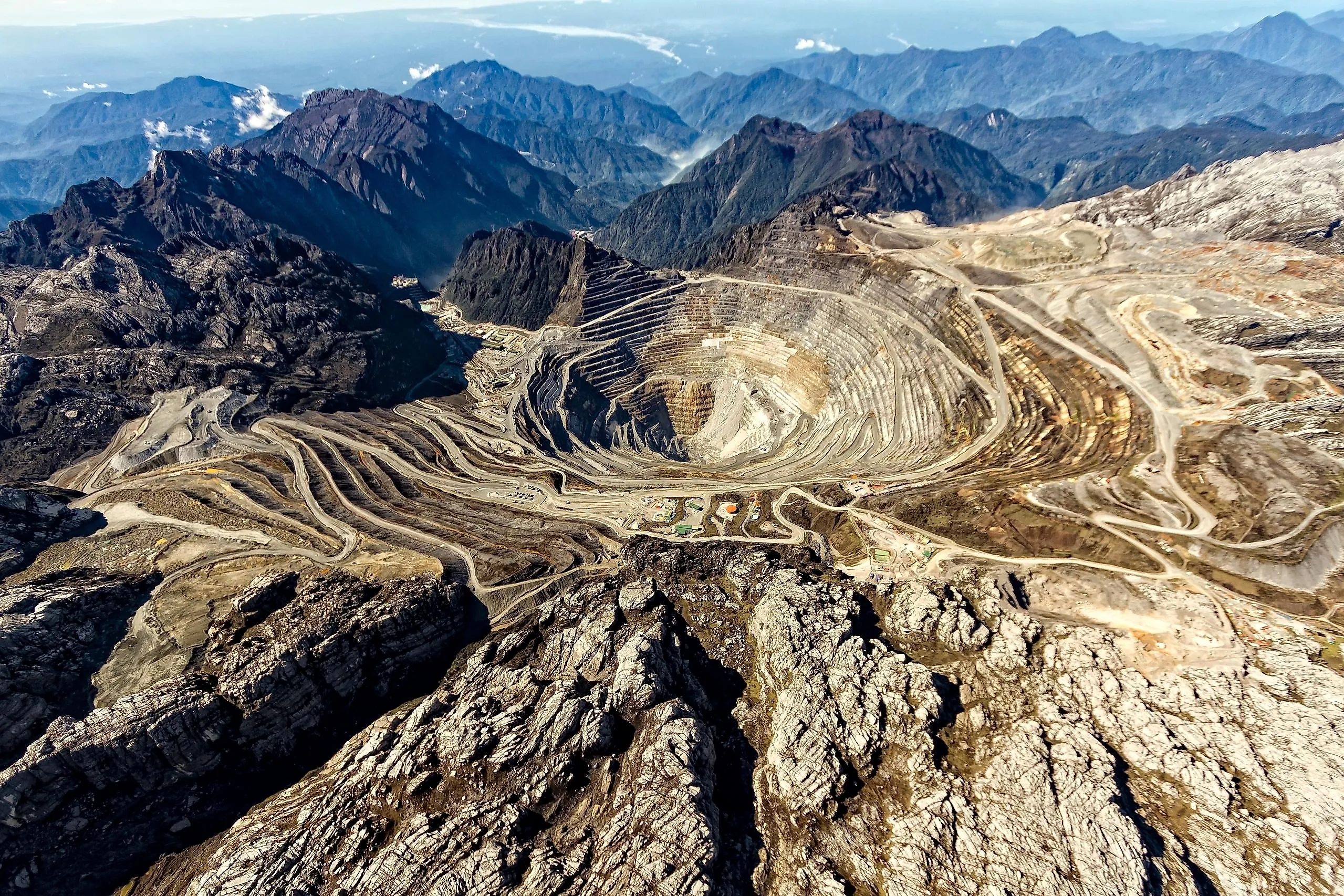
3. Grasberg (Indonesia): 1,861,000 ounces (57.9 tonnes)

High in the mountains of Indonesia's Papua region, Grasberg is really a two-for-one: one of the world's largest gold deposits sitting on top of one of its largest copper deposits. Discovered in the 1980s and run by a partnership between America's Freeport-McMoRan and the Indonesian state, it produced about 1.86 million ounces of gold in 2024, much of it a byproduct of its enormous copper output.
As the original open pit neared the end of its life, Grasberg went underground, burrowing into one of the biggest block-cave mining systems ever built. The site has become a showcase for automation, including a fleet of self-driving rockbreakers, and its proven gold reserves still run to roughly 24 million ounces.
4. Olimpiada (Russia): 1,441,300 ounces (44.8 tonnes)

Olimpiada is the crown jewel of Polyus, Russia's largest gold miner, sitting in remote Siberia some 550 kilometers north of the city of Krasnoyarsk. It produced about 1.44 million ounces in 2024, more than any other mine in the country.
The ore here is stubborn, with the gold locked inside sulfide minerals that resist normal processing. So Polyus puts bacteria to work, using bio-oxidation to break down the rock and free the metal. Deep reserves should keep the operation running well into the future.
5. Almalyk Complex (Uzbekistan): 1,114,000 ounces (34.6 tonnes)
Uzbekistan's second entry on this list is the Almalyk Mining and Metallurgical Combine, a state-owned complex better known as the country's main copper producer. Gold comes up alongside the copper, and in 2024 that added up to an estimated 1.1 million ounces, enough to crack the global top five.
Almalyk is in the middle of a major expansion meant to more than double its copper output by 2030, a buildout that should lift its gold production right along with it.
6. Batu Hijau (Indonesia): 1,009,000 ounces (31.4 tonnes)

Like Grasberg, Batu Hijau is a copper-gold mine where the gold is a lucrative sideline. Located on the island of Sumbawa and owned by the Indonesian firm Amman Mineral, it produced an estimated 1.01 million ounces of gold in 2024.
The mine made headlines in 2023, when Amman Mineral's blockbuster stock listing reportedly minted half a dozen new billionaires almost overnight, a sign of just how much money runs through a top-tier gold-and-copper operation.
7. Kazzinc Consolidated (Kazakhstan): 1,000,000 ounces (31.1 tonnes)
Kazzinc rounds out the million-ounce club, producing an even 1,000,000 ounces of gold in 2024 across its operations in Kazakhstan. As the name hints, it is primarily a zinc, lead, and precious-metals business, majority-owned by the Swiss commodities trading giant Glencore.
Glencore recently weighed selling its 70% stake but backed out when prospective buyers would not meet its price, a quiet vote of confidence in how valuable a diversified metals producer has become.
8. Ahafo (Ghana): 798,000 ounces (24.8 tonnes)
Ghana is Africa's top gold producer, and Ahafo is a big reason why. Owned mostly by Newmont, with the Ghanaian government holding the rest, it is the American miner's only operation on the continent and turned out about 798,000 ounces in 2024.
Running since 2006 and working both surface and underground ore, Ahafo has paired its mining with schools, clinics, and farming programs for nearby communities, the kind of shared-value model the industry increasingly leans on to keep operating.
9. Loulo-Gounkoto (Mali): 693,863 ounces (21.6 tonnes)
Barrick's Loulo-Gounkoto complex is the largest gold mine in Mali and one of the most fought-over assets on this list. The company owns 80% and the Malian government 20%, and in 2024 the complex produced an estimated 694,000 ounces.
That partnership has turned bitter. Under a tougher mining code, Mali has pushed for a larger share of the proceeds, shutting Barrick's office in the capital and detaining staff during a drawn-out tax dispute. It is a stark reminder of how political risk shadows even the richest deposits.
10. Kibali (DRC): 686,667 ounces (21.4 tonnes)
Down in the Democratic Republic of the Congo sits Kibali, Africa's single largest gold operation. It is jointly run by AngloGold Ashanti and Barrick, each holding 45%, with a Congolese state company owning the remaining slice, and it produced roughly 687,000 ounces in 2024.
Kibali pairs open-pit and underground mining and runs largely on its own hydroelectric power. Fresh discoveries nearby promise to stretch its life well beyond the original forecasts.
The Largest Gold Mines In The World (2024)
| Rank | Mine | Location | Production (ounces) | % of global production |
|---|---|---|---|---|
|
1 |
Nevada Gold Mines |
United States |
2,698,701 |
2.3% |
|
2 |
Muruntau |
Uzbekistan |
2,676,656 |
2.3% |
|
3 |
Grasberg |
Indonesia |
1,861,000 |
1.6% |
|
4 |
Olimpiada |
Russia |
1,441,300 |
1.2% |
|
5 |
Almalyk Complex |
Uzbekistan |
1,114,000 |
0.9% |
|
6 |
Batu Hijau |
Indonesia |
1,009,000 |
0.9% |
|
7 |
Kazzinc Consolidated |
Kazakhstan |
1,000,000 |
0.8% |
|
8 |
Ahafo |
Ghana |
798,000 |
0.7% |
|
9 |
Loulo-Gounkoto |
Mali |
693,863 |
0.6% |
|
10 |
Kibali |
Democratic Republic of the Congo |
686,667 |
0.6% |
Gold Mining And Global Reserves
Gold mining keeps expanding to feed relentless demand. Global output hit a record of roughly 3,661 tonnes in 2024, and beyond the ten giants here, thousands of smaller mines run around the clock. The rankings are restless, too. This very list looks different than it did a few years ago: Pueblo Viejo, Cadia, Lihir, Boddington, and Canadian Malartic have all slipped out of the top ten as newer or higher-grade operations climbed past them. The biggest shake-up came in 2023, when Newmont bought Australia's Newcrest Mining for $17 billion, swallowing mines like Lihir and Cadia in a single deal.
For all that activity, the supply is finite. Humans have now mined around 216,000 tonnes of gold throughout history, and estimates of what remains economically reachable underground run between roughly 55,000 and 64,000 tonnes, depending on who is counting. To stretch that, miners are leaning on automation, AI, and ever-deeper digging. The metal will not run out tomorrow, but the easy gold is long gone.