Which States Still Grow America's Tobacco?
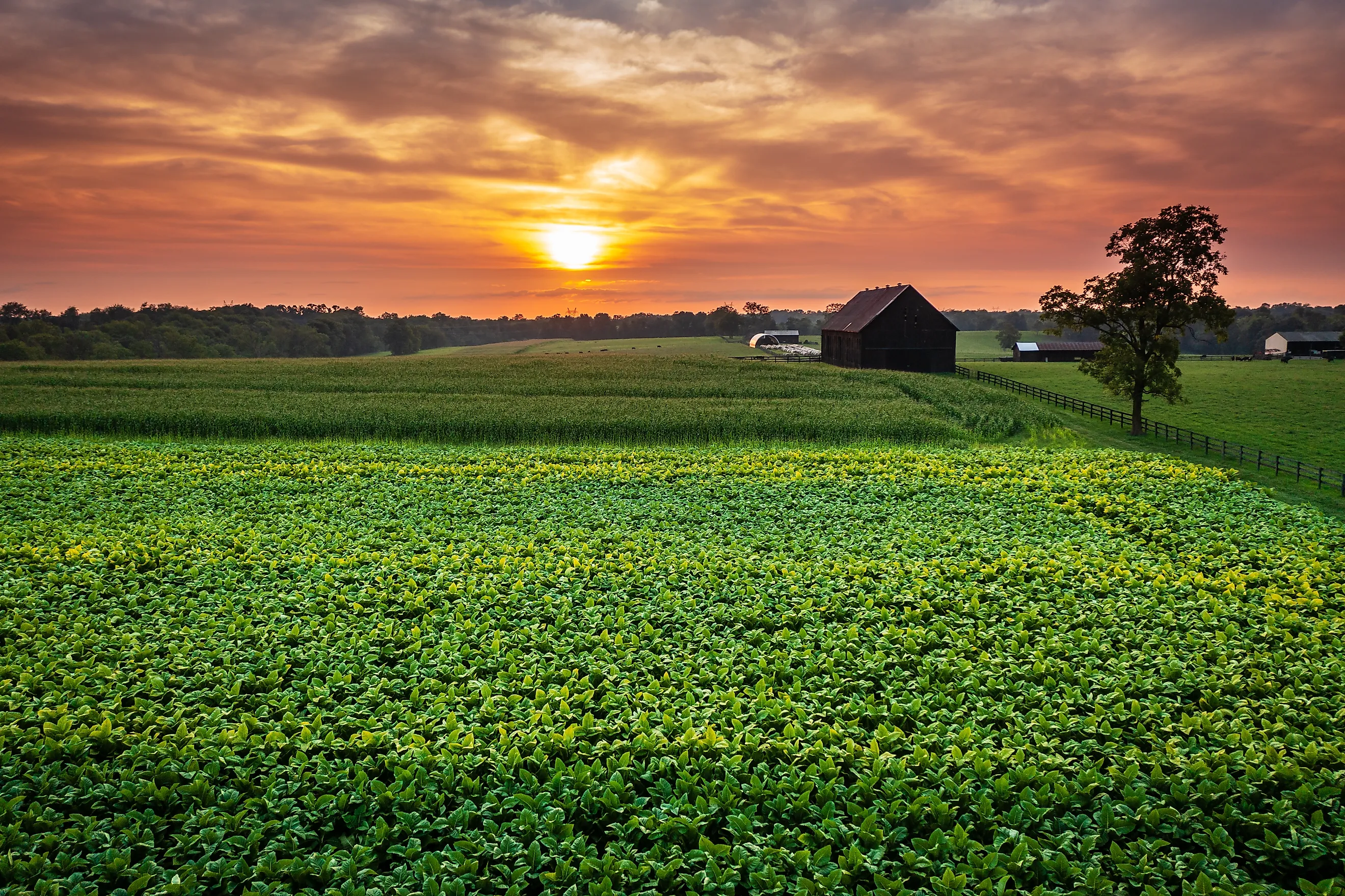
Drive through eastern North Carolina in late summer and you will still see it: wide green fields of tobacco, the broad leaves drooping in the heat, curing barns sitting at the edge of the rows. What you will not see is what used to surround them. A generation ago, tobacco was a small-farm crop grown by hundreds of thousands of families across the South, a few acres at a time. Today it is grown by a few thousand operations, most of them large, and the real question is no longer which states lead the industry but which ones still have one at all. The short answer is North Carolina, and not a lot else.
Where America Still Grows Its Tobacco

North Carolina is the whole story now, or close to it. The state grows roughly 60% of the country's tobacco and harvested about 205 million pounds of flue-cured leaf in 2024, according to the USDA. An NC State extension economist has made the point bluntly: flue-cured tobacco in the United States is now concentrated almost entirely in North Carolina, with only small amounts left in Virginia, Kentucky, Georgia, South Carolina, and Florida.
Kentucky still ranks a clear second, but it grows a different leaf. Its crop is mostly air-cured burley rather than the flue-cured type that goes into most cigarettes. After those two states, production thins out quickly. Tennessee, Virginia, Georgia, South Carolina, and Pennsylvania each keep a foothold, yet together they add up to only a fraction of what North Carolina pulls in on its own.
Tobacco Farms by State

One of the stranger facts about modern tobacco is that the state with the most farms is not the state that grows the most leaf. By number of farms, Kentucky still leads, a holdover from its history of tiny burley plots. North Carolina, with fewer but much larger flue-cured operations, grows far more tobacco from fewer farms. Here is where the remaining farms are, per the USDA's 2022 Census of Agriculture, released in February 2024.
| Rank | State | Tobacco farms (2022) |
|---|---|---|
| 1 | Kentucky | 984 |
| 2 | North Carolina | 822 |
| 3 | Pennsylvania | 377 |
| 4 | Tennessee | 241 |
| 5 | Virginia | 170 |
A Crop the Government Used to Manage

For most of the 20th century, growing tobacco was not something a farmer could simply decide to do. Starting in the 1930s, as part of the New Deal, the federal government ran a quota and price-support program that tied the right to grow tobacco to specific pieces of land. If your farm held an allotment, you could grow a set amount and sell it at a guaranteed minimum price. If it did not, you were out of the business. That system did something unusual: it spread tobacco across an enormous number of small farms and kept it there for decades. In the early 1990s, Kentucky alone had close to 60,000 farms growing tobacco, most of them working just a few acres of burley as one piece of a diversified farm.
The arrangement propped up a way of life as much as a crop. A small allotment was not going to make anyone rich, but it was reliable income that a family could count on every fall, and it anchored the rural economy across Kentucky, North Carolina, Virginia, and Tennessee.
The 2004 Buyout That Changed Everything

In 2004, Congress ended the program with the Fair and Equitable Tobacco Reform Act, known simply as the tobacco buyout. It dismantled the quota system, paid quota holders and growers to walk away, and funded those payments through assessments on tobacco manufacturers, with checks going out through 2014. Overnight, the right to grow tobacco was no longer tied to a particular farm, and the guaranteed price was gone.
What followed was a fast, brutal consolidation. Without quotas, the crop flowed to the operations that could grow it most cheaply at scale, and the small grower who had farmed three acres for 40 years mostly stopped. The numbers are stark. Kentucky had 29,237 tobacco farms in 2002. By the 2022 Census of Agriculture, it had 984, a decline of about 97% in 20 years. North Carolina fell from roughly 7,850 tobacco farms in 2002 to 822. The farms that remain are bigger, more mechanized, and concentrated in fewer counties.
What Tobacco Country Looks Like Now

The shrinking farm count tracks a shrinking crop. American farms harvested about 432 million pounds of tobacco in 2022, down from 1.74 billion pounds in 1997, according to the CDC. Two factors drove the long slide in demand: the 1964 Surgeon General's report linking cigarettes to lung cancer, and the 1998 Master Settlement Agreement, which curbed marketing and raised cigarette prices. Fewer Americans smoke every year, and the newer nicotine products taking their place, such as vapes and oral pouches, do not need anywhere near as much domestic leaf.
The global picture finished the job. China dominates world tobacco production by an enormous margin, and both Brazil and India now grow far more than the United States, which was a leading exporter within living memory. American manufacturers increasingly buy cheaper foreign leaf, which means even the tobacco grown here competes against lower-cost imports for a smaller and smaller market.
Why the Map Keeps Shrinking

The story of American tobacco is not really about climate or soil. Plenty of states could grow the crop if it paid. It is about policy and demand. A New Deal program spread tobacco across thousands of small Southern farms and held it there for 70 years, and the 2004 buyout handed the decision back to the market. The market wanted fewer, larger farms in the places that grow it most efficiently. Layer on decades of falling cigarette use and cheaper leaf from overseas, and you arrive at the map we have today: a crop that once defined the rural South, now squeezed into a handful of counties in a single state. Tobacco is still very much grown in America. It is just grown in far fewer places than it used to be.