What Is Oceania?
- Oceania is a region in the Pacific Ocean. It consists of 4 subregions, Australia and New Zealand, Polynesia, Melanesia, and Micronesia.
- Approximately 43 million people live in Oceania.
- Oceania contains 14 independent countries and 8 dependencies.
- Most of the countries of Oceania consist of many tiny islands.
- Nearly three quarters of Oceania's people live in the countries of Australia and New Zealand.
Oceania is the South Pacific geographic region that encompasses Australia, New Zealand, and the smaller island nations of the central and western Pacific Ocean. It is also classified as a continent in some geographic schemes. Oceania is conventionally divided into four subregions: Australia and New Zealand, Polynesia, Melanesia, and Micronesia. Approximately 46 million people live across the region, the great majority of them in Australia and New Zealand. Oceania contains 14 independent countries and 8 dependencies. While Australia, New Zealand, and Papua New Guinea are large landmasses, most of the region's countries and dependencies consist of small islands scattered across the central and western Pacific.
Contents
Australia And New Zealand

Australia and New Zealand together contain more than 32 million people, around 70 percent of Oceania's population. Australia's population is approximately 27 million, New Zealand's about 5.3 million. The two countries are unique in the region for having fully developed economies. The Australian economy alone, valued at well over a trillion US dollars, is larger than all the other economies of Oceania combined. Both are constitutional monarchies and parliamentary democracies, and both share a head of state in King Charles III, who succeeded Queen Elizabeth II on her death on September 8, 2022. Australia is a federation of six states and ten territories; New Zealand is a unitary state.
Most Australians and New Zealanders are of European descent, but there are substantial non-European populations as well. Australia's indigenous population (the Aboriginal Australian and Torres Strait Islander peoples) is one of the oldest continuous human populations outside Africa. The current scientific consensus is that the ancestors of Aboriginal Australians reached the ancient supercontinent of Sahul (which then connected Australia, New Guinea, and Tasmania) between approximately 50,000 and 65,000 years ago. The archaeological site at Madjedbebe in Arnhem Land has dates as early as 65,000 years ago; recent genetic studies converge on a date closer to 60,000 years ago. At the time of European contact in 1788, more than 250 distinct Aboriginal language groups were spoken across the continent; today, approximately 120 of those languages are still spoken, and only around 13 are considered to have stable speaker populations across all generations.

Most of mainland Australia is arid or semi-arid; the continent is the driest inhabited landmass on Earth. The fertile, well-watered country runs along the eastern and southeastern coastal margin between Cairns and Adelaide, and along a strip of the southwest near Perth. The great majority of Australians live in these coastal zones, with the dry interior (the Outback) thinly populated. The Australian ecosystem is unusual in its degree of endemism: many of its plant and animal lineages diverged from those elsewhere when the continent separated from Antarctica roughly 35 million years ago. Marsupials, monotremes, eucalypts, and acacias are some of the distinctive groups.

New Zealand sits across two main islands, the North Island and the South Island, plus several smaller offshore islands including Stewart Island. The country covers a remarkable range of terrain for its size, including glaciers, fjords, alpine mountains, temperate rainforest, plains, beaches, volcanic plateaus, and active geothermal areas. New Zealand's indigenous Maori people are East Polynesians whose ancestors arrived between approximately 1250 and 1300 CE in deliberate voyages by double-hulled canoe from the Society Islands, the southern Cook Islands, and the Austral Islands, making New Zealand the last major habitable landmass on Earth to be settled by humans. The Maori adopted that collective name (meaning "ordinary") only after European arrival to distinguish themselves from the newcomers. New Zealanders are commonly known as Kiwis, after the flightless bird that is endemic to the country.
Polynesia

Polynesia is the easternmost of the three Pacific island subregions of Oceania. The name comes from the Greek for "many islands," and the subregion does contain more than 10,000 of them, although most are small and many are uninhabited. About 687,000 people live in Polynesia today, distributed among three independent countries (Samoa, Tonga, and Tuvalu) and six dependencies (French Polynesia and Wallis and Futuna under France, the Cook Islands, Niue, and Tokelau under New Zealand, and American Samoa under the United States). French Polynesia is the most populous Polynesian territory at approximately 281,000; Tokelau is the smallest, with fewer than 1,400 residents.
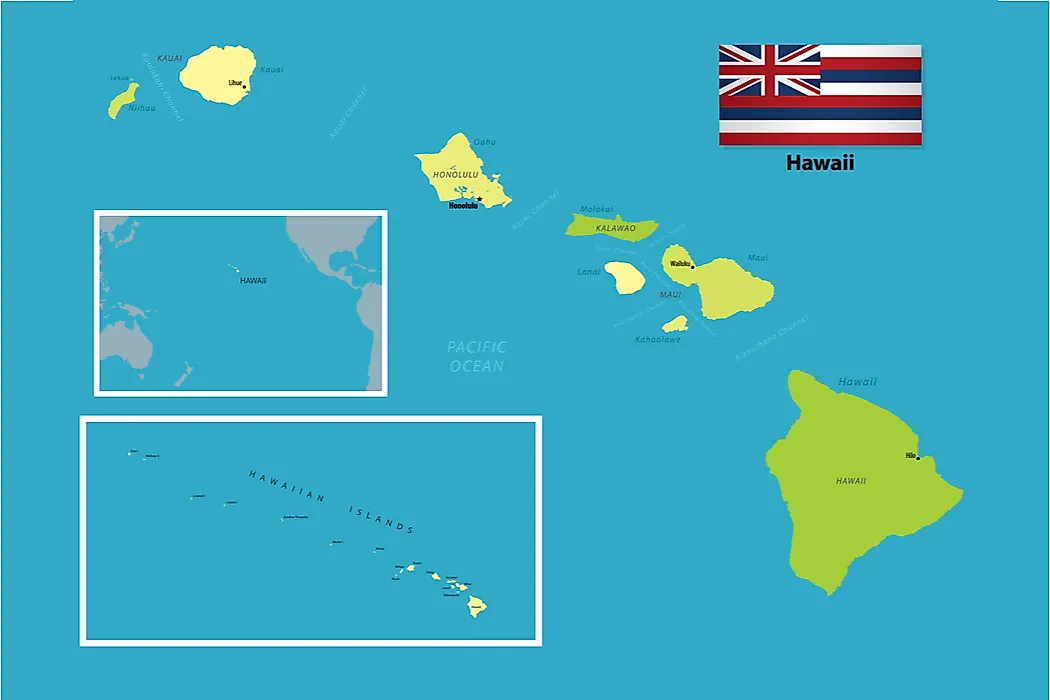
The settlement of Polynesia happened in two main waves. The first wave reached the western Polynesian islands (Tonga and Samoa) from the Lapita cultural complex of Melanesia between roughly 1000 and 900 BCE. The second wave, from a launch point in the Society Islands of central Polynesia, settled the far corners of the Polynesian triangle much later: Hawaii around 1000 to 1200 CE, Easter Island (Rapa Nui) around 1200 CE, and New Zealand between 1250 and 1300 CE. The first European contact with Polynesia was the arrival of Spanish explorer Álvaro de Mendaña in the Marquesas Islands in 1595. By the early twentieth century the entire subregion had been claimed by European colonial powers. Samoa became independent in 1962, Tonga in 1970, and Tuvalu in 1978. Samoa and Tuvalu are parliamentary republics; Tonga is a constitutional monarchy.

Many Polynesians still depend on subsistence farming, but coconut, vanilla (especially in Tonga), and other agricultural exports remain economically significant. Fishing is important, and tourism is the fastest-growing sector across most of the subregion. Polynesian languages form a closely related family within the Austronesian family, and most of the territories have their own indigenous language alongside the colonial European language of the former or current administering power. Surfing in its modern recreational form is a Polynesian export; Europeans observed indigenous Polynesians (especially in Hawaii) practicing the sport and adapted it.

Melanesia

Melanesia is the southwestern of the three Pacific island subregions. It contains about 2,000 islands spread across an arc that runs from the Arafura Sea, north of Australia, eastward to Fiji. About 11.2 million people live in Melanesia, the great majority of them (around 10 million) in Papua New Guinea, which occupies the eastern half of the island of New Guinea. The other independent states are Fiji, Solomon Islands, and Vanuatu. The French dependency of New Caledonia is also part of the subregion. The name Melanesia is from the Greek for "black islands," coined in 1832 by the French explorer Dumont d'Urville in reference to the dark complexion of many indigenous Melanesians; the name has stuck despite its colonial-era origin.
The human settlement of Melanesia is part of the same prehistoric migration that brought humans to Australia. Modern humans reached the ancient continent of Sahul (which then included New Guinea, Australia, and Tasmania) between approximately 50,000 and 65,000 years ago. Papuan and Aboriginal Australian populations share a common ancestry from that initial settlement. European contact began in the seventeenth century, and by the late nineteenth century European colonial powers had claimed all of Melanesia. Fiji became independent in 1970, Papua New Guinea in 1975, Solomon Islands in 1978, and Vanuatu in 1980. Papua New Guinea and Solomon Islands are constitutional monarchies that retain King Charles III as head of state; Fiji and Vanuatu are republics. The Bougainville Autonomous Region of Papua New Guinea held a non-binding independence referendum in December 2019, with 97.7 percent of voters favoring independence; the transition is in progress under the terms of the Bougainville Peace Agreement.

Melanesia is the most linguistically diverse region on Earth per capita. Approximately 700 distinct languages are spoken in Papua New Guinea alone, the Solomon Islands has about 120 indigenous languages, and Vanuatu more than 100. The Kanak people of New Caledonia, the largest indigenous group there, speak 28 different languages and 11 dialects. Most Melanesians also speak the relevant European colonial language or a creole based on it, including Tok Pisin (English-based) in Papua New Guinea, Pijin in Solomon Islands, and Bislama in Vanuatu. Hundreds of Melanesians continue to live largely traditional lifestyles, though Christianity and other Western cultural influences have substantially shaped indigenous Melanesian societies over the past century and a half.

The Melanesian economy is shaped by natural resources. New Caledonia holds about 10 percent of the world's known nickel reserves, the basis of much of its economy. The rainforests of the Solomon Islands and Papua New Guinea support significant forestry industries, and copper, gold, and natural gas are major export commodities for Papua New Guinea. Tourism is an expanding sector, particularly in Fiji and Vanuatu. The expansion of mining and logging has generated tension with indigenous communities concerned about environmental and cultural impacts.

Micronesia
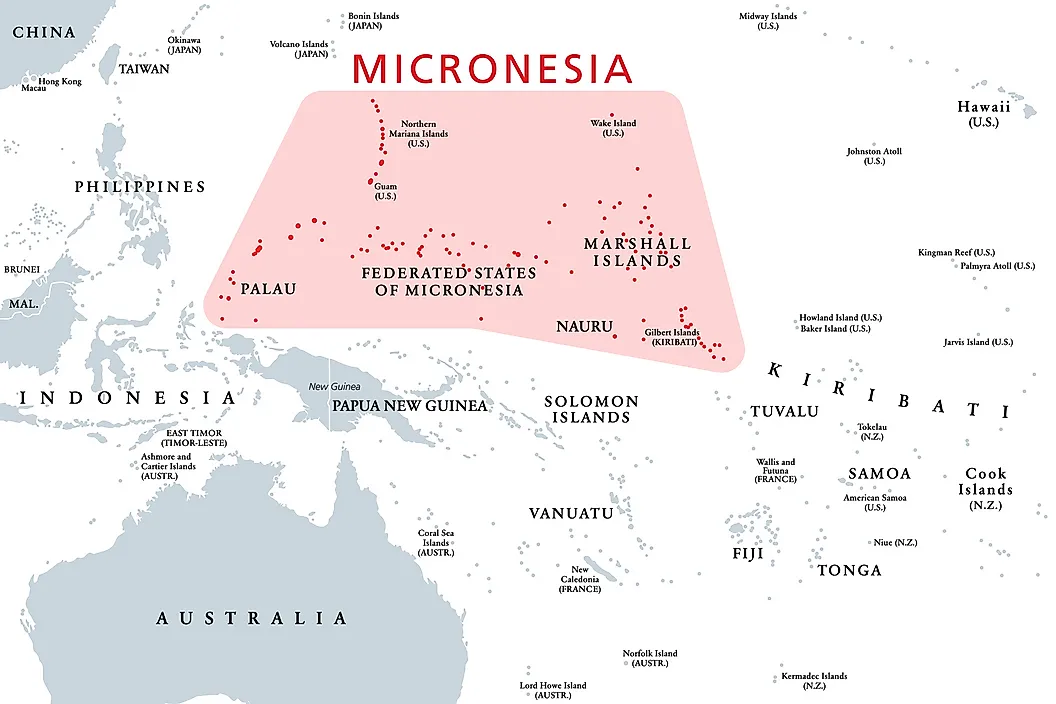
Micronesia (Greek for "small islands") is the northernmost of the three Pacific island subregions and is situated east of the Philippines, west of Polynesia, north of Melanesia, and south of Japan. About 540,000 people live in Micronesia today, distributed among five independent countries (the Federated States of Micronesia, Kiribati, the Marshall Islands, Nauru, and Palau) and two dependencies (Guam and the Northern Mariana Islands, both US-administered). The Federated States of Micronesia is the most populous Micronesian country, with approximately 100,000 residents; Nauru is the smallest, with about 12,500 people. All five independent Micronesian states are democratic republics.
The first humans to reach Micronesia arrived in the Mariana Islands roughly 3,500 years ago from the Philippines or eastern Indonesia; the Caroline Islands were settled somewhat later. European contact began in the sixteenth century with the Spanish, who claimed much of Micronesia. Spanish, German, Japanese, British, and American powers all administered parts of the subregion at various points. Decolonization began in the 1960s and was largely complete by the mid-1980s; Guam and the Northern Mariana Islands remain US territories. Three of the five independent Micronesian countries (the Federated States of Micronesia, the Marshall Islands, and Palau) have Compacts of Free Association with the United States, which provide US defense responsibility, US economic assistance, and free movement of citizens to the US in exchange for the US having strategic denial rights over their territories.

Subsistence agriculture and small-scale commercial fishing remain economically significant across Micronesia. Phosphate mining was a major economic activity in Nauru through the late twentieth century; the resource is now substantially depleted, and Nauru has had economic challenges since. The US military is a major employer in Guam and the Northern Mariana Islands. Tourism is growing across the subregion, and foreign aid (especially from the United States under the Compact arrangements) remains an important revenue source for several countries. Climate change and rising sea levels are an immediate threat to the low-lying atoll nations of Kiribati, the Marshall Islands, and Tuvalu (the latter geographically in Polynesia), several of which have begun discussing relocation strategies for their populations.

Most Micronesians are ethnically Micronesian, with some populations of mixed Micronesian-Melanesian heritage in the southern islands. Several languages are indigenous to the subregion, including Chamorro in Guam and the Northern Mariana Islands, Palauan, Nauruan, Gilbertese (the language of Kiribati), Marshallese, and the eight indigenous languages of the Federated States of Micronesia. Most Micronesians today are Christian, though traditional religious practices persist in some communities. Traditional dance, music, and craft remain important parts of Micronesian cultural life across the subregion.