Why Baby Water Moccasins Show Up In Fall
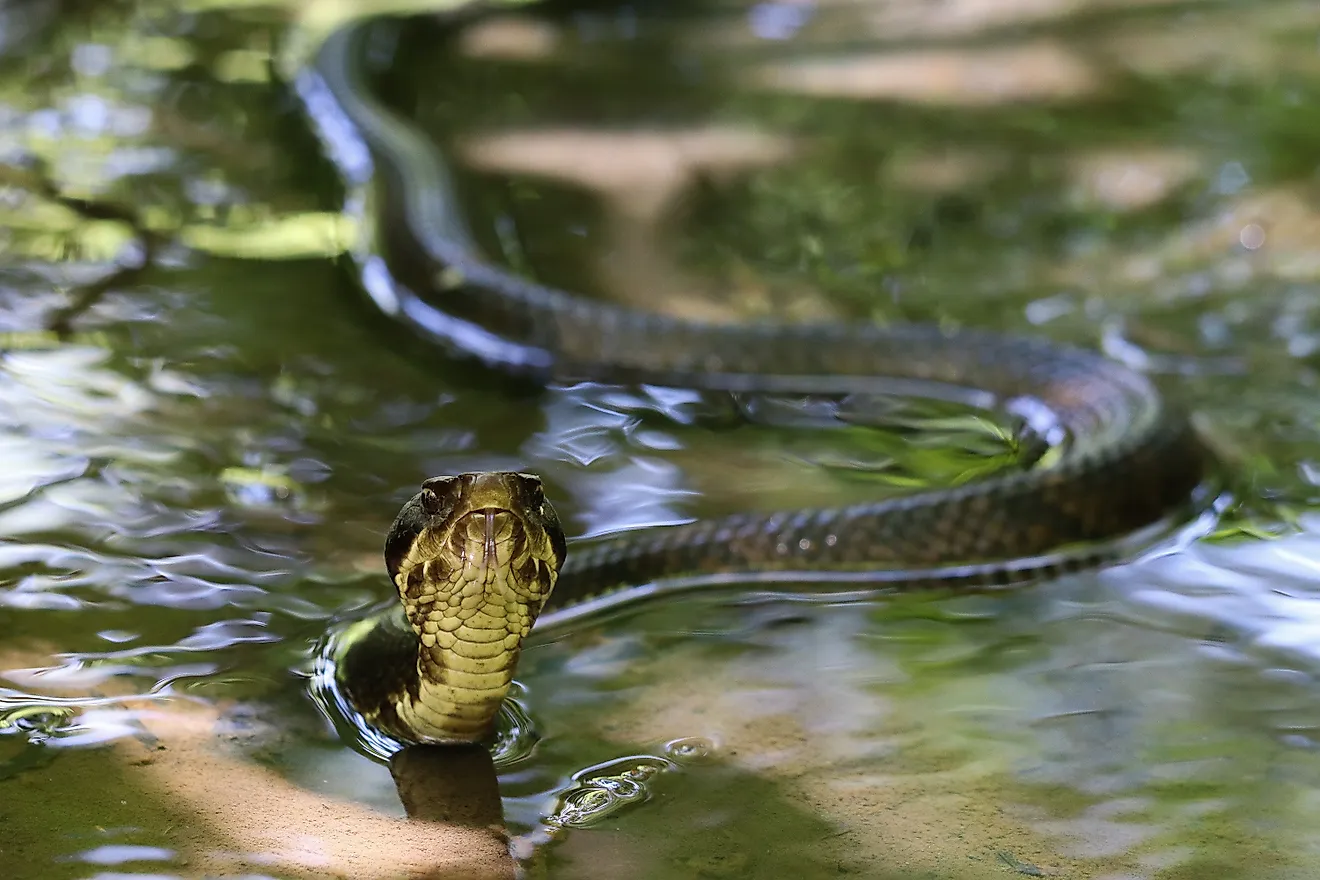
Water moccasin and cottonmouth are the same animal, and the babies look nothing like the adults. A newborn is boldly banded in reddish-brown on tan with a sulfur-yellow tail tip, while a mature one often fades to near-uniform black with barely a pattern left. This species gets harder to identify as it ages rather than easier, which is the opposite of most snakes and the source of endless confusion every autumn. The reason you see them in September is simple enough: that is when they are born. What they do next is considerably stranger, because a newborn cottonmouth goes fishing with its own tail.
They Arrive In Late Summer

The simplest explanation is usually skipped over, so it is worth stating first.
Cottonmouths do not lay eggs. Females give birth to live young between August and October, with North Carolina's wildlife agency putting litters at three to fourteen and other states reporting ranges from one to fifteen. Newborns measure roughly nine and a half to ten inches.
Females generally breed only every other year, so any given autumn's crop comes from a fraction of the adult females in an area rather than all of them. Mating happens in both spring and autumn, which spreads the timing further.
The Tail Is A Fishing Lure
Everything distinctive about a juvenile cottonmouth comes back to the bright tip on its tail, and the behavior has a formal name.
Caudal luring means tail luring. The snake raises the yellow tail tip and wiggles it, and to a frog or a small lizard it looks like a caterpillar in difficulty. The prey comes to investigate the caterpillar and the snake takes it.
It is ambush hunting with built-in bait, and it exists because a nine-inch snake cannot chase anything down. The meal has to be persuaded to approach.
The Color Fades Within A Year

The lure is temporary, and the reason it disappears tells you exactly what it was for.
The yellow fades and caudal luring typically stops after about a year, which is the point at which a cottonmouth becomes big enough to take larger prey. Some accounts describe the tail passing through green before settling to the dark color of an adult.
Once a snake can handle fish and sizeable frogs on its own, it no longer needs to convince a lizard that its tail is a grub. The bright tail is equipment for one life stage rather than a marking.
Babies Are Easier To Identify Than Adults

This is the genuinely counterintuitive part, and it reverses the usual advice about young snakes.
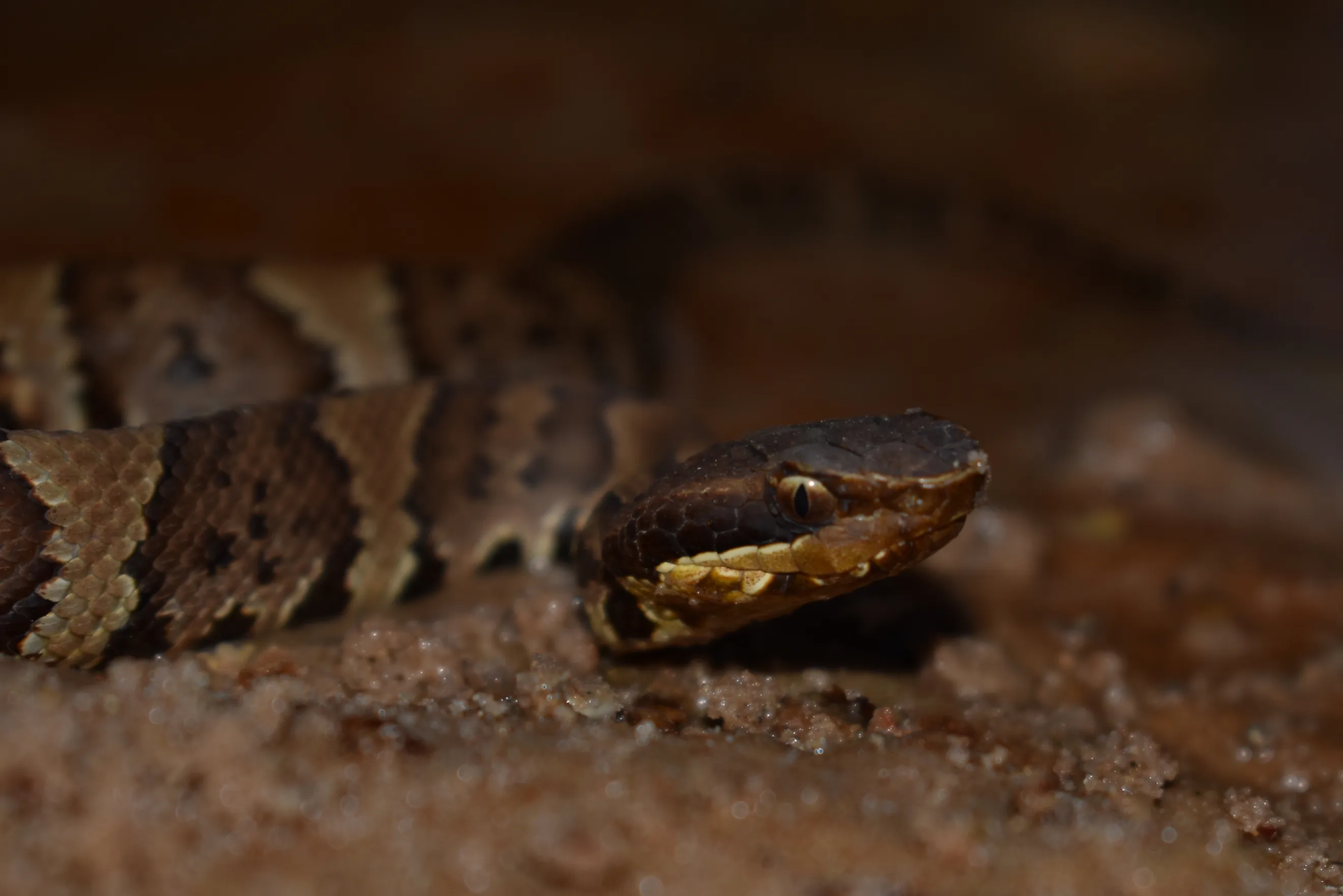
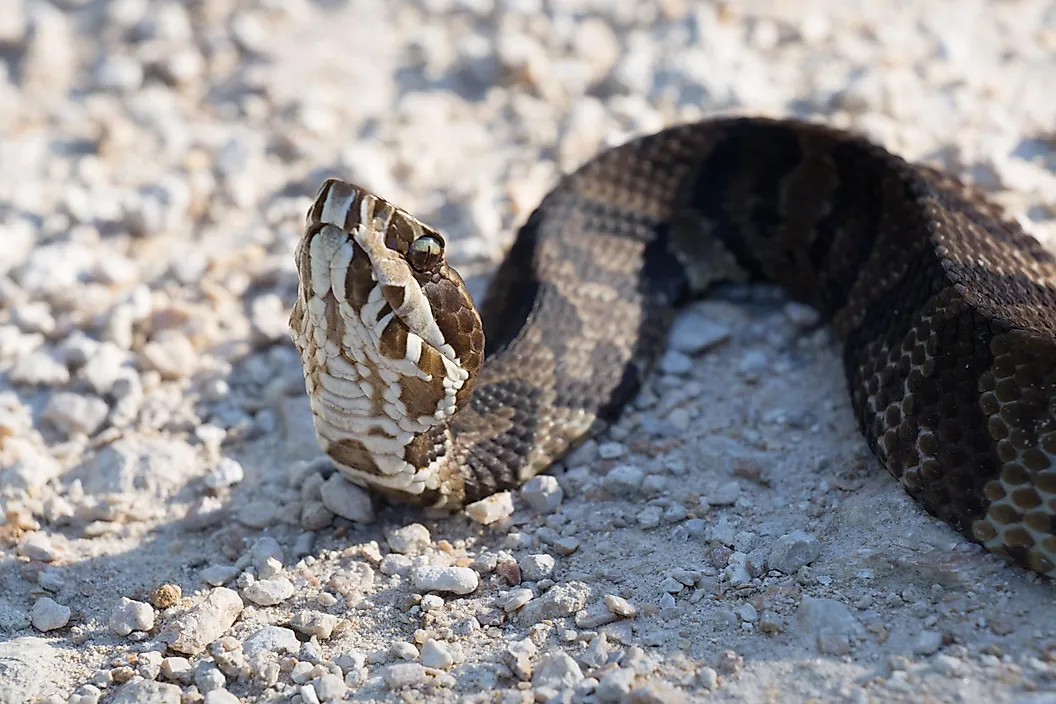
A newborn cottonmouth is sharply banded with reddish-brown crossbands on a brown ground, and the detail of that pattern is most evident in this age group. North Carolina and the University of Florida both report that older adults fade to nearly uniform dark or black with the crossbands barely visible.
So the baby is the readable one. The adult is the ambiguous one. Most species work the other way around, which is why people who learned to recognize adult cottonmouths struggle with the young.
They Look Like Copperheads, Not Like Their Parents

The consequence of all that bright banding is a specific and very common misidentification.
The University of Florida flags it directly: brightly colored juvenile Florida cottonmouths are sometimes mistaken for eastern copperheads. Both are born banded, both carry a yellow tail tip, and both are in the same genus.
The difference that settles it is the face. A cottonmouth has a bold dark band running from the eye to the angle of the jaw, giving it a masked appearance. A copperhead's eye is not obscured that way. Copperheads also keep their juvenile pattern into adulthood, while cottonmouths lose theirs.
The Band Shape Separates Them From Harmless Snakes

The more useful identification, though, is against the snakes that are actually in the water with them, and there is a precise tell.
On a cottonmouth the dark crossbands are widest on the sides of the body and narrowest across the top. On most of the harmless watersnakes that superficially resemble them, the bands are widest across the top. It is the exact reverse, and it works at a distance.
Watersnakes also carry dark stripes on the lips, which cottonmouths lack. Northern and banded watersnakes share the same wet habitat, the same banded look and the same habit of basking at the water's edge, which is why they absorb most of the blame.
A Yellow Tail Is Not Proof Of Anything

One widely repeated shortcut deserves a correction, because it is stated far too confidently online.
A bright yellow tail tip on a small snake does narrow things down, but it is not diagnostic on its own. Juvenile copperheads have one. Juvenile cottonmouths have one. Some harmless species have pale tail tips too.
What the yellow tail reliably tells you is that you are probably looking at a juvenile pit viper of some description, which is useful enough. It does not tell you which.
They Are Not More Venomous Than Adults

The belief that baby pit vipers are more dangerous than grown ones is among the most durable pieces of wrong snake information in America.
Adults have larger venom glands and produce more venom per bite. Juveniles can envenomate effectively but deliver smaller volumes through much smaller fangs. The venom is not chemically more potent in the young.
Both age classes deserve the same response, which is distance. The difference is quantity, not quality, and the adults have more of it.
Where The Newborns Actually Are

Distribution within a wetland is uneven, and the young use the same margins the adults do.
Look to log jams, cypress knees, undercut banks, floating vegetation mats and the shallow backwaters off the main channel. On warm days in early autumn they bask on logs and low branches overhanging water, which is where a paddler meets them at eye level.
The babies are also described as stocky with big blocky heads, which is worth knowing because it means size alone will not tell you whether a small snake is a juvenile cottonmouth or an adult of something harmless.
They Are Aquatic From Day One

One detail separates these newborns from every other young pit viper in America, and it is in the name of the family.
The cottonmouth is the world's only semiaquatic viper. A newborn copperhead or rattlesnake disperses across dry ground looking for cover and a winter den. A newborn cottonmouth is swimming within hours, hunting frogs and small fish along the vegetated edge of a swamp, bayou or slow river.
That changes where people meet them. A juvenile cottonmouth is not something you step on in leaf litter. It is something you find on a log at the waterline, at roughly the height of a hand reaching for a branch.
The Gape Is A Warning, Not A Threat
Autumn brings more encounters, so the defensive display is worth understanding properly.
The species is named for it. A cornered cottonmouth coils and opens its mouth to flash the white interior, which is a signal rather than an attack. The full sequence runs through gaping, tail vibration, body flattening and the release of a foul musk before any strike is attempted.
Georgia's wildlife agency puts the general point well, noting that cottonmouths are not quite the creature they are made out to be and show a measured curiosity rather than aggression. An animal running four separate warnings is trying hard to avoid a confrontation.
What To Do About Any Of This

The guidance for juveniles is the same as for adults, with one addition about looking harder in autumn.
Give any snake room and walk around it rather than past it. Look before putting hands on logs, branches or the underside of a dock. Watch where you step along vegetated shorelines through September and October. Keep dogs leashed near water, since they investigate exactly the places a small snake is resting.
Photograph from a distance if you want an identification afterwards. Do not attempt to kill it, which is how the overwhelming majority of bites happen, and which in most cases ends a harmless watersnake rather than anything venomous.
The Short Version

Baby water moccasins show up in autumn because they are born between August and October, in litters of three to fourteen, at around ten inches long, to females that breed only every other year.
They arrive brightly banded with a sulfur-yellow tail they wiggle to lure frogs and lizards, lose both the color and the behavior within about a year, and spend that first autumn looking far more like a copperhead than like the dark adult they will become. They are not more venomous than their parents. They are simply the only version of this snake that is easy to recognize, and they do not stay that way for long.