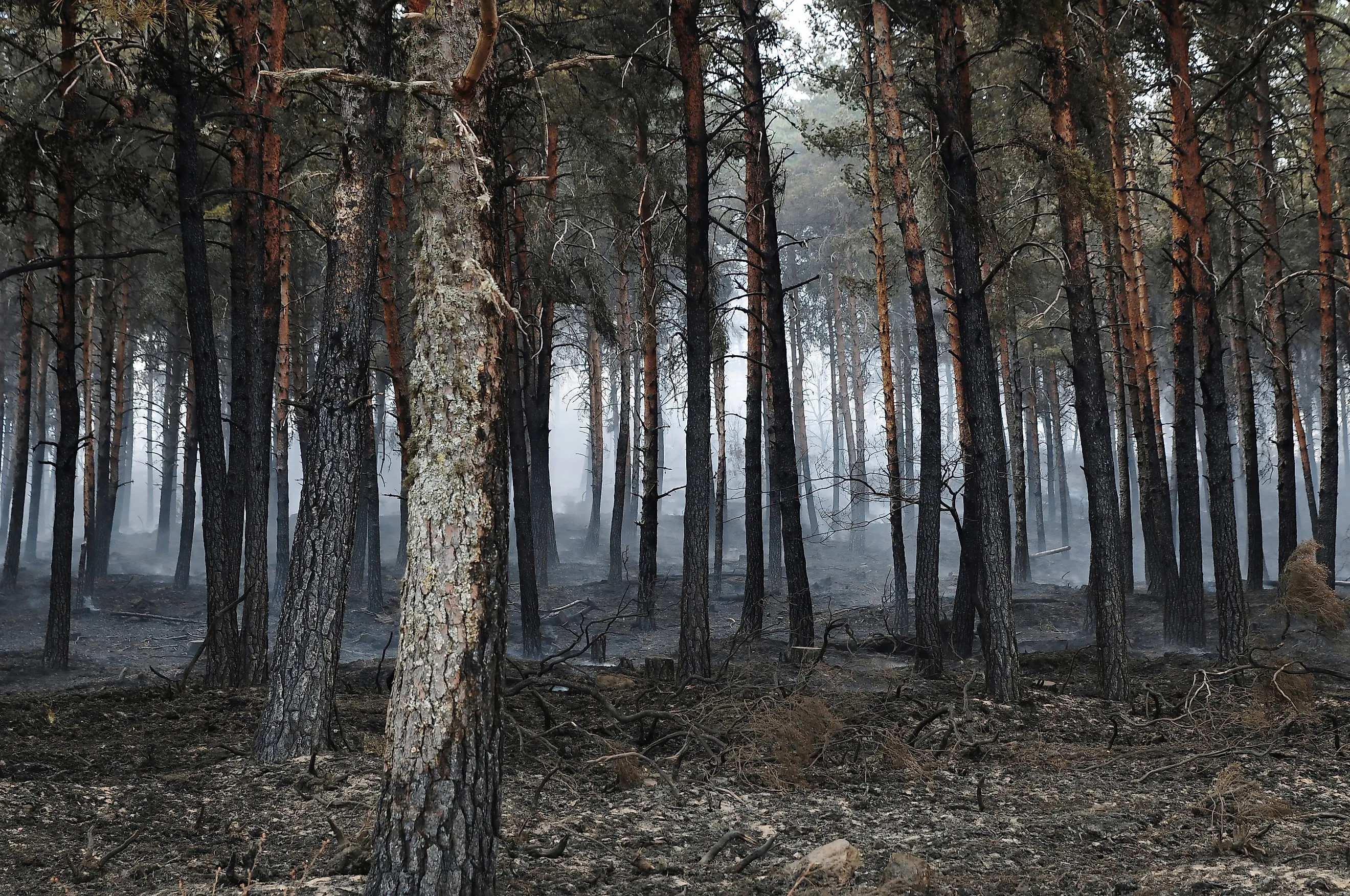
What Happens To A Forest After A Wildfire
A forest starts rebuilding within weeks of a wildfire, while the standing trees are still black. Recovery speed depends on burn severity and species. The process can take a few seasons or several decades. Some conifers carry resin-sealed cones that open only under intense heat, spilling seed onto bare, sunlit soil the moment fire clears the canopy, while coast redwoods resprout instead, from buds dormant under their bark for centuries. This piece traces that process from the soil up. It follows Big Basin's redwoods and Yellowstone's lodgepole pines through the regrowth itself, the salvage-logging fight that followed the Rim Fire on Stanislaus National Forest, and the Lassen Volcanic plots, reburned before a full recovery.
The Soil After Wildfire

Fire changes soil chemistry. Intense heat vaporizes the waxy compounds in pine needles and duff, and as those compounds sink into the soil and cool, they form a water-repellent layer just below the surface. The first heavy rain after a fire tends to run off a burned slope instead of soaking in, carrying ash and topsoil with it. That same ash also carries a pulse of nitrogen and phosphorus into the soil, and where the burn left deeper layers intact, that nutrient spike helps whatever seed survives get an early start.
The Forest Service maps the erosion risk almost immediately. A field guide for post-fire soil burn severity lets Burned Area Emergency Response teams flag the slopes most likely to erode before the next storm arrives, since a patch burned hot enough to sterilize the seed bank can sit fifty feet from ground that barely singed the understory. A study following a 2015 wildfire in the Pacific Northwest found untreated skid trails shed 0.70 grams of sediment per second under simulated rainfall, versus just 0.04 grams on undisturbed burned plots, sediment that travels downstream into the same reservoirs and irrigation intakes communities below a burn scar rely on.
How Trees Regrow After Fire

Some trees survive fire by resprouting from buds that have sat dormant under the bark for centuries. That's how California's Big Basin redwoods came back after an intense 2020 wildfire killed the canopy outright. The CZU Lightning Complex Fire tore through Big Basin Redwoods State Park in August 2020, blackening entire canopies of old-growth coast redwoods, some more than 1,500 years old. Months later, a multiyear study from Northern Arizona University, published in Nature Plants, found many of those trees still alive, their dormant buds pushing out new leaves, fueled by carbon reserves some trees had stored more than fifty years earlier. Not every species nearby fared as well. Douglas firs growing alongside the redwoods largely died outright.
Giant sequoias rely on bark instead of buds. Fibrous bark up to eighteen inches thick insulates the living tissue underneath from heat that kills most trees outright, and prescribed fire in the years before a wildfire measurably improves those odds by clearing the fuel that would otherwise burn hot enough to breach it. The Castle Fire in 2020 and the KNP Complex Fire in 2021 killed an estimated 19 percent of the world's mature giant sequoias across the Sierra Nevada. A 2026 study from UC Davis, published in Nature Communications, found groves that had received prescribed burns in the prior decade fared far better, with trees there nearly four times more likely to survive than untreated trees nearby, a gap researchers trace to thick bark holding up where lower fuel loads kept the fire from burning hot enough to breach it.
Lodgepole and jack pine rely on a third mechanism, resin-sealed cones that stay shut until fire melts them open, a trait called serotiny. The heat of a fire triggers the next generation directly, the same mechanism that reseeded Yellowstone's forests after the park's largest fire on record. Yellowstone National Park lost 793,880 acres, 36 percent of the park, to fire in 1988. The lodgepole pine forests that dominated the burned area carried serotinous cones sealed with resin, and the heat of the fire itself triggered mass seed release. Within a few years, dense young lodgepole stands covered ground that had been standing dead timber.
Managing A Forest After It Burns

After a fire on Forest Service land, managers have to decide whether to salvage the dead timber before it loses commercial value. The dead wood has a narrow window, typically a year or two, before insects and moisture make it unusable, which pushes agencies toward fast decisions immediately after a fire. That urgency has an ecological cost. Standing dead trees, or snags, provide habitat for the same wildlife species drawn to burned forest in the first place, so timber industry groups pushing for quick salvage and ecologists pushing to leave the wood standing rarely agree on the timeline.
The Rim Fire burned through Stanislaus National Forest for more than two months in 2013, consuming over 257,000 acres and leaving up to a billion board feet of dead, salvageable timber behind. The year after, the Forest Service approved logging on more than 33,000 acres of that burn scar, a decision that split loggers who wanted the wood's value from ecologists who wanted the standing dead trees left for wildlife. The dispute reached Congress, where lawmakers weighed waiving environmental review to speed up logging contracts. The fuel problem predates the fire itself. Decades of suppression build up dense undergrowth that lets a fire burn hotter than it otherwise would, a pattern the Forest Service has documented on fire-suppressed forests across the West.
How Wildlife Returns

Animals move back into a burned forest fast. Black-backed woodpeckers arrive first, since biologists consider the bird a burned-forest specialist. It nests almost exclusively in recently killed timber, where wood-boring beetles move in to feed on the dead wood and the woodpeckers feed on the beetles.
In South Dakota's Black Hills National Forest, black-backed woodpeckers moved into burned stands the same season researchers began tracking them, favoring patches with the highest density of fire-killed snags. Nest numbers stayed high for several years, but the relationship is short-lived. Once the beetle population in a stand collapses, usually within seven to ten years, the woodpeckers move on to the next fire, which is why researchers track snag density as closely as they track the birds themselves. Salvage logging that removes those snags too early can push the birds out before they have finished using the habitat.
When A Forest Fails To Recover

The techniques above have limits. Burned ground can convert permanently to shrubland instead of returning to forest when fire returns before a seed bank has had time to rebuild, or when a fire burns hot enough to kill the parent trees that would have supplied that seed in the first place.
Steeper, wetter ground with lower fuel loads going into a fire tends to hold onto new growth better than flatter, drier terrain carrying more brush. Land that has already burned once, then reburns years later, sometimes fares better than land burning for the first time in decades, since less fuel remains to feed the second, hotter pass, a pattern researchers have documented at Lassen Volcanic National Park in California. The Dixie Fire burned through Lassen in 2021 at high severity across more than 40 percent of its footprint. Only 19 percent of the tree seedlings researchers had counted before the fire survived it, and the driest, most heavily reburned patches were the least likely to regrow.
Fire And Time
Timing decides whether a forest recovers. Big Basin's redwoods could draw on decades-old carbon reserves because centuries had passed since their last catastrophic fire. The Rim Fire burned as hot as it did in 2013 partly because decades of suppression had left Stanislaus carrying more fuel than a normal cycle allows. Lassen Volcanic's worst-hit plots were the ones that reburned in 2021 before a seed bank had time to rebuild. A forest's capacity to recover tracks the gap between fires, and in stands where that gap keeps shrinking, a 19 percent seedling survival rate could become common across the fire-suppressed forests of the American West.