The Trees That Can Clone Themselves Into A Forest
The process of creating a forest from seed can take decades or even centuries. But when trees have the ability to clone themselves, a forest can spring up in a few seasons. Botanists have cataloged roughly 60,000 tree species worldwide, and vegetative reproduction occurs in many of them. That is the trick of growing a new stem from a root, a stump, or a buried branch instead of a seed. Anyone who has rooted a willow or cottonwood cutting in a bucket of water has cloned a tree. Two species carry it furthest, into growths that look like whole forests but are single organisms. One is the quaking aspen, whose largest clone covers a Utah hillside inside a national forest. The other is the banyan fig, whose aerial roots harden into trunks until a single tree shades several acres.
The Quaking Aspen

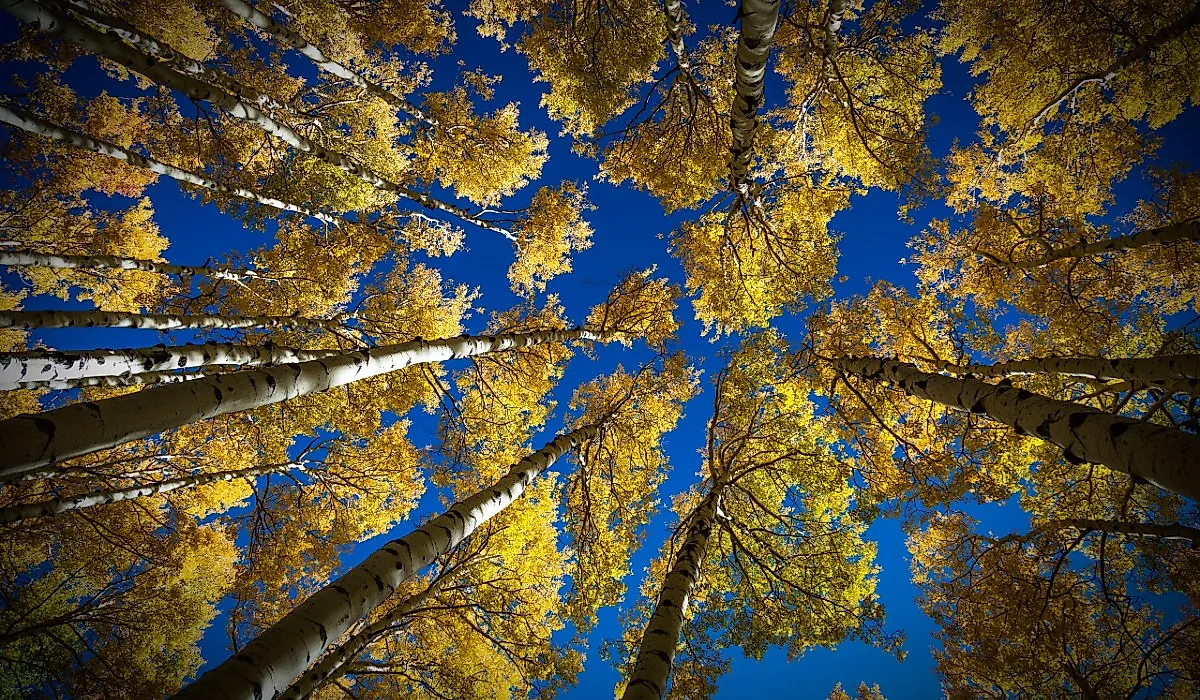
The quaking aspen (Populus tremuloides) is a slender tree, commonly 15 to 18 meters (50 to 60 feet) high. It takes its name from the way its round leaves quake on their flattened stems, called petioles, in the slightest wind. The USDA Forest Service calls it the most widely distributed tree in North America. Its range reaches Alaska in the north and Newfoundland in the east, then follows the Rocky Mountains south into the mountains of northern Mexico. It survives those southern latitudes by climbing, reaching elevations approaching 11,500 feet (3,500 meters). This species propagates mainly through its root system, so it is common to find large clonal colonies in which every stem is genetically identical and every one springs from a shared set of roots.
The most extreme case has a name. Pando, Latin for "I spread," is a single male clonal colony of an estimated 47,000 stems, or ramets. They look like individual trees but are parts of one organism, connected by a root system spanning 106 acres. Researchers with the Western Aspen Alliance at Utah State University put its weight at roughly 13 million pounds (about 6,000 metric tons), which makes it the heaviest known living organism. The superlative needs care: certain honey fungus colonies in Oregon cover far more ground, so "largest" depends entirely on whether the measure is mass or area. Its age is genuinely unsettled. No reliable method exists for dating a clone whose original stem rotted away long ago, and published estimates have run from a few thousand years to tens of thousands. The oldest living stems, which can be cored and counted, are 120 to 150 years old.

Pando sits in Sevier County, Utah, in the Fishlake National Forest, and that designation matters. National forests are managed by the USDA Forest Service for multiple uses rather than preservation alone. That is why Forest Service managers were able to clear-cut small blocks of Pando between 1987 and 1992 as an experiment meant to stimulate new sprouting. The sprouts came up and mule deer ate them. Much of the clone now holds old stems with almost nothing young coming behind them, and a fenced section is the one part regenerating well.
The Banyan Fig
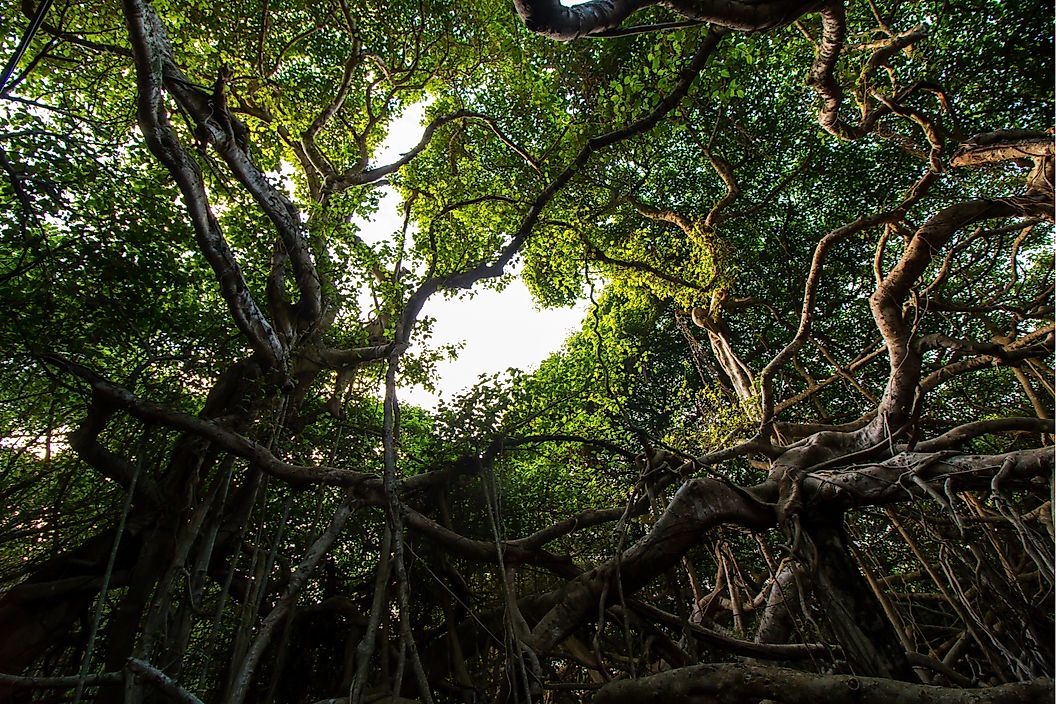
The banyan (Ficus benghalensis) is an evergreen tree of monsoon and rainforest country, also called the Indian banyan or banyan fig. It is recognizable at a distance by its leaning, interconnected architecture. It sends roots down from its branches, and once those roots reach the ground, they thicken into woody trunks that carry part of the canopy. A mature tree can appear to walk, extending some distance from where it started while remaining a single organism. It is also called a strangler fig, because it often begins life as an epiphyte perched on another tree and eventually envelops its host.

Banyans are native to the Indian subcontinent, where the species is the national tree of India and is held sacred in Hinduism, Buddhism, and Jainism. Temples are often built beneath the shade of old banyan canopies. The largest is Thimmamma Marrimanu, meaning "Thimmamma's banyan tree," which grows in Andhra Pradesh's Anantapur district about 25 kilometers from Kadiri. Guinness World Records recognizes it as the largest canopy on a living tree, a crown of 2.19 hectares, or 5.41 acres, held up by close to 4,000 prop roots. Pando covers twenty times more ground, but no tree on record spreads a single canopy wider.
Other Notable Examples
No other clonal colony approaches Pando's footprint, and none spreads a canopy to rival Thimmamma Marrimanu. But three more trees are worth knowing for the way they copy themselves: the black locust, which sprouts hardest when it is injured; the tree of heaven, which clones its way across disturbed ground faster than most natives can hold it; and the coast redwood, which encircles its own stumps with clones.
Black Locust

The black locust (Robinia pseudoacacia) is a root-suckering tree. The roots grow upward and form themselves into new stems, a habit shared by many plants, but the black locust is unusual for suckering defensively. Cut away part of its root or part of its trunk, and it answers the injury with a flush of suckers. It will also sucker when nothing has happened to it at all, which is what makes an established black locust close to impossible to remove, let alone kill. The oldest tree in Paris is thought to be a black locust standing in Square René-Viviani, across the Seine from Notre-Dame Cathedral. A plaque dates it to 1601 and credits Jean Robin, the botanist and royal gardener who brought the species over from the Appalachians under Henry IV. That date is traditional rather than documented, though the early 17th century looks about right.
Tree of Heaven

The tree of heaven (Ailanthus altissima) uses the same root-suckering method to clone itself into dense stands. The species originated in China and neighboring Taiwan and was introduced to the United States in the late 1700s as an ornamental. It has since become one of the most troublesome invasive trees in Europe and North America, since a single specimen can take over an open field at the expense of the native plants around it. It carries a second problem. The USDA Animal and Plant Health Inspection Service identifies the tree of heaven as the preferred host of the spotted lanternfly, an invasive planthopper first detected in Pennsylvania in 2014 and now established in some form across 19 states and the District of Columbia. As a result, clearing ailanthus stands has become a standard lanternfly control measure. Its toughness was immortalized in Betty Smith's novel A Tree Grows in Brooklyn, where it is the tree that pushes improbably out of the cement.
Coast Redwood

The coast redwood (Sequoia sempervirens) is the tallest tree species in the world, and it forms clonal rings called fairy rings. This is the tree of the fog belt along the northern and central California coast, not the giant sequoia of the Sierra Nevada, which holds the separate record for greatest trunk volume. When a redwood falls, burns, or is cut, the stump and its swollen basal burl stay alive and push out sprouts from buds that have been dormant under the bark for decades or centuries. Those sprouts grow into full trees in a near-perfect circle. In time, the parent rots away, and only the ring of younger clones remains.
The Redwood National and State Parks hold plenty of them, and so do the second-growth woods above Santa Cruz, California, where most rings encircle stumps left by 19th-century loggers. Fire triggers the same response. After the CZU Lightning Complex burned across Santa Cruz County in August 2020 and stripped the leaves from old-growth redwoods at Big Basin, researchers documented trees refoliating from ancient buried buds using carbon reserves decades old, which is a large part of why a burned redwood grove is rarely a dead one.
Why Do Trees Clone Themselves?

Several pressures push trees toward cloning. In cold or wind-scoured country, a small seed has almost no chance of establishing itself, while a stem pushed up from an existing root system arrives with a working water supply and a food reserve already behind it. Fire selects for the same strategy. A wildfire can take an entire canopy and leave the root systems underneath untouched, so the species that sprout come back first and hold the ground. Cloning is also efficient, skipping the expensive business of flowers, pollen, fruit, and a seedling's first vulnerable years. And a tree that is already suited to a site has good reason to expect a copy of itself to do well in the same place.
The Evolutionary Advantages Of Cloned Forests
A clonal colony behaves less like a stand of neighbors than like one distributed body. The stems share a root system, and with it a plumbing network, so a young ramet stuck in shade can draw sugar and water from older stems that are reaching full sun. Few individuals starve, which is why clonal stands grow so uniformly and turn color all at once in the fall. The colony also outlives any of its parts. Individual stems rot, snap, or burn on a cycle of a century or two, and the root system keeps producing replacements, which is how a single genetic individual persists for thousands of years while nothing standing above ground is more than a few generations old. That is also where the vulnerability sits. Pando's stems are aging on schedule, and the replacements are being eaten before they can take hold, a reminder that an organism this old is only as durable as its next crop of sprouts.









.jpg)
_spotted_near_Garida.jpg)

