The Deepest Caves In The United States
The elevator at Carlsbad Caverns National Park drops visitors 755 feet underground, and every cave below goes deeper than that. The deepest goes more than five times as far, inside a volcano on the Big Island of Hawaii. In Montana, cavers spend days on rope to reach the bottom of the country's deepest limestone cave, and a single expedition in 2024 pushed it more than 400 feet deeper.
Delissea Cave System, Hawaii: 4,115 Feet

A tree once thought to be extinct grows in the openings of the country's deepest cave. The Delissea tree, which shares its name with the Delissea Cave System, is one of the many native plants and trees growing in the cave's open pits, which cavers there call pukas. They sit on the north flank of Hualālai, the volcano behind Kona, in the Puʻuwaʻawaʻa area, where cavers with the Hawaii Speleological Survey have documented hundreds of entrances. Some are tiny skylights, and others are large, deep pits.
Below those openings, the longest continuous section of the cave descends 4,115 feet, more than three-quarters of a mile from top to bottom. Exploration began in 2003. Biologists have found a wide variety of cave-adapted organisms in the passages, and cavers have collected fossil bones from bird species that no longer exist.
Kazumura Cave, Hawaii: 3,614 Feet

Across the island on the eastern flank of Kīlauea, cavers dug through short plugs of solid rock to join separate lava tubes into one, and the result is Kazumura Cave, about 40.7 miles long. It formed inside the ʻAilāʻau lava flow, which poured out of Kīlauea Iki Crater about 500 years ago, and it follows that flow downhill through 101 entrances. Some sections are about 70 feet wide and 60 feet high.
Several of the animals living inside are found only on the island of Hawaii. A blind planthopper, Oliarus polyphemus, feeds on the roots of native ʻōhiʻa trees that grow down into the tube, and a cave cricket and a millipede share the passages with it. In the island's lava tubes, roots like these are the base of the food web, and a cave wolf spider up to 3 inches long hunts at the top of it.
Harry Shick began leading tours through parts of Kazumura on his property in 1996. On those trips, the passage lies about 50 feet below the surface, inside a tube that descends 3,614 feet from its highest entrance to its lowest point.
Tears of the Turtle Cave, Montana: 2,477 Feet

Reaching Tears of the Turtle Cave starts with a hike of about 22 miles through the Bob Marshall Wilderness in western Montana. Cavers Jason Ballensky and Hans Bodenhamer spotted its entrance in 2006, a hole in a cliff below Turtlehead Mountain, while searching the ridges on foot for caves.
Below that hole, the passage is mostly a fissure two to three feet wide that follows a stream downward through more than 40 rappels. The air holds at about 37 degrees. The walls are muddy and carry few formations. Expeditions camp underground for days, and one camp, in a small room called Camp Dangle, got its name because cavers there have to sleep on portaledges hung from the rock.
In 2014, a team pushed the cave to 1,629 feet and passed Lechuguilla in New Mexico as the deepest limestone cave in the country. By 2022 it reached 2,052 feet. An expedition from July 20 to August 4, 2024, surveyed it to 2,477 feet, the deepest point in any American cave outside Hawaii's lava tubes, where the passage ends at a sump and the stream fills the tunnel to the ceiling. Both this cave and the next-deepest one outside Hawaii, Bobsled Cave, surveyed to 1,842 feet in 2025, are in Montana's Flathead County. After the 2024 trip into Tears of the Turtle, leads higher in the cave were still unexplored.
Hue Hue (Manini Owali) Cave, Hawaii: 1,623 Feet

Back in Hawaii, a lava tube from the 1801 eruption of Hualālai's northwest flank opens just off Queen Kaʻahumanu Highway, about 2 miles north of the Kona airport, and it is popular enough with passing drivers that state transportation officials have looked into safety concerns there. The deep cave in that flow is Hue Hue, a tube that runs 6.7 miles downhill and ends about 100 feet above sea level. One more Big Island lava tube falls between Hue Hue and Tears of the Turtle in depth, the Umi'i Manu System, at 1,869 feet.
Lechuguilla Cave, New Mexico: About 1,600 Feet

For most of the 20th century, Lechuguilla looked like a dead end. Its single entrance, in Carlsbad Caverns National Park, led down a 90-foot pit to 400 feet of dry passage, and miners took bat guano from it for a year under a claim filed in 1914. Cavers began digging there in 1984, and on May 26, 1986, they broke into large walking passages. The mapped cave now runs more than 150 miles. Its walls carry formations that had never been seen anywhere in the world before, among them gypsum chandeliers that hang as long as 20 feet. Scientists also believe rare bacteria in the cave live by feeding on the rock itself.
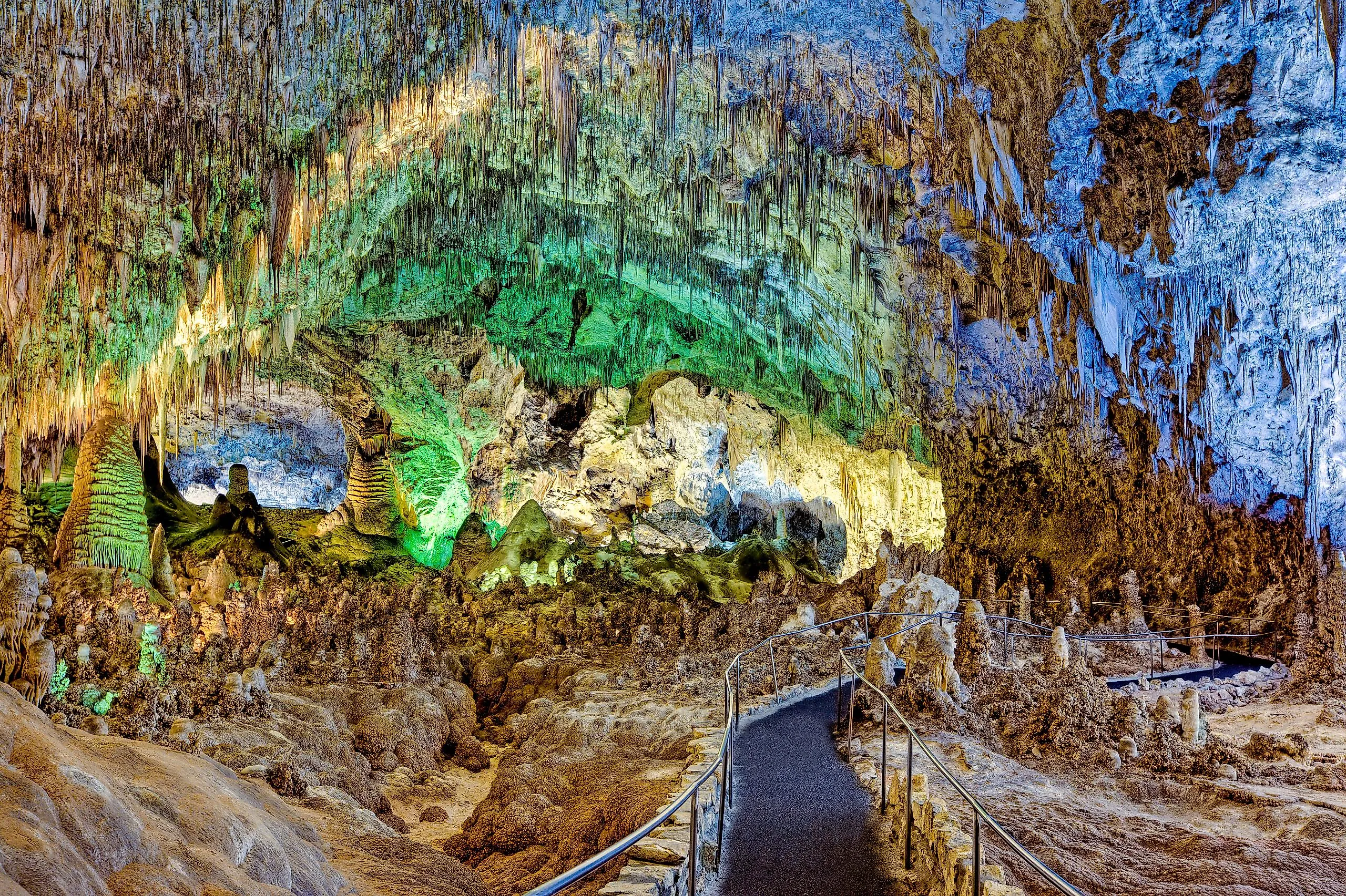
Only approved research and survey teams, along with park management trips, go inside. Elsewhere in the same park, visitors with a reservation can walk the steep, 1.25-mile Natural Entrance Trail about 750 feet down into Carlsbad Cavern and its Big Room, a chamber larger than any yet found in Lechuguilla.
Virgil the Turtle's Great House Cave, Montana: 1,586 Feet

Back in Montana, a second deep cave lies under Turtlehead Mountain, the peak above Tears of the Turtle. Students from the Bigfork High School Cave Club have laid pathways through Virgil the Turtle's Great House Cave to protect its ancient mud floor from boots. Its bottom was reached and surveyed in 2006, at 1,586 feet deep and more than a mile long, which ranked it second-deepest in the continental United States at the time. Today its depth sits within about 6 feet of Lechuguilla's latest survey.
Great Expectations Cave, Wyoming: About 1,400 Feet

High in Wyoming's Bighorn Mountains, Great Expectations Cave has an entrance at each end of its depth. The upper one sits at about 8,500 feet beside a creek, and the lower one opens 1,403 feet farther down the mountain. Only one cave in Wyoming goes deeper, Columbine Crawl in Teton County, at 1,551 feet.
Between the two entrances lie almost 8 miles of surveyed passage, including the Great Hall, Wyoming's largest known room, more than 2,000 feet long and up to 100 feet high and wide. The National Speleological Society bought the land around the upper entrance in 2003, and its members can use the cave there for exploration and survey. The lower entrance lies on federal land, in the Bureau of Land Management's Trapper Creek Wilderness Study Area.
A visitor with a reservation can walk about 750 feet down into Carlsbad Cavern's Big Room. Lechuguilla, in the same park, goes about twice as deep, and the deepest caves in Montana and Hawaii go much farther, but their lowest passages are reached only by survey teams who carry rope and gear in for days. Those teams keep moving the bottom. Tears of the Turtle stood at 1,629 feet in 2014 and reached 2,477 feet ten years later. Bobsled Cave was surveyed to 1,842 feet in 2025, the year the Delissea Cave System's 4,115-foot figure was recorded, and Lechuguilla's survey was updated again in 2026. The deepest of these numbers belongs to a lava tube on Hualālai whose pits still hold a tree once written off as extinct, and the bottom of that cave lies more than five times as far down as the floor of the Big Room.