The Fastest-Growing Trees In American Forests
A cottonwood tree on a good river bottom can clear 40 feet before a child starting kindergarten finishes grade school. Most trees never move that fast, and the ones that do share the same kind of ground: the wet soil beside streams, the fog belt along the Pacific, and any patch of forest just opened by fire or logging. The trigger is always the same, bare earth, full sun, and steady water. A dozen American species grow faster than anything else in the woods under those conditions, and the sections below run roughly from the quickest juvenile climbers down, each with a note on where in the country to find it. The height figures come from decades of USDA growth records.
Eastern Cottonwood

No tree in North America has a stronger claim to the top of this list than eastern cottonwood, the fastest-growing commercial forest species on the continent. On favorable southern sites with adequate weed control, individual planted trees have reached 43 feet by age three and topped 100 feet by age nine. Those are exceptional results from good ground, not a promise every cottonwood will keep. You can find it along streams and bottomlands across most of the eastern and central United States, its range reaching north into southern Quebec, west to North Dakota, south into central Texas, and east to Georgia. It reaches its fullest size through the Midwest, the Great Plains, and the south-central states. Growth is strongest on moist, well-drained sands and silts near streams, where fresh deposits supply both water and open sun. Its Great Plains relative, plains cottonwood, can add 6 to 12 feet of height in a single year when conditions cooperate, enough for a young tree to clear competing brush before slower neighbors crowd in.
Red Alder

A raw Pacific Northwest clearing can turn into young woodland in only a few seasons once red alder takes hold. Seedlings gain 3.3 feet or more in their first year on good sites, then exceed 9.8 feet of annual height growth between ages two and five. On a strong site an alder stands about 30 feet tall by age five and 52 feet by age ten. That early sprint matters because the species is strongly light-demanding, and a tree caught beneath a closing canopy fades fast. Red alder also changes the ground it colonizes: nitrogen-fixing bacteria live in nodules on its roots, so nitrogen accumulates in logged ground, landslides, and stream terraces where the young trees grow. Its range hugs the Pacific coast between southeastern Alaska and southern California, almost always within about 125 miles of the ocean and west of the Cascades and the Sierra Nevada, so a coastal drive through Washington or Oregon passes stand after stand of it. Among its usual companions, only black cottonwood keeps pace with its juvenile growth.
Monterey Pine

Few trees on this list have a smaller natural range than Monterey pine, which grows wild along only a thin strip of the central California coast. Its growth rate still rivals species that span whole regions. Free-growing saplings on good native sites have been measured adding 4 to 8 feet of height a year, and by age 15 a tree can stand about 53 feet tall, a pace that ranks among the fastest recorded for any American conifer. Cool temperatures, winter rain, and steady maritime influence stretch the growing season along that coast, and height growth can stay strong until roughly age 50 on better ground, though poor soil slows a tree far earlier. That same speed made Monterey pine a favorite plantation tree abroad, where foresters wanted usable timber in a hurry. In the wild it clings to just a few native groves near Monterey, Cambria, and Ano Nuevo on the central California coast, plus two islands off Baja California, so seeing it in a natural American forest means visiting that narrow coastal slice rather than any broad pine belt.
Black Willow

Wet ground that troubles most trees is where black willow does its fastest work. On Mississippi Valley floodplains, first-year seedlings can top 4 feet, and five-year-old saplings average about 32 feet. Natural stands in the lower Mississippi Valley average roughly 49 feet at age ten and 72 feet at age 20. It grows on freshly deposited mud, sandbars, river margins, and sloughs, anywhere alluvial ground stays moist through the growing season. Its seeds die quickly once they dry out, so a new willow stand depends on landing on wet mineral soil almost the moment the seed disperses. Given full sun and steady water, though, an established willow puts on a remarkable burst of height, and young rootstocks sprout readily after damage. The tree grows across most of the eastern United States wherever rivers run, but it reaches its best size in the lower Mississippi Valley and the wet bottomlands of the South. The result is a classic pioneer that seizes new river-made ground fast and holds it as temporary willow forest until longer-lived species arrive behind it.
Coast Redwood

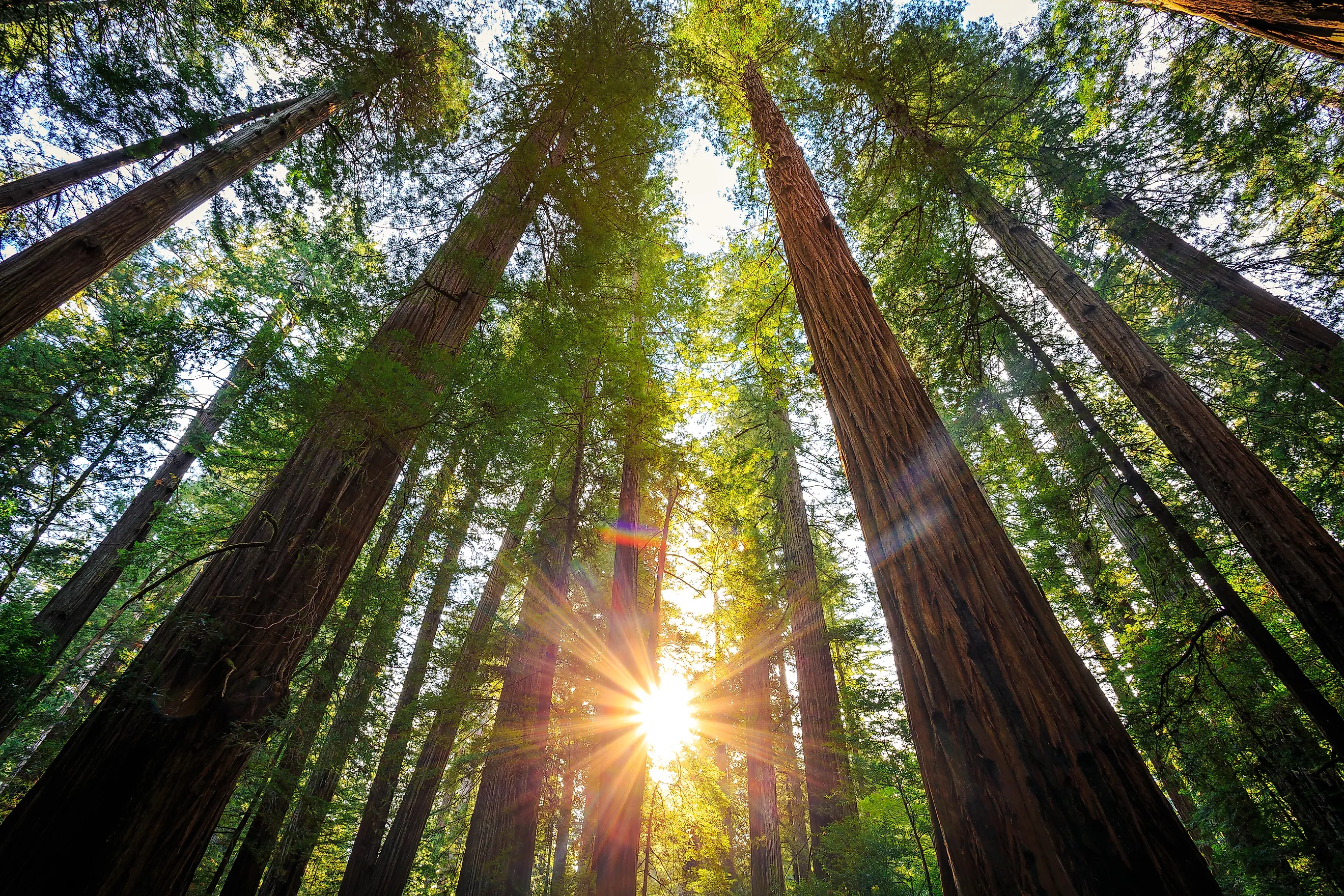
Most fast-growing pioneers are short-lived, which is what sets coast redwood apart: it pairs a quick juvenile phase with a lifespan measured in centuries. Trees four to ten years old sometimes add 2 to 6.5 feet in a year, and sprouts tied to an established root system can climb even faster, some clearing 6 feet in a single season. That early speed is how a young redwood stand rebuilds height so quickly after cutting or fire. The momentum is what astonishes. Dominant trees on good sites commonly reach 100 to 150 feet by age 50 and 165 to 220 feet by age 100, and the very best sites keep that rapid climb going well past the first century. That whole performance is confined to a coastal strip roughly 450 miles long and rarely more than 35 miles wide, reaching out of the southwestern corner of Oregon down through the fog belt of Northern California into the Santa Lucia Mountains south of Monterey. Summer fog, heavy winter rain, humid air, and reliable soil moisture mark out that narrow band where all of this is possible. Almost no other American tree matches such a quick start to such extraordinary long-term height.
Black Cottonwood

The western river bottoms have their own cottonwood, and black cottonwood climbs almost as dramatically as its eastern cousin. Trees started from cuttings frequently pass 5 feet by the end of their first year and 20 feet after four, and shoots rising from existing root systems go faster still. Moist lowlands bring out the full potential, and its range follows rivers, floodplains, and islands across western North America, reaching south out of Alaska and British Columbia through Washington, Oregon, and the northern Rockies into California, where that fast start lets young stems outrun slower competitors. Plantation results show what deep soil and steady water can produce: a coastal Washington planting on deep alluvium grew dominant trees 115 to 122 feet tall in 24 years, with the best sites far outyielding poor ones. Those are managed conditions rather than a universal forest rate, but they mark the ceiling for a tree built for height and wood.
American Sycamore

The mottled, peeling pale bark makes American sycamore easy to recognize along eastern rivers, and its growth is every bit as conspicuous. Under favorable conditions, seedlings add 36 to 48 inches in their first year. A 17-year-old North Carolina stand averaged about 70 feet tall, and an 11-year-old central Georgia plantation averaged roughly 63 feet. Sycamore stays fast-growing throughout its life, and within its range only cottonwood, certain pines, the soft maples, and black willow beat it under some conditions. It is most at home on lowlands, streambanks, and alluvial floodplains where roots reach generous moisture, and those sites let it move quickly without settling into the small, short-lived habit of a typical pioneer. It grows through the bottomlands of the eastern United States, its range spanning New England and southern Ontario in the north, the eastern Great Plains in the west, and Texas and northern Florida in the south. Given room, it becomes one of the largest hardwoods in eastern forests, with documented individuals passing 140 feet.
Yellow-Poplar

Stump sprouts give yellow-poplar, also called tuliptree, its most dramatic documented rate. On a good western North Carolina site, the leading sprout from each of 60 stumps averaged 4.7 feet of height growth a year for six years. Seed-origin trees start slower, yet good ground still yields 10- to 18-foot trees by age five, and one natural 11-year-old seedling reached 50 feet. The species wants deep, fertile, well-drained soil rather than ground that floods through the growing season, and full light is its other great advantage. Once a young yellow-poplar rises above the surrounding vegetation, its straight stem can keep a dominant place in the canopy for decades. The tree ranges across the eastern United States, reaching north into southern New England and Michigan, south into Louisiana, and east to north-central Florida, but it grows tallest in the deep, sheltered coves of the southern Appalachians. There, its height growth beats every common associate except eastern white pine through about age 50.
Slash Pine

The long southeastern growing season lets slash pine build height in repeated bursts. Past the seedling stage, juvenile trees commonly put out two to four height-growth flushes a year, with the spring shoot supplying about 62 percent of the annual gain and later summer shoots adding the rest. Long-term trials show how those flushes stack up: across test sites in Louisiana and southern Mississippi, dominant and codominant trees on the best combination of rainfall, slope, and subsoil moisture averaged 64.3 feet tall at age 20. That is a little more than 3 feet of height a year over two decades, though the yearly increment shifts with age and conditions. Soil changes the outcome sharply, since the species responds to rooting depth, drainage, available moisture, and how much fine material sits in the subsoil, and site preparation helps early on by clearing competition. Its natural range is the smallest of the four major southern pines, a band of the lower Coastal Plain running out of South Carolina south through Georgia and Florida and west into eastern Louisiana, with Georgia alone holding close to half the growing stock. That sensitivity is why two stands a short drive apart on the Coastal Plain can grow at noticeably different speeds.
Eastern White Pine

Eastern white pine saves its best burst for adolescence. An open-grown seedling is often only about a foot tall at age five, but growth accelerates sharply after that. On good southern Appalachian sites, annual height gain peaks near 3 feet between ages ten and 15; on exceptionally productive ground, the maximum has hit roughly 3.4 feet, and individual open-grown trees between ten and 20 years old have added as much as 54 inches in one year. That surge helped white pine become one of the great canopy trees of the Northeast and Appalachians, where historic individuals commonly passed 150 feet. Site quality controls when and how hard the peak arrives, since poorer ground reaches its maximum later and at a much lower rate. It grows across Newfoundland and the Great Lakes region, south through New England, and down the Appalachian spine into northern Georgia, and it is the tree behind the towering white-pine forests of Maine, the Adirondacks, and the southern mountains. A pine that looks restrained for its first few years, in other words, can become one of the forest's quickest climbers once roots, light, and moisture line up.
Loblolly Pine

Loblolly pine covers a huge share of the southeastern United States, and its speed is a big reason for its prevalence in both wild regeneration and commercial forestry. Young, open-grown loblollies commonly gain 2 to 3 feet of height a year, though not in one continuous push: seedlings produce two to five flushes a year, with the final height shaped by temperature, soil moisture, nutrients, genetics, and competition. Competition can flip the picture entirely. Hardwood sprouts and shrubs can cut loblolly seedling growth and survival by as much as 80 percent in the first seven years after regeneration, so a young pine that dodges being overtopped by about age three has a far better shot at pulling ahead. It ranges across the Southeast, reaching north into New Jersey and Delaware, south through the Carolinas and Georgia into central Florida, and west into eastern Texas, blanketing the Piedmont and Coastal Plain in nearly unbroken pine. That mix of repeated flushes and a strong response to open, well-prepared ground is why loblolly is so productive across the South, especially where moisture stays reliable without long droughts.
Quaking Aspen

Quaking aspen earns its place through a different kind of speed. Seedlings are unremarkable at first, usually reaching only 6 to 12 inches in their first year, but an established clone produces far faster root suckers after fire, cutting, or other disturbance. Those suckers outgrow seedlings for the first several years, and young aspen keeps up rapid height growth for roughly its first two decades. The underground advantage is what changes a landscape so fast: an aspen clone persists as a shared root system, so losing the above-ground stems triggers a flush of replacement shoots instead of a fresh start from seed. That habit helps explain why aspen is the most widely distributed tree in North America, ranging across forests in Alaska and Canada and reaching down into the Great Lakes, the Rockies, the Northeast, and the Southwest. Highly shade-intolerant, it depends on newly opened ground, and its root system is what lets it claim that ground quickly.
How Speed Fits Into a Forest
Fast height growth is a strategy rather than a virtue, and it comes with trade-offs. The quickest climbers here, the cottonwoods, willows, and aspen, tend toward soft wood and short lives, racing to claim light and space before slower, sturdier species catch up. Coast redwood is the striking exception, with a rapid pace that lasts a century or more, while in the southern pines and yellow-poplar that early speed shows up later as long, straight, valuable trunks. Reading their numbers together shows less about which tree wins a race than about how each one answers the same opening: sudden light, bare ground, and enough water to make the most of both.