Did Christianity Cause The Fall Of Rome?
- The first Christian Roman emperor was Constantine, and he stopped the persecution of Christians in Rome.
- There were many reasons that combined and attributed to the fall of the Roman Empire, and Christianity is just one of them.
- In 286 AD, Emperor Diocletian split the Roman Empire into two parts.
The answer is no. The fall of the Western Roman Empire was a process that unfolded over roughly two centuries and resulted from the interaction of political, military, economic, and demographic forces. The rise of Christianity coincided with that decline but did not cause it. The proposition that Christianity was responsible originates with one specific 18th-century historian, Edward Gibbon, whose influence on popular understanding of Roman history has been enormous but whose central argument on this point is rejected by almost all modern scholars of late antiquity. Understanding why requires looking at what actually happened to the empire in its final two centuries and at what the Eastern half (which was more thoroughly Christian than the West and survived another thousand years) reveals about the relationship between religion and imperial collapse.

The Gibbon Thesis
The argument that Christianity destroyed Rome is associated above all with the English historian Edward Gibbon (1737-1794), whose six-volume History of the Decline and Fall of the Roman Empire was published between 1776 and 1789. Gibbon devoted Chapters XV and XVI of his first volume to Christianity and argued that the new religion sapped the empire's martial vigor in several ways: by diverting resources to monasteries and the Church rather than the army; by promoting other-worldly concerns over civic engagement; by producing internal sectarian conflict between Catholic and Arian Christians, and between Christians and pagans; and by undermining the imperial cult that had linked political loyalty to traditional religion.
Gibbon's prose has had two and a half centuries to shape popular impressions of Roman history, which is why the question of whether Christianity caused the fall persists in classrooms and bookstores today. But the thesis was already controversial when Gibbon published it. Eighteenth-century clergy attacked his treatment of the early Church as anti-Christian polemic, and over the following two centuries professional historians have systematically picked apart his arguments. The historian J.B. Bury, who edited the modern critical edition of Gibbon, observed in 1909 that Gibbon's chapters on Christianity were the weakest part of his work.
How Christianity Came to Power in Rome

For its first three centuries, Christianity was a minority religion in the Roman Empire and was periodically persecuted by Roman authorities. The persecution under Nero in 64 AD (following the Great Fire of Rome) and the Great Persecution under Diocletian (303-311 AD) were the most severe of these, but most of the time Christians simply lived as a tolerated though disfavored minority. The decisive change came under the emperor Constantine I (reigned 306-337 AD), who issued the Edict of Milan in 313 AD jointly with the eastern emperor Licinius. The edict legalized Christianity throughout the empire and ordered the restoration of confiscated Christian property. Constantine himself converted, was baptized on his deathbed, and convened the First Council of Nicaea in 325 AD to settle Christian doctrinal disputes.
Christianity did not become the official state religion under Constantine, however. That step came in 380 AD under the emperor Theodosius I, whose Edict of Thessalonica made Nicene Christianity the only acceptable religion of the empire. Theodosius followed up in 392 AD by banning traditional Roman paganism outright. Even after these decrees, pagan worship continued in rural areas for centuries, particularly in remote regions where imperial authority was thin. The word "pagan" itself derives from the Latin paganus, meaning rural villager, because Christianity initially spread through cities and along trade routes before reaching the countryside.
The Crisis of the Third Century

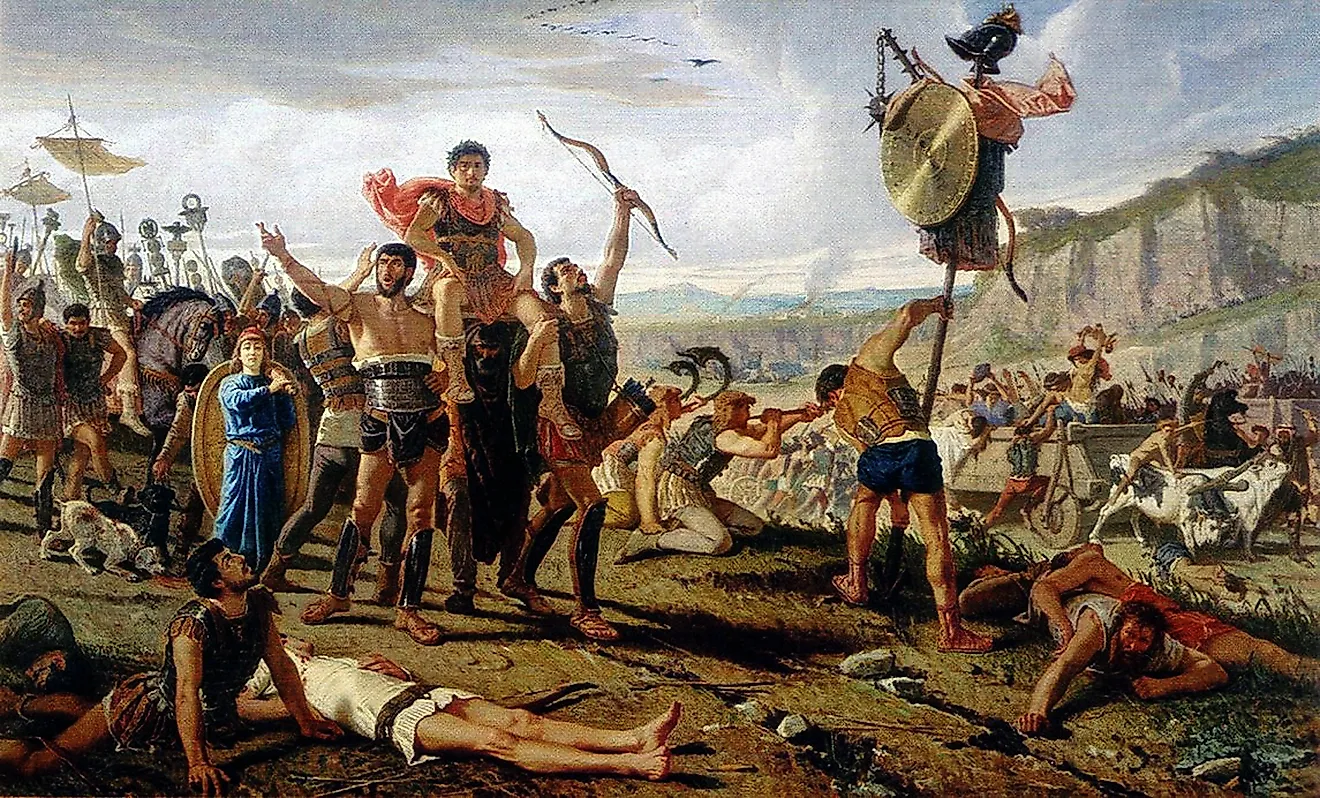
By the time Christianity was legalized in 313 AD, the empire had already suffered through the most severe crisis of its history. The Crisis of the Third Century lasted from approximately 235 to 284 AD, beginning with the assassination of the emperor Severus Alexander and ending with the accession of Diocletian. During this fifty-year period the empire saw more than twenty-five emperors, most of whom died violently, and at one point it fragmented into three competing states: the central Roman Empire, the breakaway Gallic Empire in the west (covering modern France, Spain, and Britain), and the Palmyrene Empire in the east (covering Syria, Egypt, and Anatolia).
The instability had nothing to do with Christianity, which at this point was still a minority religion under occasional persecution. The driving cause was the absence of a clear succession system: emperors were neither hereditary monarchs nor elected officials, and in practice whoever controlled the largest army usually controlled the throne. Military strongmen on the frontiers regularly marched on Rome to take power, and each civil war drained the treasury and weakened the borders. The damage of this period proved difficult to repair, and the lack of a stable succession remained a structural problem for the rest of Roman history.
Economic Decline and the Debased Currency

Running alongside the political instability was a long economic decline. Constant civil wars and military campaigns drained the treasury, and as barbarian raids made tax collection harder in the frontier provinces, the burden fell on the interior. Roman emperors responded by debasing the silver content of the standard coin, the antoninianus. Introduced under Caracalla in 215 AD with high silver content, the antoninianus contained less than five percent silver by 270 AD, with the remainder being copper coated in a thin silver wash. The resulting inflation undermined confidence in the currency and pushed many transactions back to barter.
The cumulative economic effects were severe. Small farmers, squeezed by inflation and rising taxes, abandoned their land and either fled to the cities or attached themselves to wealthy estate-holders as tenant farmers, a process that gradually transformed Roman society into the proto-feudal structure of the early medieval period. Trade volumes dropped as roads became less safe and currency lost value. Government revenues continued to shrink, which made it harder to pay the army, which in turn made it harder to defend the borders, which made tax collection harder still. The cycle was self-reinforcing and accelerated through the third, fourth, and fifth centuries.
Diocletian's Reorganization

The emperor Diocletian, who took the throne in 284 AD and reigned until his abdication in 305 AD, ended the Crisis of the Third Century through a comprehensive reorganization of imperial government. In 285/286 AD he appointed Maximian as his co-emperor with responsibility for the western half of the empire, while Diocletian retained the wealthier and more populous eastern half. In 293 AD he formalized this arrangement into the Tetrarchy: two senior emperors with the title Augustus and two junior emperors with the title Caesar, each responsible for a portion of the empire, with the Caesars expected to succeed their respective Augusti when the older men retired.
The Tetrarchy was designed to address two structural problems at once: the empire was too large to govern from a single capital, and the lack of a clear succession had produced fifty years of civil war. Diocletian also restructured the army, reformed the tax system, attempted to control inflation through the Edict on Maximum Prices in 301 AD, and presided over the most thorough persecution of Christians in Roman history (the so-called Great Persecution of 303-311 AD). The Tetrarchy collapsed quickly after Diocletian's abdication, but his administrative division of the empire endured and laid the foundation for the permanent split that came later.
External Pressure: The Migration Period
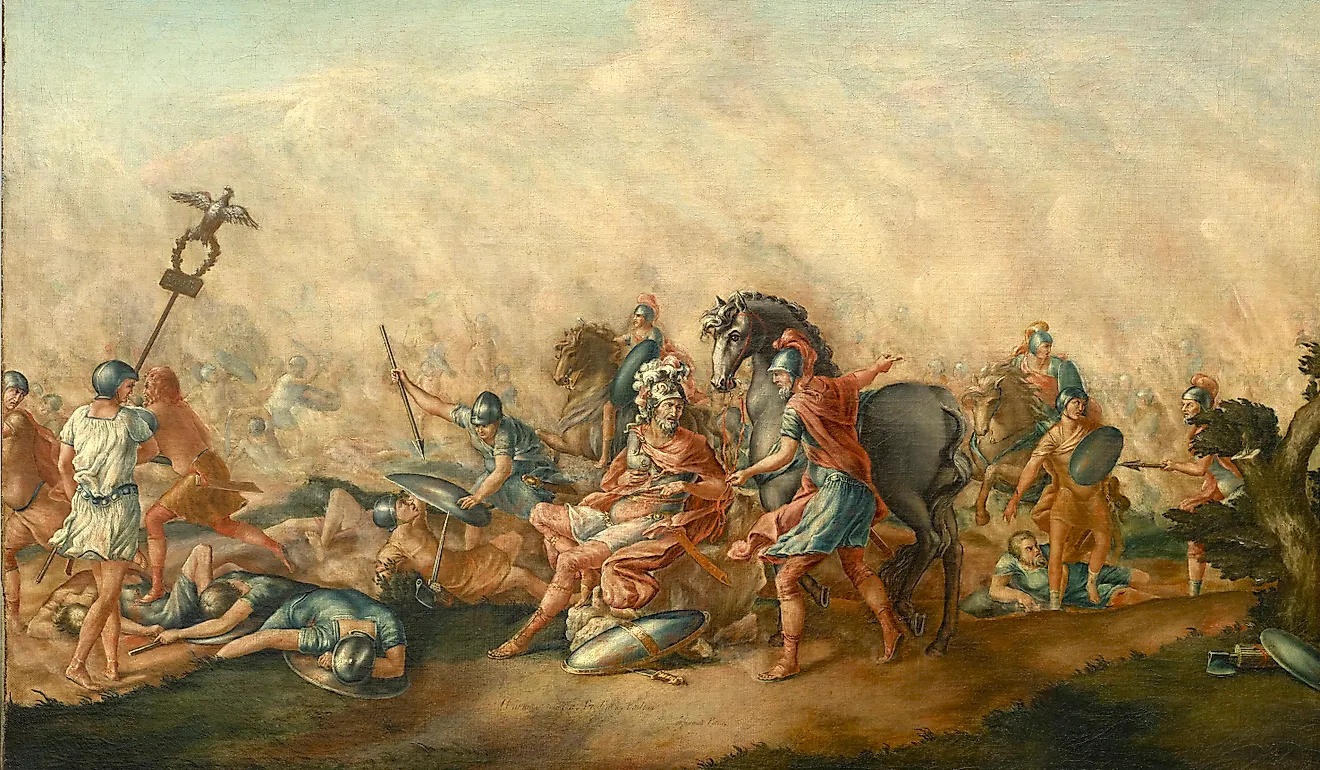
From roughly 376 AD onward, the Western Roman Empire faced sustained external pressure from migrating Germanic peoples, themselves displaced by the westward advance of the Huns under leaders such as Attila. The Visigoths under Fritigern won a major victory over the Roman army at the Battle of Adrianople on August 9, 378 AD, killing the eastern emperor Valens and demonstrating that Roman forces could be defeated in open battle by Germanic confederations. Adrianople is often treated by modern historians as a turning point, the moment after which the empire could no longer ignore or absorb the migrating peoples on its frontiers.
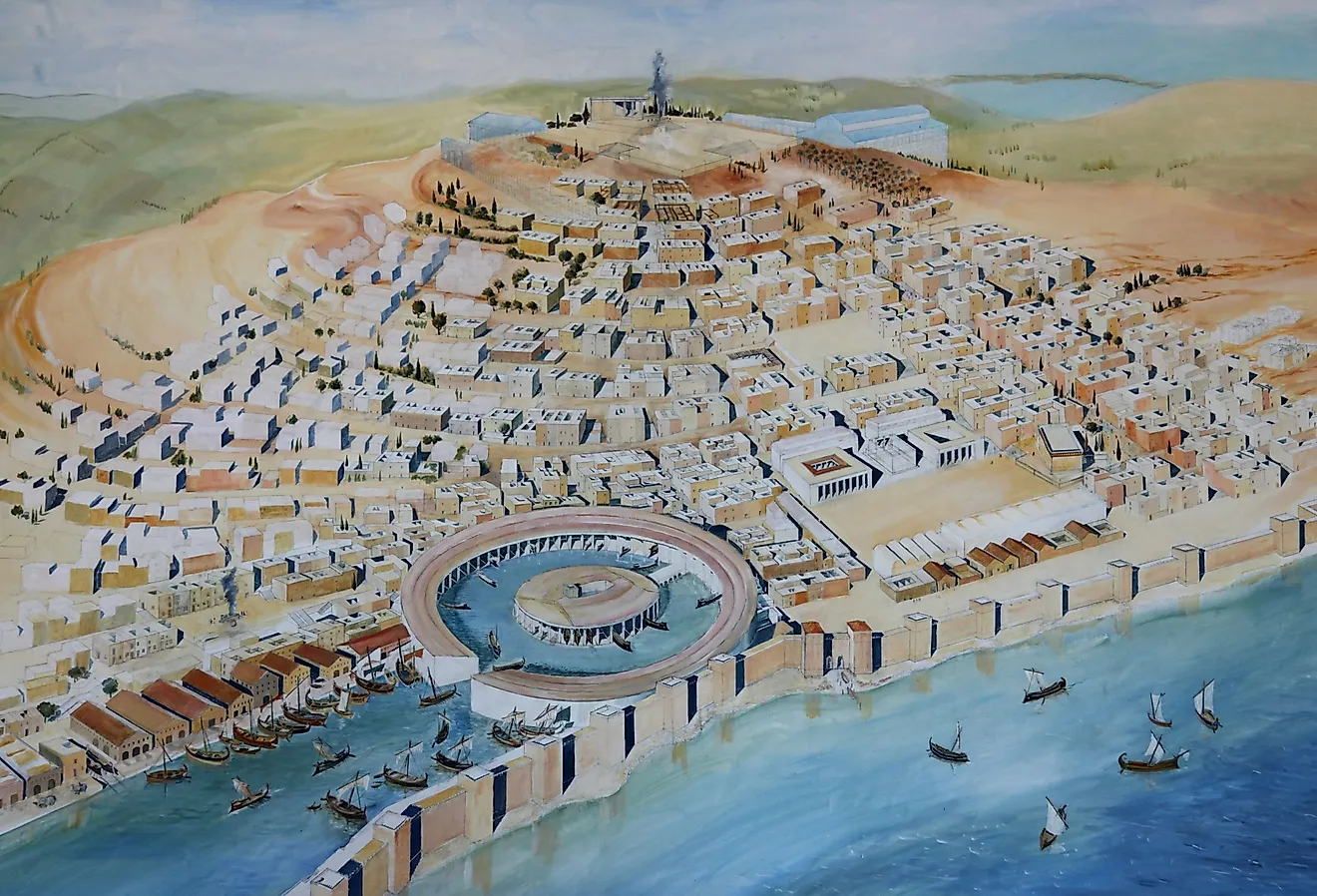
Subsequent decades saw a series of catastrophic events. Alaric and the Visigoths sacked Rome itself on August 24, 410 AD, the first time the city had been taken by a foreign enemy in nearly 800 years. The Vandals under Gaiseric crossed into North Africa in 429 AD and captured Carthage in 439 AD, depriving the Western Empire of its main grain supply and its richest remaining province. Attila the Hun invaded Gaul in 451 AD and was checked at the Battle of the Catalaunian Plains by a Roman-Visigothic alliance under the Roman general Flavius Aetius. The Vandals then sacked Rome itself in 455 AD, a more thorough plundering than Alaric's. Each of these events cost the Western Empire territory, revenue, and prestige, and the surviving provinces increasingly fell under the effective control of Germanic foederati, allied troops settled within Roman territory.
The End of the Western Empire

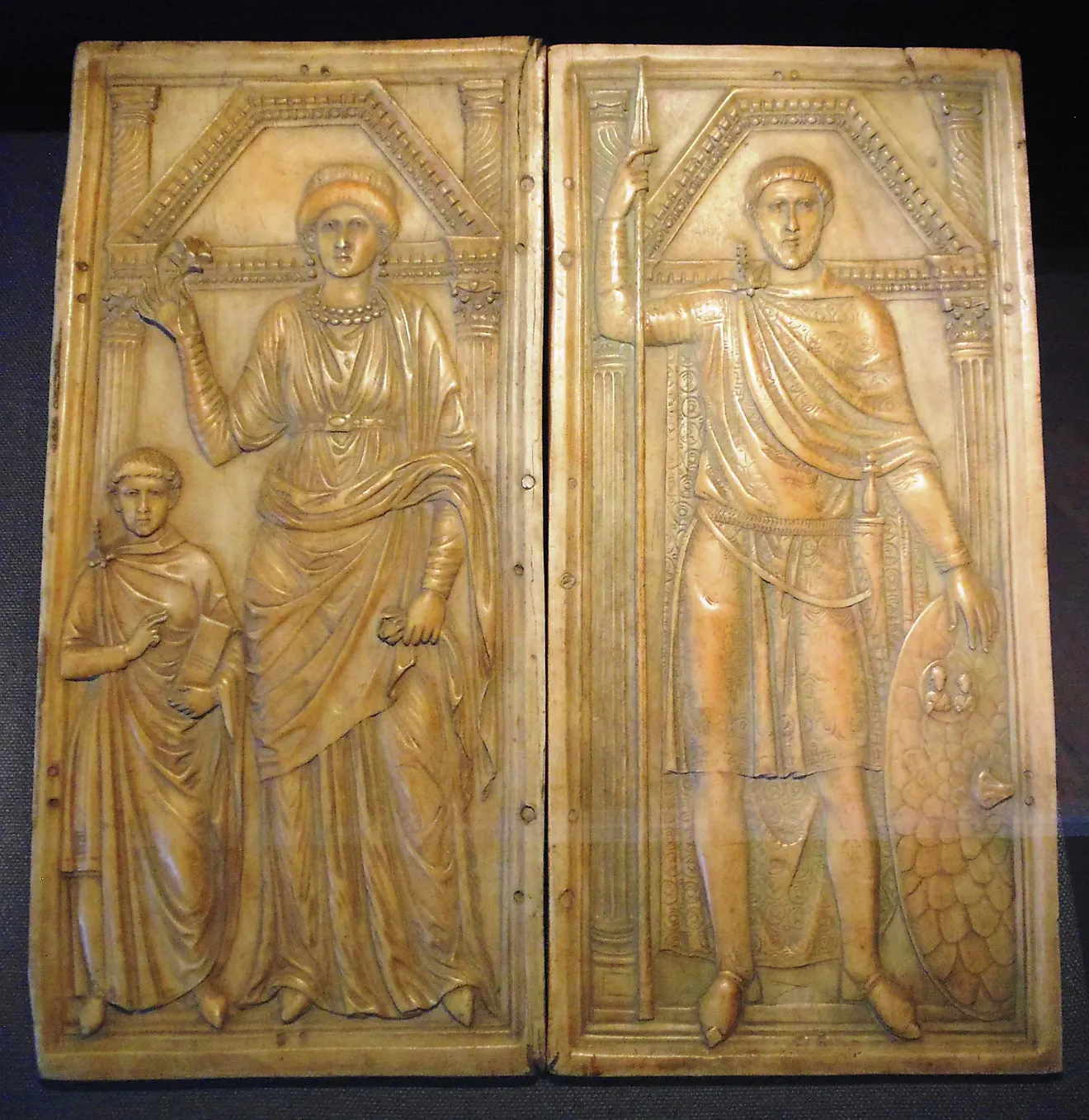
The conventional end date for the Western Roman Empire is September 4, 476 AD, when the Germanic mercenary general Odoacer deposed the teenage emperor Romulus Augustulus and sent the imperial regalia to the eastern emperor Zeno in Constantinople. Romulus Augustulus, whose nickname (the diminutive of Augustus, meaning "little Augustus") reflects both his youth and the negligible reality of his power, had been installed on the throne by his father Orestes, a Roman general of Pannonian origin. When Orestes refused to give Italian land to his Germanic foederati troops, they mutinied under Odoacer, killed Orestes at Pavia, and deposed his son.
Odoacer did not destroy Rome or end the Roman system in Italy. He ruled the peninsula as King of Italy from Ravenna (which had been the western imperial capital since 402 AD), retained the Roman administrative apparatus, and recognized the nominal sovereignty of the eastern emperor. The deposition of Romulus Augustulus is significant less because it was a moment of dramatic destruction and more because no one bothered to install another Western emperor afterward. The institution of the Western imperial throne simply ceased to exist, and the territory once governed by Rome was gradually divided among Germanic successor kingdoms (Visigothic Spain, Ostrogothic Italy, Frankish Gaul, Vandal North Africa, Anglo-Saxon Britain) over the following century.
What Modern Historians Conclude
The most direct argument against the Christianity-caused-the-fall thesis is geographic. The eastern half of the empire was more thoroughly Christianized than the western half by 400 AD, and the eastern capital of Constantinople was specifically founded by a Christian emperor as a Christian city. Yet the Eastern Roman Empire (commonly called the Byzantine Empire by modern historians, though its inhabitants always called themselves Romans) survived for almost another thousand years, until Constantinople fell to the Ottoman Turks on May 29, 1453. If Christianity had been the cause of imperial collapse, the more Christian half should have fallen first.
What modern historians of late antiquity (Peter Brown, Peter Heather, Bryan Ward-Perkins, Adrian Goldsworthy, Kyle Harper) instead emphasize is some combination of: the structural instability of the Roman succession system, the long economic decline driven by currency debasement and shrinking trade, the impossibility of defending the empire's enormous frontiers with the resources available, the demographic catastrophe of repeated plagues (the Antonine Plague of 165-180 AD, the Plague of Cyprian of 249-262 AD), and the cumulative pressure of Germanic migrations driven west by the Huns. Kyle Harper's 2017 book The Fate of Rome adds climate change to this list, citing evidence for a "Late Antique Little Ice Age" beginning around 536 AD. None of these explanations centers on religion.
Augustine of Hippo, writing in North Africa between 413 and 426 AD, addressed the Christianity-caused-the-fall question directly in his City of God. The book was a response to pagans who blamed Christianity for Alaric's 410 sack of Rome, and Augustine argued that the empire's troubles long predated Christian dominance and reflected the universal vulnerabilities of all earthly institutions. His argument was philosophical rather than empirical, but it framed the debate that modern historians have continued for sixteen centuries.
The Verdict
The rise of Christianity changed Roman society in major ways: it redirected charitable giving, restructured the social role of the Church, produced new institutions such as monasticism, and reorganized public ritual around the Christian calendar. None of those changes, however, fits the timing or the geography required to explain the fall of the Western Empire. The political instability that ultimately destroyed Roman authority was visible by 235 AD, when Christianity was still a persecuted minority. The economic decline accelerated through the third century, when the empire was still pagan. The military catastrophes that ended the Western Empire (Adrianople in 378, the sacks of Rome in 410 and 455, the loss of North Africa in 439) reflected specific failures of Roman defense, not religious decay. And the more Christian eastern half of the empire outlasted the less Christian western half by approximately one thousand years. Gibbon's thesis is elegant prose, but the evidence does not support it.