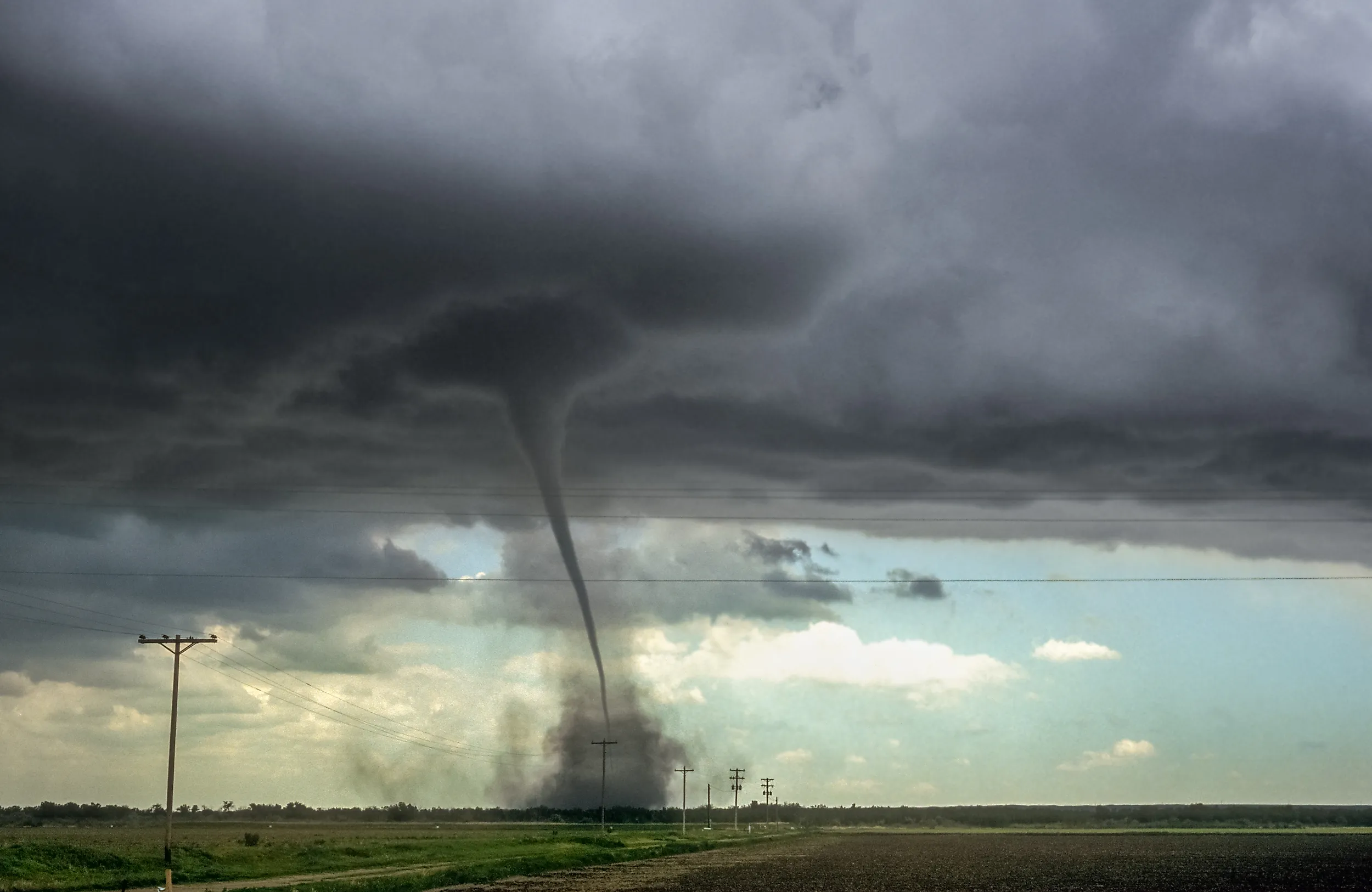
The Counties Hit By The Most Tornadoes
Kansas and Oklahoma get all the tornado hype, and neither one lands a single county in the national top ten. Count up every tornado logged since 1950 and the real leaderboard belongs to Colorado and Florida, with one Texas county crashing the party. A quick caveat before the countdown: a high count flags where tornadoes happen often and get written down, not where they hit hardest, since a county's size, its crowds, and how far you can see across it all pad the numbers as much as the weather does. With that settled, here are the ten counties where twisters touch down most.
10. Elbert County, Colorado

The list opens on the high grassland southeast of Denver, where about 140 tornadoes have been recorded since 1950. Elbert County is ranch and prairie country, home to fewer than 30,000 people spread across a wide stretch of rolling plains, and that emptiness is part of the story. With so few obstacles on the horizon, a funnel dropping over open range gets spotted and logged even when it never touches a building.
Most of what happens here is brief and minor. The worst on record came in June 1990, a storm strong enough to earn a mid-range rating on the damage scale, but the everyday reality is short-lived spin-ups over cattle country. Elbert is a fair introduction to much of this list: a lot of open Colorado ground, a lot of clear sightlines, and a tally that climbs steadily as a result.
9. Hillsborough County, Florida

The first of five Florida counties on the list surrounds Tampa, where roughly 142 tornadoes have been logged since 1950. This is the beginning of a pattern that runs through the whole ranking: Florida does not need the towering supercells of the Plains to rack up big numbers. It gets there with volume instead.
Sea breezes rolling in off the water, afternoon thunderstorms, and the occasional tropical system all spin up tornadoes here, and the storm season stretches across most of the year. The strongest logged in Hillsborough was a mid-scale storm back in 1953. What stands out is not any single event but the sheer frequency, a steady drumbeat of mostly weak tornadoes that a dense, well-populated county reliably notices and reports.
8. Pinellas County, Florida

Just across the bay from Tampa, Pinellas County has about 150 tornadoes on record since 1950, logged from one of the smallest footprints on the entire list. This is the peninsula that holds Clearwater and St. Petersburg, packed tightly between the bay and the Gulf, which makes that total all the more striking.
Pinellas also brings one of the more serious entries in Florida's record. In April 1966, a tornado rated near the top of the damage scale swept through the area, a reminder that the state's long list of minor spin-ups can still include a genuinely violent storm. Where a place like Elbert lands high through open space, Pinellas does it through density, a lot of people in a small area catching nearly everything that forms.
7. Miami-Dade County, Florida

Florida's most populous county has around 150 tornadoes on record since 1950, matching Pinellas despite covering far more ground. Nearly three million people live in Miami-Dade, and that population is central to why the count runs high. In a metro this size, few funnels go unseen.
The tornadoes here tend to be the short, warm-season variety that ride along with thunderstorms or drift in with tropical weather off the Atlantic and the Gulf. The strongest on record struck in June 1959. As with the rest of Florida's entries, the county's place on the list is a story about a long season and a lot of eyes on the sky, rather than the kind of long-track monsters the Plains produce.
6. Polk County, Florida
Inland between Tampa and Orlando, Polk County has about 167 tornadoes on record since 1950, the most of any Florida county except the one still to come. This is citrus and lake country, flatter and more open than the coastal metros, with room for storms to form and be seen.
Polk sits in the path of the same weather that works over the rest of the state, but its interior position gives afternoon thunderstorms plenty of space to develop. The worst logged here was a strong storm in May 1979. The county is a good illustration of how thoroughly Florida dominates this list: five of the top ten counties sit in a single state better known for beaches than for severe weather.
5. Adams County, Colorado

Back to Colorado, and back to the Front Range. Adams County, which extends from the northeastern edge of Denver out onto the plains, has about 177 tornadoes on record since 1950. It sits in the same restless zone as the county that tops this list, where air spilling off the Rockies collides with winds coming up from the southeast.
That collision boundary sets up again and again over this stretch of Colorado, spinning off frequent, mostly weak tornadoes that meteorologists call landspouts. A large population on the county's western side means almost every one gets reported. The strongest on record came in June 1982. Adams is the appetizer for what comes next, the same weather machine on a slightly smaller scale.
4. Palm Beach County, Florida
No county east of the Mississippi outranks Palm Beach, with roughly 195 tornadoes on record since 1950, the most in Florida. It is a total most people would never guess for a place defined in the popular imagination by Atlantic Ocean beaches and winter sun.
The county stretches nearly 2,400 square miles inland from the coast to the farm country around Lake Okeechobee, a wide mix of dense development, wetland, and open field where storms can form and be seen. Most of the tornadoes here have been weak, but not all. In October 1958, a strong tornado carved a path across the region, the most violent in the local record. Palm Beach is the clearest proof of the article's central surprise: the most tornado-logged county in the eastern half of the country sits on the Florida coast.
3. Washington County, Colorado

The third-ranked county in the country is one many people outside the state have never heard of. Washington County, on Colorado's far eastern plains toward the Kansas line, has about 227 tornadoes on record since 1950 while being home to fewer than 5,000 residents. That combination, a huge tally and a tiny population, makes it the purest example of how counting works.
The land here is wide, flat, and nearly treeless, so a storm forming anywhere in the county is visible for miles. A single outbreak can send the total climbing fast. On one day in June 2023, dozens of brief tornadoes touched down across eastern Colorado, most lasting only seconds over open field and causing little harm, yet each one entered the record. The strongest storm logged in Washington County came in July 1993. Nowhere on this list does the gap between "most tornadoes" and "most dangerous" open wider.
2. Harris County, Texas

The runner-up is the only entry that fits the stereotype of tornado country, and even it comes with a twist. Harris County, home to Houston, has around 244 tornadoes on record since 1950, a figure that surprises people because the county is better known for hurricanes and flooding, and because so much of it is pavement and freeway.
Warm, wet air off the Gulf of Mexico is the engine. When a strong system rolls across Texas and taps into that moisture, the storms it fires up can rotate, and southeast Texas produces plenty of them. Nearly five million residents spread across the metro mean almost every touchdown gets reported, so population lifts the count here as surely as it does in Florida.
Harris County also holds the list's clearest case of a city taking a hard hit. On November 21, 1992, a tornado rated near the top of the damage scale tore through Channelview, on the county's east side, the strongest and most destructive tornado in the region's records. It caused roughly $250 million in damage and injured more than a dozen people, though remarkably no one was killed.
1. Weld County, Colorado

No county in the country comes close to Weld. About 291 tornadoes have been recorded here since 1950, and second place is nearly 50 behind. The reason sits just east of where the Rocky Mountains flatten into the plains of northeastern Colorado.
Along that seam, southeasterly surface winds routinely collide with air spilling down off the mountains, and the boundary where they meet tends to set up again and again over this same stretch of ground. The spin it generates produces a parade of weak, short-lived landspout tornadoes, most touching down over open wheat and cattle country, doing little harm and lasting only minutes. Sheer size does the rest, since Weld covers more than 4,000 square miles, an enormous amount of territory for a funnel to drop onto and be seen.
Not every storm here is harmless. In May 2008, a rare, powerful tornado carved a path of nearly 40 miles through Weld and into neighboring Larimer County, tearing apart the town of Windsor, injuring dozens, and killing one person. It remains the costliest tornado in Colorado's history, and a reminder that even a county famous for gentle landspouts can turn dangerous in an afternoon.
What The Ranking Actually Shows
Line the ten up and the old picture of a single tornado corridor falls apart. Four of the top counties sit in Colorado and five in Florida, with Texas the lone name most people would have predicted. Kansas and Oklahoma, the two states practically synonymous with twisters, do not appear at all by this measure.
The explanation is not that the Plains have gone quiet. It is that raw county counts reward a particular set of conditions: large or wide-open counties where storms are easy to see, like Weld, Washington, and Elbert, and densely populated ones where residents catch and report nearly every funnel, like Harris and the Florida five. Colorado's Front Range supplies the first ingredient in bulk, and Florida's long storm season and crowded coast supply the second.
None of that maps neatly onto danger. A tornado count records how many funnels touched down and got written up, not how strong they were or how much they destroyed. The most violent tornadoes in American history struck counties that appear nowhere near this list. What these ten really measure is reach, the plain fact that tornado country runs from the Colorado high plains to the Florida coast, far beyond the narrow alley of the popular imagination.