Where Young Families Are Putting Down Roots In The United States
A family priced out of Raleigh runs the numbers on a three-bedroom house and starts driving east, past the last exit anyone talks about, until the listings finally come back under budget in a town called Zebulon. The same math is playing out around Nashville, Dallas, the Gulf beaches, and the Walmart headquarters in northwest Arkansas. Every town on this list clears two bars: a median home value under the national figure of roughly $411,000, and a concrete reason a young family would actually move there for the long haul, whether that is a new plant hiring, a school district adding buildings, or a job corridor 30 minutes up the interstate.
Remote work widened the search. In March 2026, 22.6 percent of American workers were still doing their jobs from home, so a paycheck no longer has to sit downtown. What follows are ten towns on that outer edge, each one absorbing families who wanted a yard, a good school, and a mortgage they could live with.
Conway, Sout Carolina

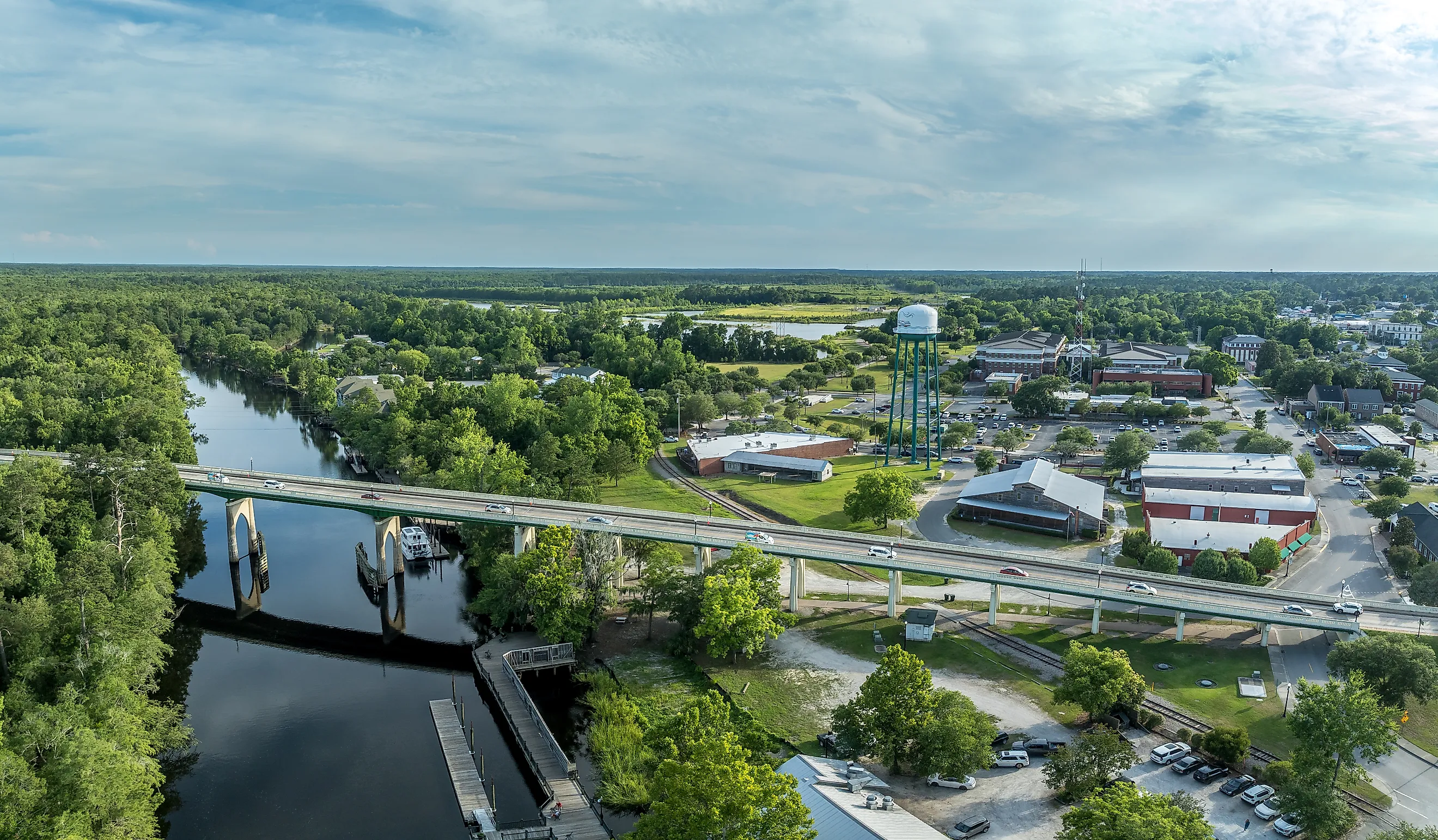
Between July 2024 and July 2025, no state added residents faster than South Carolina, which grew 1.5 percent to about 5.57 million people, mostly on the strength of families arriving from other states. Conway sits about fifteen minutes inland from Myrtle Beach and shows where that Grand Strand growth has been heading once it leaves the coast. The Horry County seat grew 22 percent between 2020 and 2025, from about 25,000 residents to roughly 30,600, and its median home value runs around $285,000, well under the national figure and a fraction of what a place near the sand costs.
The draw is a real town, not a subdivision with a beach nearby. Conway runs on county-seat jobs, a working downtown, and Coastal Carolina University just outside the city, with the wider Myrtle Beach job market a short drive east for anyone who wants it. The Waccamaw River anchors daily life: the Conway Riverwalk follows the water on boardwalk sections that tie into the historic waterfront, and the downtown keeps a full run of restaurants, shops, and old live oaks. New construction on larger lots keeps arriving at prices the beach towns cannot match, which is exactly why families are choosing the inland seat over the shoreline.
Hurricane, West Virginia

Locals say it hur-uh-kin, stress on the first syllable, and getting that right is the first test of whether you actually live in this Putnam County town along Interstate 64. Roughly equidistant from Charleston and Huntington at 22 to 30 miles each way, Hurricane offers the quiet version of everything else on this list: a median home value near $210,000, about half the national number. The city itself has held steady near 6,900 residents since the 2020 census, but the housing demand is showing up all around it, along the I-64 corridor through Putnam County, on the back of a strong school district and jobs in two nearby cities. New subdivisions tell the story, including the Woodworth Farm community with more than 400 homes planned near town.
The safety numbers are the quiet draw. CrimeGrade gives Hurricane an A-minus for violent crime, about 2 offenses per 1,000 residents, with the northwest side of town reporting roughly one case a year. Downtown Main Street has been revitalized into a run of shops and restaurants, and an ADA-accessible sidewalk now under construction will tie it to the growing Hurricane Bridge Park, where an amphitheater for concerts and performances is planned. The rest of a family's week runs through the town parks, with fishing, playgrounds, and a wave pool.
Angier, North Carolina

The Research Triangle's growth spilled south out of Wake County years ago, and Angier is where a lot of it landed. The town sits near the Wake-Harnett line and grew from 8,284 residents in 2024 to 9,410 in 2025, which made it the third-fastest-growing municipality in North Carolina that year, behind only Wendell and Zebulon. Its typical home value runs around $322,000, comfortably under the national figure and a real discount against the closer-in Triangle suburbs. That gap is the whole draw: buyers priced out of Apex or Fuquay-Varina can still get a new house here.
What makes Angier work for a family is access without the price. N.C. 55 runs a direct route toward Fuquay-Varina, Apex, and the fast-growing job and retail areas of southern Wake County, and northern Harnett County has grown enough that local officials are already discussing new transit along the Angier-Lillington-Coats corridor. Builders keep adding subdivisions for households who want the Triangle's paychecks without the Triangle's mortgages. The old downtown, marked by the Angier Town Clock, anchors a small-town center that the new arrivals are still filling in.
Princeton, Texas

Princeton led the entire country in growth in 2024 and was still third nationally in 2025, and the reason is one number. The typical Princeton home runs about $325,000, against more than $500,000 in nearby McKinney and $685,000 in Frisco, a price gap wide enough to move a household's whole decision. The Collin County exurb northeast of Dallas has more than doubled since the 2020 census, when about 17,000 people lived there, and most of the new arrivals are coming from elsewhere in the county and the wider Dallas-Fort Worth metro.
This is a working family's play, not a luxury one. The land along Highway 380 that used to be farm and open field is now a network of master-planned subdivisions feeding the Collin County job corridor, and the school enrollment has climbed alongside the rooftops. New residential communities keep breaking ground because the affordability gap between Princeton and the closer-in suburbs has held. For a family that needs DFW's paychecks but cannot clear a McKinney mortgage, Princeton is the math working out.
Foley, Alabama

Foley is the beach town you can afford, sitting about 12 miles inland from Gulf Shores with a median home value around $328,000, under the national figure and a fraction of what shoreline property costs. The city passed 30,000 residents after growing roughly 8 percent between 2024 and 2025, and it works as the commercial center for much of southern Baldwin County. Families here reach South Baldwin Regional Medical Center, major supermarkets, Tanger Outlets, and a growing restaurant corridor along Highway 59 without fighting beachfront congestion.
The draw for parents is that Foley is built for staying, not just visiting. Developers put an amusement park, an indoor water park, a hotel, and an entertainment district at OWA Parks and Resort on the city's east side, and the Foley Sports Tourism Complex runs youth tournaments through the year. Gulf Shores is close enough for a regular beach afternoon and far enough that daily life stays in the subdivisions rather than the hotel strips. The growth here reflects both the tourism jobs and steady demand for full-time housing a few miles back from the water.
Loxley, Alabama

Where Interstate 10 crosses Alabama Highway 59, warehouses have gone up almost overnight, and that junction is the whole reason Loxley grew faster than any other town on the Gulf Coast list, roughly 19 percent in a single year. The median home value runs in the low $300,000s, under the national figure, on land that stays cheaper than anything closer to the shore. From the interchange a worker can reach Mobile to the west, Pensacola to the east, and the Gulf Shores beaches to the south, which is why distribution centers and the jobs that come with them keep landing here.
For a young family, Loxley is an inland base with a paycheck attached and the coast still within reach on a day off. The Baldwin County schools serve the town and earn an A-minus on Niche across a district of more than 31,000 students. New subdivisions are filling in around the older core, and each spring the Baldwin County Strawberry Festival packs Loxley Municipal Park with tens of thousands of visitors. It is a working town first, the kind of place people move to for the job and stay for the room to grow.
Centerton, Arkansas

Centerton had 491 people in 1990. It has more than 27,000 now, up more than 50 percent in five years, and for several years running it has been the fastest-growing city in Arkansas among places its size, most of that growth coming from families. The reason is five miles east: Bentonville, headquarters of Walmart and the center of the whole northwest-Arkansas boom. Bentonville's school district, widely rated the state's best, reaches into Centerton, where Bentonville West High already sits.
The pull is the same affordability gap that shows up in Texas and North Carolina. Centerton's median home value runs around $338,000, under the national figure and well below Bentonville's roughly $485,000, so a Walmart or supplier-network family gets the same schools and the same commute for a smaller mortgage. What Centerton does not have yet is a downtown; the old Main Street is thin. The city is trying to fix that with a planned 400-acre Town Center district and a recreation center still on the drawing board. For now, families make do with the parks, which have playgrounds, splash pads, walking trails, a BMX track, and fishing.
North Port, Florida

North Port is the answer to southwest Florida's beach prices: a family gets the region without paying for a waterfront address. The city sprawls across more than 100 square miles, which leaves far more room for new subdivisions than older, hemmed-in Gulf Coast cities like Sarasota or Venice, and that room keeps the median home value in the mid-$300,000s, under the national number. The population grew about 4 percent between 2024 and 2025, and Sarasota County as a whole took in more than 6,000 residents through domestic migration.
Interstate 75 runs across the north side of town, which puts both Sarasota and Fort Myers within regional commuting range, so a household can chase southwest Florida jobs from a house it can actually afford. New construction continues around Price Boulevard and Toledo Blade Boulevard, mostly single-family homes on former platted lots. There is a lifestyle sweetener too: Warm Mineral Springs, the naturally heated pool that stays near 85 degrees year-round, is one of the town's best-known spots. Buyers come for the available housing and the access, not the beachfront.
Jarrell, Texas

Jarrell is the outermost edge of the Austin metro, and it has more than tripled in size since the 2020 census, when just 1,753 people lived there. The town sits on I-35 in Williamson County, 17 miles north of Georgetown and 44 miles from downtown Austin, which is the exact distance where Austin-area prices finally break: the median home value here is about $346,300, roughly 32 percent below the median in Leander and under the national figure. Travis County sends the largest share of newcomers, families trading a shorter commute for a house they can own.
The clearest sign of who is moving to Jarrell is in the schools. Jarrell Independent School District enrollment has jumped 96 percent since the 2018-2019 year, and the district projects it will double again over the next five years, which is not a retiree pattern. New subdivisions keep getting approved along Ronald Reagan Boulevard, and the median household income of about $111,000 tracks the professional families streaming out of the Austin core. Jarrell is a bet that the metro's edge keeps moving north, and so far the bet is paying.
Zebulon, North Carolina

Zebulon calls itself "The Town of Friendly People," and for a decade it has been one of the fastest-growing places in North Carolina, which is a strange thing to stay friendly through. The 2020 census counted about 6,900 residents; the Census Bureau's 2025 estimate puts the town near 11,900, a jump of more than 70 percent in five years, much of it families with school-age kids. Its median home value runs around $362,000, still under the national figure. The draw is the same one that built the whole eastern edge of Wake County: Zebulon belongs to the Raleigh-Durham Research Triangle, close enough for a commute of around half an hour, far enough to still afford the house. GlaxoSmithKline, US Foods, and other large employers keep offices in or near town for anyone who would rather skip the drive.
Families sorting through the schools find three well-rated public elementaries and a middle school in Zebulon, plus East Wake Academy, a K-12 charter; most high schoolers head to East Wake High in neighboring Wendell. The historic downtown along Arendell Avenue still has a full run of storefronts, and one of them is genuinely one of a kind: Olde Raleigh Distillery shares space with MacLellan Bagpipes, the only bagpipe maker on the continent. Six town parks handle the rest of a kid's week, including disc golf at Zebulon Community Park, and the Community Center packs an open gym, two fitness rooms, two activity rooms, and an art room under one roof.
The Edge Keeps Moving
Line these ten towns up and the pattern is hard to miss: none is a destination in its own right, and every one is the current outer edge of somebody's metro, the place where prices in a bigger city finally ease enough that a family can trade a longer commute for a yard and a school they chose on purpose. Conway catches the Grand Strand's inland spillover, Angier and Zebulon the Research Triangle's, Princeton and Jarrell the runoff from Dallas and Austin, Centerton the families priced out of Bentonville. Foley and Loxley and North Port are the same trade with the Gulf a few miles off. That edge does not stay put. The families arriving today are the ones bidding up the next median home value, and a decade from now those same buyers will be searching another ring out, in towns nobody is writing about yet.