8 Croatia Towns With Unforgettable Main Streets
Croatian historic towns rarely follow the wide-boulevard pattern of newer European cities. Instead, the social and commercial heart of each town runs through a single limestone-paved spine that locals know variously as a stradun, korzo, placa, or central trg. These corridors evolved over centuries of Venetian, Habsburg, and Slavic influence, and they remain the spaces where residents pass through several times a day for coffee, errands, and conversation. In Dubrovnik's Placa, visitors can see the 15th-century Onofrio Fountain in action and one of the oldest continuously operating pharmacies in Europe. Skradin's main street begins at the harbor and feeds directly into the boats that take visitors up the Krka River to the country's most photographed waterfall system. These are two of the eight Croatian towns covered below, each one's main street rewarding the kind of walk that takes you down it twice: once in daylight, once at dusk.
Dubrovnik

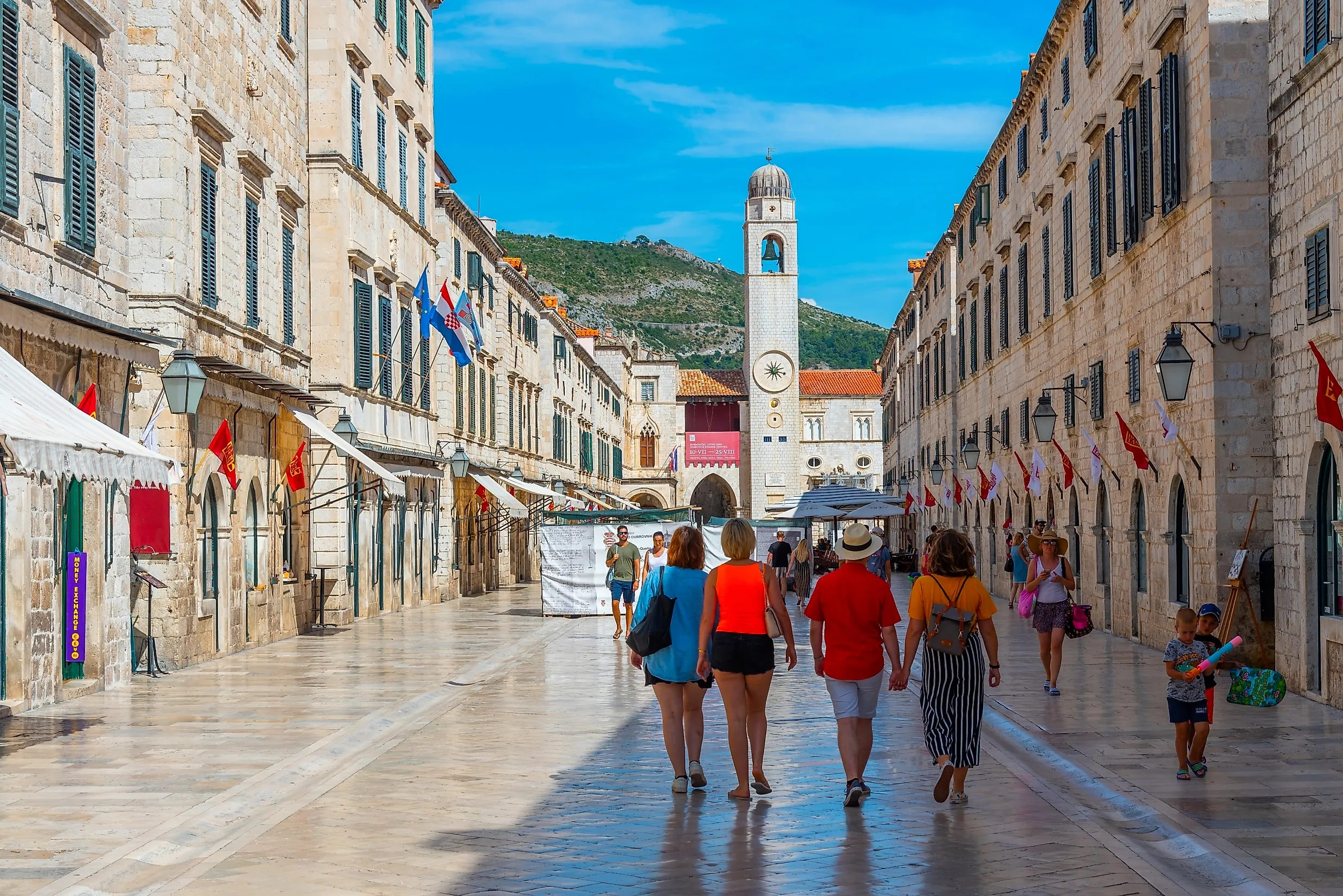
Dubrovnik sits on the southern Dalmatian coast about 370 miles south of Zagreb. The Stradun, officially called Placa, runs the length of the Old Town for roughly 300 meters between the Pile Gate at the western end and the Ploče Gate to the east. The street was paved in limestone in 1468, and the surface has been worn smooth by foot traffic ever since. The current uniform width and unbroken straightness date to the 1667 reconstruction that followed a catastrophic earthquake.
Visitors usually start at the Onofrio Fountain just inside Pile Gate, a circular stone fountain completed in 1438 as part of an aqueduct system that still delivers fresh water from the Dubrovačka River. A short walk east, the Franciscan Monastery preserves what is widely considered the oldest continuously operating pharmacy in Europe, established in 1317 and still dispensing medicines and traditional creams from its original counter. At the eastern end, Sponza Palace combines Gothic and Renaissance elements in a 1522 building that now houses the Dubrovnik State Archives. The Stradun's daily rhythm peaks during the early evening passeggiata, when most of the Old Town's residents and visitors walk the length of the street between dinner and a final coffee.
Trogir

Trogir's roughly 13,000 residents live across a small island connected to the mainland by a short bridge, with the Old Town spread across a UNESCO-listed grid of medieval streets and stone buildings about 17 miles west of Split. The town's main social spine is the Riva, the harborfront promenade lined with palms and cafes that runs along the southern edge of the Old Town facing the channel toward Čiovo Island.
A walking tour usually starts where the Riva meets the Land Gate, an arched 17th-century portal that leads into the historic core. A few steps inside, the Cathedral of St. Lawrence rises over the central square with its 13th-century Romanesque portal carved by the master sculptor Radovan in 1240, considered one of the finest stone carvings in medieval Europe. Across the square, the Cipiko Palace, built for one of Trogir's most prominent Renaissance families, hosts cultural exhibitions behind an ornate stone facade. Back on the Riva, the Kamerlengo Fortress at the western end of the promenade was completed by the Venetians in 1437 and now serves as an open-air venue for the Trogir summer festival.
Šibenik

In central Dalmatia at the mouth of the Krka River, Šibenik holds a UNESCO-listed historic core organized around several connected stone-paved streets and squares. The most prominent is Kalelarga (Long Street), the medieval main artery that runs roughly parallel to the harbor and remains the town's everyday commercial spine.
The Cathedral of St. James stands at the center of the historic core, completed in 1536 as one of the most ambitious construction projects of the Adriatic Renaissance, with the entire structure assembled from stone slabs without mortar or wooden frame elements. The cathedral's exterior includes a frieze of 71 carved stone heads ringing the apse, depicting men, women, and children believed to be 15th-century residents and notables of the area, the work of master architect Juraj Dalmatinac. A short walk from the cathedral, the Šibenik City Museum occupies the 14th-century Prince's Palace and preserves the region's archaeological collection. Higher up the slope, St. Michael's Fortress reopened in 2014 after a major restoration and now hosts summer concerts on its open-air stage with views across the harbor.
Korčula Town

On the eastern end of Korčula Island in the southern Dalmatian archipelago, Korčula Town is a fortified peninsula known for its preserved medieval street plan. The Old Town follows a fishbone pattern, with the central spine running from the Land Gate at the southern end to St. Mark's Cathedral and the harbor at the northern tip, and side streets angled deliberately to break the prevailing wind.
The Land Gate, also called the Revelin Tower, served as the main fortified entrance and now houses a small museum of weapons and traditional textiles. Just inside, St. Mark's Cathedral occupies the central square and was completed across the 14th to 16th centuries in a mix of Gothic and Renaissance styles. The Marco Polo House, claimed by Korčula as the explorer's birthplace, sits a short walk from the cathedral and operates as a small exhibition space. For evening visitors, the Moreška sword dance, a Venetian-era folk performance reenacting a battle between Christian and Moorish forces, runs Monday and Thursday evenings during summer at the open-air stage near the Land Gate.
Rovinj

Rovinj sits on a former island in northwestern Istria, connected to the mainland by a 1763 land-bridge fill that left the medieval Old Town tightly packed across a narrow peninsula. The historic spine is Grisia, a steep cobbled lane that runs from the harborfront up to the Church of St. Euphemia at the peninsula's highest point, with side streets branching off toward residential quarters.
The walk usually begins at the harbor and follows Grisia upward through a corridor of art galleries that have lined the street since the 1960s, when local artists began hanging their work directly on the building walls. Each year on the second Sunday in August, the street hosts a one-day open-air art exhibition that has run since 1967. At the top of the climb, the Church of St. Euphemia stands above the town with a 60-meter Venetian-style bell tower modeled on the campanile of St. Mark's in Venice. The church's interior preserves the relics of St. Euphemia herself, said to have arrived by sea in a stone sarcophagus in the year 800.
Motovun

The hilltop town of Motovun rises 277 meters above the Mirna River valley in central Istria, with a section of its residents living inside the medieval walls and another across the surrounding municipality. The town's main street climbs in a tight spiral from the lower town gate to the central square at the summit, lined with stone houses that have stood largely unchanged since Venetian rule.
The climb itself is the entry experience, passing through three sets of fortified gates dating from the 14th and 15th centuries before ending at the central Andrea Antico Square. The Church of St. Stephen, completed in 1614 in late Renaissance style, occupies the western edge of the square. The town's medieval ramparts run continuously around the summit and form one of the best-preserved fortified perimeters in Istria. The Motovun Film Festival, held each July since 1999, transforms the square and surrounding streets into open-air cinema venues for five days of independent and Eastern European film programming.
Varaždin

In northern Croatia about 50 miles north of Zagreb, Varaždin stands as the country's most thoroughly preserved baroque town. The Drava River flows just north of the city, and the surrounding Podravina region takes its name from the river's broad floodplain. The historic core centers on the Korzo, a pedestrianized stretch of Pavlinska and Gundulićeva streets where 18th-century townhouses have been converted to cafes, bookshops, and art galleries.
Trg Kralja Tomislava sits at the center of the route, with the Town Hall operating continuously from the same building since 1523, making it one of the longest-running municipal seats in continental Europe. A short walk west, the Old Town fortress (Stari Grad) preserves a 12th-century defensive complex now operating as the Varaždin City Museum, with displays covering the region's medieval and baroque history. Back along the Korzo, the Cathedral of the Assumption combines a 17th-century Jesuit interior with one of Croatia's finest baroque organs, used regularly during the annual Špancirfest street festival each late August. The festival draws large crowds across ten days and converts the entire historic core into an open-air performance space.
Skradin

About 11 miles inland from the Adriatic at the southern entrance to Krka National Park, Skradin is a small harbor town that has served as the gateway to the park since its 1985 designation. The main street, Bribirskih Knezova, runs from the harborfront uphill to the parish church and forms the town's commercial spine.
The harbor anchors the daily flow, with the Krka National Park boat dock operating as the staging point for trips upriver to Skradinski Buk, a series of 17 travertine waterfalls that drop a total of 45.7 meters along an 800-meter stretch of the river and rank as the park's most photographed feature. The same boat route continues further upriver to Visovac Island, a small wooded islet rising from the middle of Lake Visovac where Franciscan monks founded the Visovac Monastery in 1445. The monastery preserves a rare-manuscript library and remains accessible only by water, which has kept the site quieter than the main waterfall route. Back in town, the Skradin Heritage Museum preserves regional artifacts in a restored 19th-century stone building, and along the main street Konoba Toni and Restaurant Skradinski Buk serve traditional Dalmatian fare including Skradinski rižot, a slow-cooked beef-and-rice dish that simmers for over six hours and ranks as one of the most distinctive regional preparations in Croatia.
A Slow Walk Through Croatia
The eight towns share a structural feature uncommon in much of Europe: a single street or square that genuinely operates as the town's social heart rather than a tourist showpiece. Coffee, errands, the after-work walk, and most casual conversations happen along the same limestone-paved spine that visitors photograph during the day. Travelers who want to understand how these towns actually function should aim for the early evening hours, when the passeggiata tradition turns each main street into a slow-moving river of residents on foot, and the surrounding stone holds the murmur of Croatian, Italian, and German conversations carried on by people who live within a few blocks of where they walk.