7 Must-See Historic Forts In Illinois
For centuries, Illinois has been full of opportunities partly due to its rich land and location on major rivers. French settlers and British settlers as well as the original Native American inhabitants of the region have all staked claims to the land that makes up this state. Those competing interests sometimes created conflicts. Several of Illinois's historic forts were built by settlers for protection during the Black Hawk War. Others played a role in the American Civil War. Still others simply served as shelters. Today accurate reproductions of several forts and preserved sites with historical markers present visitors with some of Illinois's rich military history.
Fort Crevecoeur

This fort on Peoria Lake in central Illinois has the distinction of being the first fort built by the French in what is now Illinois territory. French explorer René-Robert Cavelier, Sieur de La Salle, built the fort in 1680 to protect the local Peoria people from the Iroquois. Like other forts in Illinois, it also served as a trading center. Shortly after construction, La Salle departed to continue his explorations along the Mississippi River. The militia he left in charge of the fort ended up ransacking and destroying it. A replica of Fort Crevecoeur has been built on the site using the original designs and dimensions. There is also a museum and trails around the site.
Fort de Chartres

French colonizers first constructed this fort in the 1720s in southwestern Illinois next to the Mississippi River. They used it as a base for their colonial government and military. It included a powder magazine room to hold military weapons and ammunition. The British took over the territory and fort in 1763 at the end of the Seven Years' War. In 1772, the river destroyed part of the fort, and much of the rest deteriorated over the next several decades. Reconstruction began in the early twentieth century, and visitors today can see the reimagined fort, which incorporates some of the original foundations. One highlight is the restored powder magazine, which retains original masonry sections, making Fort de Chartres home to one of the oldest buildings in the state.
Fort Kaskaskia

This was another fort built by the French in southwestern Illinois. The town of Kaskaskia was founded in 1703, and the fort was constructed around 1759 for the general defense of the town. It had only three rooms and a partially completed kitchen. Both French and US troops inhabited the fort intermittently, and it sometimes served as a haven for settlers who sought to avoid ongoing conflict with Native American tribes. In the late 1800s, the Mississippi flooded and changed course, cutting through a portion of the town and bringing a chapter of the village's history to an end. Visitors today can see remnants of the fort, including some original foundations and support beams. Garrison Hill Cemetery on site holds the graves of early settlers. Self-guided tours allow visitors to read panels of the village's history and step onto the overlook of the Mississippi River.
Apple River Fort

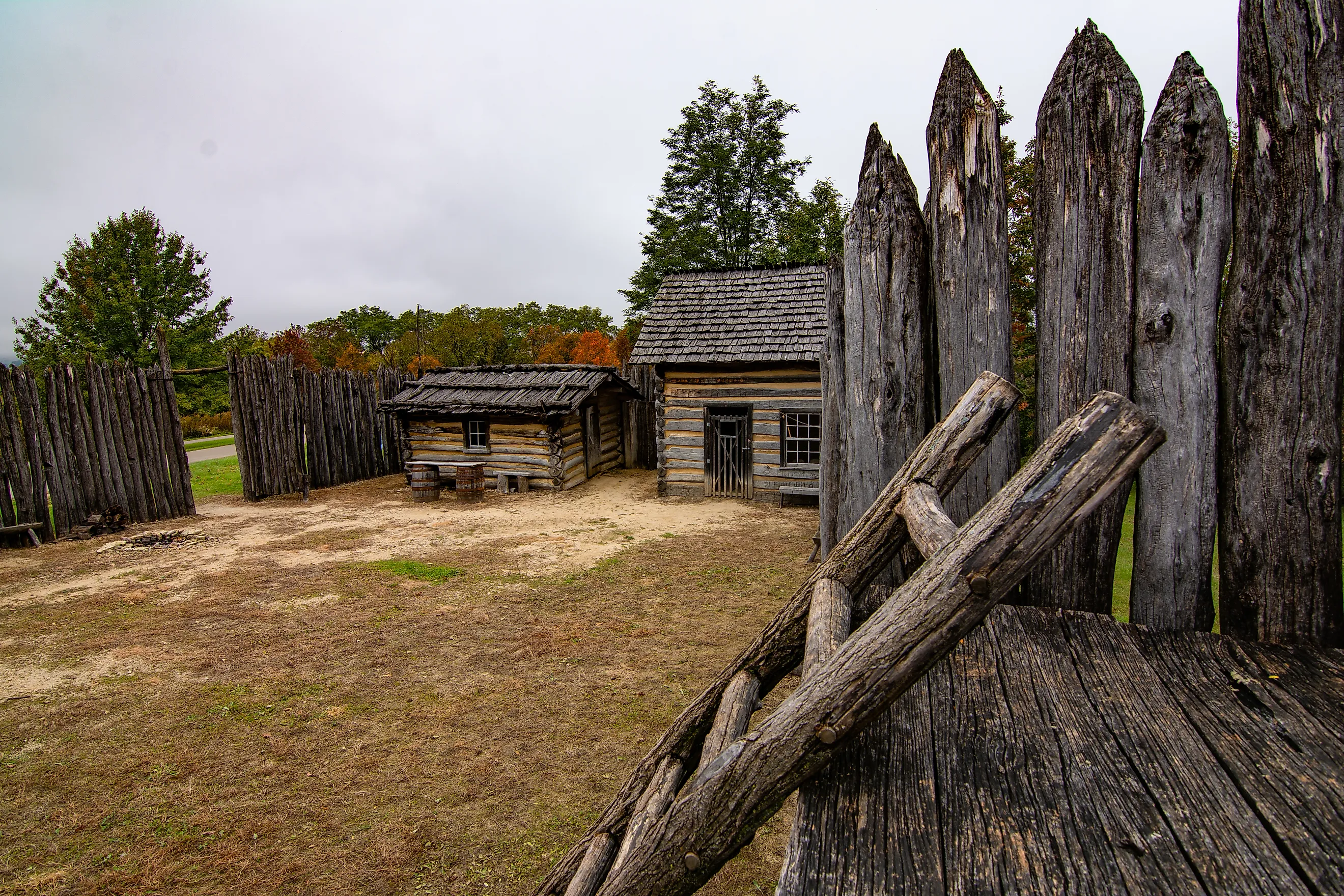
This fort was built among cabins at the Apple River Settlement in northwestern Illinois. Sauk war chief Black Hawk began advancing with members of the Sauk and Meskwaki tribes in April 1832, hoping to retrieve land they had previously ceded to the US in 1804. The Illinois governor began calling for the state militia, and the fort was hastily built by May. During the Black Hawk War on June 24, 1832, after a battle of about forty-five minutes, the men and women in the fort were able to repel Black Hawk and his roughly 200 warriors, who then withdrew. This was the only fort Black Hawk attacked during the war. The fort was torn down around fifteen years later. Today a reproduction of Apple River Fort stands near the original site. Exhibits around the area display some artifacts found at the site and tell the history of the tribes, the settlers, and their conflicts.
Fort St. Louis du Rocher

This fort once stood on the top of what is known today as Starved Rock in Starved Rock State Park in north central Illinois. It gets its name from rocher, which means "rock" in French. Construction began in the winter of 1682 under La Salle's direction, with work led by his second-in-command Henri Tonti, and was completed by 1683. For about a decade, it served as a place for both trading and administration. The French traded goods with the Native Americans and conducted diplomatic relations with the tribes there. The fort had living quarters, a powder magazine, and a chapel. It remained a popular trading post but was abandoned in 1691, as trading ceased when the tribes relocated elsewhere. Today, a historical marker at the bluff's base explains the history. There are no remains of Fort St. Louis du Rocher, but visitors can read the history and take in the views that the French and Native Americans saw atop the high cliff.
Fort Armstrong

Fort Armstrong sat on Rock Island in northwestern Illinois, in the Mississippi River between the Illinois and Iowa borders. Starting in 1804, when the Sauk and Meskwaki no longer supported the treaty under which they had surrendered their land, tensions arose in 1814 between the tribes, led by Black Hawk, and the US. The US Army built Fort Armstrong on Rock Island in 1816 to maintain peace and protect settlers. It served as a major station for the military during the 1832 Black Hawk War. In 1836, the Army no longer needed it, but the US government used it for storage. The fort was taken down in 1863 when the Rock Island Arsenal was built instead. A reconstruction of Fort Armstrong stands on the island today, along with the Rock Island Arsenal Museum, which shares the island's history and exhibits more than a thousand weapons.
Fort Defiance

The Fort Defiance site lies on the southern tip of Illinois, where the Ohio River and the Mississippi River meet. The site is part of the Lewis and Clark National Historic Trail. Here in 1803 is where Lewis and Clark trained members of their US Army unit in navigation before setting off to investigate the land that had recently been secured by the US. The site was also a military post during the American Civil War known as Camp Defiance. Although the remains of any fort have vanished, historical markers explain the history, and an observation tower offers views of what made the river confluence so significant and strategic to General Grant's Union troops during the Civil War.
Structures and Sites That Give a Glimpse into History
These were not the only forts that existed in Illinois during the past few hundred years. Several others are gone without even a replica to remember them by. Settlers of different nationalities took part in shaping the state and giving it history. Today, residents and visitors are fortunate to view historic fort sites in Illinois, where the earlier settlers and their significant events can still be remembered.