The Best College Town In Texas
Austin runs the best college town in Texas on the strength of one institution and a city built around it. The University of Texas at Austin counts Nobel, Pulitzer, and National Medal of Science honorees among its faculty and alumni. Bass Concert Hall seats 2,900 a few minutes' walk from the lecture halls. Beyond the campus gates, McKinney Falls State Park puts swimming holes inside city limits, more than 200 live music venues sit downtown, and SXSW takes the streets each March. The result is a college town where the academic calendar and the cultural calendar run on the same wavelength.
Why Austin is the Best College Town in Texas

UT Austin is one of the country's top public research universities, with a 441-acre main campus and more than 50,000 students. Its engineering and computer science graduate programs rank in the national top 10, and a number of natural-science specialties land at similar levels. The Blanton Museum of Art on campus is one of the largest university art museums in the United States, with collections spanning European, American, and Latin American work. Its centerpiece is Austin (2018), a stone-and-glass building Ellsworth Kelly designed at the end of his life and the only freestanding building he ever completed.

UT runs major research operations across science, medicine, engineering, and the humanities, and its faculty and alumni count Nobel laureates, Pulitzer Prize winners, and National Medal of Science recipients in their ranks. The Texas Advanced Computing Center on campus operates some of the most powerful academic supercomputers in the world.
College Life

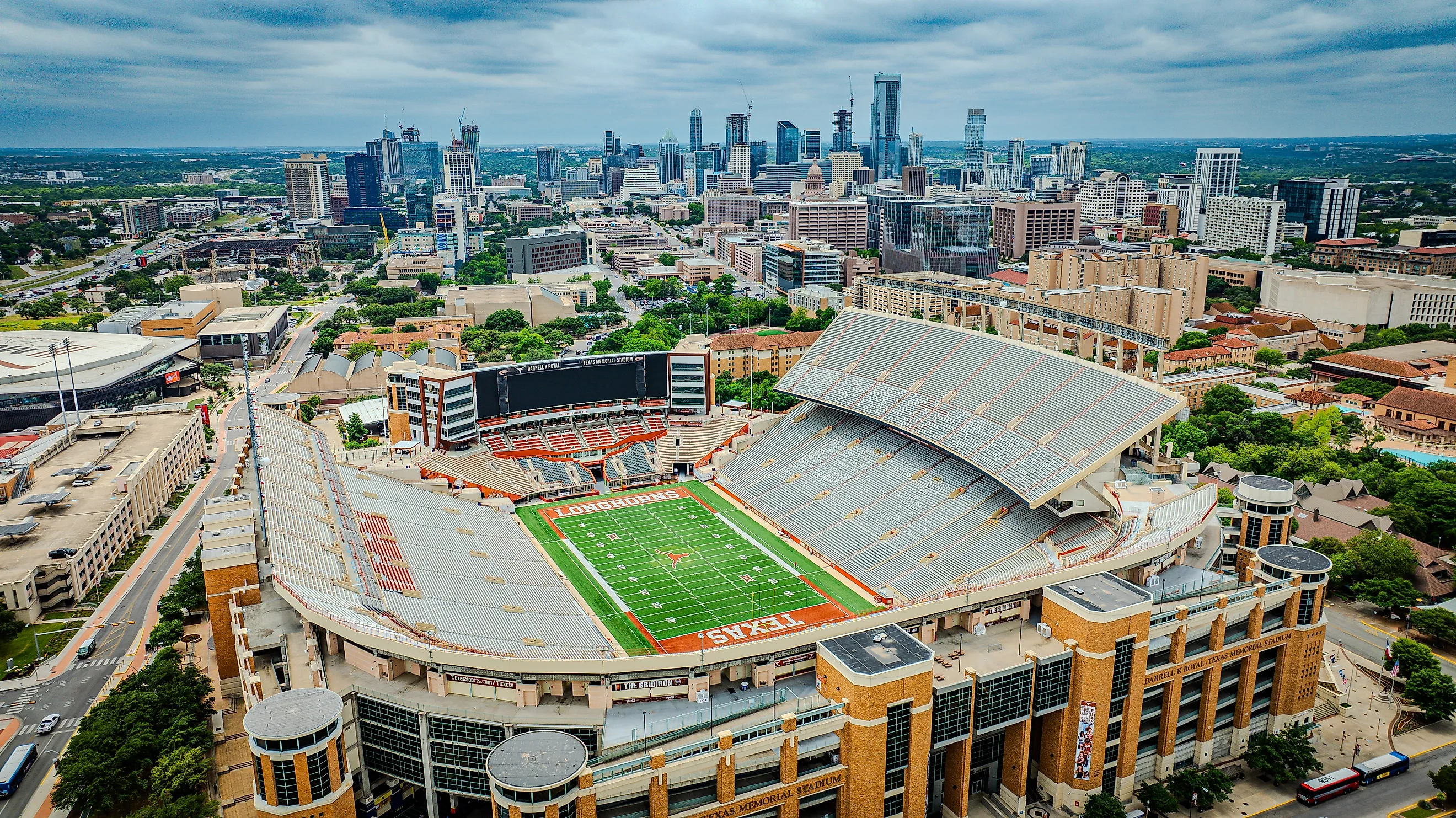
UT Austin supports more than 1,000 student organizations, from professional societies and academic clubs to fraternities and sororities. The campus calendar runs film screenings at the Texas Union, concerts in the West Mall, and Longhorn football at Darrell K Royal-Texas Memorial Stadium, which holds more than 100,000 fans on game day.
Bass Concert Hall is the largest theatre in Austin, seating 2,900, and serves as the main stage for Texas Performing Arts. A $14.7 million renovation completed in 2007 added a glass-front entrance, an expanded lobby, and acoustic upgrades. Broadway tours, classical concerts, and visiting productions all stop here.
UT also drives a meaningful share of the regional economy, generating billions of dollars in annual impact, supporting tens of thousands of jobs across the state, and pulling in research funding that runs into the hundreds of millions per year.
Community Impact

Public engagement is built into UT's mission, with programs that run from the campus into Austin neighborhoods, across Texas, and overseas. The university partners with community organizations including the Amala Foundation (youth leadership and restorative practices), CommUnityCare (a Central Texas community health network), and El Futuro (mental health services for Latino communities). These collaborations support research, outreach, and direct services in public health, youth development, and social well-being.
Cultural and Recreational Attractions

Austin runs on a mix of culture, technology, and outdoor access. McKinney Falls State Park sits about 13 miles southeast of campus, with Onion Creek cutting through limestone for hiking, swimming, and camping inside city limits. Barton Springs Pool, a few minutes from downtown, holds a 68-degree spring-fed swim hole open year-round.
The city is internationally recognized for live music, with more than 200 venues hosting performances across country, blues, rock, jazz, and indie. The Broken Spoke is a working dancehall on South Lamar that has been booking country and swing nights since 1964. The Paramount Theatre on Congress Avenue, opened in 1915, runs live music, classic film series, and comedy in a restored auditorium.

Downtown is the center of the nightlife. Sixth Street holds the densest cluster of bars and music venues, the Red River Cultural District a few blocks east runs more live music in smaller rooms, and the Warehouse District, Seaholm District, and Rock Rose at The Domain spread the dining and nightlife across the city.
SXSW lands in Austin every March and brings filmmakers, musicians, technologists, and entrepreneurs from across the world for about a week of panels, screenings, and showcases (March 12-18 in 2026). The festival started in 1987 with a few hundred attendees and now anchors the city's identity as a creative and tech hub.
The Academic and Cultural Epicenter of Texas

There is more here than the campus and the headliners. At sunset, the Congress Avenue Bridge fills the sky with the largest urban bat colony in the world: an estimated 1.5 million Mexican free-tailed bats stream out over Lady Bird Lake from spring through fall, and the emergence runs up to 45 minutes. Crowds gather on the bridge, on the lawn at the Statesman Bat Observation Area, and in kayaks below.
Live music is the next stop. The Continental Club on South Congress is a 1955 venue with a red door, a black interior, and a regular calendar where Stevie Ray Vaughan held a residency from 1980 to 1983 with Double Trouble. The Firehouse Lounge sits behind a hidden bookshelf door inside Austin's oldest standing fire station, built in 1885 and now operating as a hostel above the bar. The lounge runs prohibition-era cocktails and a low-volume jazz and blues calendar most nights.

Austin holds the trademark "Live Music Capital of the World," a top-ranked public research university, and a downtown that runs through historic dancehalls, hidden speakeasies, and a bridge full of bats. UT Austin gives the city its academic core; the live-music scene, SXSW, and the surrounding parks give it the rest. For four years of college, that is a hard combination to beat in Texas.
Austin runs the best college town in Texas on the strength of one institution and a city built around it. The University of Texas at Austin is one of the country's top public research universities, with more than 50,000 students and faculty and alumni who count Nobel laureates, Pulitzer Prize winners, and National Medal of Science recipients in their ranks. Bass Concert Hall seats more than 2,900 a few minutes' walk from the lecture halls. Beyond the campus gates, McKinney Falls State Park puts swimming holes inside city limits, more than 200 live music venues sit downtown, and SXSW takes over the streets each March. The result is a college town where the academic calendar and the cultural calendar run on the same wavelength.
The University
UT Austin's main campus covers 441 acres just north of the Texas State Capitol. The university's engineering and computer science graduate programs rank in the national top 10, and a number of natural-science specialties land at similar levels. The Texas Advanced Computing Center on campus runs Frontera and Stampede3, two of the most powerful academic supercomputers in the world. The Harry Ransom Center on the West Mall holds the only complete Gutenberg Bible in Texas, plus literary archives for James Joyce, David Foster Wallace, and Gabriel García Márquez among hundreds of others.
The Blanton Museum of Art on the south edge of campus is one of the largest university art museums in the country, with collections spanning European, American, and Latin American work. Its centerpiece is Austin (2018), a stone-and-glass building Ellsworth Kelly designed at the end of his life and the only freestanding building he ever completed.
Campus Life
UT Austin supports more than 1,300 registered student organizations, including over 60 fraternities and sororities. Darrell K Royal-Texas Memorial Stadium holds 100,119 fans on Longhorn football Saturdays and is the largest stadium in the Big 12. The Tower (the 307-foot Main Building, completed in 1937) lights up burnt orange after major Longhorn wins, with a special "all-orange" lighting reserved for national championships.
Bass Concert Hall, the largest theater in Austin, runs Texas Performing Arts programming with 2,926 seats and a 2007 renovation that added an expanded lobby and acoustic upgrades. Touring Broadway productions, classical concerts, and visiting opera and dance companies all stop here. The Cactus Cafe inside the Texas Union, run by the university since 1979, is a 145-seat singer-songwriter listening room where Lyle Lovett, Suzanne Vega, and Lucinda Williams have all played early-career sets.
Outdoor Access from Campus
Austin is one of the few major college towns where students can be on a serious trail or in a swimming hole within 15 minutes of leaving the dorm. McKinney Falls State Park sits about 13 miles southeast of campus, with Onion Creek cutting through limestone for hiking, swimming, and camping inside city limits. Barton Springs Pool, two miles south of the UT Tower, holds a 68-degree spring-fed swim hole that runs year-round and has been the city's outdoor public bath since 1917.
The Ann and Roy Butler Hike-and-Bike Trail loops 10 miles around Lady Bird Lake on the Colorado River, passing within walking distance of the Frank Erwin Center site and the Long Center. The trail connects to a 30-mile network of urban paths that lets bike commuters reach campus from most parts of the city without crossing major arterials.
Beyond Campus
Austin holds the trademark "Live Music Capital of the World" with more than 200 venues running calendars across country, blues, rock, jazz, and indie. The Broken Spoke is a working dancehall on South Lamar that has booked country and swing nights since 1964. The Continental Club on South Congress is a 1955 venue where Stevie Ray Vaughan ran a regular Tuesday-night residency from 1980 to 1983 with Double Trouble. The Paramount Theatre on Congress Avenue, opened in 1915, runs live music, classic film series, and comedy in a restored auditorium. Sixth Street, three blocks north of campus, holds the densest cluster of student-friendly bars and music venues.
SXSW lands in Austin every March and brings filmmakers, musicians, technologists, and entrepreneurs from across the world for about a week of panels, screenings, and showcases. The festival started in 1987 with a few hundred attendees and now anchors the city's identity as a creative and tech hub. UT students get reduced-rate access to many sessions and screenings, and several panels are held in campus venues.
One more for the campus-life list: at sunset from spring through fall, the Congress Avenue Bridge fills the sky with the largest urban bat colony in North America, an estimated 1.5 million Mexican free-tailed bats streaming out over Lady Bird Lake. The emergence runs up to 45 minutes, and crowds gather on the bridge, on the lawn at the Statesman Bat Observation Area, and in kayaks below. The bridge is about a mile and a half south of the UT Tower, an easy ride on a bike or scooter.
UT Austin gives the city its academic core, the live-music scene and SXSW give it the rest, and the parks and trails put the outdoors within a short ride of any dorm. For four years of college, that combination is hard to beat in Texas.