The 10 Best Small Towns In New York To Chill Out
The Beekman Arms at Rhinebeck has been renting rooms since 1766. Saratoga Race Course has been running thoroughbred meets since 1863. The bottom of Skaneateles Lake is visible through twenty feet of clear water in most spots, and Caffè Lena in Saratoga Springs has been hosting folk acts almost every night since 1960. The following New York communities each carry their own pace and their own reason to visit. None of them depends on being close to somewhere else.
Mount Tremper

Mount Tremper is a Catskills hamlet in the town of Shandaken in Ulster County, named for the mountain that rises just to its east. The hamlet works well for visitors looking to step off the grid for a weekend, with the Esopus Creek running right alongside the main road and the Catskill Forest Preserve covering most of what's around. The Zen Mountain Monastery on Plank Road runs residential and day programs covering beginner-level meditation through longer silent retreats. Mount Tremper Arts handles the contemporary performance side with dance and music events in a renovated Catskill barn.
Hikers usually start at the Tremper Mountain Fire Tower trailhead on Old Route 28, with the round trip running about 5.5 miles and the restored 1917 fire tower offering wide views from the summit. Phoenicia is two miles up the road, with the Phoenicia Diner, several outfitters for tubing the Esopus, and the Empire State Railway Museum in the old train depot. Skiing season pulls in a different crowd, with Belleayre Mountain and Hunter Mountain both within a half-hour drive.
High Falls

High Falls is a hamlet in the town of Marbletown, Ulster County, named for the Rondout Creek waterfall that drops sharply through the village. The Delaware and Hudson Canal Museum on Mohonk Road covers the nineteenth-century anthracite coal canal that ran through the area, with restored locks still visible alongside the museum building. The Last Bite, the Egg's Nest, and DePuy Canal House handle most of the eating in town. The Country Inn off Berme Road runs as a small bar and music venue that pulls in a steady stream of weekend acts.
The hiking is mostly at the Mohonk Preserve seven miles north, where the Labyrinth Trail and Bonticou Crag deliver some of the better ridge scrambles in the region. Closer to home, the High Falls section of the Delaware & Hudson Canal Heritage Trail follows the old canal route on a flat path well-suited for walking. The village's working-class canal-era roots show up in the stone and frame buildings still standing along Main and Mohonk roads.
Skaneateles

Skaneateles is a village on the north end of Skaneateles Lake in the Finger Lakes, about a half-hour drive west of Syracuse. The lake itself is one of the cleanest in the state, clear enough that the bottom is visible through twenty feet of water in many spots, and Syracuse draws its drinking water directly from it through an unfiltered supply system serving more than 200,000 people. Genesee Street runs the main commercial strip, lined with cafes, restaurants, and shops in nineteenth-century buildings. The Skaneateles Historical Society maintains The Creamery, an 1899 dairy building that now serves as the local history museum, with exhibits on the lake steamboats and the founding of the village.
Boat life is the main draw in summer. Mid-Lakes Navigation runs sightseeing cruises, dinner cruises, and a regular Sunday afternoon Skaneateles-to-Glenside loop. The Skaneateles Festival pulls in chamber-music ensembles for free outdoor concerts through August. Restaurants worth a stop include Doug's Fish Fry (sit-down or walk-up window), the Sherwood Inn dining room (since 1807), and Bluewater Grill for dinner with a lakefront view.
Cold Spring

Cold Spring is a village in the town of Philipstown on the east bank of the Hudson River, almost directly across from Storm King Mountain. According to local lore, the village took its name from a cold spring on the riverbank where George Washington stopped for a drink. Main Street runs straight down to the river, lined with antique shops, bookstores, and restaurants in nineteenth-century brick buildings. The Hudson House inn at the end of Main has been operating since 1832, and the village's Metro-North station puts Cold Spring about 90 minutes from Grand Central, which makes it a workable day-trip option. The Foundry School Museum on Chestnut Street covers the West Point Foundry that produced the Parrott Rifle (Robert Parker Parrott's rifled artillery piece used heavily by the Union during the Civil War) just downhill from the village.
The Hudson Highlands State Park covers most of the land around the village. The Cornish Estate Trail follows an old carriage road past the ruins of the early-twentieth-century Cornish family dairy estate, with stone walls and a collapsed barn that read as part of the forest now. Across the Bear Mountain Bridge, the Anthony's Nose trail climbs to a Hudson River overlook that takes about 90 minutes round trip. Boscobel House and Gardens, just north of the village, hosts the Hudson Valley Shakespeare Festival in summer in a tent on its grounds.
Ithaca

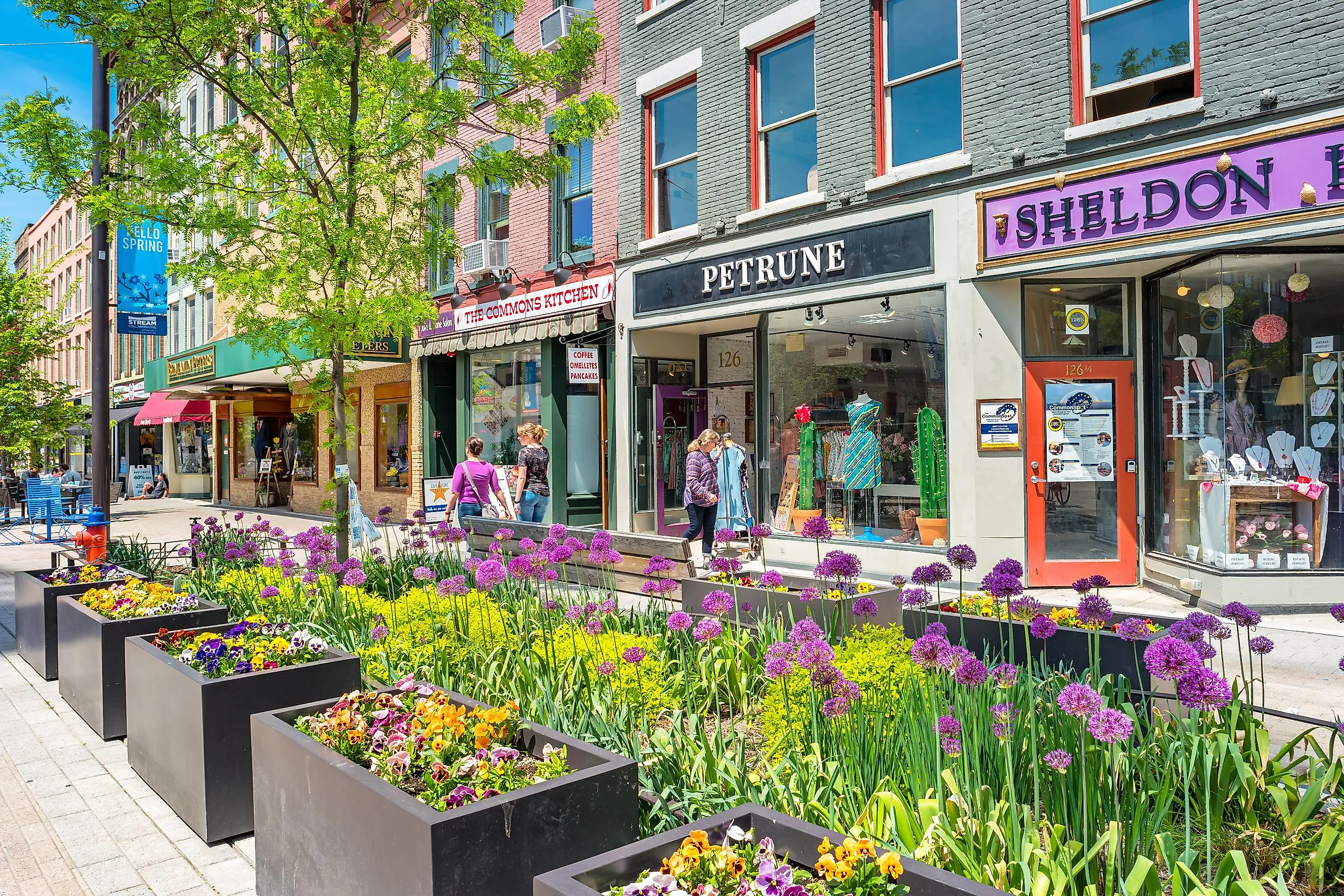
Ithaca sits at the southern tip of Cayuga Lake in the Finger Lakes region, anchored by Cornell University and Ithaca College on opposite ends of town. The Cornell campus side has the Herbert F. Johnson Museum of Art, the Cornell Lab of Ornithology at Sapsucker Woods, and the Cascadilla Gorge Trail, which runs right through the middle of the university with a series of waterfalls. The Commons in downtown Ithaca is a pedestrian-only stretch of State Street with restaurants, shops, and the Cinemapolis art-house cinema.
The gorges define a lot of what makes Ithaca distinctive. Treman State Park has Lucifer Falls and a series of stone-cut paths along Enfield Creek that run dramatically down the gorge. Taughannock Falls State Park to the north has the tallest single-drop waterfall east of the Rockies at 215 feet. The Museum of the Earth on Trumansburg Road covers regional geology and paleontology, and Newfield Covered Bridge (1853) sits just southwest of town as one of the oldest covered bridges still in daily traffic use in the country.
Saratoga Springs

Saratoga Springs is a small city in Saratoga County, famous for its horse-racing tradition and natural mineral springs. Saratoga Race Course has been running thoroughbred meets since 1863 and remains one of the oldest active sporting venues in the country. The summer meet runs mid-July through Labor Day. Saratoga Spa State Park, just south of downtown, houses several public mineral baths, the Saratoga Performing Arts Center (the summer home of the New York City Ballet and the Philadelphia Orchestra), and the Lincoln Mineral Springs bottling plant.
Broadway is the main downtown corridor, with restaurants, the Tang Teaching Museum at Skidmore College a few blocks east, and the National Museum of Racing & Hall of Fame directly across from the race course. Waterfall hunters can hit Spier Falls Dam on the Hudson River seventeen miles northwest, the smaller Snook Kill Falls about four miles north of town, and the much bigger Cohoes Falls roughly thirty miles south near Albany. Caffè Lena on Phila Street is one of the oldest continuously operating folk-music venues in the country, dating to 1960, with shows nearly every night.
Woodstock

Woodstock is a town in the Catskills with an arts-community history that stretches back to the founding of the Byrdcliffe Arts Colony in 1902, one of the earliest planned art colonies in the country. The 1969 Woodstock Music Festival actually took place at Max Yasgur's dairy farm in Bethel, about sixty miles southwest, but the town's name became the brand and the association has carried through. Today the village runs an active visual-arts and live-music scene, with the Woodstock School of Art, the Center for Photography at Woodstock, and the long-running Maverick Concerts chamber-music series staged at the historic Maverick Concert Hall (built 1916, one of the oldest continuously operating summer music venues in the US).
Tinker Street is the main shopping strip, with independent bookstores, vintage shops, pottery galleries, and music memorabilia. The Bear Cafe and Cucina Woodstock cover the dinner scene, and Bread Alone is the morning standard. Bluestone Wild Forest provides hiking just outside town, and Overlook Mountain (4.8 miles round trip) climbs to a fire tower and the ruins of the abandoned Overlook Mountain House hotel, both worth the steep ascent.
Beacon

Beacon is a city in Dutchess County on the east bank of the Hudson River, with the Metro-North Beacon station providing a 90-minute Manhattan connection. The town takes its name from the signal fires that were lit on Mount Beacon during the Revolutionary War to warn the Continental Army of British movements. The big modern draw is Dia:Beacon, a contemporary-art museum housed in a former Nabisco printing factory on the riverfront, which opened in 2003 with a permanent collection focused on large-scale minimalist and conceptual works.
Main Street runs about a mile through the heart of Beacon, with restaurants, galleries, vintage shops, and Victorian-era houses on the residential blocks. Hudson Beach Glass on lower Main has been blowing glass on site since 1987 and runs studio tours. The Beacon Farmers Market runs every Sunday year-round at the Long Dock Park area on the river. For hiking, the Mount Beacon trail climbs about a thousand feet over a mile and a half, with the remains of the old Mount Beacon Incline Railway visible along the route.
Rhinebeck

Rhinebeck is a Dutchess County village along the Hudson Valley north of Poughkeepsie, with a Main Street and Market Street intersection that has stayed mostly intact for two and a half centuries. The Beekman Arms claims to be the oldest continuously operating inn in the country, with documentation dating to 1766. The building still serves food and rents rooms, and George Washington, Aaron Burr, and Franklin Roosevelt all stayed there at various points. Foster's Coach House Tavern on Montgomery Street keeps the local-tavern tradition running in a building that was a stagecoach stop.
The Old Rhinebeck Aerodrome runs weekend airshows from mid-June through mid-October with restored pre-WWI and Golden Age aircraft, including biplane rides for visitors. Wilderstein Historic Site, the Queen Anne mansion that was the home of Daisy Suckley (cousin and confidante of FDR), opens for tours May through October with original interiors. The Dutchess County Fairgrounds on Route 9 host the annual Dutchess County Fair every August. Cinema 1 and 2 on East Market Street runs first-run films from a 1920s building.
Amenia

Amenia is a town in eastern Dutchess County along the Connecticut border, established in 1788. The Red Meeting House on Route 22, also known as the original meeting house of St. Thomas Episcopal Church, dates to 1748 and stands as one of the oldest surviving wooden church buildings in the region. The town's bigger draws today include Troutbeck, the historic Joel Spingarn estate that hosted early NAACP meetings and now operates as a high-end country inn and event venue, and the Silo Ridge resort community south of town.
Wassaic, a hamlet within the town, hosts the Wassaic Project, a contemporary art residency program with exhibitions in a restored grain mill building. Cascade Mountain Winery runs tastings in a working orchard setting outside the village. The Harlem Valley Rail Trail, a 26-mile paved rail-trail running from Wassaic north toward the Massachusetts border, threads through some of the most pleasant rural walking the state has to offer.
Slowing Down in New York
The Red Meeting House at Amenia (1748), the Beekman Arms at Rhinebeck (1766), the Hudson House at Cold Spring (1832), Saratoga Race Course (1863), the Sherwood Inn at Skaneateles (1807), the Maverick Concert Hall at Woodstock (1916), the Byrdcliffe Arts Colony (1902), Caffè Lena at Saratoga Springs (1960), and Dia:Beacon (2003) all carry their own working histories, and each shows up to do its old job whether visitors come or not. The pace they set is theirs, and it runs on its own schedule rather than anyone else's.