7 Coolest Towns on the Chesapeake Bay for a Summer Vacation
The Chesapeake Bay is the largest estuary in the country and the third largest in the world. That kind of scale makes for an unusual set of summer-vacation options. The towns ahead are walkable, with most either on the bay itself or on one of its many rivers. Cape Charles trades on Victorian-era streets. Oxford runs colonial-quiet. Smith Island feels half-Cornwall, half-American-South.
Cape Charles, Virginia

Cape Charles sits at the southern tip of Virginia's Eastern Shore where the Chesapeake meets the Atlantic. The town was founded in 1886 as the southern terminus of the New York, Philadelphia & Norfolk Railroad, and the planned-town grid is still legible. Mason Avenue is the commercial spine, lined with Victorian and Craftsman storefronts that work as boutiques, galleries, and small restaurants. The big easy win is Cape Charles Town Beach. Walk to the end of any block on Bay Avenue, hit the sand. No fee, no parking war, no resort gates.
Coastal Baking Co. handles mornings on Mason Avenue, and Brown Dog Ice Cream is the standard after-beach stop. The Bay Haven Inn from 1906 still runs as a bed-and-breakfast, and the marinas keep a steady boat-and-paddleboard rotation in season. Kiptopeke State Park is nine miles south of town, with a public beach, fishing pier, and the line of concrete ships scuttled offshore as breakwaters in the 1940s. The Chesapeake Bay Bridge-Tunnel runs about 17.6 miles south from town and lands in Hampton Roads, which makes Norfolk and Virginia Beach an easy day trip.
Irvington, Virginia

Irvington sits on Carter's Creek off the Rappahannock River, just upstream from where the Rappahannock empties into the bay. It is and always has been an oyster town. The local oyster industry has come back hard in the last fifteen years after a long stretch of decline, and you can taste the result on virtually any local menu. The Tides Inn has been the resort anchor since 1947, with a marina, sailing school, full dining program, and a Tartan 10 racing fleet. The Dog and Oyster Vineyard a mile out of town pairs estate wines with raw oysters in a setting designed for slow afternoons.
The Steamboat Era Museum on Irvington Road tells the story of the riverboat lines that connected Chesapeake towns to Baltimore and Washington between the 1860s and 1930s. Just outside town, Christ Church (Lancaster County) was completed in 1735 and stands as one of the most intact colonial Anglican churches in North America. The brickwork, cruciform plan, and triple-decker pulpit are all original. The local farmers market runs the first Saturday of each month on Steamboat Road, with seafood, produce, and crafts from the surrounding Northern Neck.
Onancock, Virginia

Onancock is on a tidal creek off Tangier Sound on the bayside of the Eastern Shore. The town was founded in 1680 and the early street grid still works on foot. Onancock Wharf is the operational heart of the place, with a working marina, Onancock Town Park, and the ferry dock for trips to Tangier Island. The Tangier ferry runs May through October and takes about 75 minutes one way, landing on an isolated island where waterman culture has barely changed in three generations.
Back in town, the Mar-Va Theater on Market Street is the cultural anchor. The 1936 building was restored in the 2000s and now runs live music, films, and seasonal stage productions on its single screen. North Street Playhouse handles the smaller community-theater calendar. Bizzotto's Gallery-Cafe and Mallards at the Wharf cover most of the lunch-and-dinner needs. Ker Place on Market Street, built around 1799, runs as a museum focused on Federal-era life on the Eastern Shore and is the headquarters of the Eastern Shore of Virginia Historical Society.
Oxford, Maryland

Oxford was chartered in 1683 and the entire town fits inside roughly half a square mile on a peninsula in the Tred Avon River. The walking is flat and the streets are short. The Robert Morris Inn, built around 1710 and still operating as both restaurant and inn, sits at the foot of Morris Street where it meets the river. The Oxford-Bellevue Ferry has been running across the Tred Avon since 1683, making it one of the oldest privately operated ferries in continuous service in the country. It runs Memorial Day weekend through October and the crossing takes about ten minutes.
The Oxford Museum on Market Street covers local maritime history, with photographs and exhibits from the era when this was a busy colonial seaport. Oxford Community Center hosts seasonal art shows and concerts in a 1929 schoolhouse. Two restaurants run the food scene year-round. The Robert Morris Inn handles the more formal end, and Doc's Sunset Grille on Tilghman Street keeps things casual with crab cakes and a screened porch. Safe Harbor Oxford handles the visiting-yacht traffic, and the Oxford Library on Oxford Road runs a busy summer lecture series.
Smith Island, Maryland

Smith Island is the only inhabited offshore island in Maryland's portion of the Chesapeake, and the only way there is by boat. Most visitors come on the passenger ferry out of Crisfield, about 12 miles southeast on the Eastern Shore. The island is split among three villages: Ewell, Tylerton, and Rhodes Point. Ewell is the largest, with the ferry dock, the Smith Island Cultural Center, and Bayside Inn restaurant for crab cakes and the famous local cake. Smith Island Cake was declared Maryland's official state dessert in 2008, and the ten-layer construction remains the frosting-heavy reason most day-trippers cross the bay in the first place.
Local dialect on the island carries a faint Cornish-Devonshire English inflection traceable to the seventeenth-century settlers, though it has softened considerably in recent decades. The Smith Island Cultural Center walks through that history with documentaries, artifacts, and exhibits on the watermen's life that still shapes the local economy. Bike rentals at the Ewell dock get you to Tylerton and Rhodes Point if you want a fuller tour. The feral goats of Goat Island (a small islet off the northern edge) are a local curiosity rather than a managed attraction.
Solomons, Maryland

Solomons sits at the mouth of the Patuxent River where it meets the Chesapeake, on a thin peninsula that locals just call Solomons Island. The Calvert Marine Museum runs the educational anchor of town, with three main halls. The paleontology hall covers the Miocene-era fossils found in the nearby Calvert Cliffs (shark teeth, whale bones, the works), the maritime hall walks through Patuxent River boat traditions, and the relocated Drum Point Lighthouse sits on the museum grounds.
The Drum Point Lighthouse is a hexagonal screwpile structure built in 1883 and moved to the museum in 1975 when it was no longer needed at its original Patuxent River location. It is one of only three surviving Chesapeake screwpile lighthouses. The Solomons Boardwalk runs along the inner harbor, with restaurants like CD Cafe and Stoney's Kingfishers spilling out toward the water. The Solomons Maritime Festival runs every May, and the Patuxent River Appreciation Days draw a big crowd every October.
St. Michaels, Maryland

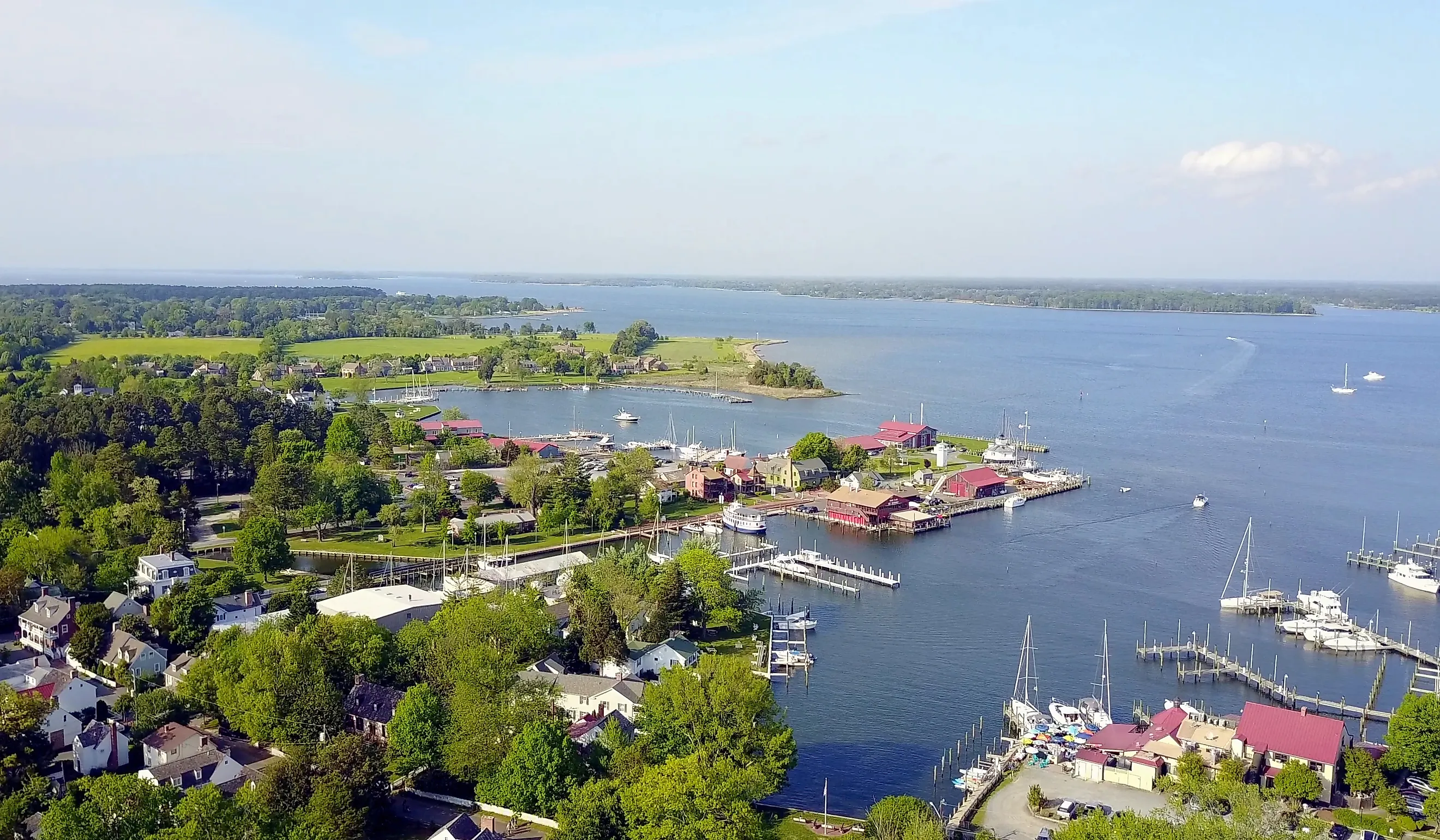
St. Michaels traces back to 1677 and carries a War of 1812 story that has stayed with it for more than two centuries. When a British squadron sailed up the Miles River in August 1813 to shell the shipbuilding yards, locals reportedly extinguished house lights and hung lanterns in the trees behind town, throwing off British gunner aim so the shells fell short. Whether the lanterns trick actually worked is contested by historians, but the story has stuck and earned the place its local "Town That Fooled the British" tag. The 18-acre Chesapeake Bay Maritime Museum on the harbor covers the rest of the local maritime history.
The museum's signature piece is the 1879 Hooper Strait Lighthouse, a hexagonal screwpile relocated to the museum grounds in 1966. The Crab Claw restaurant has been the bay-front lunch standard since 1965, served family-style with paper-on-the-table crab feasts. Talbot Street runs four walkable blocks as the main shopping and dining strip. Patriot Cruises and the schooner Sail Selina II both run scheduled bay sails out of the harbor, including a sunset option that books up most summer Saturdays well in advance.
What Holds These Towns Together
All seven of these towns started as something else: a railroad terminus, a colonial seaport, a steamboat stop, an oyster center, an island settled by English colonists with their dialect intact. That working history still shapes the place. The buildings, the harbors, and (in some cases) the boats are still earning a living. A summer trip to any of them comes packaged with that watermen story whether you ask for it or not, which is most of the point.