The Congo Rainforest
- The Congo Rainforest encompasses six African countries: Cameroon, Central African Republic, Republic of Congo, Democratic Republic of Congo (DRC), Equatorial Guinea, and Gabon.
- More than 150 ethnic groups have lived in the Congo rainforest area for over 50,000 years, with some relying on hunting and gathering for survival in the rainforest.
- Over the past 30 years, some of the biggest causes of deforestation in the Congo rainforest have been agriculture, mining, and urban expansion.
The Congo Basin holds approximately 1.2 million square miles (3.1 million square kilometres) of primary tropical rainforest, the second-largest unbroken tropical forest on Earth after the Amazon and the largest in Africa. The forest represents about 18% of the world's remaining tropical rainforest by area. Per recent World Resources Institute analysis, the Congo Basin removes an average of 160 million tonnes of carbon dioxide equivalent from the atmosphere each year (2015-2024 average), and is now the largest remaining net carbon sink among the world's three major tropical forest blocks; the Amazon's sink capacity has been substantially weakened since 2010 by fire, drought, and deforestation, while the Congo Basin has retained most of its absorbing capacity. The forest contributes important ecosystem services to a regional population of approximately 100 million people who depend directly on it for food, water, energy, and materials.

The Congo Rainforest is shared by six African countries: Cameroon, the Central African Republic, the Republic of the Congo, the Democratic Republic of the Congo (DRC), Equatorial Guinea, and Gabon. The DRC holds about 60% of the basin's total forest cover, the largest national share, and the DRC's primary forest area is now the second-largest of any country in the world after Brazil's. Forest cover as a percentage of national territory ranges from 85% in Gabon and 80% in Equatorial Guinea down to 60% in the Republic of the Congo and 42% in the DRC.
Contents:
Climate
The Congo Rainforest has a tropical climate year-round, with high humidity, persistent precipitation, and consistently warm temperatures. North of the equator, the dry season runs roughly November through March and the wet season April through October; south of the equator the pattern is reversed. Annual precipitation across most of the basin averages 1,200 to 2,000 millimetres (48 to 80 inches), with some areas of the central basin exceeding 2,500 millimetres. Daytime temperatures typically range between the high 60s and low 80s Fahrenheit (about 20 to 28 degrees Celsius), with relatively small seasonal swings; the cooling effect of the Benguela Current produces somewhat lower minima along the southwestern coastal margin. Daily temperature ranges between day and night can reach 15 degrees Celsius (27 degrees Fahrenheit).
The most consequential climate change in the Congo Basin over recent decades has been the lengthening of the dry season, which has expanded at approximately 10 days per decade in the northern Congo and somewhat slower in the south. The dry season has been starting earlier and ending later, delaying the recovery of vegetation each year. Climate-vegetation modelling indicates that if the trend continues, large portions of the current evergreen forest could transition to seasonally dry forest, tropical savannah, or woody grassland over the coming century. Research published by Hubau and colleagues in Nature in 2020 also found that the carbon-absorbing capacity of intact African tropical forests began declining around 2010, an effect that, while less pronounced than the Amazon's decline, suggests that the Congo Basin's status as the world's largest tropical carbon sink should not be assumed to continue without active protection.
Plants And Wildlife

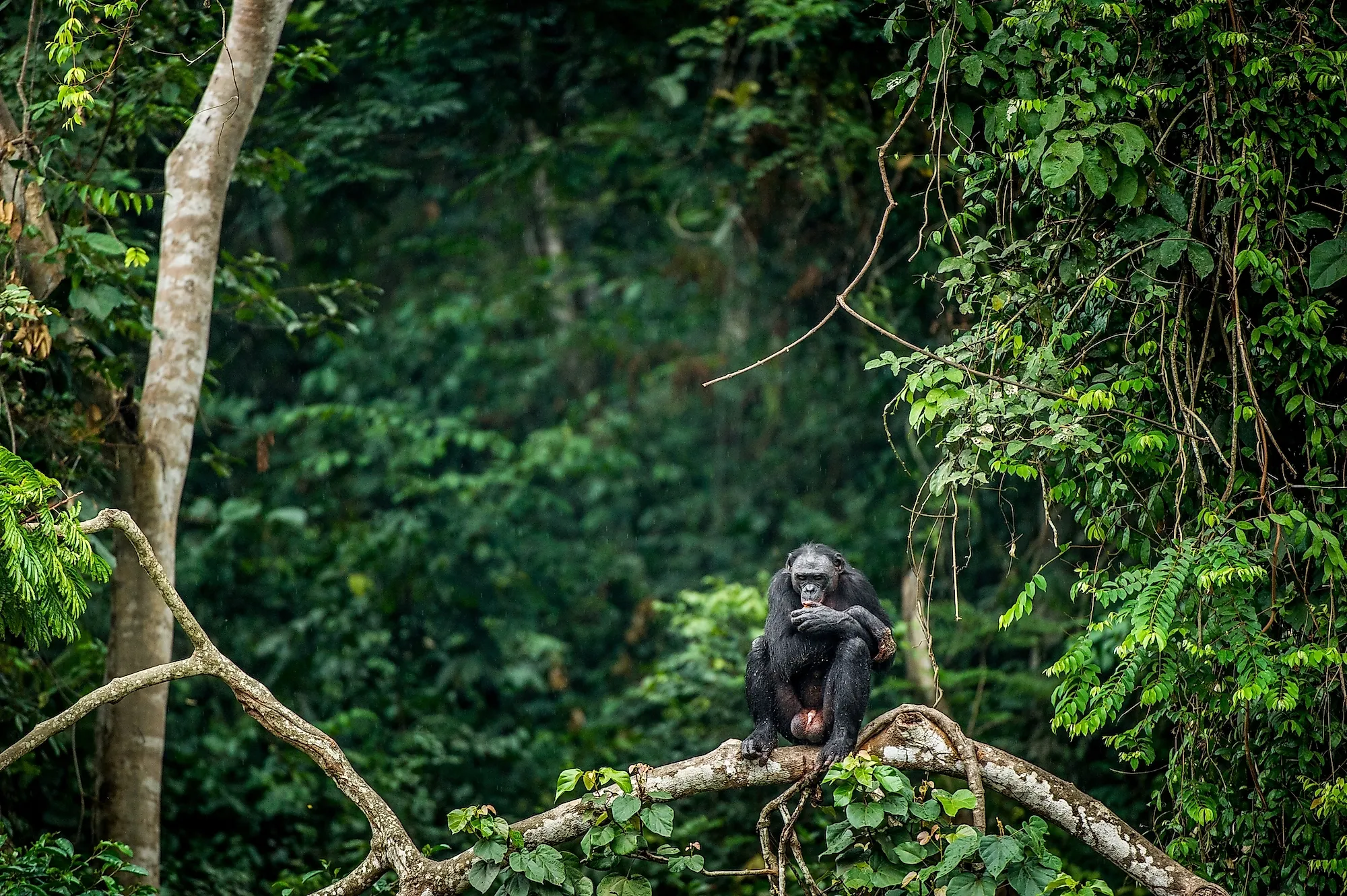
The Congo Basin is among the most biodiverse regions on Earth. The current scientific inventory includes more than 10,000 tropical plant species (approximately 30% endemic to the basin), more than 600 tree species, about 400 mammal species, around 1,000 bird species, more than 700 fish species, and an unknown but substantial number of invertebrate species. Among the basin's animal species are the African forest elephant (Loxodonta cyclotis), the western lowland gorilla (Gorilla gorilla gorilla), the chimpanzee (Pan troglodytes), the bonobo (Pan paniscus, found only in the DRC south of the Congo River), the okapi (Okapia johnstoni, endemic to the DRC), and the African golden cat. The forest elephant is the most consequential single species ecologically: the species has been confirmed by recent research to disperse the seeds of at least 96 tree species, and the absence of forest elephants is now linked to slower forest recovery and reduced large-tree regeneration in deforested or hunted areas.

Research has documented that Central African forests have a lower density of small trees than the Amazon or Bornean forests. The mechanism is thought to be browsing pressure from elephants and other large herbivores, which suppresses sapling density and reduces competition with the largest forest trees. The implication is that the loss of forest elephants is not simply the loss of one species but a structural change to the forest itself: in areas where elephant populations have collapsed (notably much of the DRC, where Global Conservation estimates that approximately 95% of the country's forests are now functionally empty of elephants), sapling densities have increased and the long-term mature-tree composition is shifting.
Protected Areas

Approximately 16% of the Congo Basin's land area is under some form of formal protection, with substantial variation between the six countries. DRC has approximately 8% to 13% of its land area protected (depending on definition), and the DRC government has committed to expand this to 15%. Gabon created a national park system in 2002 consisting of 13 parks covering approximately 11% of the country's land area, replacing a prior regime in which less than 1% had been formally protected. The Central African Republic protects roughly 16.6% of its territory and Equatorial Guinea around 16.8%. Cameroon's major protected areas include Campo Ma'an National Park, the Dja Faunal Reserve (a UNESCO World Heritage Site), Lobeke National Park, Waza National Park, and Korup National Park.
Several protected areas span multiple countries to form contiguous conservation landscapes. The Sangha Trinational complex (TNS), a UNESCO World Heritage Site since 2012, combines Lobeke National Park in Cameroon, Nouabalé-Ndoki National Park in the Republic of the Congo, and Dzanga-Ndoki National Park in the Central African Republic across approximately 750,000 hectares of contiguous lowland rainforest at the meeting point of the three countries. Nouabalé-Ndoki, contrary to what is sometimes reported, sits in the Republic of the Congo rather than the DRC, in the northern Likouala Department, and contains one of the most intact remaining forest-elephant populations in Central Africa. Other major protected sites in the basin include Salonga National Park (the largest tropical rainforest national park in Africa, in the DRC), Virunga National Park (the oldest national park in Africa, established 1925 in the DRC), Odzala-Kokoua National Park (Republic of the Congo), and Lopé National Park (Gabon, also a UNESCO site).

People

More than 150 ethnic groups live within the Congo Basin, and human presence in the forest goes back at least 50,000 years. The forest peoples sometimes collectively called the "Pygmies" (a contested term that many of the groups themselves prefer not to use) include the Mbuti and the Efe in the Ituri Forest of the DRC, the Aka and Ba'Aka in the western Congo Basin and the Central African Republic, the Twa in several countries, the Baka in Cameroon and Gabon, and the Kola and Bagyeli on the Atlantic side of Cameroon. Many of these groups historically depended on hunting and gathering and have ongoing legal and political struggles with national governments over land tenure and the boundaries of national parks established without their consent.
The wider population that depends directly on the Congo Basin for food, water, fuel, medicine, and materials is approximately 100 million across the six countries, considerably larger than the 75 million sometimes cited from older figures. The dependence operates on multiple scales: subsistence-level reliance on forest resources is heaviest in remote areas, while urban populations in Kinshasa, Brazzaville, Yaoundé, and other cities depend on the forest for charcoal (which supplies cooking energy for the majority of the basin's urban population, particularly in the DRC where only about 10% of the population has access to grid electricity). The combination of these pressures, applied to a forest that has not historically borne them at modern scale, is the main reason deforestation has accelerated since the early 2010s.
Threats

Through the 1990s and into the early 2010s, the Congo Basin had the lowest rates of primary-forest loss of any major tropical forest, well below the Amazon and Southeast Asia. That changed during the 2010s, and the trend has continued through 2024-2025. According to Global Forest Watch data, the Congo Basin saw a 14.2% increase in primary forest loss in 2024 over 2023, in a year that set a record high for tropical primary forest loss globally. The DRC alone accounts for more than 75% of the basin's annual loss. Tshopo, Sankuru, and Maniema provinces in central and eastern DRC recorded the highest absolute tree-cover loss in 2024, with Tshopo alone losing 1.93 million hectares (4.8 million acres) of total tree cover.
The principal drivers have shifted substantially from older accounts. Slash-and-burn smallholder agriculture remains the largest single driver in the DRC and the Central African Republic, where industrial-scale clearing is still relatively rare. Charcoal demand is a major secondary driver in the DRC, where the absence of grid electricity for the majority of the population sustains a large urban charcoal market. Industrial agriculture (especially palm oil plantations, rubber, and sugar) is an expanding but still relatively small fraction of total loss. Artisanal mining has emerged as a particularly consequential driver: a 2024 study published in Nature Sustainability by Ladewig et al. found that artisanal mining in eastern DRC causes approximately 28 times more deforestation indirectly (through associated road-building, settlement, and agricultural conversion) than it does directly through the cleared mine area itself. Fire emerged as a major new concern in 2024, with the DRC losing approximately 95,399 hectares of forest to fire in that year alone, and NASA satellite data through 2025 suggesting further intensification. Fires have been particularly concerning in the Cuvette Centrale peatland complex (a 145,529 square kilometre peatland shared between the DRC and the Republic of the Congo, which stores an estimated 30 billion tonnes of carbon and is one of the world's largest individual peatland carbon stores).

Unsustainable hunting for the commercial bushmeat market is the leading direct threat to large vertebrate populations across the basin. In the DRC alone, more than one million tonnes of bushmeat are estimated to be consumed annually. The trade is particularly damaging to species with slow reproductive rates, including monkeys, antelopes, the bonobo, and both gorilla species. The African forest elephant has been driven to Loxodonta cyclotis-only Critically Endangered status (the IUCN designation since March 2021) primarily by ivory poaching; the species' continental population declined by approximately 86% between 1984 and 2015. A 2024 IUCN status report (released November 2025) put the total African forest elephant population at 135,690 individuals, with 66% in Gabon and 19% in the Republic of the Congo, reflecting both improved DNA-based survey methodology and the near-complete collapse of forest-elephant populations in the DRC.
Conservation

Coordinated conservation of the Congo Basin began in earnest with the Yaoundé Summit of March 17, 1999, where the heads of state of the six basin countries signed the Yaoundé Declaration committing to coordinated forest protection. The 1999 agreement led to the establishment of the Central African Forests Commission (COMIFAC) in 2005, which has since adopted successive ten-year Convergence Plans (the 2015-2025 plan is now coming to its end, with a new edition under preparation). Within the first decade after Yaoundé, the basin's formally protected area grew to cover more than 10% of the forest. The Congo Basin Forest Partnership, launched at the 2002 World Summit on Sustainable Development, links donor governments, NGOs, and basin governments around forest protection.
UNESCO has been active in the basin since 2000 through programs including Biodiversity Conservation in Regions of Armed Conflict, focused on World Heritage sites in the DRC, and the Central Africa World Heritage Forest Initiative (CAWHFI). Five of the basin's national parks are inscribed on the UNESCO World Heritage list: Salonga, Virunga, Garamba, Kahuzi-Biéga, and Okapi Wildlife Reserve in the DRC; the Sangha Trinational complex shared between Cameroon, the Republic of the Congo, and the Central African Republic; and Lopé-Okanda in Gabon. Several of these sites have been placed on UNESCO's "World Heritage in Danger" list during periods of armed conflict in the eastern DRC, where the long-running insurgencies in the Kivus and Ituri have repeatedly affected Virunga, Kahuzi-Biéga, and the Okapi Wildlife Reserve.
REDD+ (Reducing Emissions from Deforestation and forest Degradation) frameworks are active in five of the six basin countries (Gabon excepted). National pledges and bilateral agreements, including the United Kingdom's 2021 and 2022 commitments to fund DRC forest protection at COP26 and the 2023 European Union deforestation regulation (EUDR) that affects exports of palm oil, cocoa, coffee, soy, beef, rubber, and timber to the EU, are reshaping the policy environment around the basin's forest economy. Whether these initiatives are sufficient to reverse the accelerating loss is the central open question. As of late 2025, the deforestation curve in the Congo Basin is still moving in the wrong direction, and the basin's role as the world's largest remaining tropical carbon sink is no longer secure. The forest contains carbon, biodiversity, and human livelihoods at a scale that cannot be substituted by any other ecosystem on the African continent, and what is lost in the next decade will not be recoverable in any meaningful human timescale.