Five Classic Americana Downtowns In Arizona
The Arizona communities of Winslow, Wickenburg, Globe, Douglas, and Willcox can all brag about their classic Americana downtowns. They're the kind of places that were built up around train depots, courthouses, banks, movie theaters, and yes, saloons, with attractive old brick storefronts still in daily use.
Winslow residents still drive on the original road surface of Route 66. Wickenburg's Santa Fe depot has stood unaltered since 1895. Globe's Broad Street became a National Register historic district in 1987. Douglas rebuilt the Gadsden Hotel in 1929 around a 42-foot stained glass mural, and Willcox's Railroad Avenue faces a Southern Pacific depot from 1880. All five of these classic Americana towns are worth getting to know.
Winslow

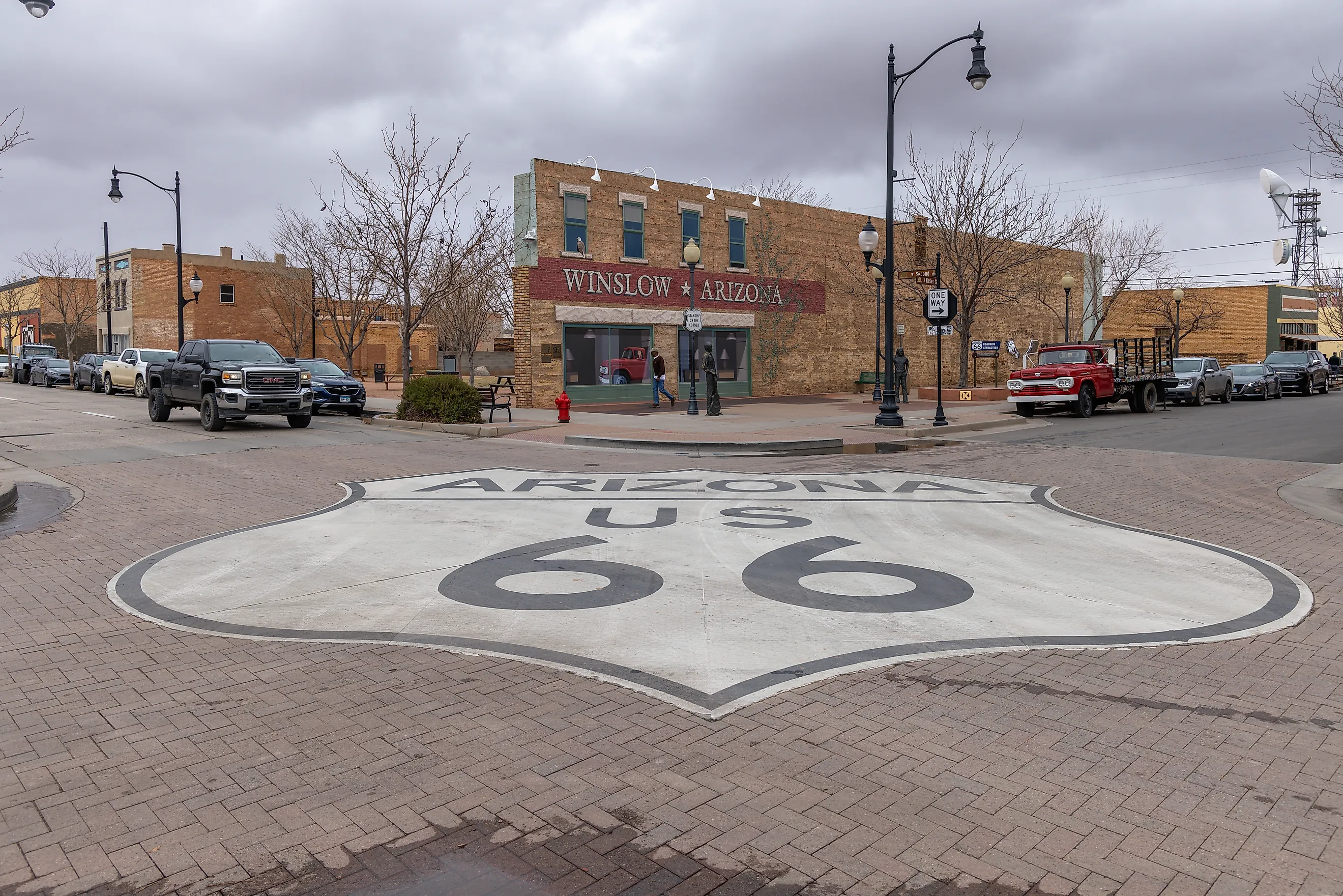
Second Street through downtown Winslow is the original alignment of Route 66, and the concrete roadway poured for the highway is still in use on Second and Third streets. Brick storefronts from the Santa Fe Railway era lines both sides, and at the corner of Second Street and Kinsley Avenue, Standin' on the Corner Park celebrates the Eagles' classic 1972 hit, Take It Easy. It's easy to spot: just look for the bronze statues of a guitar-carrying balladeer and Glenn Frey, backed by a two-story mural of a girl in a flatbed Ford and speakers playing classic rock all day. It doesn't get any more Americana than that.
Across the street, the Old Trails Museum occupies a bank building from 1921 and uses donated objects, photographs, and oral histories to explain the Santa Fe Railway, the Harvey Girls who staffed the railroad's restaurants, and Route 66 (admission is free).
A few blocks west, the Winslow Chamber of Commerce and Visitor Center is in the Lorenzo Hubbell Trading Post and Warehouse, built in 1917 and four years later used as the distribution hub for a trading company that supplied the Navajo Reservation.
The town's centerpiece, though, is La Posada Hotel. Opened in 1930 as the last of the great Fred Harvey railroad hotels and designed by the architect who created the Grand Canyon's Desert View Watchtower, it closed in 1957 and was gutted for railway offices. Reopened as a hotel in 1997 after a lengthy restoration, it's also home to the Turquoise Room restaurant, an art gallery, and gardens. Amtrak's Southwest Chief still stops at the depot behind it.
Independent businesses on Second Street include Sipp Shoppe, a crepe and milkshake counter in the old Navajo County Bank Building, the RelicRoad Brewing Company next door, and the Standin' on the Corner RT66 Gift Shop.
The Standin' on the Corner Festival, held the last weekend of September, brings live music, a classic car show, and vendors to the downtown streets.
Wickenburg

Buildings from the early 1900s line Frontier Street in Wickenburg, and the Santa Fe Depot on North Frontier Street, built in 1895, is among the oldest of the railroad's wooden stations in Arizona. It stands in its original form with no additions and now houses the Wickenburg Chamber of Commerce and the town visitor center.
Parked beside it are a Santa Fe locomotive 761, a 2-8-0 steam engine built in 1900, and a Southern Pacific drover caboose. The last passenger train left the depot in 1969.
The town began with the Vulture Mine, discovered by Prussian prospector Henry Wickenburg in 1863, which produced 340,000 ounces of gold before it closed in 1942. At the corner of Wickenburg Way and Tegner Street, a 200-year-old mesquite known as the Jail Tree served as the town lockup from 1863 to 1890, with prisoners simply chained to its trunk. A self-guided walking tour from the visitor center passes life-size bronze statues of frontier characters, six of them with push-button narration.
The Sigler Western Museum occupies the former Brayton's Commercial Company building from 1906 on Frontier Street. A Smithsonian affiliate, it features a collection of more than 600 works of Western art and stages the invitational Cowgirl Up! exhibition of Western women artists each spring.
For movie buffs, the Saguaro Theatre, a single-screen cinema opened in 1948, still shows first-run films.
Downtown shops and restaurants are independently owned and worth checking out. Bedoian's Bakery and Bistro on East Wickenburg Way, Nana's Sandwich Shoppe on Tegner Street, Anita's Cocina on Valentine Street, and Buttermilk and Honey Bakeshop on Frontier Street will fill those hungry tummies.
The Old Livery Mercantile, Stoney Saddlery on Apache Street, and Wickenburg Antiques and Artisans on East Wickenburg Way, meanwhile, will satisfy that urge to shop.
Globe

The Globe Downtown Historic District covers nearly 14 acres of Broad Street between Cedar and Tebbs streets, with buildings that went up mostly between 1880 and 1935. Its centerpiece is the Gila County Courthouse, built in 1906 from locally quarried dacite in an Italian Renaissance style.
Now the Cobre Valley Center for the Arts, it's home to galleries on the second floor, a third-floor theater, and a room devoted to Rose Mofford, Arizona's first female governor and a Globe native.
The rest of Broad Street is an interesting looking run of stone and brick commercial blocks, including the Elks Building from 1910, a Romanesque structure billed by local guides as the tallest three-story building in the United States, the Neoclassical Gila Valley Bank and Trust from 1900 with its Corinthian pilasters, the Old Dominion Mercantile from 1904, and the Hamill Building from 1906, once home of the Arizona Silver Belt newspaper.
The Holy Angels Catholic Church, built in 1918, still tolls the hour from its bell tower.
The Drift Inn Saloon has been pouring drinks under its original pressed-tin ceiling since 1902. At the end of Broad Street, the Pickle Barrel Trading Post fills the 8,000-square-foot Old Dominion Commercial Company warehouse, built in 1905 to store equipment for the Old Dominion copper mine, with turquoise jewelry, Apache baskets, and antiques.
Bravo Americano Moderno serves wood-fired pizza from a brick building on Broad Street, and La Luz Del Dia is the Mexican restaurant with the coffee-cup sign.
The Old Dominion Mine itself, which operated from the 1880s until 1931, is now the Old Dominion Historic Mine Park, a self-guided outdoor museum with trails named for mining claims and a boneyard of old equipment.
One mile south of downtown, Besh-Ba-Gowah Archaeological Park preserves a 200-room Salado pueblo occupied between 1225 and 1400, with a museum of Salado pottery.
Douglas

G Avenue in Douglas is a main street of masonry and brick commercial blocks built with the money that copper smelting and cattle ranching brought to this corner of the state after 1901. The Gadsden Hotel at 1046 G Avenue opened in November 1907 and was named for the Gadsden Purchase of 1854 that brought southern Arizona into the United States. A fire in 1928 left only the elevator cab, the marble staircase, and the marble columns standing, and it was rebuilt on an even grander scale in 1929.
The lobby is the reason to walk in. An Italian marble staircase, solid marble columns, a 42-foot Tiffany-style stained glass mural of a desert scene, and the original Otis elevator from 1907 are all highlights with the Saddle and Spur Saloon is off the lobby. Hotel lore says Pancho Villa rode his horse up the staircase and chipped the seventh step.
One block north on G Avenue, the Grand Theatre opened in January 1919 with 1,600 seats and a stage that hosted legends such as Ginger Rogers, Anna Pavlova, and John Philip Sousa.
Though now gutted and being redeveloped as an open-air amphitheater, its terra cotta facade, the carved faces above the marquee, and the tiled entry still read "Grand Theatre."
The Douglas Art Association runs a gallery of regional and cross-border artists in a building from 1902, and Art Car World, a museum of more than 35 decorated art cars, can be viewed by appointment downtown.
The Douglas-Williams House, built in 1909, is home to the Douglas Historical Society and its photographic collection. At the airport east of downtown, the Border Air Museum displays a letter from the Roosevelt White House declaring Douglas Municipal Airport the first international airport of the Americas.
Willcox

Railroad Avenue in Willcox faces the Southern Pacific tracks that created the town as a construction camp in 1880. The redwood-frame depot on South Railroad Avenue was completed in December of that year and is billed as the only original passenger depot still standing on the southern transcontinental route between Los Angeles and Chicago.
Restored, it now serves as Willcox City Hall. Historical markers along the avenue identify the Headquarters Saloon, the Palace Saloon and Pool Hall from 1905, and the Willcox Commercial Hotel from 1916.
Across from the depot, Railroad Park has a bronze statue of Rex Allen, the legendary singing cowboy of 1950s westerns. Allen was born in 1920 and raised on a homestead 40 miles north of the town, and the grave of his horse, Koko, is also located in the park.
The Rex Allen Arizona Cowboy Museum at 150 North Railroad Avenue opened in 1989 and houses the Arizona Cowboy Hall of Fame.
Around the corner on Maley Street, the Chiricahua Regional Museum covers the valley's Apache and ranching history, and Big Tex BBQ at 130 East Maley Street serves barbecue from an old railroad car. Rex Allen Days, held the first full weekend of October since 1951, brings a rodeo, parade, and carnival to town.
Wine businesses have taken over many of the downtown's old storefronts. The Willcox area grows 74 percent of Arizona's wine grapes and has numerous tasting rooms, most of them within a few blocks of Railroad Park.
Keeling Schaefer Vineyards is set in the Willcox Bank and Trust building from 1917 on North Railroad Avenue, next door to the Rex Allen Museum. Birds and Barrels Vineyards is at the corner of Railroad Avenue and Maley Street.
Main Streets That Never Modernized
While none of these five towns set out to become historic attractions, each has managed to preserve their Americana heritage. The businesses set inside their old buildings not only trade on this heritage, but they also do their part in preserving the past for the rest of us to enjoy. These downtowns can easily be walked, and each tells a fascinating chapter in Arizona's story.