9 Idyllic Small Towns In Minnesota To Visit In 2026
Minnesotans tend to know these towns by what people made here. In Pipestone, masons cut pink quartzite out of the ground and stacked it into storefronts. In New Ulm, German families brewed lager and never stopped. In Two Harbors, the first iron ore left the docks in 1884. Each place still runs on the thing that started it. That is what makes a weekend in any of them worth the drive. Here are nine to put on the 2026 list.
Grand Marais

A billion years ago, lava cooled into the dark basalt that forms Artist's Point. You can walk it. A path crosses the rock and a concrete breakwater out to the Grand Marais Lighthouse, a steel skeleton tower first lit in 1922. Come at sunrise and the open lake throws the light back at you. Locals do this in every season, parka or not.
The line at World's Best Donuts starts before mid-morning, and the deep-fried Skizzles sell out. Get there early. Uphill from the water, the Grand Marais Art Colony runs classes and rotating shows inside a converted church, and it is the oldest art colony in the state. The North Shore built this town on fishing and timber. Now people come for the rock, the water, and the doughnuts.
Stillwater

Lumber money built the red-brick Main Street here, and the whole district is on the National Register of Historic Places. You can see the town two ways. Paddlewheel boats run the St. Croix past sheer limestone bluffs, and the Stillwater Trolley climbs the streets where the lumber barons put up their Victorian houses and stone churches. The river came first. Logs floated down it, and the mills paid for everything above the waterline.
Lowell Park runs along the water on both sides of the Stillwater Lift Bridge. Summer markets and the Rivertown Fall Art Festival fill its lawns. Less than ten minutes on foot, the Warden's House Museum sits in an 1853 limestone house that held the keepers of the Minnesota Territorial Prison. Guided tours cover fourteen rooms, with 19th-century furniture, prison contraband, and the lumber trade that started it all.
New Ulm

German families laid out New Ulm in the Minnesota River Valley in the 1850s, and the town has kept the accent ever since. The August Schell Brewing Company has poured lager since 1860, which makes it the second-oldest family-owned brewery in the country, behind only Yuengling. The Hobo Band plays polkas and waltzes in the beer garden. A few blocks off, Flandrau State Park runs eight miles of trail through hill prairie and oak-shaded bluffs above the Cottonwood River. Its swimming pond has a sand bottom that drops from ankle-deep at the edge to seven feet at the far end.
In the center of town, the Brown County Historical Society Museum fills three floors. The exhibits cover the Dakota War of 1862, the early Native American cultures of the valley, and the German settlement that followed. The 45-foot Glockenspiel stands at Schonlau Park a few blocks away. Its 37 bronze bells ring several times a day, and carved figures turn on a stage above the street while they play.
Lindström

Swedish settlers founded Lindström in the 1850s, and the town leans into it. Swedish flags fly downtown, a Dala horse statue stands near the main street, and the old water tower is shaped like a 105-foot coffee pot. Volunteers raised the money to get it steaming again in 2025, and now it lets off steam twice a day, at 10 a.m. and again at 3 p.m. That is fika, the Swedish coffee break, and people here still keep it. The Chisago County Historical Center holds the rest of the story, from vintage kitchen equipment to period clothing brought over from Sweden.
West of downtown, Allemansrätt Wilderness Park covers 125 acres with more than 10,000 feet of shoreline on three lakes. Trails pass an 1853 homestead, low glacial ridges called eskers, and wetlands that dry up by late summer. When you come off the trail hungry, Gustaf's On Main serves chicken meatball sandwiches and chicken pot pie, along with other Scandinavian plates.
Nisswa

Every Wednesday from June through August, the turtles take over. The Nisswa Turtle Races have run since 1963, on a track just off Main Street behind the Chamber building. Registration opens at 1 p.m. and the racing starts at 2, and it is five dollars to enter with one of their turtles. Afterward, the crowd walks to The Chocolate Ox for hand-scooped ice cream and fudge, with a candy wall stocked floor to ceiling with taffy and jelly beans.
A railroad once ran through the middle of Nisswa. The tracks are gone, and the paved Paul Bunyan State Trail runs 120 miles down the old corridor now, carrying cyclists and runners in summer and snowmobiles in winter. The old Northern Pacific depot still stands on Main Street as the local historical museum. Its Pioneer Village holds a 1908 depot building, a red caboose, and a one-room schoolhouse moved in from a closed living-history site.
Excelsior

The brick storefronts on Water Street open almost straight onto Lake Minnetonka, and sailboats fill the bay all summer. Charter cruises and pontoon rentals crowd the public docks at the Port of Excelsior, the main launch onto the water. Along the shore, Excelsior Commons opens onto wide grassy lawns that slope down to a swimming beach, and the town books summer concerts there.
Maynards runs a wraparound deck out over the lake, and the dockside tables fill up with walleye plates and cold beer as the sun drops behind the water. A few blocks inland, the Minnesota Streetcar Museum runs a half-mile ride on a restored wooden trolley. Stop at the restoration shop and you can watch the crew work on the rest of the historic fleet.
Red Wing

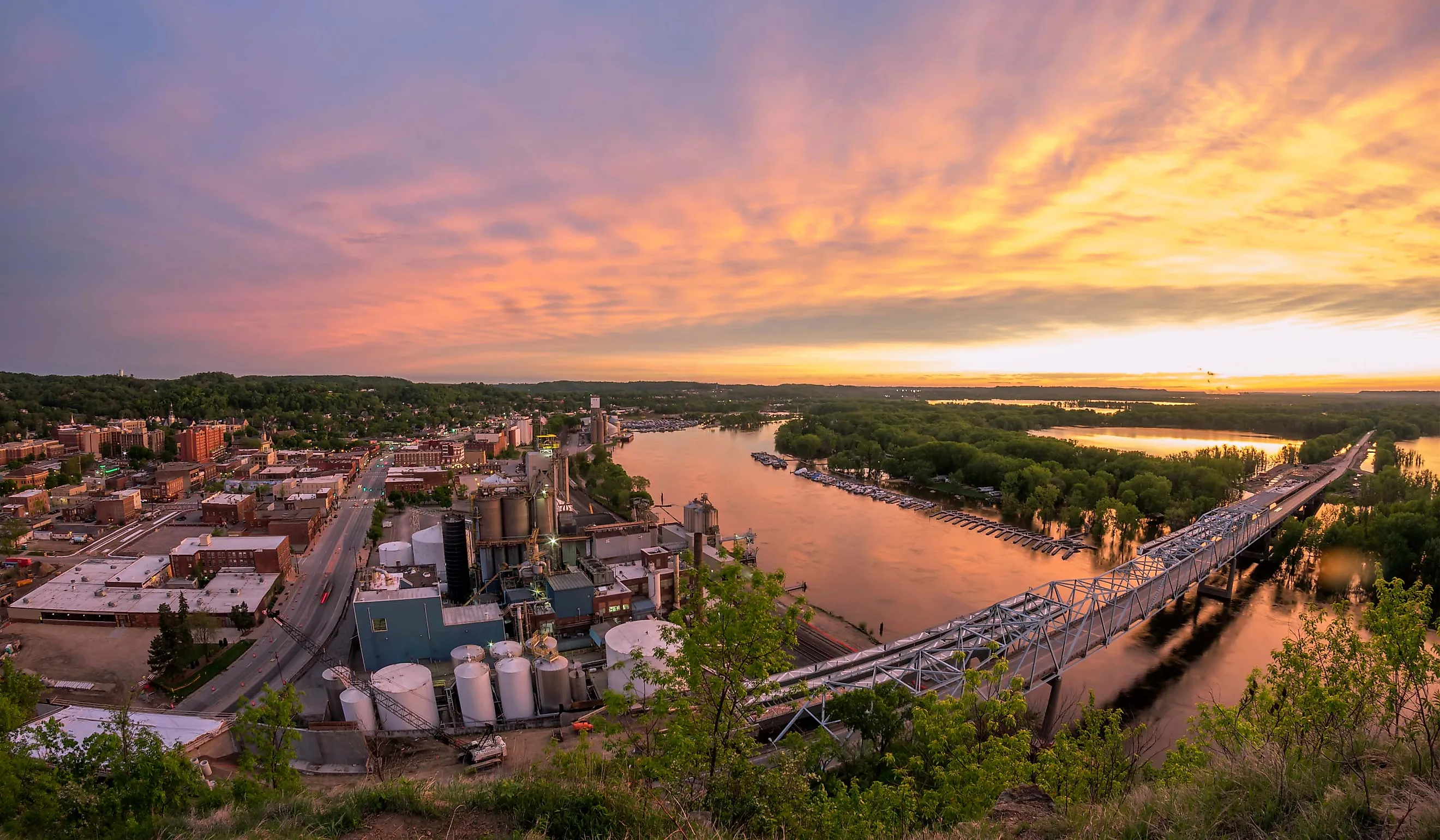
Barn Bluff rises straight off the Mississippi at the edge of downtown, and the steep trail to the 400-foot summit gives you the whole river valley, towboats and all. Back down in town, the Red Wing Shoe Company Museum lays out more than a century of leatherwork. The centerpiece is the world's largest boot, a size 638 ½ D built for the company's 100th birthday in 2005. It stands 16 feet tall, runs 20 feet long, and weighs over 2,300 pounds.
Clay made this town too. The potteries boomed here in the 19th century, and the Pottery Museum of Red Wing keeps the salt-glazed crocks and hand-painted dinnerware from those years. The Sheldon Theatre closes out the night, a small 1904 playhouse with gilded plasterwork and velvet seats that still books live performances.
Pipestone

The whole downtown is the color of the ground under it. Masons cut the pink and red quartzite from quarries nearby and built the storefronts of the Pipestone Historic District out of it. Follow the stone to its source at Pipestone National Monument, where the three-quarter-mile Circle Trail loops past red cliffs and active quarry pits. Enrolled tribal members still cut the soft pipestone by hand here, the only place in the country where that quarrying is allowed. Partway around the loop, Winnewissa Falls drops 20 feet into a pool ringed by tallgrass and stone.
The Pipestone County Museum sits in the old City Hall, a Richardsonian Romanesque building in the same quartzite. Four galleries across two floors hold regional pioneer pieces, vintage textiles, and a replica of the county's first claim shanty. Down at street level in the 1896 Moore Building, Prairie Maiden Treasures sells Native American gifts, and a dozen carved gargoyles look down from the facade above the door.
Two Harbors

Iron ore built Two Harbors. The first shipment off Minnesota's Iron Range left these docks in 1884, and ore boats still load at Agate Bay, close enough to watch from shore. Above the bay, the Two Harbors Lighthouse has run since 1892, which makes it the oldest operating light station in the state. Climb the square brick tower for the view across Agate Bay, or tour the attached keeper's quarters. A few minutes east, the curved shore of Burlington Bay Beach draws agate hunters down to pick through the cobblestones.
Inland, the Duluth & Iron Range Railroad Depot Museum sits in a restored 1907 brick depot and covers the rail line that hauled the ore, plus the mining, fishing, and logging that built Lake County. Finish the night at Castle Danger Brewery, whose Castle Cream Ale is one of the more popular craft beers in the state.
One Raw Material, Nine Different Towns
Set these nine side by side and the pattern holds. Each town still runs on the thing that started it, just turned to a gentler use. The quarry at Pipestone is a walking trail now. The ore dock at Two Harbors is a place to watch the boats. The rail line through Nisswa carries bikes. Grand Marais trades its fishing past for art and a view of the lake, and New Ulm keeps brewing the same lager. None of these towns froze itself for visitors, and that is exactly why a weekend in any of them sticks with you.