9 Best Downtowns In Southern California
A single Los Angeles shopping mall can cover more ground than the whole downtown of a town like Julian or Ojai. That is the surprise of Southern California's best small towns, downtowns so compact that a whole town center fits in the footprint a big city fills with one mall. The trade is size for density, with everything you would want inside a few walkable blocks. Each of the nine here is a full downtown at pocket scale, and no two are alike. Start with whichever is closest to home.
Laguna Beach

Artists settled Laguna Beach as a plein-air colony in the early 1900s, and traces of that history are still visible downtown. More than 100 works of public art stand within the city limits, among them murals, sculptures, and reliefs, many within a short walk of the beach. Forest Avenue is the heart of it, a brick-lined pedestrian street of galleries set in restored early-1900s buildings, among them Sue Greenwood Fine Art, known for West Coast contemporary work. A few blocks west, behind a white facade, the Laguna Art Museum holds one of the oldest collections of California art in the state.
Across Pacific Coast Highway, Heisler Park sits on a bluff above the shoreline, with paths down to tidepools, sculptures, and native gardens. In the north part of downtown near Gallery Row, Zinc Cafe has been a breakfast and lunch fixture for years, with a shaded patio and a small bookshop inside. Main Beach, a short walk south, is where downtown ends and the sand begins, with a curved boardwalk, volleyball courts, and a historic lifeguard tower.
San Juan Capistrano

San Juan Capistrano grew up around its mission, founded in 1776, which makes it one of the oldest towns in California. The mission is still the center of town, and the annual Return of the Swallows, marked each spring around St. Joseph's Day, remains one of its best-known traditions. Los Rios Street, often called the oldest residential street in California, runs just across the train tracks, and its original adobe and Victorian-era homes are now cafes, shops, and galleries. One of them, the Ramos House Cafe, sits in an 1881 cottage with a garden patio and is known for a fixed brunch menu of dishes like crab hash and rosemary cornbread.
The mission's Great Stone Church, largely ruined by the 1812 earthquake, still stands at the center of the compound, along with preserved gardens, fountains, and the Serra Chapel, the oldest building in California still in regular use. A short walk away, the Tea House on Los Rios is known for a multi-course afternoon tea inside a restored turn-of-the-century home. The town's small train station is still in use, and the 19th-century Capistrano Depot next door is now home to Trevor's at the Tracks, a restaurant built into the station's original waiting room.
Claremont

Claremont was laid out as a college town, and the seven Claremont Colleges still sit within walking distance of its center. The result is a downtown with a consistent architectural character and an easy walking scale. The core, known as Claremont Village, is a grid of brick storefronts, shaded sidewalks, and narrow alleys of bookstores, coffee shops, and small theaters. Some Crust Bakery, in a building close to a century old, is a Village fixture, known for a custom ice cream sandwich counter.
Claremont also has a strong horticultural streak. The California Botanic Garden, formerly the Rancho Santa Ana Botanic Garden, covers 86 acres and holds the largest collection of native California plants in the state. In the Village, the Claremont Lewis Museum of Art is housed in the town's 1927 Spanish Colonial Revival train depot. A preserved tree canopy and a strict sign ordinance are the reason the storefronts are not crowded out by large advertising.
Redlands

Redlands grew rich on navel oranges in the late 1800s, and the Victorian-era money from that boom is still visible along State Street, the spine of downtown. The town was incorporated in 1888, and brick storefronts, shade trees, and old commercial buildings stand along State Street between Orange and 9th, now home to shops, restaurants, bakeries, and bars. The most photographed spot downtown is Orange Street Alley, better known as Umbrella Alley, where roughly 420 open umbrellas hang overhead in a canopy of color.
Just outside the core, the Redlands Bowl has been the site of a free summer music series since 1924, which its organizers bill as the longest continuously running summer festival in the country where no admission is charged. Downtown also sits near a run of landmarks from the citrus era: the 1897 Kimberly Crest House, a French chateau-style mansion above the town; the A.K. Smiley Public Library of 1898; and the Lincoln Memorial Shrine beside it, the only Lincoln memorial west of the Mississippi. On Thursday evenings in the warmer months, the Market Night street fair fills several blocks of State Street with produce stands, food booths, and live music.
Idyllwild

Idyllwild sits about a mile up in the San Jacinto Mountains, an unincorporated village with no traffic lights and no chain stores. Its ceremonial mayor is a golden retriever: the first Mayor Max won a fundraiser-style election in 2012, and two more golden retrievers have held the office since. The small village center, along North Circle Drive and the surrounding blocks, is a walkable cluster of galleries, cafes, bookshops, and gift stores, most of them one-off local businesses.
The town has a long arts streak, home to the Idyllwild Arts campus and an annual art walk, and it turns up on lists of the country's best small art towns. Just past the shops, the granite faces of Tahquitz Rock and Suicide Rock rise above the pines, long popular with rock climbers, and trails from the edge of the village climb toward San Jacinto Peak. The weekly Idyllwild Town Crier is still the local paper, and on a normal weekend the sidewalks fill with hikers coming down off the mountain and day-trippers up from the desert.
Julian

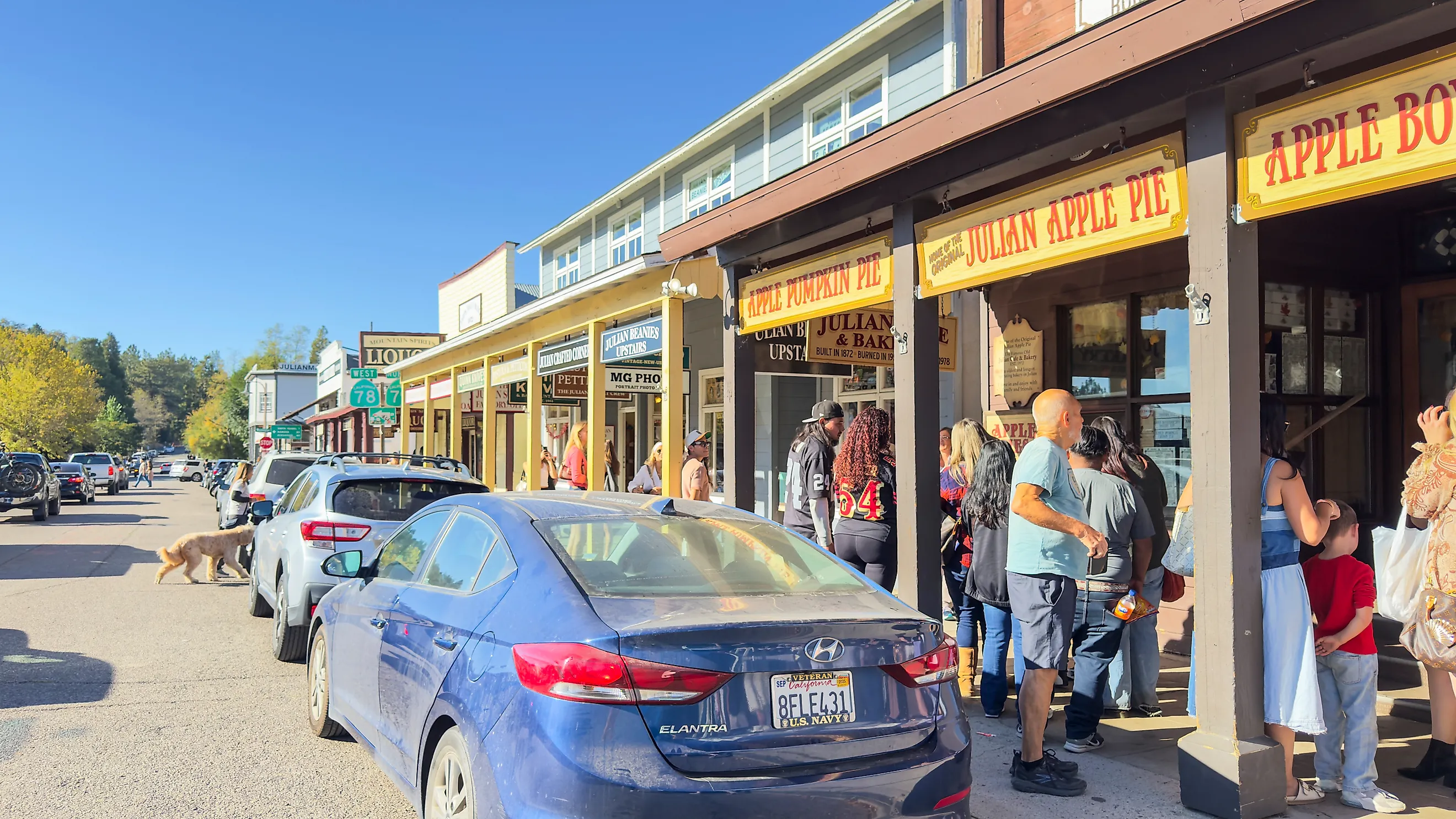
Gold turned up in a creek near Julian in 1869, and the mining town that followed sits in the Cuyamaca Mountains at about 4,200 feet, roughly an hour east of San Diego. A 1976 ordinance requires the fronts of Main Street buildings to match the town's 19th-century look, so the historic core reads much as it did a century ago. The Julian Gold Rush Hotel, built in the 1890s by Albert Robinson, a formerly enslaved man, still takes guests and is billed as the oldest continuously operating hotel in Southern California.
When the gold played out in the 1890s, apples took its place, and Julian apple pie is now the town's calling card, with pie counters and cider stands along Main Street. The Eagle Mining Company runs tours through an old hard-rock gold mine at the edge of town, and the Julian Pioneer Museum and the town cemetery on the hill above fill in the mining-era history. Fall is the busy season, when the orchards draw weekend crowds up the mountain, and a rare snow does the same in winter.
Ojai

Ojai lies in a narrow valley ringed by the Topatopa Mountains, whose bluffs catch a well-known band of pink light at sunset that locals call the Pink Moment. Spiritual teachers, artists, and environmentalists have long gravitated to the valley; Jiddu Krishnamurti began giving annual talks here in the 1920s, and the Krotona Institute and the Krishnamurti Library on McAndrew Road remain from that era. Downtown runs along a single stretch of Ojai Avenue, with whitewashed arches and tilework that date to a 1917 fire, after which the town center was rebuilt in Spanish Colonial Revival style.
Bart's Books, a few blocks off the main strip, is an open-air bookstore arranged around a live oak, with much of its stock shelved outdoors on the honor system. In the center of downtown, Libbey Park has a shaded pergola, tennis courts, and the Libbey Bowl concert venue. The Ojai Valley Museum, in the town's former Catholic church, keeps local Chumash artifacts and rotating art exhibits, and Beacon Coffee, nearby, roasts on site.
Solvang

Danish-American settlers founded Solvang in 1911 to build a Danish colony and folk school far from the Midwest, and the Danish character came first, well before tourism. In the 1940s, civic groups leaned into that identity, and downtown now looks like a European village, with half-timbered facades, stork murals, and windmills along Copenhagen Drive and Alisal Road. Some street signs are still in Danish. Near the Solvang Book Loft and the Hans Christian Andersen Museum stands a one-third-scale replica of Copenhagen's Round Tower, finished in 1991.
At Olsen's Danish Village Bakery, in the same spot for more than 50 years, the bakers still make aebleskiver, kringle, and marzipan from family recipes. The Elverhoj Museum of History and Art, in a former private home built in Scandinavian style, holds exhibits on the settlement's history and its arts scene. The open-air Solvang Festival Theater is the site of a summer performance season, and Bit O' Denmark, one of the town's oldest restaurants, is set in one of Solvang's original 1911 buildings, with a menu of smorrebrod, frikadeller, and pickled herring.
Coronado

Coronado sits on a peninsula tied to the mainland by a narrow sand spit and reached by the San Diego-Coronado Bridge or by ferry. Its layout is nearly symmetrical, with the Hotel del Coronado on the ocean side and the Ferry Landing Marketplace facing the bay. Orange Avenue runs down the middle, a stretch of low buildings, mission-style banks, independent shops, and civic landmarks. Spreckels Park, at the center, is the setting for weekly summer concerts and is bordered by houses built between 1900 and 1930.
The Hotel del Coronado opened in 1888 and is one of the last of the big wooden Victorian beach resorts, filling an entire oceanfront block. Presidents, royalty, and film crews have all passed through over the years, and the 1959 comedy Some Like It Hot was shot there. On Orange Avenue, Clayton's Coffee Shop still has a 1940s interior and a curbside pie window, and the Coronado Historical Association runs a museum in a former bank building, with exhibits on naval history, local architecture, and the bridge. Coronado Brewing Company has had a restaurant and tasting room on Orange since 1996.
The Case For The Small Downtown
The common thread across these nine is restraint. Height limits, historic-district rules, and a century of small-lot ownership are the reason each core stays compact and easy to walk. In Julian and Idyllwild that scale comes from mountain isolation. In Coronado and Laguna Beach it comes from the water at the edge of town. In Redlands, Claremont, and San Juan Capistrano it comes from citrus-era and mission-era blocks that were never cleared for something bigger. None of these places is a city, and that is exactly why residents still run errands and meet for coffee in the same few blocks that visitors come to see.