8 Towns In Gulf Coast That Transport You To The Past
The French built their first Gulf capital at present-day Ocean Springs in 1699, before there was a New Orleans or a Mobile. Spanish, French, and American flags have flown over this coast in the centuries since, and its older towns still show it. Colonial street grids, antebellum homes, oyster docks, and brick forts mark the small Gulf Coast towns that the beach-resort version of the shoreline tends to skip over. They are the places where the past is still the main attraction.
Apalachicola, Florida

Apalachicola, Florida, grew rich as a cotton port in the 1830s and 1840s, and the grid those years laid out still organizes the town. Six public squares, City, Chapman, Gorrie, Franklin, Madison, and Washington, form the core of the Apalachicola Historic District. The blocks around Fifth and Sixth Streets carry the highest concentration of pre-1860s buildings, a dense record of the boom years in wood and brick. Gorrie Square takes its name from Dr. John Gorrie, the physician whose 1840s experiments with ice-making laid groundwork for refrigeration and air conditioning.
Trinity Episcopal Church, on Gorrie Square, dates to the late 1830s and counts among the oldest churches in Florida. The John Gorrie Museum nearby tells the rest of the doctor's story. Down at the water, the fishing fleet still ties up where the cotton ships once loaded, and Apalachicola Bay remains bound to the oyster trade that made the town's name, even with the wild harvest now restricted to let the reefs recover. Walking the squares and the docks together spans most of two centuries.
Cedar Key, Florida

Cedar Key is a barrier island off Florida's Nature Coast, the stretch of Gulf shore between the Big Bend and the Tampa Bay suburbs. The Cedar Keys National Wildlife Refuge wraps the surrounding islands and channels, and kayakers paddle out among them. The town is one of the last pieces of old Florida, a low-rise fishing and clamming community that skipped the high-rise era entirely. That is the main reason people come.
Cedar Key Museum State Park makes a good first stop. The 18-acre site gathers exhibits assembled with help from a University of Florida design team, tracing the island's history and the Gulf waters around it. The grounds include the Whitman Home, which preserves the collection of Native American artifacts and Cedar Key shells assembled by St. Clair Whitman. Together they sketch a settlement that has watched the Gulf for a very long time.
Fairhope, Alabama

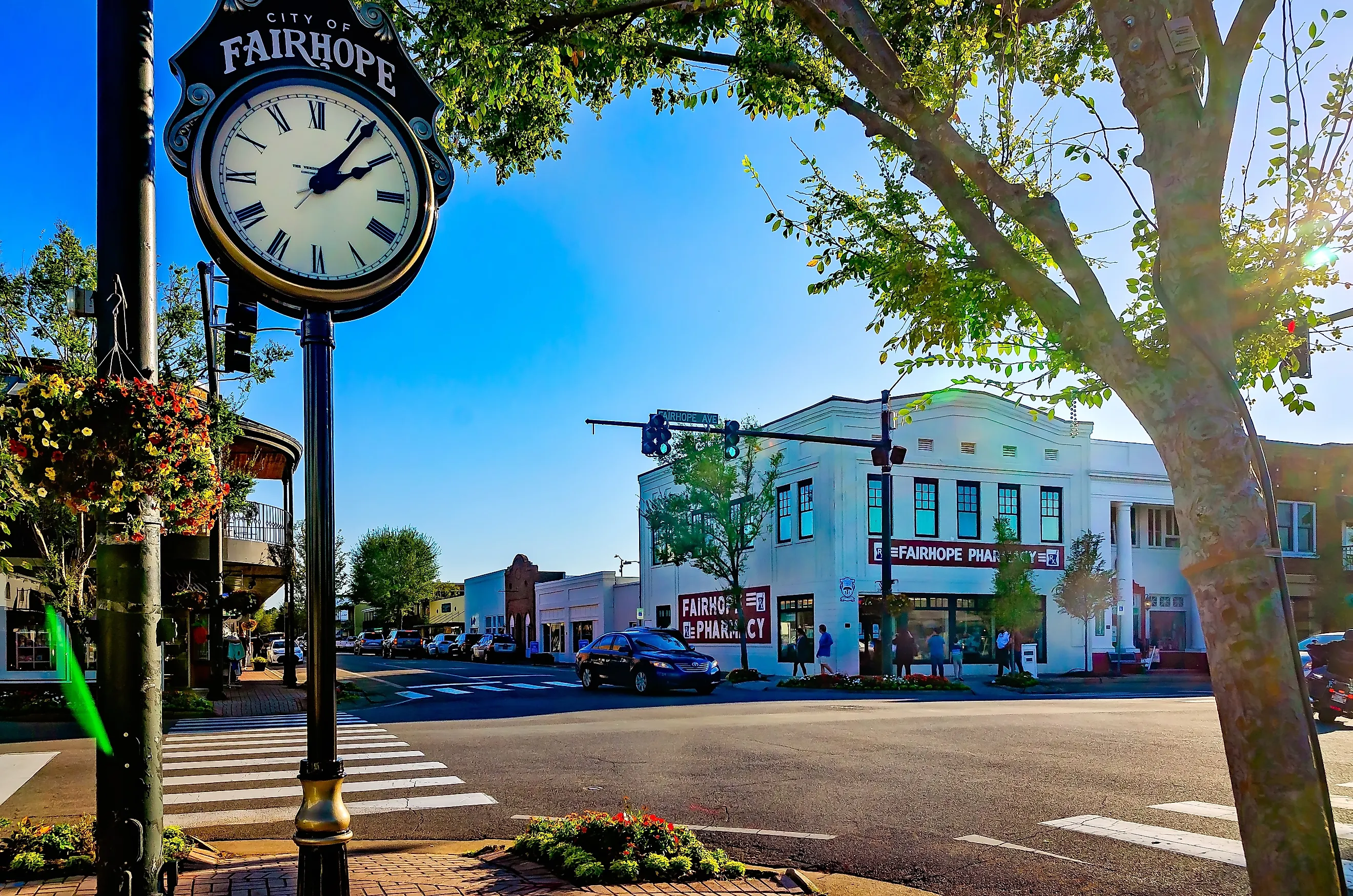
Fairhope began in 1894 as a utopian experiment. Twenty-eight followers of the economist Henry George came down from Iowa, bought a stretch of bluff on the eastern shore of Mobile Bay, and founded a single-tax colony, a place where the land was owned in common and leased rather than sold outright. They named it for the "fair hope" they had of making it work. The Fairhope Single Tax Corporation still operates on that model today, more than 130 years later.
The colony's idealism shaped the town that formed around it, and the early-1900s downtown along Fairhope Avenue still shows it, with brick storefronts, wide sidewalks, and a long-running independent bookstore. The quarter-mile Municipal Pier, built by the colony to raise money, still reaches into Mobile Bay past a rose garden and a beachfront park the colony later gave to the city. The Fairhope Museum of History, in the old Spanish-mission-style city hall, lays out the single-tax story, the early settlers, and the Mobile Bay jubilee, the strange nights when fish and crabs crowd the shallows along the shore.
Bayou La Batre, Alabama

Bayou La Batre is a working fishing town on the Alabama mainland, set along the bayou that gives it its French name and opening onto the Mississippi Sound. The state calls it the Seafood Capital of Alabama, and the title is earned at the docks, where shrimp and oyster boats load and unload all day. A historical marker downtown lays out the basics, including the settlement's founding in 1786. The French name has stuck for more than two centuries.
Bayou La Batre reached a wider audience through Forrest Gump, which made the town the home of its shrimping storyline, and the real working waterfront looks much as the film found it. Older homes and neighborhoods line the streets set back from the water. The real draw is still the docks themselves, where the fishing fleet comes and goes against a backdrop that has changed little in decades.
Bay St. Louis, Mississippi

Bay St. Louis stretches along the Mississippi Sound at the mouth of the Bay of St. Louis, in Hancock County, about an hour east of New Orleans. The French explorer Iberville named the bay for Louis IX of France in 1699, the same expedition that founded the colony at Ocean Springs. The settlement that took root here became one of the oldest resort towns on the Gulf, a summer escape for wealthy New Orleans families who arrived by steamship and, later, by rail.
That resort era left the Old Town historic district, a National Register neighborhood of antebellum and Victorian cottages under moss-draped oaks along Beach Boulevard. One commercial building on Main Street has housed shops since 1840, among the oldest in continuous use on the Gulf Coast, and St. Stanislaus College down the beach dates to 1854. Hurricane Katrina tore through the waterfront in 2005, but the town rebuilt the old district largely as it was, which is why it still reads as a step into the 1800s.
Ocean Springs, Mississippi

The French landed at present-day Ocean Springs in 1699 and built Fort Maurepas, the first capital of their Louisiana colony, while searching for the mouth of the Mississippi River. That makes the town one of the oldest European sites on the Gulf, older than New Orleans or Mobile. Historical markers around town trace the French beginnings and the centuries that followed, including ties to neighboring Louisiana. Touring the old residential streets is the clearest way into that history.
The O'Keefe Home, from the 1850s, stands at Jackson and Porter Streets, and the Bel-Vue, reckoned the oldest house in town, dates to about the same decade. The Schmidt Estate looks out over the Mississippi Sound across its own small islands and ponds. Ocean Springs is also an arts town, home to the painter Walter Anderson, whose work hangs in a museum off Washington Avenue. The shops along that street still bring life to the old downtown.
Biloxi, Mississippi

Biloxi's signature landmark is its lighthouse, a cast-iron tower raised in 1848 in what is now the median of Beach Boulevard. It was the South's first cast-iron lighthouse, authorized the year before through legislation that Mississippi congressman Jefferson Davis sponsored. For sixty-three years a mother and daughter, Maria and Miranda Younghans, tended the light, the longest run of women keepers at any American lighthouse. A Fresnel lens was installed in 1856.
Also on Beach Boulevard is Beauvoir, the last home of Jefferson Davis and now a library and research center, its grounds open for tours. The Old Brick House, one of the city's older surviving homes, dates to the mid-1800s and now appears on the National Register. Hurricanes have leveled most of old Biloxi more than once, which makes the survivors, the lighthouse above all, the better markers of how far back the town goes.
Port Isabel, Texas

Port Isabel is the old port town at the foot of the causeway to South Padre Island, the resort end of Padre Island, on the mainland side near the southern tip of the Texas coast. Long before the beach resorts across the water, this was a working harbor. A Mexican ranching village stood on the point in the 1700s, and in 1846 the U.S. Army under Zachary Taylor built a supply depot here, Fort Polk, during the war with Mexico. The fort was abandoned by 1850, but the settlement around it became Port Isabel.
The town's landmark is the Port Isabel Lighthouse, built in 1852 of brick carried by schooner from New Orleans. It is the last Texas lighthouse open to the public, and the climb up the tower looks out over the bay to the dunes of South Padre. The keeper's cottage and the nearby Port Isabel Historical Museum round out the rest of the town's history, from the Mexican-American War through the days when this was the shipping point for the whole lower Rio Grande Valley. The beach crowds are a causeway away, but the history is here on the mainland.
The Gulf Before The High-Rises
Strip away the resort towers and the Gulf Coast still shows its older shape in places like these. Apalachicola's cotton-era squares, Biloxi's 1848 lighthouse, and the low fishing docks of Cedar Key all predate the beach-vacation economy by a century or more. Some of the history is hard, built on cotton and conflict as much as on oysters and salt air. All of it is still standing, close enough to the water to smell the same tide the first settlers did.