8 Rockies Small Towns With Unmatched Friendliness
Mountain views may stop the car, but a warm welcome makes travelers stay. Cody, Wyoming, fills summer nights with rodeo cheers while Philipsburg, Montana, starts Flint Creek Valley Days over Rotary pancakes. Fernie, British Columbia, turns Station Square into a weekly social, and Red Lodge, Montana, brings neighbors together for the Festival of Nations. Across these Rocky Mountain towns, local traditions make strangers feel like regulars.
Red Lodge, Montana

Red Lodge got its name from a Crow lodge painted red, which served as a waypoint for travelers long before the town existed. Mining profits helped put up those brick shops on Broadway Avenue, though now most are taken up by cafes and shops instead of the old saloons and mercantile shops. The coal mines also gave the town its best-known tradition. Immigrant families from across Europe filled Red Lodge in the boom years, and the Festival of Nations that celebrated them ran here from 1950 until 2017, when a shortage of volunteers put it on hiatus. The county museum brought it back for a three-day tribute weekend in the summer of 2025.
The Pollard opened as the Spofford Hotel on the Fourth of July in 1893, built by the Rocky Fork Coal Company as the first brick building in town. It took its current name in 1902, when Thomas Pollard bought the place and added twenty-five rooms. The Carbon County Historical Society and Museum presents the coal mining era with old pictures and recovered tools. When wintertime comes around, Red Lodge Mountain provides activities for skiers and snowboarders during the winter season. In summer, you will often see vehicles head up the Beartooth Highway toward Yellowstone, the stretch of road CBS correspondent Charles Kuralt once called the most beautiful drive in America.
Waterton, Alberta

This small settlement sits within Waterton Lakes National Park, and the improvement district that encompasses the village counted 132 permanent residents at the last census. There is no mayor and no town council. An improvement district council runs things instead, which is unusual enough in Alberta that residents tend to explain it to visitors before anyone asks. New in June 2026, Wildflower Day gave over a Saturday to guided hikes and wildflower viewing on horseback. Art activities for children and wildflower-themed yoga rounded out the day.
The federal government protected the lakes as a forest park reserve in 1895, and the townsite that grew up afterward never sprawled past a few blocks squeezed between the mountains and Upper Waterton Lake. Sitting on its bluff over the water since 1927, the Prince of Wales Hotel is the view most people photograph first. A few blocks over, Cameron Falls drops over rock more than a billion years old, right at the edge of Waterton Avenue. The Community Centre is what keeps things running year-round, with craft fairs and markets when the tourists are around. Down at the marina, the Waterton Inter-Nation Shoreline Cruise Co. still runs seasonal boats to the Canada-U.S. border and Goat Haunt in Montana.
Fernie, British Columbia

Coal mining put Fernie on the map back in the late 1800s. Fire wiped out most of downtown in April 1904, and the city council responded by requiring fireproof construction in the commercial core. A second fire on August 1, 1908, finished the job in about 90 minutes. The rebuild that followed is the reason Second Avenue still shows its brick and stone after more than a century. Rotary Park turns into a farmers market on Sundays through the summer, with produce tables next to whoever's selling baked goods that week, and it is the sort of place where locals stop to catch up as much as they do to shop.
Station Square hosts Wednesday Socials all summer, when downtown fills with live music and food trucks and the town turns out. For time outdoors with friends, Fernie Alpine Resort operates ski lifts throughout winter on over 2,500 acres. The Fernie Museum occupies the former Home Bank building. It holds the mining history now, along with almost all other aspects of this town's past.
Buena Vista, Colorado

This town takes its name from the Spanish for "beautiful view," which fits, sitting as it does with the Collegiate Peaks right there in front of you. Railroads and the mining camps up toward Leadville built the town in its early years. Once the mining boom settled down, it was the Arkansas River that drew people in, and nowadays rafting and fishing attract nearly as many people as the rush for gold ever did. Down by the water, South Main is the part of town where you will find trails connecting spots to eat and shop, all right next to the river. When the river is running high, there is a good chance you can spot kayakers and paddleboarders packing into the whitewater park.
Not far from town, Browns Canyon National Monument pulls in adventurers for hiking and wild rafting. Over at the old Chaffee County Courthouse, the Buena Vista Heritage Museum runs exhibits focused on the town's mining heyday. The friendliest gathering on the calendar is Gold Rush Days, an August weekend of vendors and live music in McPhelemy Park. It closes out with the town's pack burro race, the third leg of the Western Pack Burro Association's Triple Crown.
Salmon, Idaho

Long before Salmon became a spot known for ranching and rafting, the Lemhi Valley was home to the Agaidika, a Shoshone band whose name translates to "Salmon Eaters." Later on, the town sprouted as a handy pit stop for nearby mining camps and then became the seat of Lemhi County, a role it has held ever since. To get a real feel of the town's friendly nature, half the town turns out for the Lemhi County Fair and Rodeo every August, animal in the ring or not.
The Sacajawea Interpretive, Cultural and Educational Center sits two miles east of downtown on a 71-acre park the city opened in 2003, in the valley the community holds to be Sacajawea's birthplace. Exhibits cover her life, her people, and her work as interpreter and guide for Lewis and Clark. Trails on the grounds look out over the valley. Main Street still keeps all those early-1900s brick buildings, and shop owners here tend to ask about your plans before you finish looking around. Anglers show up from across the Northwest for the Chinook salmon and steelhead season. Salmon River Days takes over downtown every Fourth of July weekend, and one of its fixtures is the pancake breakfast that Hospice of Salmon Valley volunteers have been serving for decades.
Philipsburg, Montana

By the 1980s, Philipsburg mirrored other Montana mining towns that had already hit a rough patch, marked by empty storefronts and a vanished silver industry. Instead of tearing down what was left, locals took a different route when they bought up old brick buildings along Broadway Street and decided to bring them back to life by fixing them up. A large chunk of downtown was added to the National Register of Historic Places, preserving one of Montana's best-kept nineteenth-century business districts.
Every July, the Rotary Club serves its pancake breakfast during Flint Creek Valley Days, a tradition that still pulls people in from all around. Candy was one part of Broadway Street's comeback. The Sweet Palace took over a restored 1890s storefront and filled it with sweets from around the world, enough that some visitors plan a stop there before anything else. A few doors down, the Sapphire Gallery lets visitors sift buckets of locally mined gravel, then cuts and polishes whatever sapphires they find. Gem Mountain offers its own sapphire mining experience nearby. Granite once held 3,000 people at the peak of the silver boom. It is now a ghost town of stone foundations about four miles from Philipsburg, reached by a steep gravel road and preserved as Granite Ghost Town State Park.
Wallace, Idaho

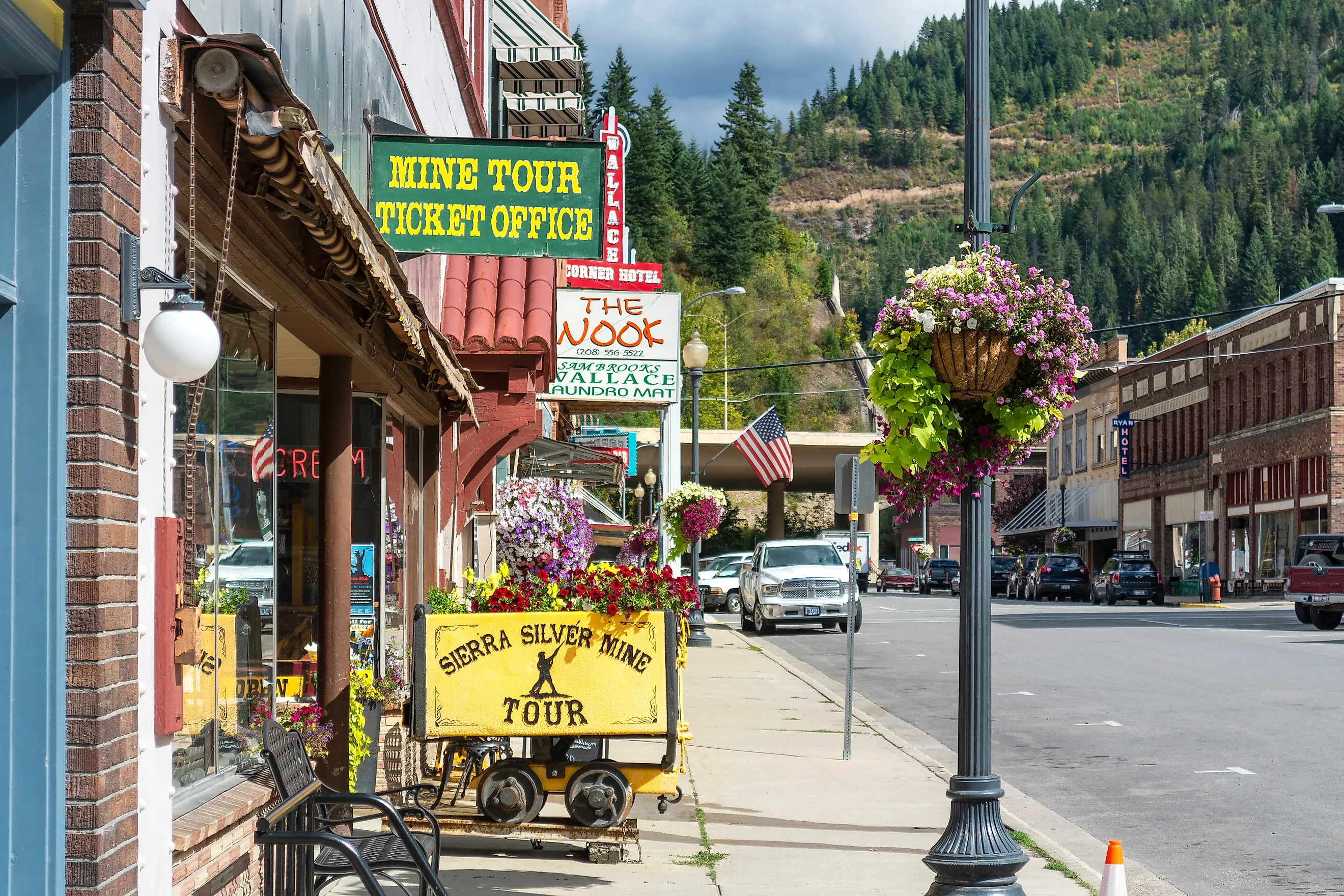
Almost all structures in central Wallace are listed on the National Register of Historic Places, and for good reason. In 1967, highway planners proposed running Interstate 90 straight through downtown. The town resisted by getting its buildings registered, a fight that dragged on for more than two decades. Much of that work fell to a local preservation society, mostly grandmothers who went building to building and filed the paperwork themselves. The railroad depot was listed in 1976, and the downtown district followed in 1979. The interstate finally went up and over on an elevated viaduct, finished in 1991, and downtown never lost a block.
Silver mining still supports the local economy. The Sierra Silver Mine Tour picks visitors up downtown and trolleys them out to an underground training mine, where retired miners demonstrate hard-rock methods. About 20 miles east, the Route of the Hiawatha lets cyclists pedal through former railroad tunnels and over trestles under the Bitterroot Mountains. The Oasis Bordello Museum preserves the former brothel much as it was left when it closed in 1988, down to the groceries on the counter. Ginger Murphy, the madam who ran it, bought uniforms for the high school marching band. Former students later brought one back to hang in her old room.
Cody, Wyoming

Buffalo Bill Cody founded this town in 1896, betting it would become the gateway to Yellowstone. That bet paid off, though Cody never really let go of its welcoming ranching life. Horses can outnumber cars on some side streets in summer. Every night between June and August, lots of the town shows up for the Cody Nite Rodeo, which has run nightly since 1938 and bills itself as the longest-running nightly rodeo in the world. Locals in Old West costumes stage a shootout in front of the Irma Hotel most summer evenings, and anyone in town who feels like being a cowboy that week can just jump in and grab their chance.
At the Buffalo Bill Center of the West, five museums sit together under one roof. Between them, they cover Plains Indian heritage, Western artwork, and antique guns. More than two dozen frontier-era buildings were hauled in from around the region to make up Old Trail Town, reassembled board by board on their new lots. Buffalo Bill opened the Irma Hotel in 1902 and named it for his youngest daughter. The cherrywood back bar in the dining room came from France, and the story the hotel has always told is that Queen Victoria sent it after his Wild West show played for her in London.
The Rockies will never run short on dramatic scenery, but these towns prove that the people can leave just as strong an impression. Long after the mountain views fade into memory, it is the smaller moments that stay with you. A volunteer serving breakfast. A shop owner who stopped to chat. A tradition that refused to disappear. Those are the stories worth taking home long after your trip is done.