8 Of The Most Adorable Small Towns In Oregon
The small towns of Oregon each have one thing they do like nowhere else. Seven monumental bronzes line Joseph's Main Street beneath the Wallowa Mountains. More than 1,300 quilts cover the balconies and storefronts of Sisters each July. Elaborate sandcastles rise on the beach at Cannon Beach for a single day before the tide takes them. In Astoria, Victorian homes stack up the hillside above the Columbia. In Baker City, more than a hundred historic buildings survive from the mining boom. These 8 towns sit well outside Portland and Eugene. A few line the Pacific shoreline. Others sit near the Cascades and the Columbia River Gorge. Two sit in the far northeast corner.
Astoria

Victorian houses stack up the hillside above the mouth of the Columbia, fog rolling through them, a working waterfront underneath. It looks like a film set, which is partly why so much has been shot here. One of the best places to step into that history is the Flavel House Museum, built in 1886 for Captain George Flavel, a river bar pilot who became Astoria's first millionaire. Fourteen rooms of Queen Anne woodwork and wraparound porches are impressive enough on their own. The corner tower, where Flavel watched ships come and go, is particularly fitting for a man whose livelihood revolved around the river.
The river stays close at the waterfront downhill. The Astoria Riverfront Trolley runs a 1913 streetcar called Old 300, originally built for San Antonio. Volunteer conductors narrate, rides cost a dollar, and the trolley runs May through October between Pier 39 and the West Basin Marina. Underneath the tracks runs the Riverwalk, four miles of path past old canneries and heritage buildings, with the Astoria-Megler Bridge arcing overhead and sea lions barking from the docks. That bridge stretches across the Columbia toward Washington and fills much of the view. For an even broader perspective, head uphill to the Astoria Column on Coxcomb Hill. A spiraling mural of the region's history covers the exterior of the 125-foot tower, and the staircase inside climbs to a view of town, river, bridge, and, on a clear day, the Pacific beyond.
Joseph

In 1996, the town's mayor and merchants set out to reshape downtown, burying power lines that interrupted the mountain view and laying cobblestone sidewalks. Six years later, seven monumental bronzes went up along Main Street. A town of roughly a thousand people had turned into an unlikely outdoor art destination beneath the Wallowa Mountains. Today, the self-guided Joseph Art Walk includes more than a dozen life-sized and larger sculptures, among them a depiction of Chief Joseph of the Nez Perce, for whom the town is named. The bronzes are more than Main Street decoration, and their roots in the town run deep. Bronze foundries have operated in Joseph since the early 1980s, and Valley Bronze of Oregon runs foundry tours on Alder Street. They take visitors behind the finished sculptures to see how they are cast.
Beyond downtown, the mountains that frame all that public art become the main attraction. About six miles south, Wallowa Lake stretches through a glacially carved valley between towering moraines, with swimming and boating along its shoreline. From near the lake, the Wallowa Lake Tramway climbs 3,700 vertical feet to the summit of Mount Howard, the steepest tram in North America. At the top, the view from Main Street gives way to a wide panorama across the Wallowa Mountains and Eagle Cap Wilderness.
Jacksonville

When the railroad bypassed Jacksonville in 1884, the boom ended, and business gradually shifted toward nearby Medford. The resulting lack of development helped leave much of its Gold Rush-era core unusually intact, and today the downtown is protected as a National Historic Landmark District. One of the easiest ways to explore it is on the Walk Through History tour, a free, one-hour guided tour that winds past the buildings and streets that survived those quieter decades. The Jacksonville Trolley Tour follows a similar story but covers more ground, making it another way to get acquainted with the historic district.
That history feels more personal at the Beekman House Museum, the 1870s home of Cornelius Beekman, who arrived during the Gold Rush and became one of southern Oregon's most prominent bankers. Costumed docents run themed Victorian tours through the home, covering household details like etiquette and table settings. The tours come close to showing what everyday life looked like for a prosperous Jacksonville family.
Something more contemporary plays out against that same historic setting: the Britt Music & Arts Festival. Summer concerts fill a natural hillside amphitheater on the former estate of pioneer photographer Peter Britt, who documented the same town below in the 19th century.
Sisters

Western-style storefronts fill downtown Sisters, with the Three Sisters rising behind them, though the town's most distinctive feature is considerably softer: quilting. Each July, the Sisters Outdoor Quilt Show ranks as the largest outdoor quilt show in the world. For one day the streets become a gallery, with more than 1,300 quilts hung from balconies, fences, and building fronts across town. The same creative streak shows up again later in the year at the Sisters Folk Festival, usually the weekend after Labor Day. Organizers spread more than 30 musical acts across seven venues under the fitting motto "All the Town's a Stage."
The mountains visible between those storefronts are never far away, either. The Peterson Ridge trail system begins just blocks from downtown, an easy route through the surrounding forest for hikers, runners, and mountain bikers alike. Whychus Creek Trail has an accessible stretch that leads toward an overlook. For a quieter outing, head about fifteen miles northwest toward Suttle Lake, where a shoreline trail winds through fir and maple forest and boats slip out onto the water.
Yachats

A few hundred people live between the Siuslaw National Forest and a basalt shoreline that takes the full force of the Pacific, so in Yachats, the coast is never just background scenery. The 804 Trail is one of the easiest ways to reach it, following a route through town that residents fought for years to keep open to the public. The mostly flat, unpaved, dog-friendly trail traces the water's edge past rocky coves. It connects Smelt Sands, Yachats State Recreation Area, and the Oregon Coast Trail.
The scenery grows even wilder about 2 miles south at Cape Perpetua Scenic Area, where 2,700 acres of coastal rainforest meet the ocean, and 26 miles of trails climb through the headland. At the top stands a stone shelter built by the Civilian Conservation Corps, with a view across as much as 70 miles of coastline on a clear day.
Back at sea level, the same volcanic rock produces some of the coast's most dramatic sights: waves surge into Devil's Churn, Thor's Well appears to swallow the ocean, and the spouting horn at Cook's Chasm sends seawater shooting into the air. After the display, The Little Log Church and Museum is a much quieter final stop, a small building that holds a piece of local history and lives up to its name.
Hood River

Hood River sits in an enviable pocket of Oregon, with orchards spreading through the valley on one side, the Columbia River at its doorstep, and Mount Hood and Mount Adams on the horizon. Downtown is a natural starting point, where restored buildings along Oak Street house galleries, bakeries, and local breweries such as Double Mountain and Full Sail. From the historic depot nearby, the Mount Hood Railroad heads south into the valley, through a landscape long shaped by the fruit-growing industry that runs through much of the area.
You can explore that landscape more closely on the 35-mile Hood River Fruit Loop. The drive winds through the valley past orchards, farm stands, wineries, cideries, alpaca farms, and lavender fields beneath Mount Hood. Back in town, the steady Gorge winds off the Hood River Waterfront Park pull kiteboarders and windsurfers onto the water. Beginners can practice in the more sheltered water around the Hook, while those staying on shore can watch the action before heading to nearby pFriem Family Brewers to end the day.
Cannon Beach

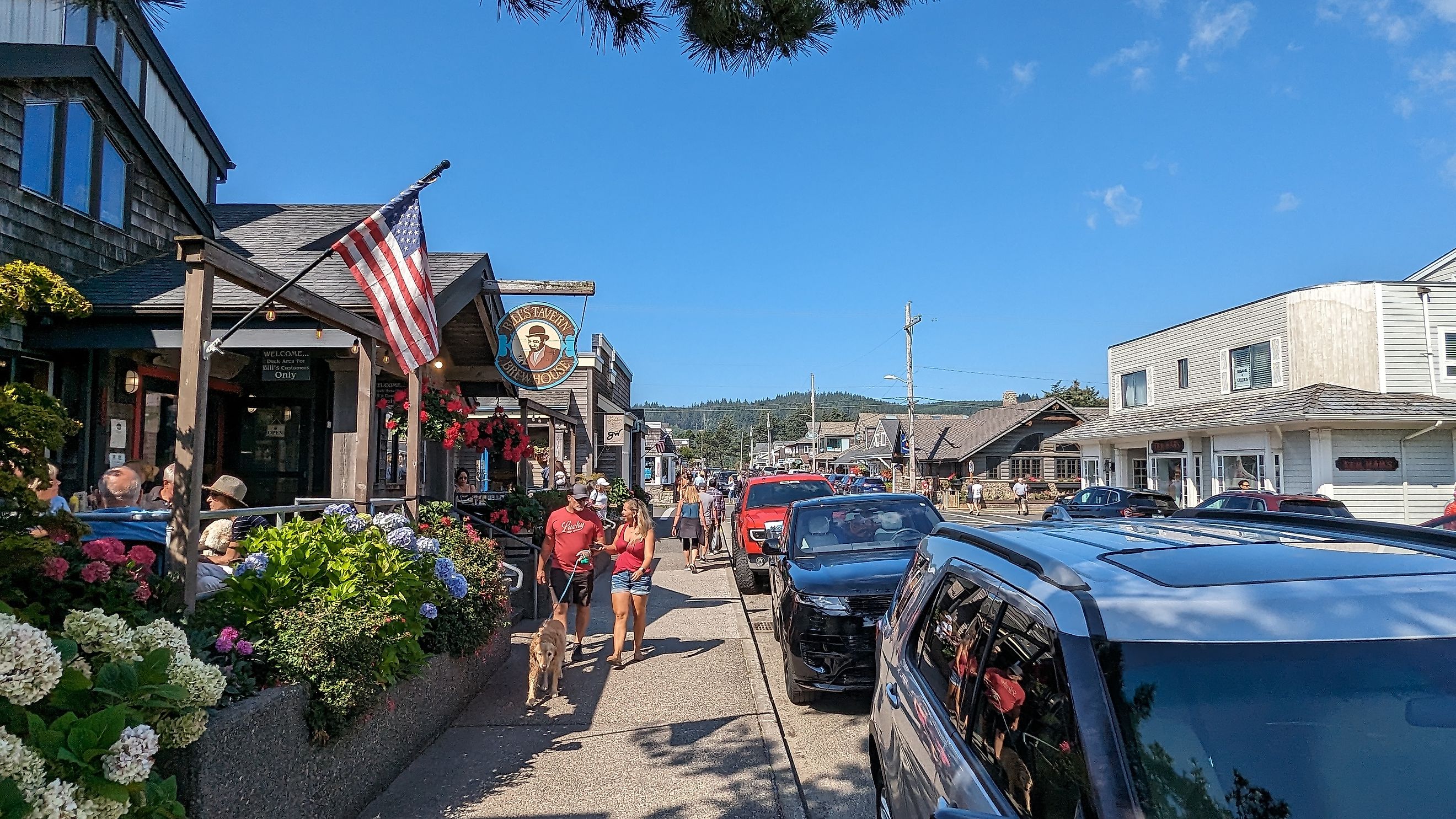
Cannon Beach is hard to mistake for anywhere else on the Oregon Coast: cedar-shingled buildings, a long sweep of sand, and the unmistakable silhouette of Haystack Rock. The 235-foot sea stack stands over the shoreline, and at low tide the surrounding Marine Garden fills with sea stars, anemones, and other tide-pool life. Look higher between late April and early July, and you may also spot tufted puffins nesting near the summit.
The coastline grows wilder just north of town at Ecola State Park, where forested headlands rise above secluded beaches, and viewpoints look back toward Cannon Beach and Haystack Rock. Indian Beach sits between the bluffs, a draw for surfers as well as visitors exploring its rocky shoreline at low tide. The higher overlooks are particularly good places to scan the Pacific for migrating whales. Back in town, Hemlock Street trades ocean views for galleries and studios that show work by Northwest painters, sculptors, photographers, and glass artists. That same creative streak turns up on the sand each June during the Cannon Beach Sandcastle Contest. It started in 1964 after a tsunami washed out the Elk Creek Bridge, and residents now build elaborate sculptures on the beach for a single day before the tide takes them, a fitting finale for a town so tied to the coast.
Baker City

More than a hundred historic buildings fill Baker City's Victorian commercial district, with the Elkhorn Mountains rising behind streets that were shaped by the mining and settlement booms of the late 19th century. One of its grandest survivors is the Geiser Grand Hotel, which opened in 1889, closed in 1968, and returned after an extensive restoration in 1993. Inside, mahogany columns, Victorian-style chandeliers, and a stained-glass ceiling recall the extravagance of Baker City's boom years, even for visitors who are only stopping in for a look.
More of that history sits nearby at the Baker Heritage Museum, housed in the city's former 1920 municipal natatorium. Its collections cover local life across a century and include the Cavin-Warfel mineral collection, whose centerpiece is an enormous Arkansas crystal. A few streets away, the Adler House Museum tells a more personal story in the preserved early-20th-century home of local businessman and philanthropist Leo Adler, largely as he left it. Baker City's history reaches well beyond downtown, too. At Flagstaff Hill, the National Historic Oregon Trail Interpretive Center covers the emigrants, Native peoples, miners, and others tied to the westward migration, and trails outside lead toward surviving wagon ruts. With the actual Oregon Trail landscape still visible beyond the exhibits, the story that starts in Baker City's preserved streets runs far past them.
Small Towns Worth the Drive
None of these places puts on a show for visitors, which is exactly why they work. Joseph and Baker City sit in the far northeast corner and require real commitment. Cannon Beach and Astoria are ninety minutes from Portland. Yachats and Jacksonville reward anyone already heading down the coast or the I-5 corridor. Go in the shoulder seasons if you can, when the sidewalks are empty and shopkeepers have time to talk. What draws people here was never manufactured. It just held on longer than it did elsewhere.