8 Fairy-Tale Small Towns In New Jersey
New Jersey's fairy-tale charm is hiding in plain sight. There is Hope, a stone village built by Moravian settlers in the 18th century, with a museum on local history housed in what may be a 19th century tollkeeper’s house. An elaborate Gingebread Castle in Hamburg recalls a time when architecture could be pure theatrical fantasy. Clinton's historic mills bring an old riverside village to life. Then, there is the seaside town of Spring Lake that surrounds a spring-fed lake with wooden bridges and a white gazebo. These eight small towns show that New Jersey's most enchanting places are not imaginary kingdoms but real communities where history, architecture, and landscape combine to create something almost magical.
Millburn

South in Essex County, Millburn borders the 2,110 acres of South Mountain Reservation, an Olmsted designed landscape it shares with Maplewood and West Orange. Hemlock Brook drops 25 feet over a rock wall there into the West Branch of the Rahway River. The red blazed loop to Hemlock Falls runs 0.6 miles with a climb to the spillway above it. Carriage roads and the Washington Rock Lookout fill out the rest of the reservation. In Short Hills, the Cora Hartshorn Arboretum and Bird Sanctuary covers 16.45 acres of woodland and 3 miles of trails around the Stone House, a trap rock building Bernhardt E. Muller finished in 1933. Taylor Park has covered 13 acres downtown since 1924, and its lawn fills with summer concerts and Fourth of July events. About a five minute walk away, the Paper Mill Playhouse stages musicals on Brookside Drive, including pre Broadway productions and revivals.
Hope

Southwest in Warren County, Moravian missionaries planned out the village of Hope in 1769 and built it in stone. Their gristmill, store, tavern and church still stand along the main streets as shops and homes. The Hope Historical Society runs a museum on High Street in what was likely the 1820s tollkeeper’s house, at the top of the stone bridge over Beaver Brook. An 1850 map of Warren County, old photographs and Moravian records fill its rooms. Visitors pick up the self guided walking tour brochure there, and plaques mark the buildings that predate 1830. Nearby, Land of Make Believe is a pirate themed water park with family rides. At Jenny Jump State Forest, the Summit Trail reaches 1,090 feet and has a stunning view of the Delaware Water Gap. Ghost Lake below it allows boating and fishing, and an astronomy club runs an observatory inside the forest.
Mount Tabor

East in Morris County, Methodists founded Mount Tabor in 1869 as a camp meeting ground. The tented campground became a village of summer cottages, and those cottages became year round homes. Today, the cottages line narrow lanes in Victorian trim, cut and scrolled in the gingerbread style the district is known for, and the neighborhood appears on both the state and national historic registers. A self guided walking tour marks 20 signposts, each with a QR code that pulls up historic photographs of the spot where you stand. Trinity Park sits at the heart of it, with ten lamp posts modelled on late 1800s oil burners and a fountain the historical society helped restore. Nearby, the Richardson History House on Trinity Place is an 1873 camp meeting cottage, and a tour inside shows how families lived during those summer meetings. The historical society has run an annual house tour since 1994.
Hamburg

Hamburg sits in Sussex County along the Wallkill River, where Wheatsworth Road runs past the Gingerbread Castle. The Viennese architect and theater designer Joseph Urban designed the castle. Its owner, F.H. Bennett, built it between 1928 and 1930 next to a mill dating to 1808. Preservation New Jersey lists the two buildings among the state’s endangered places. Today, it remains closed to visits but there are some plans to renovate it. Farther along the same road, golfers play Ballyowen Golf Club over a treeless rolling meadow modelled on the heathland links of Ireland and Scotland. The course offers 360-degree views across the Wallkill Valley, and a bagpiper plays at Owen’s Pub for patrons. Crystal Springs Resort runs the course along with the nearby Grand Cascades Lodge. Guided tours at the lodge walk through a wine cellar of nine connected chambers, and swimmers can experience a tropical pool indoors in its Biosphere Pool Complex.
Clinton

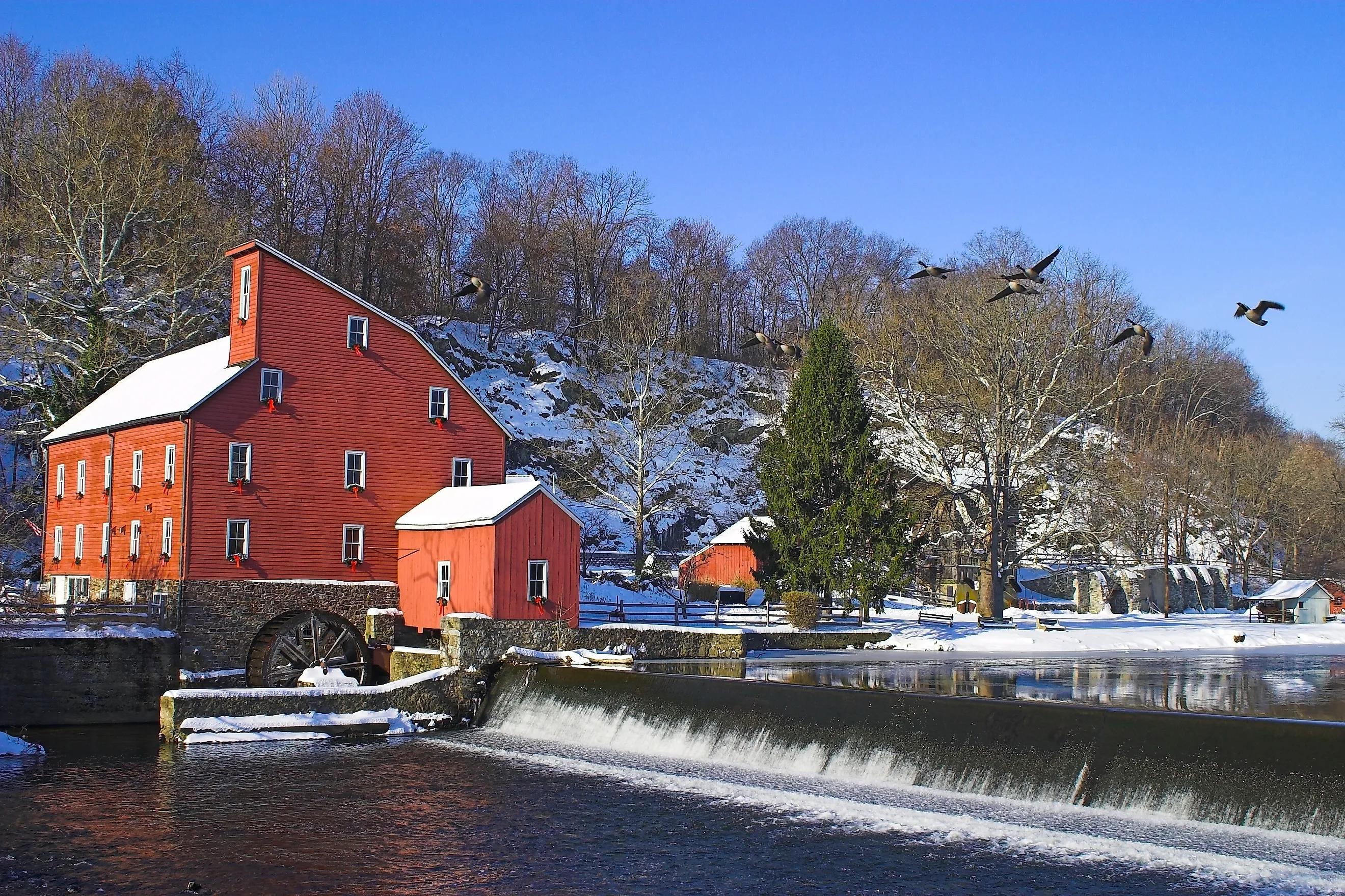
Southwest in Hunterdon County, Clinton sits on the South Branch of the Raritan River, with the Red Mill above the water. Ralph Hunt built the mill around 1810 to process wool, and it operated until 1928. Today the Red Mill Museum Village spreads over 10 acres with a quarry, a one room schoolhouse, a log cabin and a working blacksmith shop. Every October the staff turn the mill over to the Haunted Red Mill fundraiser, with gentler Happy Haunts for younger visitors. Directly across the water, the Hunterdon Art Museum shows contemporary art, craft and design inside a 19th century stone mill on the National Register. The museum also teaches classes and hosts workshops in the same building. The streets above both mills make up a historic district of more than 200 buildings built between 1810 and 1930, heavy on Greek Revival and Italianate.
Frenchtown

West of Clinton, Frenchtown was built along the Delaware River at the foot of Bridge Street. A six span steel truss bridge opened there in 1931 and still crosses over to Uhlerstown, Pennsylvania. Before the modernized steel structure, a wooden covered bridge stood at that crossing, originally built in 1843. A walkway along one side now lets people cross the river on foot. On the New Jersey bank, the upper trail of Delaware and Raritan Canal State Park follows the river south along the old Belvidere and Delaware Railroad bed. Among the Victorian storefronts behind it, ArtYard runs exhibition galleries and the 162 seat McDonnell Theater across four buildings near the middle of town, with live performance, film screenings and an artist residency. FiNNBAR serves a rotating menu inside the old Frenchtown Inn, and Sunbeam General Store, in business since 1889, sells gifts, toys and outdoor gear on the same street.
Lambertville

Downriver from Frenchtown, the canal and the Delaware run side by side through Lambertville. The People’s Store Antiques Center has been a landmark on North Union Street since 1839, and more than 50 dealers now sell furniture, silver, porcelain, paintings and vintage clothing across its four floors. Lambertville Station serves dinner inside an 1867 train depot restored to its original details, with the canal and the river in view from the tables. James Wilson Marshall lived on Bridge Street from about 1817 to 1834. In 1848, he found gold at Sutter’s Mill that drove prospectors to the California Gold Rush. The Lambertville Historical Society now runs the home as a museum, with the parlor and a bedroom furnished to match life in the 1830s. Its volunteers lead guided walking tours of the central district from spring through fall.
Spring Lake

Spring Lake surrounds a spring fed lake on the Monmouth County shore, and Divine Park rings that water with roughly 1.3 miles of sidewalk. Walkers cross the lake on two wooden bridges and pass a white gazebo at the northwest end, while boats and kayaks cruise the water. St. Catharine Church, on Essex Avenue, has 27 paintings throughout its interior walls. In 1904, Gonippo Raggi came from Rome to create them and finished the last by 1928. His works span the seven Sacraments, a Pentecost and copies of Raphael. Martin Maloney donated the church to the Diocese of Trenton in memory of his daughter Catharine, who died in 1900 at 17. On the ocean side, the boardwalk runs above two miles of beach, and the North End and South End Pavilions each have a swimming pool and a bathhouse. Two galleries at the Spring Lake Historical Society on Warren Avenue show exhibits on the town's early history all the way up to the present. The Community House on Madison Avenue stages plays and musicals through the season.
While these New Jersey towns may feel like a fairy tale, they are perfectly real and waiting for you to experience them. A fantastical escape can take place while crossing a river on foot, or while climbing a ridge for a panoramic view, and even while walking a lane of historic cottages from end to end. Each town is an adventure of your choosing; all you need to bring is your imagination.