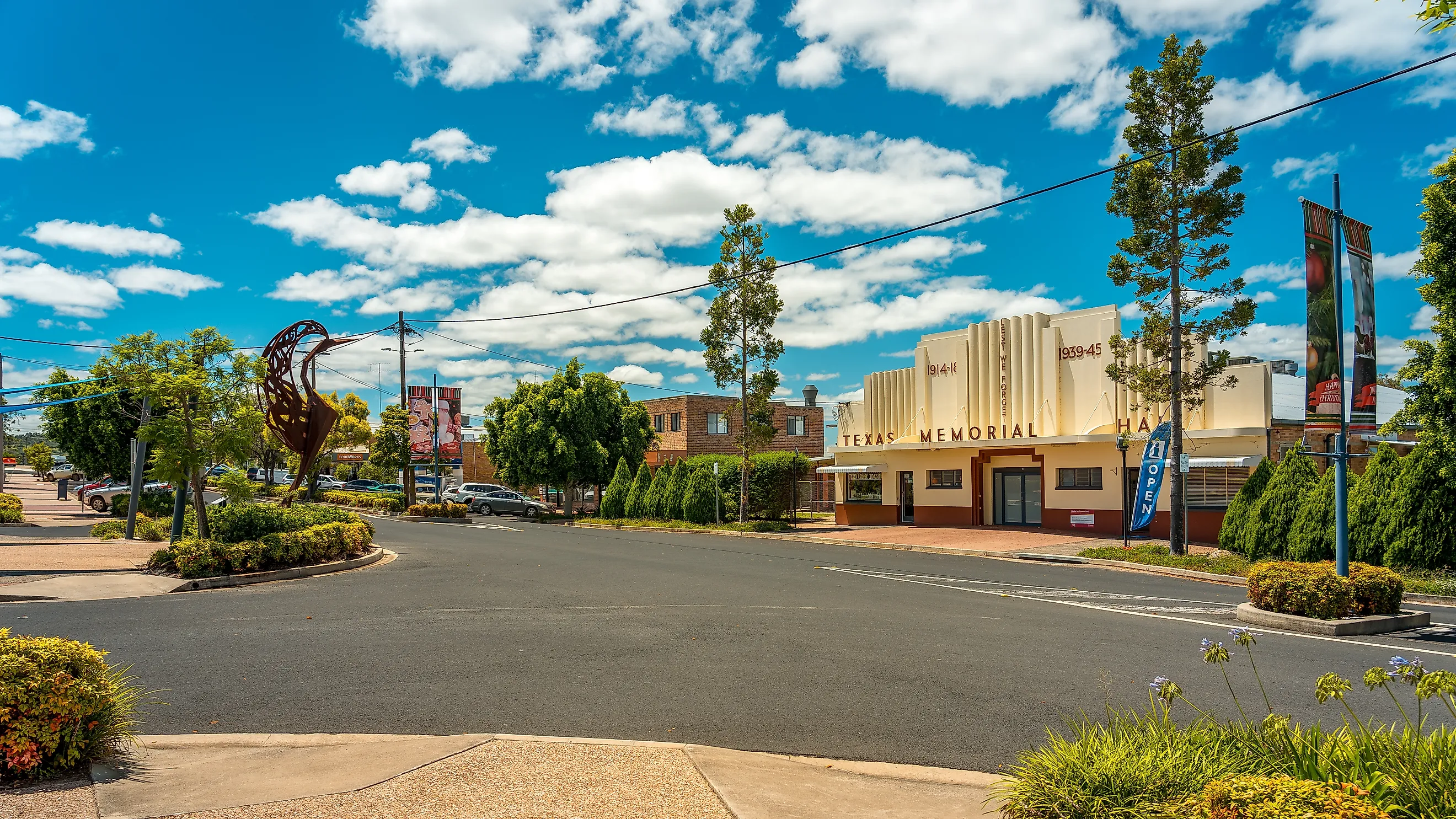
You Won't Believe This Town Is In Queensland
Texas is a town in Queensland's border country with an American name that has stuck since the 1840s. Its bicentennial park is planted with pecan trees sent over by citizens of its U.S. namesake. The Dumaresq River runs along the edge of town past the ruins of old tobacco barns. From there the options open up into fishing and canoeing and hill walks with views over the valley. The national parks just across the New South Wales border take hikers through sandstone country where black-striped wallabies and rare geckos still turn up.
How a Queensland Town Became Texas

Before European settlement, the region was home to the Bigambul people, who relied on the Dumaresq River for water and sustenance. In the 1840s, J. McDougall and his brothers came to the land to take advantage of its fertile soil. At first, they called it Cullybullan, but changed it to Texas.
The name changed after a conflict with squatters, which the McDougalls compared to the border tensions between the Republic of Texas and Mexico, giving the settlement its unlikely name.
With its location on the Dumaresq River, the town experienced rapid growth, adding cattle farming, a mine, a cheese factory, and a tobacco factory. At one time, Texas produced up to 25% of Australia's tobacco. The town's fortunes were not always secure, and by the 1920s, it was facing a rabbit plague that devastated nearby farmland. The community responded by transitioning to a rabbit meat production facility, capturing and using the rabbits for meat and skin.
Rabbit Works, Tobacco, and Rail
Texas preserves its distinctive local history through its unusual museums. One such museum is the Texas Rabbit Works Museum. The museum stands on the site of the original factory, where trapped rabbits were processed for export to the United States and England. It employed 33 people and processed 6,000 rabbits daily, a crucial factor in the town's survival during the Great Depression.
Today, the museum maintains the old equipment and artifacts of rabbit trapping and processing, which were so crucial to this town's livelihood. Texas also preserves its tobacco-growing history through the Texas Heritage and Tobacco Museum. The museum includes a complex of buildings, including a shearing shed, jail and stocks, a smithy, a Post Office Store, and a School Room, giving visitors a broader sense of the town's working past. It preserves artifacts related not just to tobacco farming but also to silver mining.
Texas doesn't just keep history alive through artifacts; it also revives old ways of life, as seen at the Texas Railway Museum. This museum is currently working to rebuild an old rail line to take passengers out on rides on its historic locomotives. The railroad ran in Texas from 1930 to 1994, when it shut down due to the onset of motorized trucks as an alternative.
On the Dumaresq and Beyond
While Queensland is commonly associated with beaches, Texas's outdoor attractions reflect its river setting and its unusual connection to its American namesake. Visitors can make their own outdoor adventure by choosing a spot on the Dumaresq River to fish. All around the river, one can find the ruins of tobacco barns, a reminder of a bygone era. Visitors can also take canoes out onto the serene river that runs through the backcountry hills of Queensland.
Near the centre of town is the Texas Bicentennial Park, which honors the arrival of the First Fleet to Australia in 1788 by Captain Arthur Phillip, marking the beginning of European settlement of the continent. This park reflects the town's connection to Texas, with pecan trees planted throughout. These trees were donated by citizens from Texas, U.S., as an offer of friendship since the pecan is a staple of Texan agriculture.
For more rigorous outdoor activities, there's the 12-hole course at the Texas Golf Club, which offers scenic views of the surrounding hills and opportunities to meet locals during Thursday social rounds.
Another option just outside town is Glenlyon Dam, which offers waterskiing, canoeing, swimming, and fishing. For those who prefer hiking, Texas also sits within reach of several national parks and state forests, including Kwiambal National Park to the south and Dthinna Dthinnawan National Park to the west, both across the border in New South Wales. These parks are well-suited to secluded bushwalking. Dthinna Dthinnawan is named after the original word for a place where an emu footprint is found. By exploring this park, visitors can spot rare black-striped wallabies or zig-zag velvet geckos.
Hikers can take in a scenic overview of the town by driving east to the Beacon Lookout, which sits on a hill facing the wider Dumaresq River valley.
A Town Unlike the Rest of Queensland

When faced with the adversity of feral rabbits destroying their tobacco crops, Texans rolled up their sleeves and created a booming rabbit industry. When the railway closed, Texans preserved as many of the historic cabooses as they could and are working to turn them into a local heritage attraction. It's not all hard work in Texas, as they know how to relax, whether that's on a golf hole at the course or spending a day fishing at the river. What stays with visitors is how fully Texas, Queensland, embraces its unusual name, border-country history, and small-town way of life.