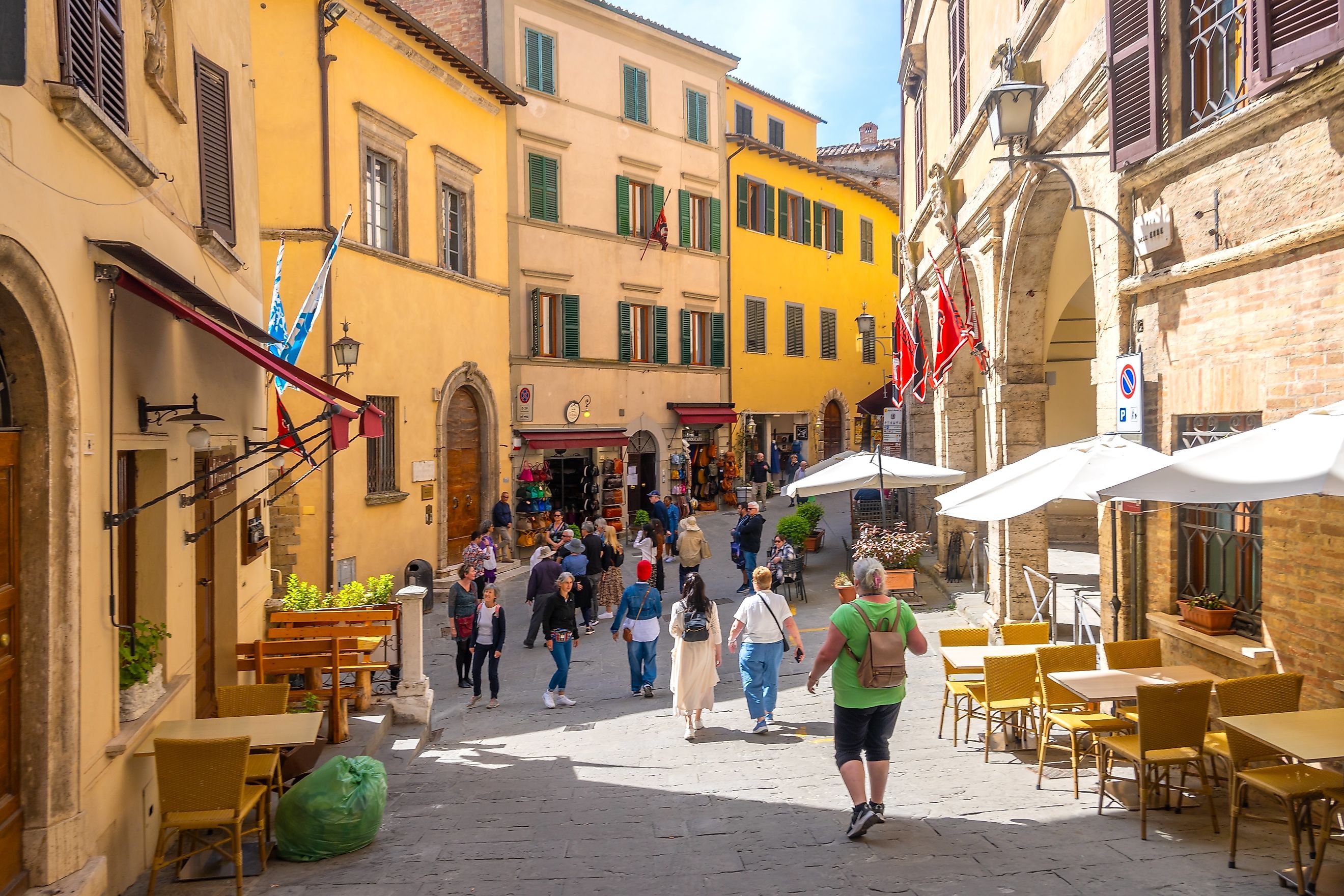
This Is The Friendliest Small Town In Italy
Montepulciano sits on a 605-meter limestone ridge in southern Tuscany, halfway between the Val d'Orcia and the Val di Chiana. Roughly 13,000 people live in the comune, and a tight historic core of Renaissance palaces, churches, and stone-paved streets has stayed largely intact for the better part of five centuries. The town gives its name to Vino Nobile di Montepulciano, the red wine that became the first in Italy to receive DOCG status in 1980. Wine production still anchors local life, and the calendar of public events that surrounds it (the February Anteprima previews, the August Bravio delle Botti barrel race) gives most visits to Montepulciano a clear shape.
A Hilltop Town That Survived Its Own History

The settlement on the ridge dates to Etruscan times, and a community on the hill has existed since at least the 4th-3rd century BCE. After the fall of the Western Roman Empire, the town developed into a religious center under the Lombards, then became a contested stronghold throughout the 12th century, repeatedly attacked by the Republic of Siena. Montepulciano signed a formal alliance with Florence in 1390 after expelling the Del Pecora family, and the alliance held through the 15th and early 16th centuries. The town's golden age followed when Florence brought in the leading architects of the early Italian Renaissance (Antonio da Sangallo the Elder, Jacopo Barozzi da Vignola, Baldassarre Peruzzi) to design the palaces that still line the streets today. Florence's conquest of Siena in 1559 ended the regional rivalry that had given Montepulciano its strategic importance, and the town gradually settled into the agricultural and wine-producing role it has kept ever since.

The town's defensive layout still shows in the modern street plan. Most streets curve uphill toward Piazza Grande at the summit, the original gathering and command point. Walls, civic buildings, and churches across the historic center now provide a continuous architectural record from the medieval period through the late Renaissance.
The Wine Scene

Vino Nobile di Montepulciano is made from at least 70 percent Sangiovese, locally called Prugnolo Gentile, and aged for a minimum of two years before release. It became the first DOCG wine in Italy when the appellation system was introduced in 1980. The Riserva tier requires three years of aging, and a newer Pieve designation released for the 2022 vintage subdivides the territory into 12 historical zones based on the medieval parish boundaries that defined them. The local Consorzio represents about 80 producing wineries, and Montepulciano is widely considered alongside Brunello di Montalcino and Chianti Classico as one of Tuscany's three principal red wine regions.
In town, two cellars built into the historic streets give a fast introduction to the local wine. Cantina De' Ricci runs cathedral-like vaulted underground rooms cut into the tufa beneath a Renaissance palace and offers tours along with tastings. Cantina Contucci, just steps from Piazza Grande in Palazzo Contucci, has been making wine on the same property for centuries and is considered one of the oldest active producers in town. In the surrounding countryside, estates such as Avignonesi, Poliziano, Boscarelli, and Icario produce well-regarded examples of the appellation and run tastings paired with views back toward the town's skyline and the Val d'Orcia.
The February Anteprima

Each February, the Consorzio del Vino Nobile holds the Anteprima del Vino Nobile, the official preview of the year's new vintages. The 2026 edition (the 32nd) ran February 22-23 inside the Fortezza Medicea just below Piazza Grande and gathered 57 producers, the largest turnout in the event's history. Tastings cover the Vino Nobile annata, the Riserva, the new Pieve designation, the Rosso di Montepulciano, and Vin Santo. The Anteprima sits inside the broader Settimana delle Anteprime di Toscana, the regional preview week that introduces buyers, journalists, and visiting enthusiasts to the new releases from Tuscany's main appellations. Public tickets sell out quickly and registration closes ahead of the event, so booking the trip well in advance is the safer approach.
Piazza Grande And The Bravio Delle Botti

At the top of the hill, Piazza Grande concentrates the most important civic and religious buildings of Montepulciano in a single small square. The unfinished brick facade of the Duomo di Montepulciano (completed between 1594 and 1680) faces the crenellated Palazzo Comunale, designed by the Florentine architect Michelozzo and modeled on the Palazzo Vecchio in Florence. The Palazzo Comunale tower can be climbed for one of the better long views over the Val d'Orcia. Renaissance palaces such as Palazzo Contucci and Palazzo Tarugi line the remaining sides of the square.

The square hosts the finish line of the annual Bravio delle Botti, held the last Sunday of August. Two pushers from each of the town's eight contrade race an 80-kilogram empty wine barrel along a 1.8-kilometer uphill route through the historic center, ending in front of the Duomo. The current barrel format dates to 1974, when a parish priest, Don Marcello Del Balio, replaced the older horseback version of the race, which traces back to the 14th century. The week leading up to the race is the busiest of Montepulciano's calendar, with public dinners in each contrada, evening processions by torchlight, and flag-throwing displays in the square.
The Sanctuary Of The Madonna di San Biagio

A short walk west of the historic center brings you to the Sanctuary of the Madonna di San Biagio, a Greek-cross church standing alone in open country below the town walls. Antonio da Sangallo the Elder designed it, and construction ran from 1518 to 1545 on the site of an earlier pieve where a miraculous image of the Virgin was said to have appeared. The building is one of the most influential examples of central Italian Renaissance church architecture and is widely studied as a forerunner to later Roman designs.

The setting is part of the appeal. The church sits among orchards and farmland with clear sightlines back toward Montepulciano's outer walls, and visitor numbers stay much lower than at the central piazza. Most travelers walk down from the town in 15-20 minutes and combine the visit with time in the historic center afterward.
Where To Stay
Inside the walls, restored townhouses, small guesthouses, and a handful of boutique hotels occupy buildings dating to the 16th and 17th centuries. Rooms are usually compact, parking is limited, and access often involves walking up steep streets, but staying inside the historic core puts you within a short walk of every major site. Outside the walls, agriturismos and rural villas offer larger rooms, on-site vineyards or olive groves, and meals built around local products. Demand peaks from late spring through early fall, when both inside-the-walls hotels and surrounding agriturismos fill quickly. Booking ahead by several months is the safest approach for travel between May and October.