2026's 8 Best Small Towns To Visit In Switzerland
Switzerland's smaller towns are gateways to some of the country's most significant landmarks. In Zermatt, the Gornergrat Railway climbs to 3,089 meters (10,135 feet) for views of the Matterhorn and surrounding glaciers. Lauterbrunnen sits in a deep valley and is home to Staubbach Falls, which drops about 300 meters (984 feet) off a steep cliff behind the village. Appenzell preserves distinctive cultural traditions, such as the annual Landsgemeinde, an open-air cantonal assembly held on the last Sunday in April. These eight destinations give travelers plenty to explore beyond Switzerland's major cities and are well worth a visit in 2026.
Zermatt

The Matterhorn rises to 4,478 meters (14,692 feet) above Zermatt, making the village one of Switzerland's best-known Alpine destinations. The Gornergrat Railway is Switzerland's first electric cogwheel railway. It opened in 1898 and climbs from Zermatt to 3,089 meters (10,135 feet), where visitors can see the Matterhorn, glaciers, and numerous peaks exceeding 4,000 meters. The railway remains one of Zermatt's signature excursions.
Hikers can follow the Five Lakes Walk, an 11.3-kilometer (7-mile) route linking Stellisee, Grindjisee, Grünsee, Moosjisee, and Leisee. Under favorable conditions, the Matterhorn is reflected in several of the lakes. Back in town, visitors can explore the historic Hinterdorf district, where old wooden buildings recall Zermatt's farming past. The Matterhorn Museum also documents local history and the first ascent of the iconic mountain.
Grindelwald

Grindelwald sits beneath the Eiger in the Bernese Oberland and provides access to several major mountain excursions. Visitors can travel through the Jungfrau region toward Jungfraujoch, where Europe's highest railway station stands at 3,454 meters (11,332 feet). Another popular outing begins with the gondola ride to Grindelwald First. At the summit area, the First Cliff Walk follows the mountainside on elevated walkways and ends at a viewing platform overlooking the surrounding Alps. From First, hikers can reach Bachalpsee, a mountain lake at 2,265 meters (7,431 feet). The return hike from First takes about two hours. Travelers looking for more adventure can also try the First Flyer, a zip line that carries riders downhill at speeds of up to 80 kilometers per hour (50 mph).
Lauterbrunnen

Lauterbrunnen occupies a steep-sided Alpine valley associated with 72 waterfalls. Staubbach Falls drops about 300 meters (984 feet) from the cliff immediately behind the village and is one of the valley's most recognizable sights. Farther south, Trümmelbach Falls carries glacial meltwater from the Eiger, Mönch, and Jungfrau through a series of waterfalls inside the mountain. Visitors can explore the falls using tunnels, paths, stairs, and viewing platforms during their seasonal opening period.
Lauterbrunnen is also a convenient starting point for visiting mountain villages above the valley. The Wengernalp Railway climbs from Lauterbrunnen to car-free Wengen, while cable cars and connecting transport provide access to Mürren. Visitors can spend a day combining Staubbach Falls and Trümmelbach Falls with an excursion to either village.
Appenzell

Appenzell is known for its decorated buildings, regional traditions, and proximity to the Alpstein mountains. Visitors can walk along Hauptgasse, where brightly painted façades line the historic center, before visiting Museum Appenzell. Its exhibits trace the cultural history of Appenzell Innerrhoden, including embroidery, folk art, furniture painting, and traditional customs. The village also hosts the annual Landsgemeinde, an open-air cantonal assembly held in Landsgemeindeplatz on the last Sunday in April.
Outdoor excursions begin in the nearby Alpstein range, which contains hiking routes, mountain inns, and cableways. Ebenalp is one of the most accessible destinations, with trails leading toward the famous Äscher mountain restaurant. Visitors can also explore Seealpsee, a mountain lake surrounded by steep Alpine terrain.
Stein am Rhein

Stein am Rhein is best known for its remarkably preserved old town beside the Rhine. Rathausplatz is lined with historic buildings decorated with elaborate painted façades and projecting oriel windows. Visitors can also tour the former Abbey of St. George, a medieval Benedictine complex whose rooms contain historic interiors, artwork, and carved woodwork. Together, the square and abbey provide a detailed look at the town's architectural and religious heritage.
Above town, Hohenklingen Castle overlooks the Rhine and the rooftops of Stein am Rhein. The castle can be reached on foot and offers broad views across the surrounding countryside. Travelers can also take a seasonal boat trip along the Rhine and nearby Lake Constance, connecting Stein am Rhein with other waterfront communities.
Gruyères

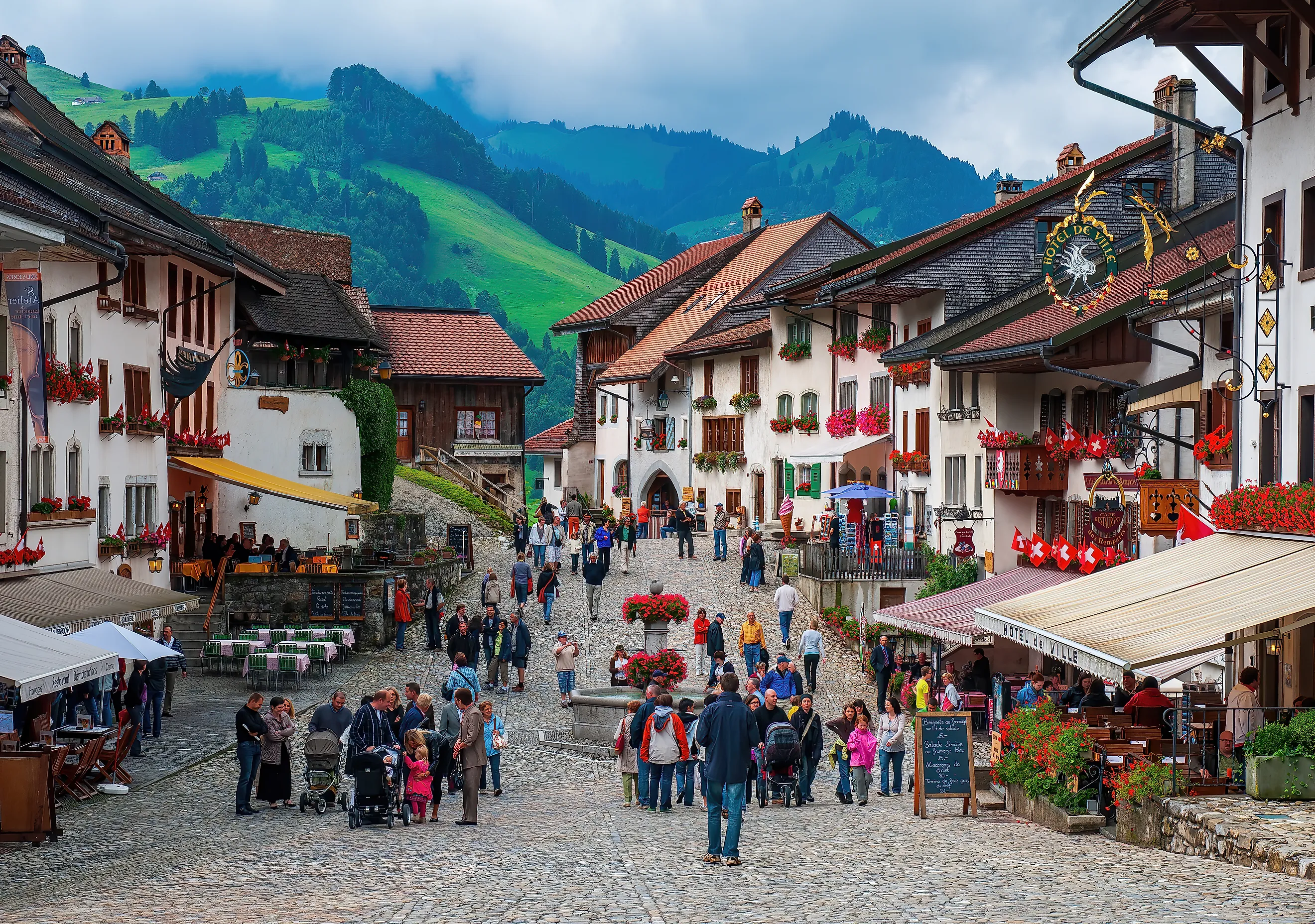
The medieval hill town of Gruyères is largely closed to regular visitor traffic, making its historic center easy to explore on foot. At the upper end of the town stands Gruyères Castle, whose exhibits span centuries of regional history, art, and legend. Visitors can explore its furnished rooms, ramparts, garden, and exhibitions. The walk along the cobbled main street toward the castle is itself one of the town's defining experiences.
Near Gruyères railway station, La Maison du Gruyère introduces visitors to the production and history of Gruyère AOP cheese. Back in the medieval center, the H.R. Giger Museum displays an extensive collection of the Swiss artist's work, including designs for the visual world of the film Alien. Visitors can also spend time exploring the town's medieval streets and historic buildings.
Murten

Murten, also known as Morat, sits on the southeastern shore of Lake Murten and retains a well-preserved medieval center. Visitors can walk sections of the historic ramparts for elevated views across the roofs and lake. Below the walls, the old town is lined with arcaded streets, fountains, shops, and historic buildings. The town is also closely associated with the Battle of Murten, fought nearby in 1476 during the Burgundian Wars.
The lake provides several options beyond the historic center. Seasonal passenger boats depart from Murten for cruises across Lake Murten, while nearby Mont Vully is known for vineyards, walking trails, and views across the Three Lakes region. Visitors can therefore combine the ramparts and old-town streets with a lake cruise and an excursion to Mont Vully.
Ascona

Ascona sits on the northern shore of Lake Maggiore in Switzerland's Italian-speaking canton of Ticino. Its lakeside Piazza Giuseppe Motta is lined with colorful buildings, cafés, and a waterfront promenade. Behind it, Ascona's historic center contains narrow lanes, courtyards, art galleries, and old buildings. Walking between the piazza and the surrounding streets is an easy way to explore the town's combination of lakeside scenery and architecture.
Above Ascona, Monte Verità preserves the history of an early 20th-century community associated with artists, writers, and alternative social movements. Its museum complex includes Casa Anatta and other historic buildings. Visitors can also take a boat to the Brissago Islands, whose botanical garden features plants from subtropical regions worldwide.
Small Towns, Big Rewards
Zermatt, Grindelwald, and Lauterbrunnen put some of Switzerland's best-known Alpine landscapes within easy reach of trains and hiking trails. Appenzell and Stein am Rhein add historic streets, museums, and regional traditions, while Gruyères and Murten preserve substantial medieval heritage. Farther south, Ascona brings Lake Maggiore, art, and botanical attractions into the mix. Together, these eight towns offer mountain excursions, historic sites, museums, and waterfront outings beyond Switzerland's largest cities.