2026's 11 Most Scenic Ontario Towns
Ontario has a set of towns you just have to slow down for. A limestone gorge runs straight through the middle of Elora, deep enough that the overlooks feel unreal. In Goderich, eight streets radiate like spokes around an octagonal courthouse square. In Tobermory, the water in a limestone sea cave turns a shade of blue you would expect somewhere far south of the Bruce Peninsula. These 11 small towns, built around rivers, waterfalls, and impossibly clear water, are the ones worth a full tank of gas and the long way around.
Niagara-on-the-Lake

Niagara-on-the-Lake, a town of about 20,000 where the Niagara River empties into Lake Ontario, is often called the prettiest town in Canada, and the flower-lined streets make it hard to argue. At the heart of it is Queen Street, one of the best-preserved 19th-century streetscapes in the country, all Victorian storefronts and hanging baskets. Local spots line the street, among them 11th Post on Queen for a meal or the Shaw Festival Theatre for a show. History sits right at the edge of the water at Fort George National Historic Site, a restored War of 1812 British fort above the river below the town. Drive the Niagara Parkway out of town and you reach wine country, where estate vineyards run toward the escarpment. Between the theater, the gardens, and the tasting rooms, this is a town for a slow, enjoyable afternoon.
Elora

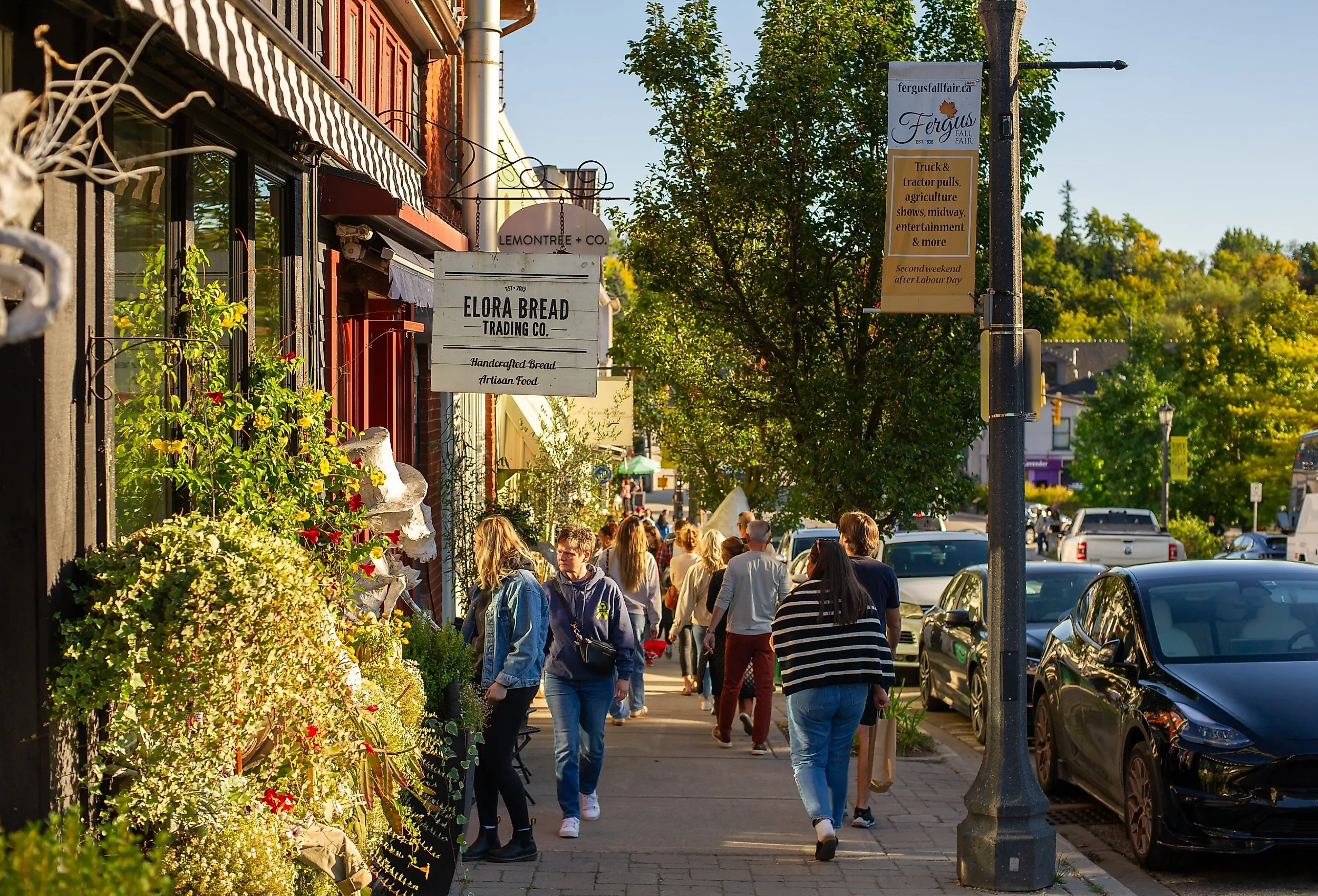
Elora, a limestone village of roughly 6,000 on the Grand River, is one of the most photographed places in Ontario, and one look at the gorge explains why. The Elora Gorge is a limestone canyon around 70 feet deep, cut straight through the bedrock, with riverside trails for novice and avid hikers and overlooks that feel almost unreal. Above the falls stands the restored 1832 Elora Mill, a five-story limestone grist mill turned hotel, and just below it sits the Tooth of Time, a stubborn islet of rock in the middle of the current. Down at street level, Mill Street runs along the river with 1800s stone shops, galleries, and cafes, including the popular Lost & Found Café for a good brew and all-day breakfast. It is small, walkable, and photogenic at nearly every corner.
Goderich

Goderich, a Lake Huron town of about 7,700 that locals bill as the prettiest in Canada, is laid out around one of the most unusual downtowns in the country. Its center is Courthouse Square, a genuine octagon of heritage storefronts around the county courthouse, with eight streets radiating out toward the lake. Follow one down to the water and you reach the Goderich Lighthouse, built in 1847 and the oldest on the Canadian side of Lake Huron, on a bluff above three sandy beaches and a long waterfront boardwalk. Take another and you can join a guided tour of the Huron Historic Gaol, a 19th-century jail. The town is famous for its sunsets, and for good reason: the sky over the lake turns to color most evenings. For a walk with a view, cross the Menesetung Bridge, a converted 1907 railway span high above the Maitland River.
Stratford

Stratford, a city of about 36,500 on the Avon River, may be famous for its theater festival, but its signature image is the river itself, sliding past parkland with white swans on the surface. Those swans, released onto the river each spring in a celebrated parade, are the emblem of the town. Along the banks are the Shakespearean Gardens, a formal riverside garden beside an old stone bridge, and the grassy expanse of Lake Victoria. The modernist Festival Theatre, home of the Stratford Festival, sits on a rise above the water. In Stratford, with its preserved 19th-century downtown and miles of riverside paths, the water is the main draw and the river is never far from view.
Huntsville

Huntsville, the largest town in Muskoka at about 24,500, sits on a chain of lakes and rivers that made it a favorite of the Group of Seven painters. Its walkable downtown runs along the Muskoka River, where a historic swing bridge still pivots open over the water, and painted murals of Group of Seven works spread across the building walls like an open-air gallery. The real eye-catcher is just outside town at Arrowhead Provincial Park, with its waterfalls, beaches, and well-known winter skating trail, along with the island-dotted expanse of Lake of Bays. Add the gateway drive into Algonquin Provincial Park a half hour east, and Huntsville is the launch pad for some of the most photographed wilderness in the province.
Gravenhurst

Gravenhurst, a town of just under 15,000 on Lake Muskoka, is known as the gateway to Muskoka, and it looks the part. The center of the action is the Muskoka Wharf, an 89-acre revitalized waterfront on the lake with shops, a marina, and local favorites such as The Blue Willow Tea Shop. Tied up alongside is the star attraction, the RMS Segwun, the oldest operating steamship in North America, built in 1887 and still cruising the lake next to the sleek Wenonah II. The Muskoka Boat and Heritage Centre on the wharf holds a collection of antique wooden boats, a nod to the region's cottage-country history. With the lake spread out beyond the docks, Gravenhurst offers the Muskoka postcard without the drive deeper north.
Port Hope

Port Hope, a town of about 18,600 on Lake Ontario, has one of the best-preserved main streets in the province. That street is Walton Street, a wall-to-wall stretch of 19th-century storefronts curving down toward the lake, with the Capitol Theatre at its center, one of the last atmospheric theaters still operating in Canada, complete with a painted-sky ceiling. The Ganaraska River runs right through downtown, and every fall spawning salmon fight their way upstream through the middle of town. Follow the river down to the lake and you reach the sandy East and West Beaches. Add rolling countryside just past the edge of town, and Port Hope's reputation as one of the most photogenic small towns in Ontario is easy to understand.
Merrickville

Merrickville, a village of about 3,500 on the Rideau Canal, is regularly named one of the prettiest in Canada, and its setting on the water backs up the claim. The Rideau Canal, a UNESCO World Heritage site, runs through town in a three-lock flight, with the massive stone Merrickville Blockhouse of 1832 beside it, moat and all, the largest of the four blockhouses built along the canal. The heritage main street is said to hold more designated historic buildings than any Ontario community its size, filled today with galleries, studios, cafes, and local classics such as the Mainstreet Restaurant & Patio. Down by the river, the ruins of the old Industrial Heritage Complex sit on an island in the current, a photogenic reminder of the village's mill-town past. Small, storied, and lined with limestone, Merrickville rewards a slow wander.
Gananoque

Gananoque, a town of about 5,500 on the St. Lawrence River, is the Canadian gateway to the Thousand Islands, one of the most beautiful stretches of water in the country. From the town docks, visitors board cruises that thread among the archipelago's granite islands, summer cottages, and even a castle or two. In town, the Gananoque River drops over a small waterfall beside Confederation Park, and the waterfront marina fills with boats all summer. For an evening out with a view, the Thousand Islands Playhouse stages shows in the restored 1909 Gananoque Canoe Club, right on the water. Between the river, the islands, and the parks, the shoreline is where nearly everything in town happens.
Collingwood

Collingwood, a town of just over 29,000 on Georgian Bay, is the rare Ontario spot where a bright shoreline meets a genuine mountain backdrop. Just outside town rise The Blue Mountains, home to Blue Mountain Resort, the province's largest ski hill in winter and a base for hiking and biking the rest of the year. Higher up, Scenic Caves Nature Adventures on the Niagara Escarpment has a long suspension bridge strung above the treetops, with the bay in the distance. Down at the water, the towering old grain elevators known as the Collingwood Terminals rise like a castle over the harbor, and Sunset Point Park opens onto wide views across the bay. Add the waterfront Georgian Trail for cyclists, and Collingwood works as a four-season scenic base.
Tobermory

Tobermory, a harbor village of around 1,500 at the northern tip of the Bruce Peninsula, is arguably the most striking entry on this list, largely because of the water. The star is the Grotto, a limestone sea cave in Bruce Peninsula National Park where the water glows an almost tropical blue. Offshore, boat tours run to Flowerpot Island in Fathom Five National Marine Park, named for the flowerpot-shaped rock pillars along its shore. Back in town, Big Tub Harbour is so clear you can look down at two 19th-century shipwrecks resting on the bottom, with the little Big Tub Lighthouse at the entrance. Cliffs, coves, and turquoise shallows make this the closest Ontario comes to the Caribbean.
Skip the Highway and Take the Scenic Route
Ontario's prettiest corners are not the ones you rush past on the highway. They are the towns where the river runs through the middle of downtown, where the sunset over the lake is worth stopping for, and where the walk from a morning coffee to the water takes about five minutes. The draw in Niagara-on-the-Lake is its flower-lined streets; in Tobermory, its glowing blue coves; in Elora, a gorge cut through solid limestone. Eleven towns, eleven reasons the scenic route beats the fast one. Pick one and give it an unhurried afternoon.