13 Most Welcoming Towns In Georgia's Countryside
In Greensboro, touring the oldest masonry jail in the state means borrowing a key from a shop down the block and letting yourself in. That is how welcome works across Georgia's countryside: the landmark trusts you, the festival feeds you, and the town is small enough to see before lunch. Some of these 13 towns made their name on gold, others on apples, rivers, roses, or a president who never left home. What they share is an easy way with visitors and a best feature set right out in the open. Skip the big cities. The good stuff is out here.
Dahlonega

America struck gold here in 1829, a full twenty years before anyone panned a nugget in California, and the rush has never quite let go of the town. The Dahlonega Gold Museum fills the old 1836 Lumpkin County Courthouse, one of the oldest surviving courthouses in Georgia, and the bricks in its walls still carry flecks of the local gold that built it. A federal mint ran in town from 1838 to 1861 and struck more than $6 million in coins before the Civil War closed its doors.

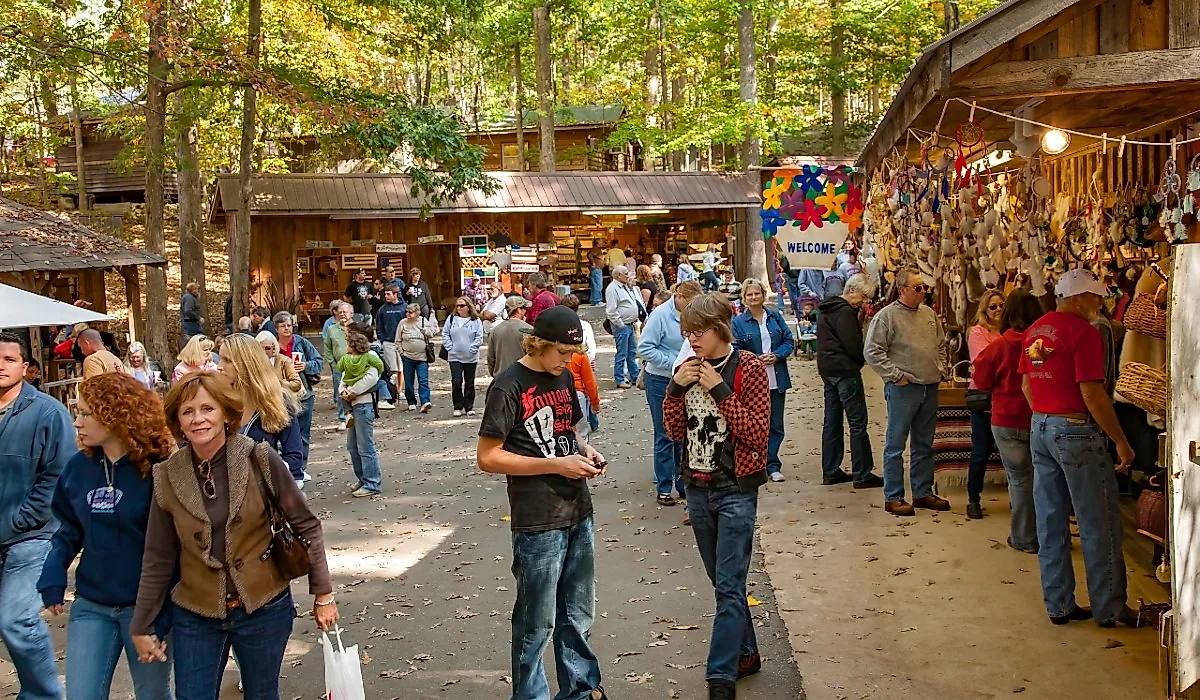
You can still drop underground after it. Consolidated Gold Mine guides visitors about 200 feet down a real shaft, and Crisson Gold Mine, worked since 1847, still crushes ore on a stamp mill and lets you pan for color. Every October the square packs out for Gold Rush Days, one of the biggest craft festivals in north Georgia, and the welcome turns loud, musical, and impossible to miss.
Blue Ridge

The train is why most people come, and it earns the billing. From the 1905 depot in the middle of downtown, the Blue Ridge Scenic Railway rolls a 26-mile round trip along the Toccoa River to the twin towns of McCaysville, Georgia and Copperhill, Tennessee, where a painted line on the pavement lets you stand in two states at once. The two-hour layover is just long enough for lunch before the ride back.

Mercier Orchards is the other institution, a family farm market in the hills above town famous for U-pick apples, fried pies, and hard cider. Lake Blue Ridge takes the boating, the Toccoa carries tubers all summer, and the downtown crams shops, galleries, and restaurants into a few walkable blocks. A day here slides from the rail platform to the water without much of a drive in between.
Madison

Madison sells itself as the town Sherman refused to burn, supposedly too pretty to touch. The truth is better. Sherman never came through at all. A wing of his army under General Slocum did, and the town center survived largely thanks to lobbying by Joshua Hill, a pro-Union former senator who happened to know Sherman's brother. The soldiers still torched the depot and the cotton, but the houses stood, which is why Madison holds one of the largest intact collections of nineteenth-century architecture in the state.
Those houses are the whole visit. Heritage Hall, the Rogers House, and Rose Cottage open as museums, and the Madison-Morgan Cultural Center fills an 1895 Romanesque Revival building that began life as one of the Southeast's first public graded schools. Between stops, the downtown runs to home-decor shops and long-timers like Gussie's House of Flowers, in business here more than fifty years. Twice a year the town throws open its historic homes for spring and holiday tours, which is Madison being Madison: proud of the place and glad to walk you through it.
Thomasville

The Big Oak has stood on the corner of Crawford and Monroe since about 1680, which makes it older than the country by nearly a century. The live oak runs about 68 feet tall with a limb span near 165 feet, and the city mounted a camera across the street so anyone can snap a free photo beneath it. Thomasville has gone by the Rose City for a hundred years, and its free public rose garden keeps more than 1,500 bushes blooming through spring and summer.

The strangest house in town is the Lapham-Patterson House, an 1885 Queen Anne cottage built by a Chicago shoe merchant who had survived the Great Chicago Fire. Still rattled by it, he designed a home with almost no right angles and around two dozen exterior doors, so he could always find a way out. Just outside town, Pebble Hill Plantation opens its grounds and art collection for tours. All of it dates to the 1880s, when wealthy Northerners wintered here for the pine-scented air, and that old resort habit still shows in how easily Thomasville hosts a crowd.
Washington

The Confederacy effectively ended in Washington. Jefferson Davis held the last meeting of his cabinet here in early May 1865 and dissolved his government before riding off, and the roughly $100,000 in Confederate gold that vanished soon after has fed treasure-hunting legends ever since. The empty chest that once held it sits today in the Mary Willis Library, which is the better story anyway: opened in 1889 as the first free public library in Georgia, and still lit by a Tiffany memorial window.
The town wears its history on foot. The home of Robert Toombs, the Confederate secretary of state, is now a state historic site with tours and exhibits; Callaway Plantation preserves early Georgia farm buildings at the edge of town; and the Washington-Wilkes Historical Museum fills in the rest. The real pleasure is the walk between them, house to library to shaded side street, with the whole town's past laid out at an easy pace.
Greensboro

The Old Gaol went up in 1807 with two-foot granite walls, a set of gallows, and a trap door, and it is widely called the oldest standing masonry jail in Georgia. It looks like a small fortress dropped onto a downtown street, and the way you tour it tells you everything about the town: you borrow a key from a shop nearby and let yourself in. Greensboro is the kind of place that hands you the key and trusts you with it.
The rest of the day splits between the street and the water. Downtown keeps its historic storefronts, churches, and the Greene County history museum, while Lake Oconee, a few minutes out, brings the boating, fishing, and lakeside dining that earned this stretch the name Georgia's Lake Country. A visit bends easily toward whichever suits the weather, and locals treat the brewery on Main Street as the obvious place to end it.
Cave Spring

The town swims in a pool shaped like the state of Georgia. Rolater Park's spring-fed swimming hole holds around 1.2 million gallons in the outline of the state, one of the largest such pools in Georgia, and every January locals ring in the new year with a polar plunge into it. The park's namesake cave sits right there too, a limestone chamber that holds a steady 57 degrees year-round, and the spring behind it pushes out roughly two million gallons of drinking water a day.

History sits close by in the Vann Cherokee Cabin, built around 1810 by a Cherokee man named David Vann, whose community was among those forced west on the Trail of Tears. The square around the park keeps its antique shops and cafes, and the cave, the pool, and the storefronts all sit within an easy stroll. Cave Spring gathers its best features into one park and lets you find them without trying.
Hiawassee

Bell Mountain trades a 360-degree view over Lake Chatuge for a short, steep drive to the top. The summit was donated to the public about a decade ago, and its overlook decks take in the water and the ridgelines of two states at once. Down at lake level, Chatuge handles the boating, fishing, and camping that fill a mountain summer.
The town gathers at the Georgia Mountain Fairgrounds on the lakeshore. The Georgia Mountain Fair has run here since 1950 and now draws crowds well into six figures, alongside concerts and a packed events calendar. Next door, Hamilton Gardens keeps one of the Southeast's largest collections of native rhododendron and azalea, which peaks in a festival each spring. This is a small county seat that knows how to throw a party, and it throws it on the water.
Blairsville

Vogel is one of the two oldest state parks in Georgia, opened in 1931 at the foot of Blood Mountain. The Civilian Conservation Corps built much of it during the 1930s and dammed Wolf Creek to make 22-acre Lake Trahlyta, and a small on-site museum still tells the CCC's story. It is the kind of park where the history and the hiking share a trailhead.

Brasstown Bald rises just outside town to 4,784 feet, the highest point in Georgia, with an observation deck that reaches across four states on a clear day. Closer in, Meeks Park follows the Nottely River with trails and ball fields and hosts the town's Scottish Festival and Highland Games, while the 1899 Old Courthouse Museum holds down the square. Blairsville puts the state's rooftop within an easy morning of a picnic in the park.
Clayton

Black Rock Mountain State Park is the highest state park in Georgia, perched at 3,640 feet on the Eastern Continental Divide with views that run 80 miles into the Blue Ridge on a clear day. It rises right above Clayton, close enough that the overlooks feel like an extension of Main Street. A real summit next door to a real downtown is the whole appeal of this corner of Rabun County.
The mountain culture runs deep here. The Foxfire Museum and Heritage Center grew out of a student magazine started in 1966 and now preserves about twenty log structures of traditional Appalachian life, including cabins, a chapel, and a working gristmill. The nearby Chattooga became the first river east of the Mississippi named Wild and Scenic, in 1974, and its Class III and IV rapids famously stood in for the whitewater in the film "Deliverance." Clayton keeps the heritage and the whitewater within the same short drive.
Ellijay

Ellijay is the Apple Capital of Georgia, and the orchards outside town prove it every fall. U-pick farms like B.J. Reece and the Red Apple Barn throw open their rows for the harvest, and the Georgia Apple Festival, running since 1971, fills two October weekends with hundreds of vendors at the Lions Club fairgrounds. Come autumn, this is one of the busiest small towns in the mountains, and the apples are the reason.
The rest of the year the town leans on its rivers and its square. The Cartecay draws tubers and kayakers to a run of gentle whitewater just east of downtown, and Gilmer Arts anchors the culture with exhibits and performances near the courthouse. The compact square makes a natural staging point, a place to grab a fried pie and a coffee before heading up into the ridges. Ellijay ties the orchards to the town center with barely any distance in between.
Plains

A town of fewer than 700 people produced a president, and Plains has never stopped being his hometown. Jimmy Carter was born here in 1924 and died here in December 2024 at the age of 100, and the Jimmy Carter National Historical Park now tells that whole arc across a handful of walkable sites. The memorial garden where he and Rosalynn Carter are buried, designed by Rosalynn herself, opened to the public in the summer of 2025, beside a pond at their old home.
The park's pieces are scattered through the tiny town. Plains High School, which both Carters attended, serves as the visitor center and museum, while the Boyhood Farm in nearby Archery has been restored to the way it looked before electricity reached it in 1938. The old Plains Depot, which ran as Carter's 1976 campaign headquarters, still stands downtown. You can even arrive by the SAM Shortline, a vintage excursion train that links Plains to the rest of southwest Georgia's rail country. For a town this small, the welcome is national.
Darien

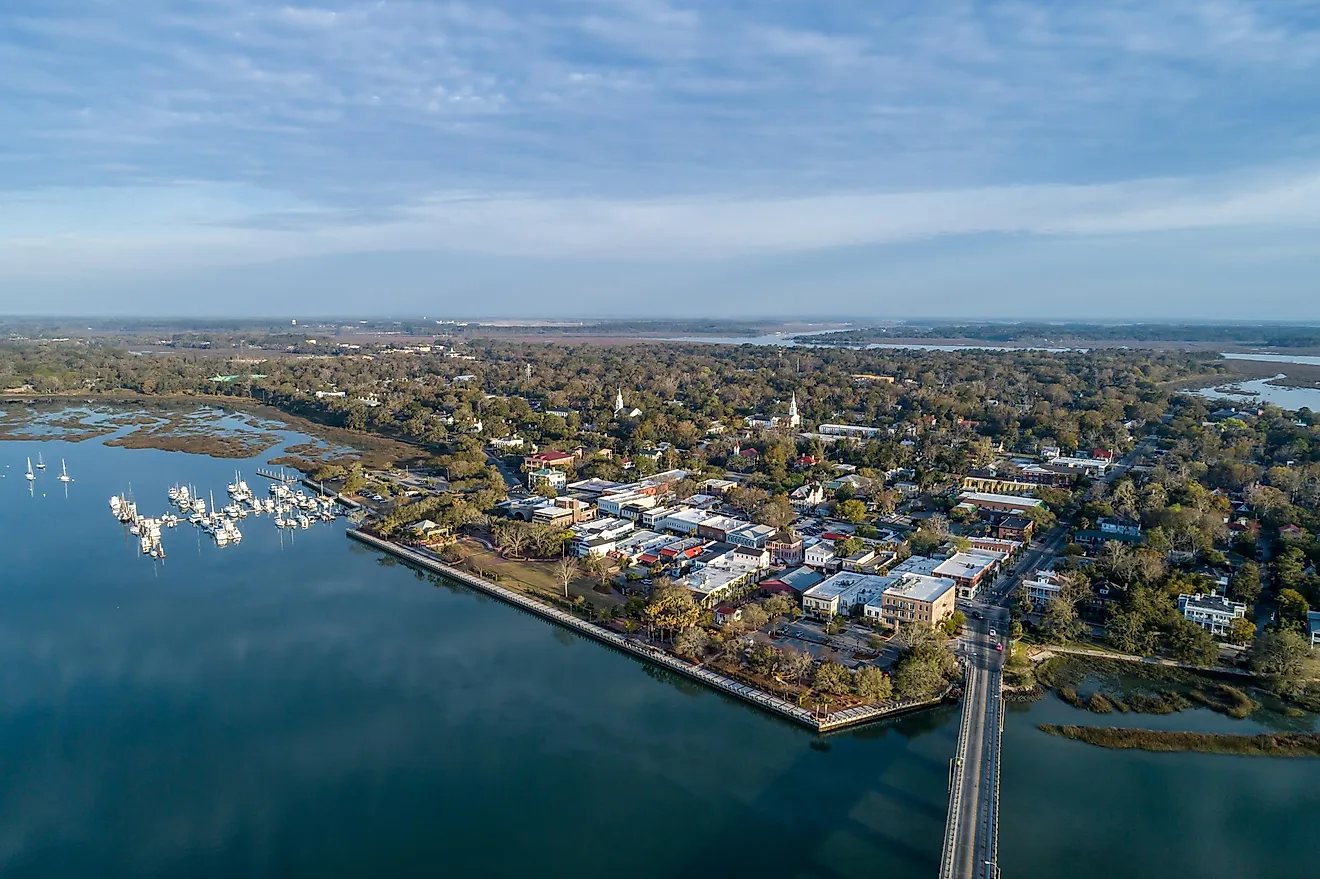
The one coastal stop on this list ends at a shrimp-boat dock. Darien sits where the Altamaha River fans out into salt marsh before it reaches the Atlantic, and the working fleet still ties up along the waterfront, unloading the catch the town has lived on for generations. Fort King George State Historic Site guards the edge of town, a reconstruction of the 1721 outpost that was once the oldest English fort on the Georgia coast and the southern edge of British America.
Scottish Highlanders founded the town in 1736 and named it New Inverness, and the Oglethorpe-planned squares of the Vernon Square-Columbus Square district still hold their old churches and homes. The harder history sits just outside town on Butler Island, a former rice plantation worked by enslaved people, where Fanny Kemble wrote the anti-slavery journal that later made her famous; Union troops, among them the Black soldiers of the 54th Massachusetts, burned Darien in 1863. Today the easiest place to take it all in is Darien Waterfront Park, with a bench, the tide, and the shrimp boats coming home at dusk.
What These Towns Share
The thread here is not a look or a landscape but a habit of hospitality. Town after town sets its headline attraction out in the open and all but waves you in: the jail hands you its key, the rose garden charges nothing, the fair feeds the whole county, and the smallest place on the list treats every visitor to a president's hometown like a neighbor. The distances are short, the pace is unhurried, and the welcome tends to arrive before you have finished parking. That, more than any single sight, is the case for pointing the car away from the cities and into Georgia's countryside.