Towns Engineered to Survive Hurricanes
When Hurricane Ian flattened southwest Florida in 2022, one inland town kept its lights on. Babcock Ranch was engineered for exactly that moment. No place is truly hurricane-proof. Smart design can still build a community that takes the hit and keeps working.
The ten communities below take on those threats in wildly different ways. Some picked safer ground before a single street got paved. Others raised whole neighborhoods above the flood line. A few buried their power lines or bolted in barriers and pumps. Several of these systems are still under construction today. Every place here can still be ordered to evacuate.
Babcock Ranch, Florida

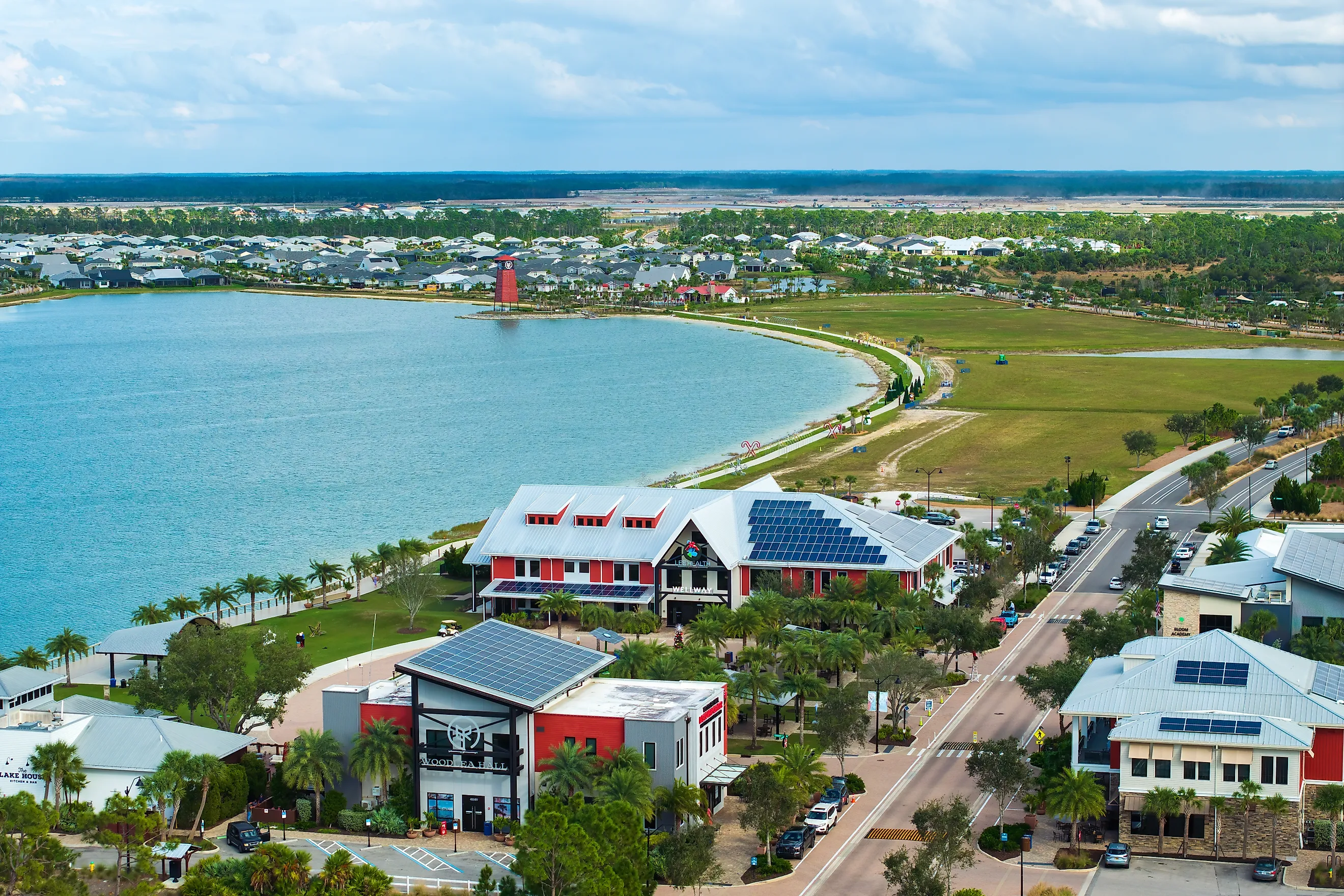
Amy Wicks spent the hours before Ian driving her town's drainage paths, checking that nothing blocked the water and hoping no alligators had moved into the pipes. She is the civil engineer who designed Babcock Ranch's water system, and her town is one of North America's clearest examples of a community planned around hurricane resilience from its first streets. Developers put it inland on ground roughly 25 feet above sea level. Power and communication lines run underground, and a connected web of lakes, wetlands, and swales gives heavy rain somewhere to pool before it swamps the roads. Homes meet Florida's high-wind code, and a large solar array with battery storage backs up the grid. Ian tested all of it in September 2022. The storm killed 149 people and did roughly $112 billion in damage across the state. FEMA later reported that Babcock Ranch kept its power and running water and that its buildings came through virtually undamaged. Residents still hauled off downed trees and patched screens, but their homes stayed livable while surrounding towns went dark for weeks.
Hunters Point, Florida
Hunters Point does not have the luxury of high ground. This small neighborhood sits right on the water in Cortez, where moving away from the flood zone was never on the table. So its builders went up instead. The homes are elevated, built well above minimum code, capped with storm-rated roofs and windows, and wired to their own solar panels and batteries. Those batteries keep the essentials humming when the regional grid drops. The setup faced back-to-back gut checks during the brutal 2024 season. Hurricane Helene shoved severe flooding onto Florida's Gulf Coast, and Milton arrived less than two weeks later. FEMA reported that the Hunters Point homes stayed powered and undamaged through both. Federal officials toured the place afterward to figure out why it worked. One neighborhood does not prove every waterfront lot can be made safe. It proves that elevation, tough construction, and backup power are three separate problems that have to be solved together.
Alys Beach, Florida

At Alys Beach, storm resistance is not an upgrade a buyer can skip. This Gulf Coast development says it became the first community in the world to require every home to meet the Insurance Institute for Business & Home Safety's FORTIFIED for Safer Living standard. That program zeroes in on the parts of a house that give out first: the roof, the doors, the windows, and the connections tying the big structural pieces together. Alys Beach piles on one more rule that sets it apart. Every building uses solid masonry walls and roofs. These heavy shells give wind fewer light edges to peel up, and protected openings keep flying debris from bursting in and blowing the roof off from the inside. The uniformity is the point. A single failed roof becomes shrapnel for the house next door, so the rule covers the whole development. The concrete shrugs off wind, though no masonry wall makes a beachfront town immune to a monster surge.
Punta Gorda, Florida

Hurricane Charley came ashore near Punta Gorda on August 13, 2004, with sustained winds around 150 mph, and turned the town into a full-scale test of stronger building. Damage across Charlotte County hit roughly $5.4 billion. The city's answer was not one heroic seawall or shelter. Recovery played out under Florida's statewide building code, which had taken effect two years earlier and demanded beefier roofs, better-fastened siding, and impact-rated windows or shutters in the most exposed spots. One church made the difference impossible to miss. Eight employees rode out the storm inside First Baptist Church's worship center, finished in 2001, while Charley ripped the steeple off an older part of the property. FEMA investigators reported the newer sanctuary held and protected everyone inside. Ian battered Punta Gorda again in 2022, especially along its seawalls and waterfront. The town's win is not total protection but steady gains: stronger roofs, protected windows, elevated construction, and metal connectors stitching roofs, walls, and foundations into one piece.
Galveston, Texas

Few American cities have physically rebuilt themselves the way Galveston did. The 1900 hurricane killed more than 6,000 people, and local leaders decided a seawall alone would never be enough. The first stretch, finished between 1902 and 1904, ran 17,593 feet along the Gulf, stood about 17 feet above mean low tide, and weighed roughly 40,000 pounds per foot. Then came the truly audacious part. Engineers jacked up around 500 city blocks and pumped 16.3 million cubic yards of sand underneath them. Crews lifted about 2,000 buildings on hand-cranked jackscrews while a slurry of sand and water was fed below. Streets, streetcar tracks, pipes, yards, churches, and shops all had to be nudged up to the new height. The project lifted much of the built city above the 1900 flood line and reshaped how water drains off the island. Galveston still floods from the bay side and can be overrun by storms bigger than its defenses, but the grade raising permanently cut its exposure.
New Orleans, Louisiana

New Orleans shows off both the scale of modern hurricane engineering and the trap of mistaking lower risk for safety. When Katrina hit in 2005, about 80 percent of the city went underwater. Water topped 15 feet in places, 50 major breaches tore open, and 169 of roughly 350 miles of levees and floodwalls failed. The rebuilt Hurricane and Storm Damage Risk Reduction System ran about $14.5 billion. It now knits together levees, floodwalls, gates, canal closures, pumping stations, and erosion-resistant surfaces across five parishes. The headliners are the Lake Borgne surge barrier and the West Closure Complex, where huge pumps push water past a sealed storm-surge gate. The system is built to blunt a surge with a 1 percent chance of hitting in any given year. That is not the same as stopping every Category 5. Sinking soil, rising seas, punishing rain, mechanical breakdowns, and bigger-than-design storms all stay on the threat list. New Orleans gets through on a regional network that has to be inspected, maintained, operated, and raised as the ground keeps dropping.
Hoboken, New Jersey

Superstorm Sandy found Hoboken's weak spot in October 2012. Water poured in through the low northern and southern edges of town and filled the middle like a soup bowl. Roughly 80 percent of the city flooded, and officials estimate about 500 million gallons rushed in. People lost power for weeks, the National Guard pulled residents out of trapped buildings, and the storm caused more than $100 million in private losses plus another $10 million in public damage. Hoboken came back with a four-part plan: block the coastal surge, slow the rainwater crossing the streets, stash it temporarily, then pump it out. The five-acre ResilienCity Park can hold or manage as much as 2 million gallons while doubling as an ordinary park on dry days. Underground tanks, rebuilt streets, pumps, walls, and movable gates stack up behind it. Nearly $300 million is committed to the larger regional project, though big chunks are still under construction. Hoboken earns its spot as a city mid-redesign, not a finished shield.
Belmopan, Belize

Belmopan's best hurricane defense is not a wall or a reinforced roof. It is 50 miles of distance from the sea. Hurricane Hattie tore through Belize in 1961 and wrecked about three-quarters of the houses in low-lying Belize City, then the national capital. Rather than wrap every government office in new coastal barriers, the country's leaders picked a fresh site about 50 miles inland and roughly 250 feet above sea level. Construction started in 1967, and the first phase opened in 1970 as government offices began pulling back from the coast. The move parked the nation's administrative heart beyond the reach of Caribbean storm surge. Belmopan can still catch hurricane-force winds, river flooding, blocked roads, and long power outages. Its planners never claimed to eliminate tropical cyclone risk. They lifted the national government off the country's most exposed coastal plain. It is a fix that is simple in theory and brutally hard once a city has already grown roots.
Darwin, Australia

One Christmas morning rewrote how an entire country builds. Cyclone Tracy crossed Darwin in the early hours of December 25, 1974. The official wind gauge clocked 217 kilometers per hour before it broke, more than 70 percent of the city's homes were destroyed or badly damaged, and about 41,000 of Darwin's 47,000 residents were left with nowhere to live. At least 66 people died, and 35,362 were flown out in Australia's largest peacetime evacuation. Reconstruction teams picked through the wreckage to learn why roofs, metal sheets, fasteners, and flimsy frames had torn apart. The new rules treated a house as one linked structure: roof tied hard to walls, walls anchored down to the foundation. Engineers also discovered that repetition kills. Later testing hammered cladding and fasteners through more than 10,000 pressure cycles, because sheet metal works itself loose after thousands of flexes even when no single gust exceeds its rating. The Darwin Area Building Manual fed into Australia's later cyclone codes and made wind resistance the law rather than a nice-to-have.
Naha, Japan

Naha does not lean on one giant defense. Its resilience is baked into thousands of buildings and decades of learning to live with Okinawa's steady parade of typhoons. Storm after storm pushed the island away from light wooden homes and toward reinforced concrete and concrete block. Japan's national climate-adaptation platform estimates reinforced concrete now makes up about 80 percent of homes across Okinawa Prefecture. Naha sits at the heart of that building culture, its heavy walls and roofs offering wind far less to grab and fling. Okinawa also wrote climate-smart housing guidelines in 1997 and updated them in 2015, folding in hard lessons about typhoons, heat, airflow, and the salt-soaked air. Concrete carries its own curse: salt creeps into hairline cracks and eats the steel reinforcement inside. So prefectural programs push tougher concrete mixes, including fly ash in key structures, to slow the salt and moisture. Naha can still flood and lose power, but its wall of heavy construction keeps failed roofs from spraying debris through whole neighborhoods.
The Common Thread
These ten towns follow no single survival formula. Belmopan moved its institutions inland. Galveston lifted the ground under hundreds of blocks. Babcock Ranch and Hunters Point stacked safer elevations, tougher buildings, drainage, and steadier power. Alys Beach forced one standard across a whole development. Punta Gorda and Darwin used their disasters to change how ordinary buildings get connected and inspected. New Orleans and Hoboken lean on regional systems that must hold across many miles, while Naha spreads its protection through its building stock.
The shared lesson is that one defense never covers everything. Wind-tight walls mean little once surge climbs to the living-room floor. A seawall does nothing about rain pooling behind it. Solar panels cannot promise power without protected wiring, controls, and storage. Even the sharpest-designed town has to maintain its gear, question its old assumptions, and clear out when officials say go. What makes these places worth studying is not that they beat hurricanes. It is that they turned well-documented ways of failing into specific, deliberate design choices.