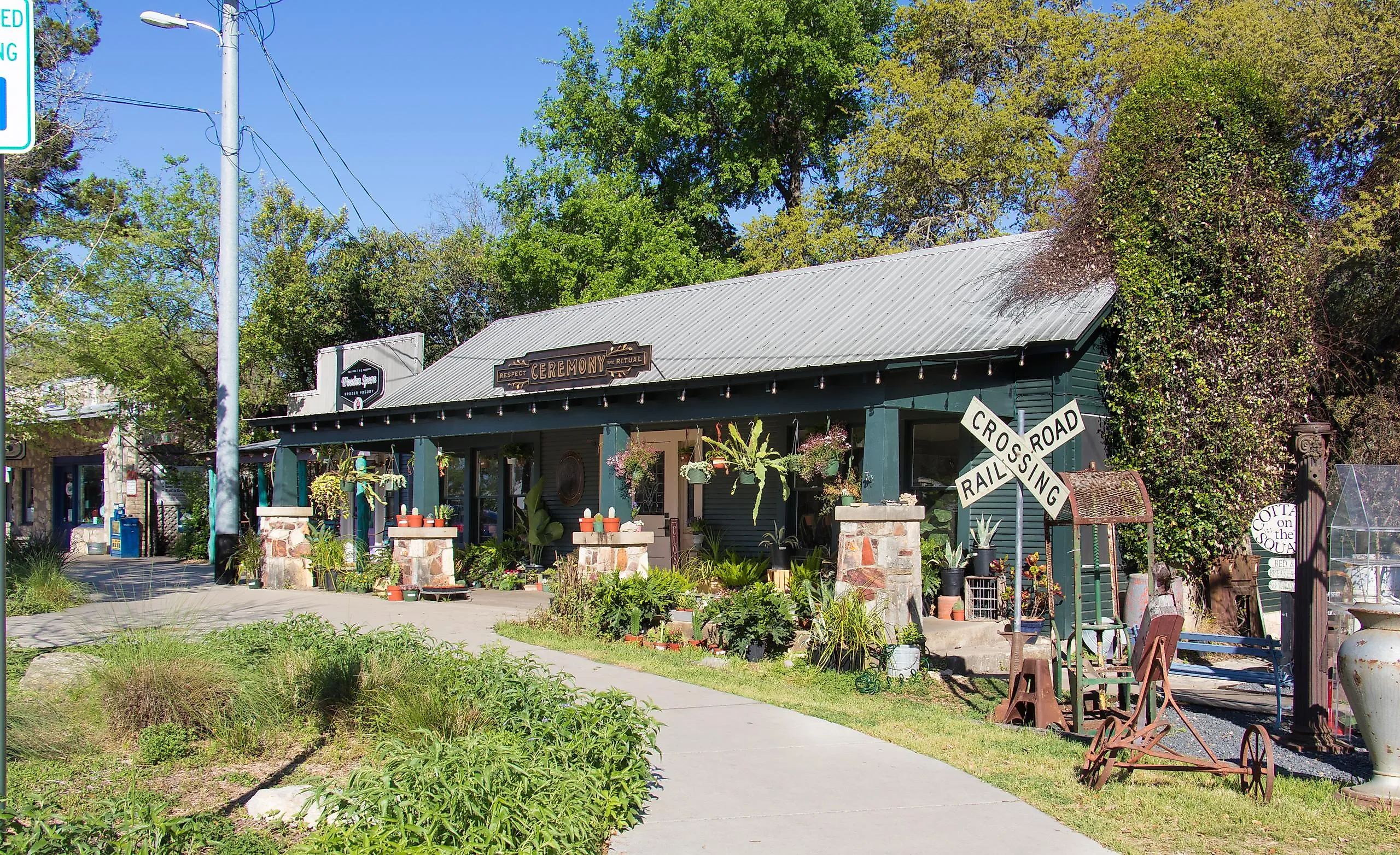
12 Cutest Small Towns In Texas For 2026
A Texas county spent decades moving its original log courthouse around before finally setting it back on the square in Comanche, where it still stands as the oldest wooden courthouse in the state. That is exactly what this list runs on: one specific thing somebody paid to keep alive, right on a street you can walk. Every town here has one, a dance hall swinging since 1878, a soda still bottled with cane sugar, a beer that outlived Prohibition. None of it hides behind a fence or an hour down a gravel road. These are towns small enough to cross in an afternoon, and in every case that one thing is the reason the place looks the way it does. Start walking.
Gruene
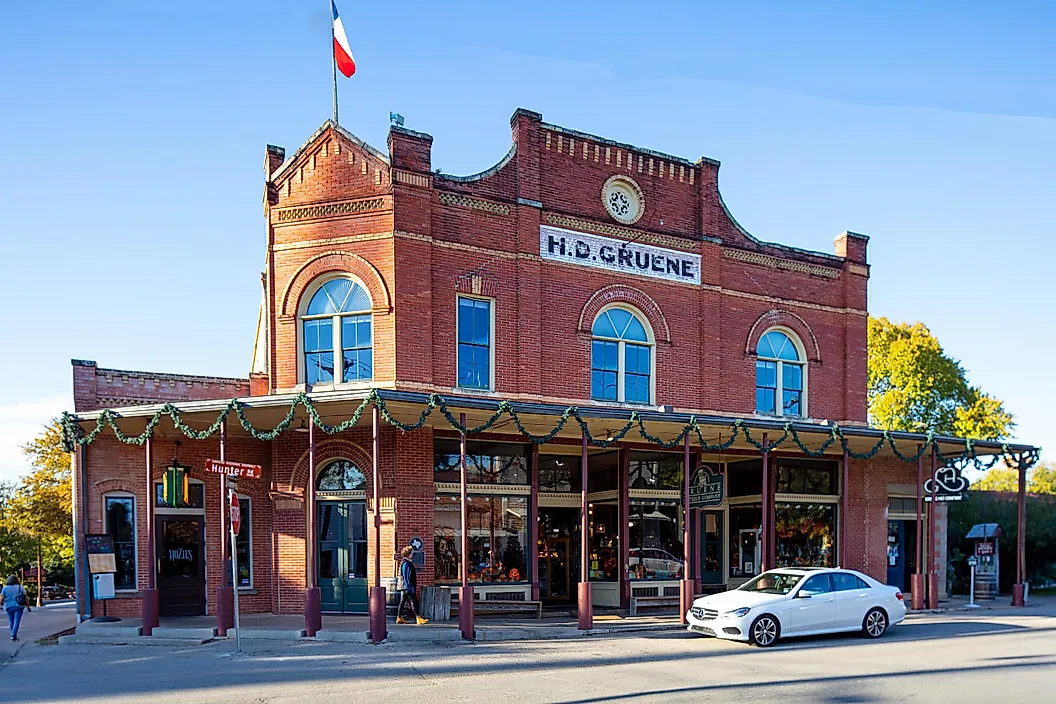
Gruene Hall has not stopped since 1878, which makes it the oldest continually operating dance hall in Texas, and you feel every one of those years the second you walk in. It is one big 6,000-square-foot room under a high tin roof, side flaps propped open for open-air dancing, a bar up front and a small stage in back, and that is about it. It never needed more. George Strait, Lyle Lovett, Hal Ketchum, Willie Nelson: they all played this floor on the way up. The hall anchors a short strip left over from Gruene's cotton-shipping days on the Guadalupe, now a historic pocket of New Braunfels. The old general store still trades out of one of the community's first buildings, and the cotton gin next door is a restaurant these days. Henry D. Gruene built all three before he died in 1920, and all three are still standing. Walk to the end of the strip and you hit the river, where outfitters rent tubes all summer.
Jefferson

Jefferson runs its old brick streets right along Big Cypress Bayou, and the bayou is the whole reason there is a town at all. Steamboats worked their way up it through the 1800s, hauling cotton out and everything else in, and the money built a downtown of antebellum brick and iron. Then the boats quit, the last one in 1904, and the district simply froze at its river-port peak instead of paving over it. The Jefferson General Store still sells Southern staples off wooden shelves. The historical museum fills an 1888 federal courthouse and walks you through the steamboat years and the Civil War. The House of the Seasons, up since 1872, still takes overnight guests. And a restored steam train, the Jefferson Railway, runs the same bayou the boats once did. About 2,000 people live here now. This was once a port that rivaled Galveston.
Wimberley

Wimberley started as a ranch settlement where Cypress Creek runs into the Blanco River, and water still calls the shots. Blue Hole is the swimming spot, a shaded stretch of Cypress Creek with rope swings over green water, and it is so beloved the town caps how many people can get in on a summer day. On the square, Wimberley Glassworks runs live glass-blowing, a team hauling molten pieces out of the furnace while you stand a few feet away. Artists have been drifting in for decades, and the square filled up with their galleries and shops. First Saturday of every warm month, Market Days sprawls across Lion's Field, one of the bigger open-air markets in the Hill Country. The Blanco runs the south edge and the limestone hills hold the wineries and guest ranches, but Cypress Creek is the part you reach on foot.
Shiner
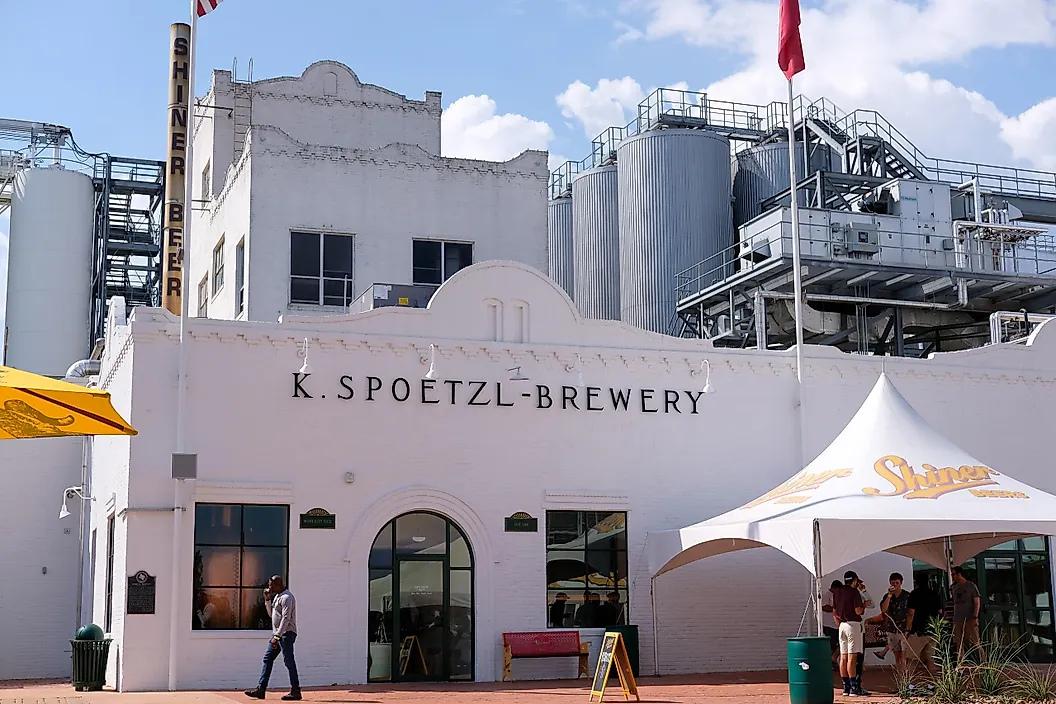
They have been brewing beer in Shiner since 1909, and the Spoetzl Brewery that does it is the oldest independent brewery in the state. The origin story is exactly what you would hope: Czech and German immigrants farming the land around town could not find the beer they missed from home, so they formed the Shiner Brewing Association and made it themselves. Then a Bavarian brewmaster named Kosmos Spoetzl, who had somehow ended up brewing in Egypt, took the place over in the 1910s and put his name on it. Shiner Bock, that dark little lager, now ships coast to coast out of this one small-town plant. It even outlasted Prohibition on near beer and ice. The tour walks you past the copper tanks and down to the bottling line, where every last drop still passes before it leaves town, and the tasting room is waiting at the end. Two thousand people, one national beer brand.
Dublin

Dublin Bottling Works has run on East Elm Street since 1891, the oldest soda bottling plant in Texas and the very first place to bottle Dr Pepper, which had been invented over in Waco in 1885. Here is the part locals will not let you forget: Dublin kept bottling it with pure cane sugar long after everyone else switched to corn syrup, right up until a 2012 trademark settlement ended the deal. People used to drive hours for the "real" stuff. The family-owned plant still bottles its own cane-sugar sodas today, root beer and cola among them, and the store on the grounds sells them by the case. Next door, the W. P. Kloster Museum holds one of the biggest hoards of soda memorabilia anywhere, gathered by a plant man who never met a Dr Pepper sign he did not want. A bottling line, not a slogan, is what put this town of 3,500 on the map.
Comanche

There is a one-room log cabin on the Comanche courthouse square, and it is the oldest standing wooden courthouse in Texas. Everybody calls it Old Cora. They squared up the logs in 1856, a box a little over twelve feet on a side, to serve the county's first seat at a long-gone settlement called Cora. When the seat moved to Comanche in 1859, the cabin eventually followed, got shuffled around the county for decades, and finally came home to rest on the square. It sits there now under the Fleming Oak, the live oak a settler once hid behind during a raid and then defended for the rest of his life, next to a restored old well. Just about every storefront around the neat square wears a county historical plaque. The town also remembers the day in 1874 that John Wesley Hardin gunned down a deputy here, an event the county museum lays out in a diorama.
Granbury

The Granbury square beat every other courthouse square in Texas to the National Register of Historic Places, listed back in 1974. The limestone buildings from the 1880s and 1890s still ring it at their original height, cut from local white stone and never once knocked down for anything taller. The 1886 Granbury Opera House faces the square and still runs weekend shows in its restored 309-seat house, twin curved staircases and all. The Second Empire Hood County Courthouse holds the middle, finished in 1891, and the 1885 jail with its hanging tower stands a block over. More than forty historic landmarks sit within a walk of each other, which almost never happens in a town this size, and it is why the downtown feels like one whole piece instead of scattered leftovers. Lake Granbury laps the edge of town, but the square is the part built to be crossed on foot.
Lockhart
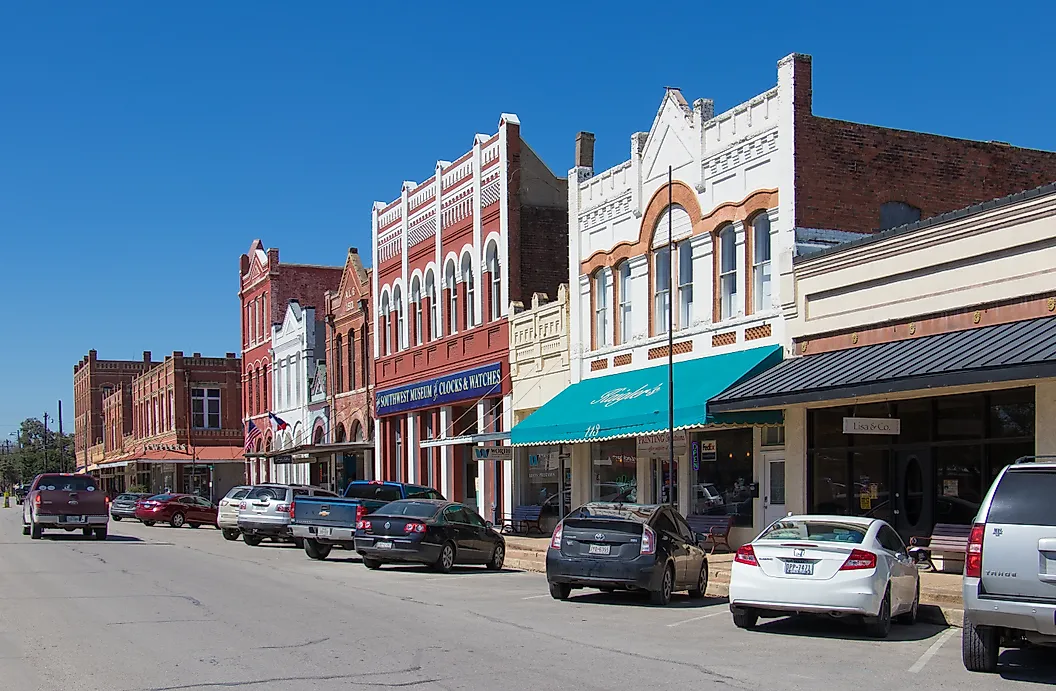
The Texas legislature made it official: Lockhart is the Barbecue Capital of Texas, and three smokehouses within a short walk of the square earn the title. Kreuz Market, Black's, and Smitty's have all been at it for generations, and Smitty's, a block off the courthouse, still burns its fire right on the floor of a pit room gone black with a century of smoke. The 1894 Caldwell County Courthouse runs the show, a rust-colored Second Empire hulk with a clock tower you can spot for blocks, planted in the middle of a nine-block historic district. A marker on the square remembers the 1840 Battle of Plum Creek, fought just outside town, and the Caldwell County Museum covers the Chisholm Trail herds that once came through. Lately artists priced out of Austin have moved into the old storefronts, so the same square now runs to galleries and studios too.
Johnson City

Johnson City sits on the Pedernales River, and it is where Lyndon B. Johnson grew up. His boyhood home still stands on Ladybird Lane, the turn-of-the-century house he lived in from age five through high school, open for tours all year. It anchors the Lyndon B. Johnson National Historical Park, whose Johnson City unit also keeps the Johnson Settlement, the cabins and land his forebears worked before the place even had a name. Across the Pedernales, the state park runs the Sauer-Beckmann Living History Farm, where rangers in period clothes work a 1900s farmstead entirely by hand, no shortcuts. The park headquarters is an easy walk from downtown. And past all the presidential history, the blocks around the courthouse have filled up with tasting rooms, because the Hill Country vineyards start right outside town.
Bandera

Bandera calls itself the Cowboy Capital of the World, and it has the state and national markers to make it stick. The town ran cattle up the Great Western Trail in the 1870s, and the dude ranches that came after turned the whole cowboy business into a spectator sport. The Frontier Times Museum has been Bandera's cabinet of curiosities since 1933, opened by a newspaperman named J. Marvin Hunter, and it now packs in more than forty thousand frontier relics plus a rodeo champions' hall. Downtown keeps its native-limestone buildings, and most Saturdays reenactors stage a shootout right on Main Street with a chuck wagon and live longhorns parked nearby. The Medina River bends along the edge of town, close enough to walk to from the courthouse. And live country and acoustic music turns up somewhere in town nearly every night of the year.
Rockport

The Fulton Mansion looms over Aransas Bay at the north edge of Rockport, a French Second Empire showpiece that cattle money built. George W. Fulton got rich shipping tallow and hides between here and New Orleans, and from 1874 to 1877 he raised a house he called Oakhurst among the wind-bent live oaks. It had indoor plumbing, central heating, and gas lighting when almost nothing else on this coast did. The place spent decades as a restaurant and a rec center before the state stepped in and restored it. Downtown, the Rockport Center for the Arts hangs new exhibits and never charges you a dime to look. And out at nearby Goose Island stands the Big Tree, a live oak more than a thousand years old and nearly ninety feet across, already ancient when the Spanish first reached this coast.
Brenham
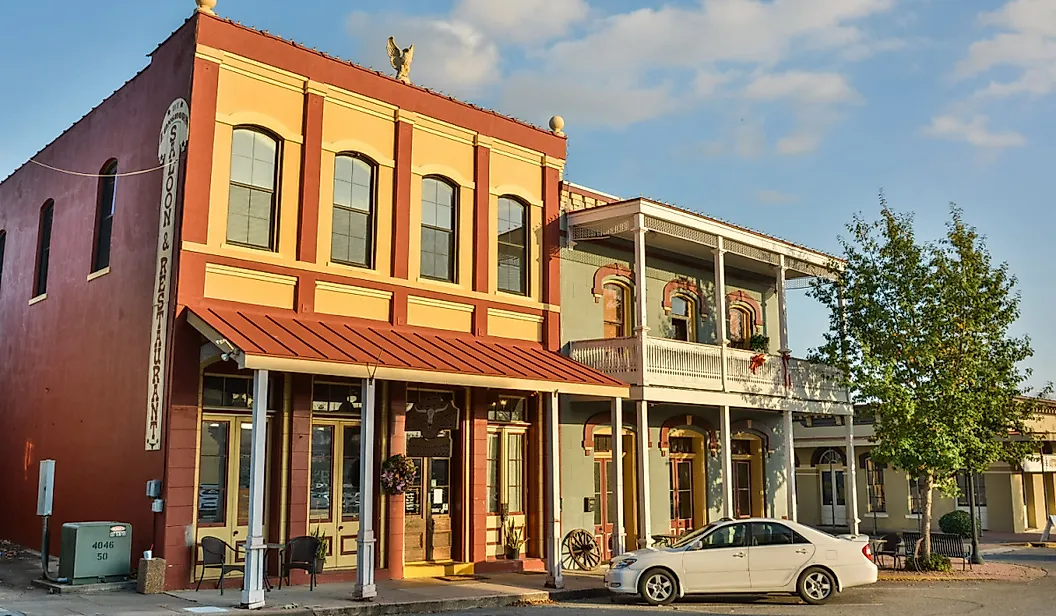
Blue Bell Creameries has been making ice cream in Brenham since 1907, and that plant on the edge of town is why most Texans know the name at all. It started as a little local creamery churning a few gallons a day, and now it ships pints across much of the country, still out of this one Washington County town. Downtown has its own history going, separate from the ice cream, with the Dunlap Buildings dating to 1870 and a nice run of preserved storefronts along the old commercial blocks. Glissmann's holds down a historic drugstore building, and the Brenham Fire Museum sits close by. The town leans on its history about as hard as the county leans on its farms, and the two are never far apart. One small creamery kept one small town on the national map.
Small Objects, Kept Working
Notice the pattern: these things are still here because somebody kept paying to keep them here. A community picked up a log courthouse and hauled it around for decades before setting it back on the square. A family kept a dance hall swinging for going on a century and a half. Dublin decided its cane-sugar soda was worth bottling long after the rest of the industry gave up, and the line still runs. There are hundreds of small towns in this state. The ones that pull you off the highway are almost always the ones that refused to let go of one particular thing.