11 Secluded Towns In New York
Some of New York's quietest corners have fewer than a thousand residents and a history that runs deeper than the ski lodges and farm stands suggest. Narrowsburg grew up on the timber trade, lashing logs into rafts on the Delaware River and floating them downstream to Philadelphia shipyards. Cold Spring cast the Parrott rifle cannon for the Union Army at the West Point Foundry. Saranac Lake was a tuberculosis cure town before it was a paddling town. The eleven places below have all slipped off the main routes, and that is exactly why they are worth the drive.
Lake Placid

Lake Placid is the rare town that has hosted the Winter Olympics twice, first in 1932 and again in 1980, the year of the "Miracle on Ice" upset over the Soviet hockey team. Before any of that, it was a late-19th-century retreat for wealthy New Yorkers who came up to the Adirondacks for the cold air and the lakes.
The Lake Placid Olympic Museum lays out that history with medals, sleds, and vintage footage. Mirror Lake sits in the middle of the village with a shoreline path for walking and kayak and paddleboard rentals during the warmer months. Adirondack Park wraps the whole town with hiking access on every side.
Skaneateles

Skaneateles sits at the northern tip of Skaneateles Lake, one of the Finger Lakes, with around 2,500 residents in the village. The lake is clean enough that Syracuse pulls its drinking water from it without filtration, and most of the town's attractions trace back to that water. The shoreline path leads to a public swim area, and a handful of outfitters rent kayaks by the hour.
The Charlie Major Nature Trail follows an old railway bed past mill ruins from the town's 19th-century industrial years. A few Finger Lakes Land Trust preserves sit just outside the town center, with birdwatching and short hikes the main reasons to stop.
Saranac Lake

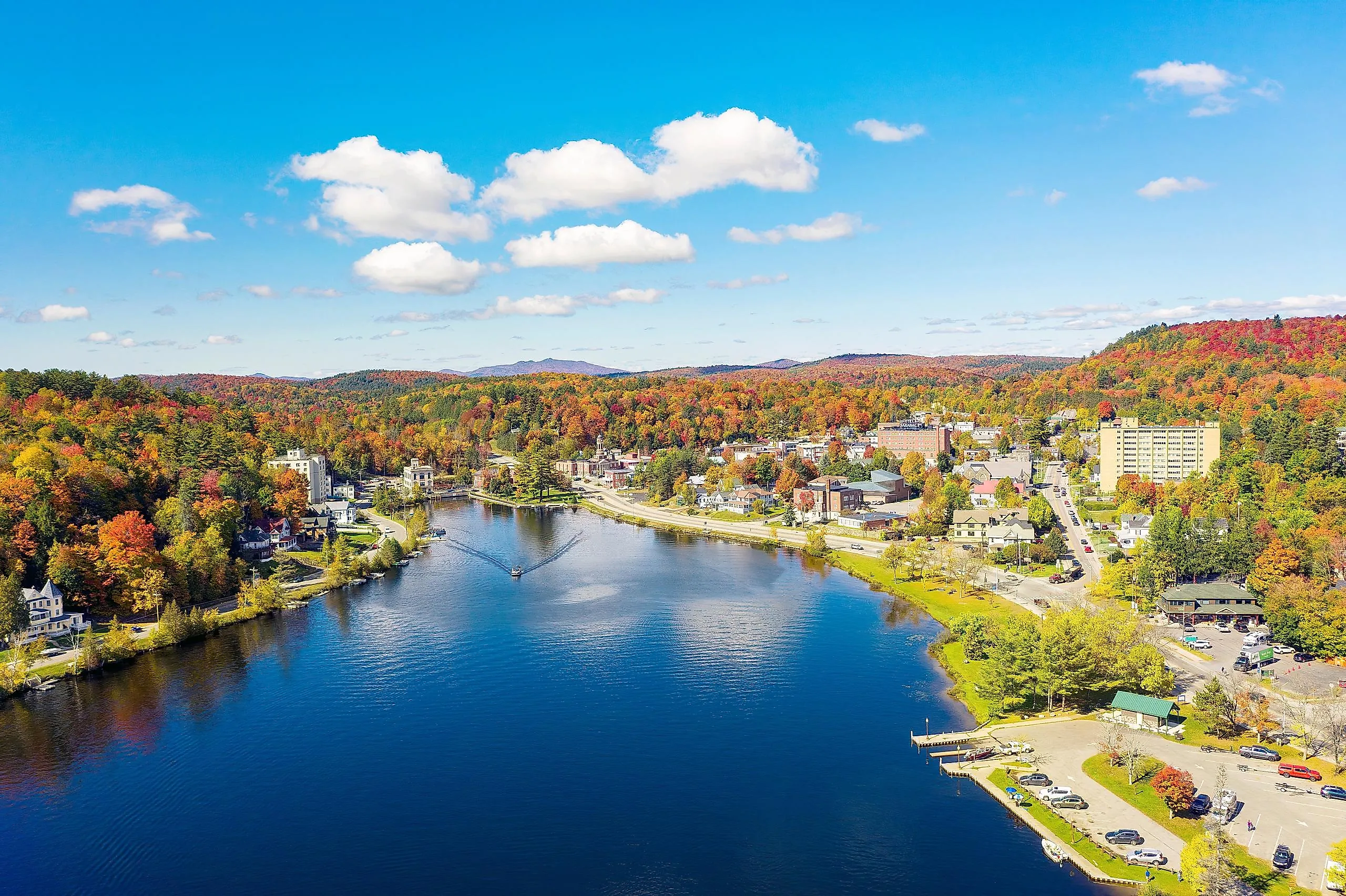
Saranac Lake started as a tuberculosis cure town in the 19th century, when Dr. Edward Trudeau opened his Adirondack Cottage Sanitarium here in 1884 and patients from all over the country came to "take the cure" by sitting outside in Adirondack air. Dozens of the old cure cottages still stand, identifiable by their long covered porches built for open-air sleeping.
The short climb up Mount Baker takes under an hour and delivers the standard Adirondack payoff of lakes and forest on all sides. The Saranac Chain of Lakes is a paddler's loop, and every February the Saranac Lake Winter Carnival, running since 1897, puts up a full-size ice palace cut from the lake itself.
Cold Spring

Cold Spring sits on the east bank of the Hudson River in the Hudson Highlands, directly across from Storm King Mountain. The town was a major Civil War-era artillery producer: the West Point Foundry, operating from 1818, made the Parrott rifle cannon that the Union Army relied on heavily. The West Point Foundry Preserve now covers the ruins with wooded walking trails and interpretive signs.
Main Street drops straight down to the river past a run of preserved 19th-century storefronts. For hikers, the Breakneck Ridge trailhead is a short walk north of town and has long had a reputation as one of the more demanding day hikes in the region.
Narrowsburg

Narrowsburg sits at the narrowest and deepest point of the Delaware River, with a population of around 400. In the 19th century, loggers lashed timber into rafts here and floated them downriver to Philadelphia shipyards. The river still defines the town, just with kayaks and canoes instead.
Public access points for paddlers are scattered along the banks. The Tusten Mountain Trail climbs through hemlock and hardwood forest just outside of town, and the Upper Delaware Scenic and Recreational River corridor is one of the better stretches for spotting bald eagles on the East Coast, especially in winter.
Windham

Windham calls itself the "Gem of the Catskills" and runs as a classic two-season town: hiking and cycling from late spring through fall, skiing and snow sports in winter at Windham Mountain. It is a compact village surrounded by the wilder northern edge of the Catskills.
The Windham High Peak Trail climbs to a 3,524-foot summit in the northern Blackhead Range and pulls in serious hikers working on the Catskill 3500 Club list of 35 peaks. CD Lane Park has a small lake for easy fishing and picnicking, and the flat, paved Windham Path is a reliable in-town walk that stays green well into October.
Phoenicia

Phoenicia is a hamlet of around 300 people in the Catskill Mountains along Esopus Creek. It started as a lumber town in the 19th century and has since become a small-scale gateway for hikers and paddlers heading into the Catskills.
The Tanbark Loop Trail is a moderate climb with views of the town and creek below. Esopus Creek itself is the local draw, with trout fishing in the upper stretches and outfitters renting tubes for the slow-water runs in summer. The Catskill Forest Preserve wraps the whole area in publicly accessible trails.
Ticonderoga

Ticonderoga sits on the narrow strip of land between Lake George and Lake Champlain, which is precisely why it was a critical military stronghold in both the French and Indian War and the American Revolutionary War. The Fort Ticonderoga we see today is an early-20th-century restoration of the original French fort begun in 1755, now operated as a living-history site with daily reenactments through the warmer months.
Mount Defiance is the overlook hike, a short but steep climb to the point where British general John Burgoyne's army positioned cannons in 1777 and forced the fort's surrender without a fight. Back in town, the LaChute River Walk Trail traces the old mill channels that once powered local industry.
Greenport

Greenport sits on the North Fork of Long Island, at the eastern terminus of the Long Island Rail Road, where it has run since 1844. Until the late 19th century the village was a whaling and shipbuilding port; today it is one of the last working waterfronts on the island, with scallopers and oystermen still unloading at the docks. The population sits at around 2,500.
Mitchell Park is the village's front door to the harbor, with a restored 1920s carousel that runs year-round and a short waterfront walk to the ferry dock for Shelter Island. The East End Seaport Museum covers Greenport's oyster, whaling, and World War II torpedo-testing years.
Margaretville

Margaretville is a village of around 500 in the western Catskills, sitting on the East Branch of the Delaware River. It was an agricultural hub in the 19th century and has since settled into a quieter role as a trailhead town for the surrounding Catskill Forest Preserve.
The Dry Brook Ridge Trail climbs to one of the better open viewpoints in the western Catskills. Anglers work the East Branch for brown and rainbow trout. Belleayre Mountain, ten minutes up the road, runs a ski operation in winter and opens its lift for mountain biking and hiking in summer.
Ellicottville

Ellicottville (the town, around 1,500 people; the village within it, closer to 300) sits near the Pennsylvania border in the southwestern corner of the state. It began as a 19th-century farming town and grew into a four-season resort once Holiday Valley and HoliMont opened their ski runs by the early 1960s.
Allegany State Park is the regional heavyweight with around 64,800 acres of trails, lakes, and cabin loops. In town, the Nannen Arboretum holds a collection of uncommon trees on a walkable campus, and Ellicottville Village Park hosts outdoor summer concerts and craft fairs.
Plan the Drive
The state has big-name parks and weekend towns, but the quieter places are where the character shows. Fort Ticonderoga still has cannons pointed at Lake Champlain, Skaneateles supplies Syracuse's tap water straight from the lake, and Saranac Lake is still dotted with 140-year-old cure cottages with open-air porches. These eleven towns reward the longer drive.