11 Offbeat Croatia Towns To Visit In 2026
Croatia has plenty of stone old towns and Adriatic beaches, but some of its smaller communities are memorable for much stranger reasons. One claims to stand at the center of the world, another celebrates a legend involving a rooster and an Ottoman siege, and an Istrian hill town reinvented itself as a colony of artists. Elsewhere, visitors can walk through a preserved village containing Josip Broz Tito's birthplace, peer into enormous karst sinkholes, or encounter an island carnival whose central ritual involves lowering a puppet down a rope. All 11 towns are small, but their size is not what makes them offbeat. Each preserves a landmark, tradition, landscape, or local story that is difficult to mistake for anywhere else in Croatia.
Hum

Hum has acquired an outsized reputation for a place small enough to explore on foot in minutes. The Istria Tourist Board promotes the fortified settlement as the "smallest town in the world," but its unusual traditions provide better reasons to linger. Hum marks one end of Glagolitic Alley, a roughly four-mile route from Roč punctuated by 11 monuments celebrating the angular script once widely used in Croatia.
The town also preserves an unusual annual election. Residents choose their župan, or prefect, according to an old custom in which votes are recorded by cutting marks into a wooden stick. Another local tradition involves biska, an Istrian brandy flavored with mistletoe and associated particularly closely with Hum. An annual brandy festival brings producers together to compete over versions of biska and other fruit and herb spirits. Between the medieval walls, ancient alphabet, unconventional ballot box, and mistletoe liquor, Hum manages to fit considerable eccentricity into a remarkably small footprint.
Grožnjan

Grožnjan could have become another quiet Istrian hill town after much of its population departed during the upheavals that followed World War II. Instead, artists moved into vacant buildings, and the settlement formally developed into a "Town of Artists" during the 1960s. That identity remains visible today as galleries and studios occupy old stone houses and summer programs bring musicians and artists into streets originally built for an entirely different era.
Stop at Fonticus City Gallery to see contemporary exhibitions before wandering the lanes around it, where studio signs and artwork appear among medieval façades. During summer, Grožnjan becomes particularly animated as the Jeunesses Musicales International Cultural Centre organizes workshops and courses for young musicians, and performances spill into squares and other public spaces. For a break from the galleries, follow part of the Parenzana, the former narrow gauge railway between Trieste and Poreč that now carries cyclists and walkers through tunnels, vineyards, and the countryside below town.
Kumrovec

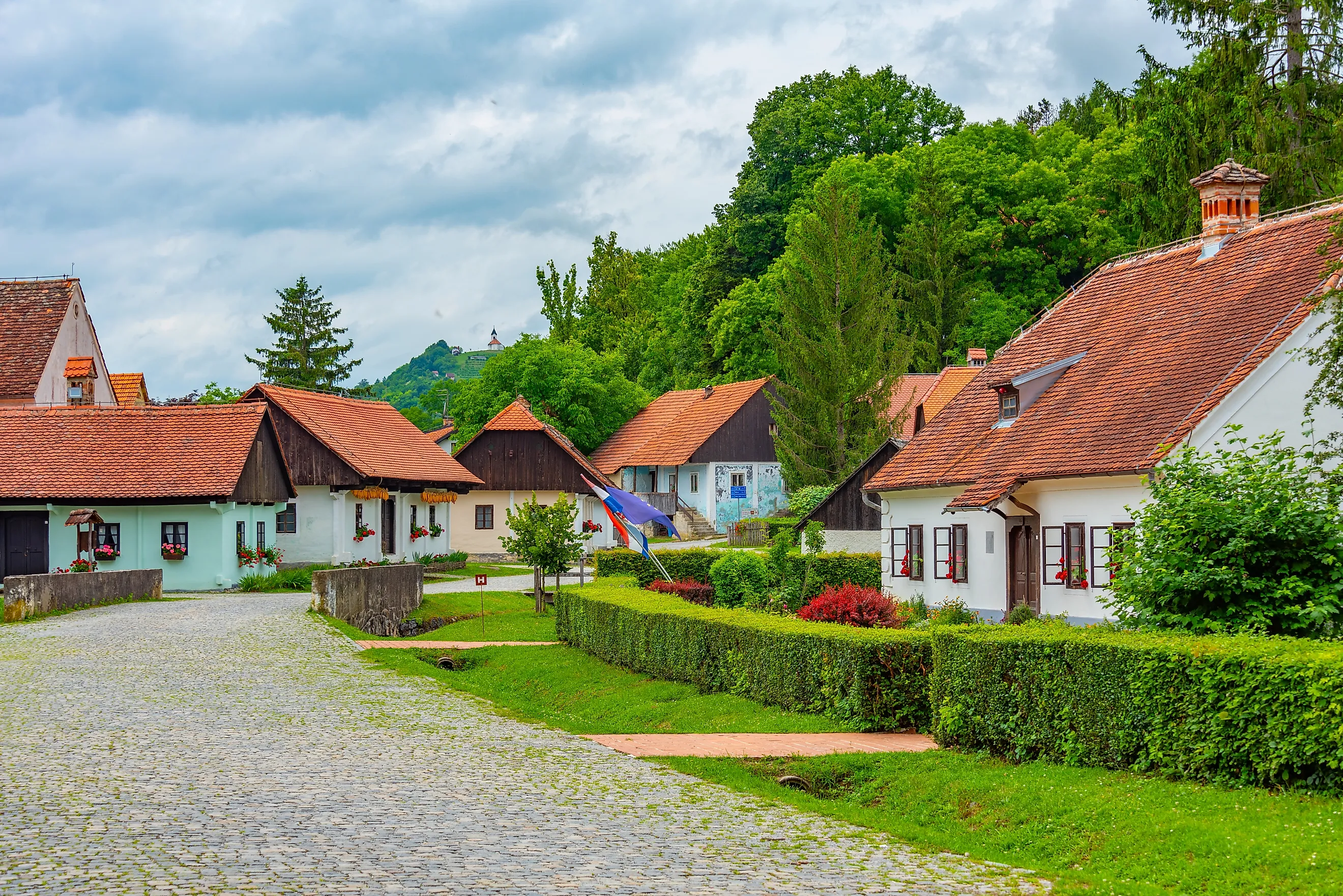
Kumrovec offers something more immersive than an ordinary local history museum. The Staro Selo Museum preserves the historic village center as an open-air ethnographic complex, with dozens of restored houses and farm buildings illustrating everyday life in Croatia's Zagorje region around the turn of the 20th century. Visitors move between furnished homes, barns, workshops, and gardens rather than through conventional galleries. Demonstrations and exhibits explore traditional trades ranging from blacksmithing and pottery to weaving and gingerbread making.
One house carries considerably broader historical significance. Josip Broz Tito's birthplace, a traditional Zagorje dwelling built in 1860, stands within the museum village and contains an exhibition devoted to his life. Nearby, the preserved old school and reconstructed farm buildings broaden the experience beyond Tito, making Kumrovec an unusual place in which an entire village serves as the exhibit. The result feels less like visiting a collection of artifacts and more like walking through a carefully preserved version of rural Croatia from more than a century ago.
Ludbreg

Ludbreg has built part of its identity around an audacious geographical claim, because the town calls itself the "Center of the World." In the main square, concentric circles radiate from a central point, while plaques identify cities supposedly positioned around Ludbreg according to the town's imaginative map of the world. New places have joined the project over the years, turning a local legend into an evolving piece of public art.
The idea becomes particularly playful during the annual Center of the World celebration. Ludbreg even has a fountain called the "Lighthouse to the World," which has poured local wine during festivities instead of water. A more solemn tradition surrounds the Sanctuary of the Precious Blood of Christ, associated with a reported Eucharistic miracle dating to 1411 and subsequent pilgrimage. Visitors can therefore move within a few blocks from an invented geographical center marked in the pavement to one of northern Croatia's longstanding Catholic pilgrimage sites, an unlikely combination that gives Ludbreg an identity entirely its own.
Đurđevac

Few Croatian festivals have an origin story quite like Picokijada. According to local legend, Ottoman forces besieging Đurđevac expected hunger to force its defenders to surrender. With almost no food remaining, the townspeople supposedly loaded their last rooster into a cannon and fired it toward the enemy camp. The attackers interpreted the extravagant gesture as evidence of abundant supplies and withdrew. Each summer, Đurđevac reenacts the Legend of the Picoki beside the medieval Old Town fortress, complete with performers, horses, pyrotechnics, and the famous rooster. The festival is held in June, so check the current dates before planning a visit around it.
Đurđevac has another surprise beyond the fortress, which is sand. The protected Đurđevac Sands preserve remnants of extensive sand deposits that once earned the surrounding landscape comparisons with a desert. The town has embraced the idea at the nearby Croatian Sahara, where the desert theme extends to camels and other animals. A rooster fired from a cannon and a pocket of "Sahara" in northern Croatia make Đurđevac unusually well qualified for an offbeat itinerary.
Varaždinske Toplice

Long before Varaždinske Toplice became a modern Croatian spa town, Romans were soaking in the same naturally heated water. They called the settlement Aquae Iasae, and archaeological excavations have uncovered an unusually substantial Roman thermal complex in the center of today's town. Visitors to the Aquae Iasae archaeological site can see the remains of baths and pools alongside a Roman forum and the capitolium, where temples honored Jupiter, Juno, and Minerva. The principal thermal spring still emerges within the archaeological area.
Varaždinske Toplice occasionally takes the Roman connection much further. During Aquafest, historical interpreters return the archaeological park to something resembling its ancient role, with Roman legionaries, gladiators, period-inspired food, workshops, and performances occupying the site. Even outside the festival, the unusual continuity remains tangible, since modern spa facilities operate in a town whose thermal identity reaches back approximately two millennia. Few places allow visitors to compare contemporary wellness culture with the excavated bathing complex of people who came for essentially the same hot water centuries earlier.
Ozalj

Ozalj Castle. By Miroslav.vajdic - Own work, CC BY-SA 4.0
Ozalj combines a medieval castle, early electrical engineering, and Croatian art along a short stretch of the Kupa River. Ozalj Castle occupies a rocky position above the water and contains collections connected with the Zrinski and Frankopan families, whose histories loom large in early modern Croatia. Downriver stands something far less expected, the Munjara, a hydroelectric power plant completed in 1908. Its monumental stone architecture makes an industrial facility look surprisingly at home among Ozalj's historic landscape.
The town was also the birthplace of watercolorist Slava Raškaj, and Ozalj has turned that connection into an unusually interactive way of exploring her work. The Slava Raškaj route leads to locations that she painted, where reproductions allow visitors to compare her watercolors with the present-day Kupa landscape. Rather than encountering the artist only inside a museum, visitors can stand before the riverbanks, castle surroundings, and other scenes that inspired her. The route ties Ozalj's art, architecture, and river setting together without reducing any of them to a conventional sightseeing stop.
Nin

Nin's most unusual attractions come from the shallow lagoon surrounding its historic center. At Queen's Beach, visitors have long coated themselves in dark medicinal mud found near the shoreline before letting it dry in the sun and washing it away in the sea. The practice gives a day at the beach a decidedly different character from the usual Adriatic swimming trip. Nearby, Nin Saltworks continues a salt-making tradition stretching back more than 1,500 years, using seawater, sunshine, and wind in shallow evaporation pools. Its Museum and House of Salt explain how the mineral makes its way out of the lagoon and onto the table.
Crossing into Nin's historic center reveals another curiosity, the ninth-century Church of the Holy Cross. Its compact proportions have inspired the oft-repeated local description of it as the "smallest cathedral in the world," although it never actually served as a cathedral. The tiny church, therapeutic mud, and working salt pans make Nin much stranger than its postcard-ready coastal setting initially suggests.
Sinj

Every August, Sinj turns a centuries-old military story into a horseback competition. During the Sinjska Alka, riders known as alkari gallop down a track and attempt to strike a small suspended iron ring with long lances. The tournament commemorates Sinj's resistance to an Ottoman attack in 1715 and has continued for more than 300 years, earning recognition from UNESCO as intangible cultural heritage.
Visitors do not have to arrive during the competition to understand the spectacle. The Museum of the Sinjska Alka displays historic weapons, uniforms, equipment, and documents while multimedia installations reconstruct the 1715 battle and the Alka procession. Above town, the remains of the Old Town fortress connect that story to the landscape in which the fighting occurred. Sinj's history also intertwines with the Sanctuary of the Miraculous Madonna of Sinj, the focus of a major annual pilgrimage. Horsemen with lances, fortress ruins, and religious processions make local history something residents still perform rather than merely preserve behind glass.
Imotski

Imotski does not need an eccentric festival or invented geographical claim. Two enormous holes in the landscape provide enough intrigue. Blue Lake occupies a karst sinkhole immediately below the town, surrounded by steep limestone walls. Its water level changes dramatically with rainfall and groundwater conditions, and in particularly dry periods the lake can disappear, allowing residents and visitors to descend onto the exposed bottom. The proximity is remarkable, since Imotski's streets and Topana Fortress stand directly along the rim.
Less than a mile away, Red Lake presents a much more forbidding counterpart. Sheer reddish cliffs plunge into a vast sinkhole containing deep water far below, making access to the lake itself considerably more difficult. Rather than adding unrelated attractions, the best way to experience Imotski is to compare these neighboring geological formations and then climb around Topana Fortress for another perspective over Blue Lake. Few Croatian towns place everyday urban life so casually beside geology on this scale.
Lastovo

Look across the roofs of Lastovo village and the chimneys may attract as much attention as the churches. Known locally as fumari, these elaborate structures developed into architectural status symbols, with builders creating distinctive crowns and decorative forms rather than repeating a standard design. Wandering the historic village becomes a kind of rooftop scavenger hunt as different fumari appear above stone houses along the steep lanes.
Lastovo's most unusual tradition is even harder to mistake for anywhere else. The centuries-old Lastovo Poklad recalls a local legend about a Catalan messenger who supposedly arrived during a pirate threat. During the carnival ritual, islanders make a puppet called the Poklad, dress it elaborately, and lower it repeatedly along a rope above the village before eventually burning it. Music, traditional clothing, dancing, and carefully prescribed rituals accompany the event. The combination of eccentric chimney architecture and an elaborate carnival centered on a descending puppet gives this remote Adriatic community an appropriately unconventional place at the end of the list.
Croatia Beyond The Familiar
Croatia's offbeat towns show that the country's smaller communities can be memorable for reasons having little to do with conventional sightseeing. Hum preserves an unusual election and Glagolitic heritage, Ludbreg places itself at the center of the world, and Đurđevac celebrates a siege legend involving a rooster while maintaining its own Croatian "Sahara." Elsewhere, Roman bathers, lance-wielding horsemen, medicinal mud, giant sinkholes, and Lastovo's elaborate carnival connect local history with experiences that remain part of these places today. Taken together, the 11 towns reveal a Croatia shaped not only by castles, beaches, and medieval streets, but also by local traditions and peculiarities that have resisted becoming interchangeable.