11 Most Walkable Town Centers on the Gulf Coast
The best Gulf Coast towns don't always require a vehicle to find the most memorable attractions. In Bay St. Louis, visitors can enjoy the Alice Moseley Folk Art Museum and then take a stroll to the Washington Street Pier. Similarly, Carrabelle's Carrabelle History Museum places visitors in close proximity to the Carrabelle River waterfront, which is even home to a riverwalk. These 11 towns have compact centers where you can park the car and have plenty to see and do without getting back behind the wheel.
Cedar Key, Florida

Cedar Key is about two hours north of Tampa and feels more like an old fishing village than a conventional beach town, and its compact waterfront is particularly pleasant to explore on foot. Much of the action is concentrated around Dock Street and Second Street, where weathered buildings, galleries, restaurants, and working waterfront views create an unmistakably Old Florida setting.
The Cedar Key Historical Society Museum is a good place to get acquainted with the area's history, and it is only a short walk from the central waterfront. Continue toward the Cedar Key Arts Center, surrounded by galleries and locally made art.
From there, follow the waterfront toward Cedar Key Beach, where Lil Shark Park gives children a place to play right on the Gulf of Mexico. The beach is less than a mile from much of the downtown waterfront, making it possible to combine sightseeing with some time beside the water.
Pass Christian, Mississippi

Pass Christian has a compact center where the Gulf of Mexico, historic buildings, restaurants, and harbor all come together within a relatively small area. The downtown is packed with galleries, charm, and local culture.
The Pass Christian Harbor is a natural anchor. It has a public fishing pier and boat launches, and the waterfront is an appealing place to watch boats come and go. From the harbor, walk west along the waterfront toward War Memorial Park, a green space near the beach with stunning live oak trees draped in Spanish Moss. Two blocks to the north of the park is Robin's Nest in the Pass, a boutique owned by the family of Good Morning America host Robin Roberts that showcases jewelry, pottery, and coastal gifts crafted by local artisans.
Pass Christian works well for travelers who prefer a stroll that combines architecture, water views, local businesses, and beach scenery rather than a long list of formal attractions.
Port St. Joe, Florida

Port St. Joe has the kind of compact center that rewards travelers who park once and explore slowly. The town's location on St. Joseph Bay gives the center a distinctly coastal setting without requiring visitors to drive from one attraction to another.
Reid Avenue forms the heart of downtown, with local businesses, restaurants, and historic sites concentrated within a few blocks. The Constitution Convention Museum State Park provides one of the town's most unusual historical stops. Exhibits explain Florida's first constitutional convention, held in St. Joseph in 1838, giving visitors a glimpse into the community's early importance.
From the museum, it is a short walk through downtown to the Cape San Blas Lighthouse, which preserves one of the area's most recognizable maritime landmarks. Continue toward Frank Pate Park along the bayfront. The park has open views of St. Joseph Bay and several amenities, including a fishing pier, picnic areas, and a pirate-themed playground. It's a natural place to slow down after exploring the downtown streets.
Palacios, Texas

Palacios's small center has enough to keep walkers occupied for several hours. The town sits on Tres Palacios Bay, and its waterfront gives the center a strong connection to the fishing and boating traditions that shaped the community.
The Palacios City-by-the-Sea Museum is a natural place to begin. Housed in the historic R.J. Hill building, it covers local history, including the area's fishing, agriculture, and early settlement. From there, head toward Palacios Pavilion, a beautiful waterfront gathering place overlooking the bay. The surrounding South Bay Park provides walking paths, open grassy areas, and water views, creating a pleasant change from the town's streets.
The central blocks around Commerce Street and Main Street contain locally owned businesses and restaurants, making the walk between the museum and waterfront more interesting than a simple point-to-point stroll. The town's small scale means most of these stops are within several blocks of one another.
Palacios is particularly appealing for travelers who enjoy working waterfronts rather than polished resort districts. The scenery comes from shrimp boats, bay views, fishing activity, and wide-open Texas skies rather than elaborate attractions.
Port Isabel, Texas

Port Isabel's compact historic center combines South Texas history with waterfront scenery, and several of its best-known attractions are within an easy walk of one another. The town's Port Isabel Lighthouse State Historic Site provides the most recognizable landmark, with the restored lighthouse standing near the center of town.
From the lighthouse, walk a few blocks to the Port Isabel Historical Museum, housed in a building built in 1899. Exhibits cover the area's history, including the Mexican-American War and the development of the community around the Laguna Madre.
Continue toward the waterfront and to the longest fishing pier in Texas, the Pirate's Landing Fishing Pier, where the views open across the Laguna Madre and the Queen Isabella Causeway. The route from the lighthouse to the waterfront takes only a few minutes on foot and passes local shops and restaurants along the way.
The Port Isabel City Park area is another place to take in the coastal setting, and the streets surrounding the central plaza are compact enough for casual wandering. Port Isabel is a place where the attractions don't feel artificially grouped. The lighthouse, museum, waterfront, and local businesses all reflect different parts of the town's history and setting, yet they fit into a walkable central area.
Fairhope, Alabama

Fairhope's downtown sits above Mobile Bay, giving its walkable center a combination of leafy streets, independent businesses, galleries, and waterfront scenery. Fairhope Avenue forms the main commercial spine, but some of the town's most enjoyable walking comes from wandering the side streets and shaded public spaces.
The Fairhope Museum of History occupies a former city hall and explores the area's unusual founding as a utopian community in the late 19th century. From there, the surrounding downtown blocks are filled with shops, galleries, cafés, and restaurants.
Walk toward Fairhope Municipal Pier and Park, roughly a mile from the museum. The route follows Fairhope Avenue and then opens toward the bay, where the pier extends into Mobile Bay and offers broad views of the water. The park includes walking paths, benches, gardens, and picnic areas. Back downtown, Fairhoper's French Quarter adds another distinctive architectural touch, with colorful buildings inspired by New Orleans, and courtyards tucked among the commercial streets. The distance between the museum and pier is .7 of a mile, but the route is part of the experience.
Tarpon Springs, Florida

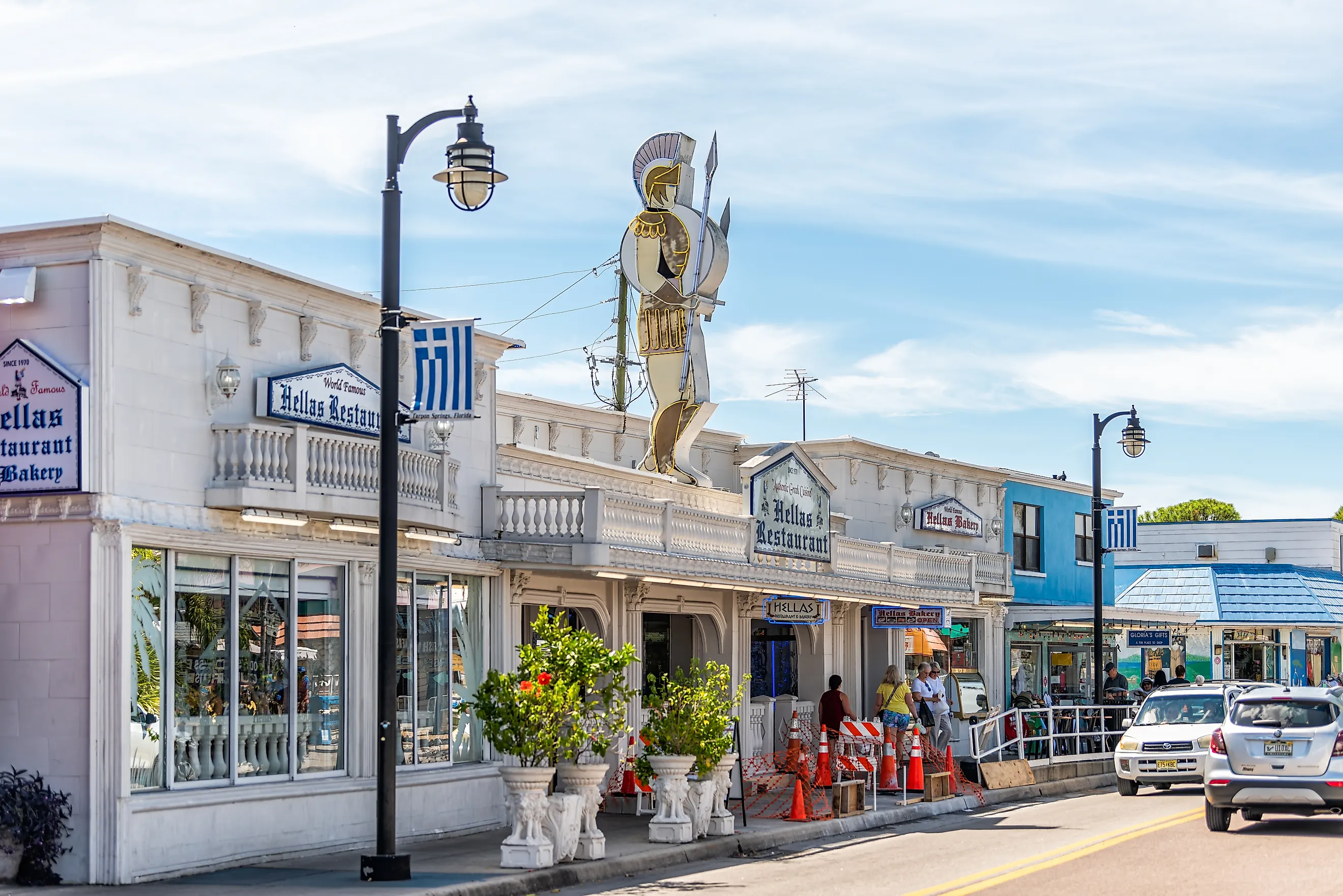
Tarpon Springs offers one of the most distinctive walking experiences on Florida's Gulf Coast, thanks to the Greek heritage that remains visible throughout its historic center. Dodecanese Boulevard and the nearby streets around the Sponge Docks form the heart of the town's visitor district, with Greek restaurants, bakeries, shops, and sponge-related businesses lining the route.
The Tarpon Springs Sponge Docks are the obvious centerpiece. Wooden boats, sponge displays, and waterfront businesses reflect the community's long connection to the sponge industry. From the docks, walk south along Dodecanese Boulevard toward downtown, a route of roughly a mile that gradually shifts from waterfront attractions to historic commercial streets. Along the way, you'll encounter Greek restaurants and shops selling everything from natural sponges to imported foods.
Separated by only 0.4 miles around Craig Park, two landmarks offer completely different worlds: the Tarpon Springs Heritage Museum explores the broader community's maritime and cultural roots, while the Safford House Museum provides a look inside a beautifully preserved 1883 Victorian estate.
Tarpon Springs is especially interesting because walking reveals the town's cultural identity gradually rather than presenting it in one concentrated attraction. The transition from the working waterfront to the older residential and commercial streets makes the walk itself part of the experience.
Bay St. Louis, Mississippi

Bay St. Louis has one of the Gulf Coast's most enjoyable combinations of historic streets and waterfront scenery. Old Town Bay St. Louis occupies a compact area near the water, with galleries, boutiques, restaurants, and historic buildings filling the blocks around Main Street and South Beach Boulevard.
The Alice Moseley Folk Art Museum is an especially distinctive stop, showcasing the colorful work of the Mississippi folk artist and giving the town's art scene some historical context.
From the museum, it's a short walk through Old Town toward Washington Street Pier, where the waterfront opens up to views across the bay. The pier is a popular fishing spot and provides a pleasant place to pause after wandering through the commercial district.
The Bay St. Louis Historic L&N Train Depot adds another layer of local history and sits within the broader Old Town area. The surrounding streets are filled with older homes and commercial buildings, making the walk between attractions as interesting as the destinations themselves.
Visitors who want a genuine town center rather than a resort complex will appreciate Bay St. Louis. Park once, wander the old streets, and eventually find your way back toward the water.
Dunedin, Florida

Dunedin has a lively Main Street that is easy to explore on foot. Main Street runs through the heart of the community, lined with restaurants, breweries, galleries, boutiques, and independent businesses. The streetscape feels distinctly local rather than dominated by large chains.
The Dunedin History Museum occupies a former railroad depot just off Main Street and explores the town's development, including its connection to the railroad. Right next to the museum, the Dunedin Downtown Market hosts its pet-friendly summer season on Saturdays from July through October, featuring over 60 vendors with fresh produce, crafts, and live music.
From there, it is only a short walk to Edgewater Park, located on the Dunedin Marina, just steps west of Main Street. The park features a playground, picnic pavilions, and a large shaded lawn with views of the Gulf of Mexico. Its prime location makes it an ideal spot for viewing sunsets, relaxing by the water, or walking to nearby downtown shops and restaurants.
Dunedin stands out because its walkability isn't dependent on one historic block. Instead, restaurants, cultural attractions, parks, and waterfront paths form a connected network, giving visitors several ways to shape a stroll according to their interests.
Crystal River, Florida

Crystal River's walkable town center offers something different from the more polished Gulf Coast beach towns: a connection to Florida's springs, wildlife, and Old Florida history. The commercial core around North Citrus Avenue is compact, with restaurants, shops, and local businesses occupying the central blocks.
Also, on North Citrus Ave., you will find Heritage Village. Its entrance, nestled under the large canopy of oak trees, opens into a vibrant open-air marketplace, home to several additional boutiques.
Visitors can also walk toward Hunter Springs Park, one of Crystal River's most attractive waterfront spaces. The park sits along Kings Bay and has a swimming area, boardwalk, picnic facilities, and views across the spring-fed water. It is only a few blocks from the central business district, so the walk between the museum and the park is short and straightforward.
Crystal River's center is best for travelers who want to combine a unique shopping experience with local history and a glimpse of the area's clear spring waters.
Carrabelle, Florida

Downtown Carrabelle has a wonderful, unhurried Old Florida charm where you can easily park once and explore everything on foot. Strolling along Marine and Tallahassee streets and St. James Ave., you'll find a tight-knit cluster of local eateries and eclectic boutiques.
The town's identity is closely tied to the Gulf, and its central streets lead naturally toward the Carrabelle River and the working waterfront.
The Carrabelle History Museum provides an introduction to the community's past, including its fishing and maritime traditions. From the museum, it's a short walk toward the Carrabelle River waterfront, where visitors can watch boats and take in views across the river. The Carrabelle Riverwalk adds another pedestrian-friendly stretch along the water, with benches and views of the river and harbor.
Carrabelle doesn't offer the dense concentration of attractions found in larger Gulf Coast destinations. Instead, its appeal comes from scale and scenery. A short walk through the center reveals a working coastal community rather than a town designed primarily around tourism.
The Gulf Coast has plenty of destinations where a car is useful, but it also has smaller communities that reward travelers who would rather park once and explore at street level. In places such as Cedar Key, Pass Christian, Port Isabel, and Bay St. Louis, waterfronts, museums, historic buildings, restaurants, and local businesses sit close enough together to turn walking into part of the experience. The result is a slower way to see the coast, one where the route between attractions can be just as interesting as the attractions themselves.