11 Prettiest Main Streetscapes In Gulf Coast
The Gulf Coast stretches across five states, so the ocean is the common link among towns whose cultural histories and identities could not be more diverse. A lighthouse in Texas, a bayou landing in Louisiana, and a mineral spring in Florida offer something different from the beach boardwalks that usually define the region. In Rockport, Texas, visitors can browse galleries a few blocks from Aransas Bay, while Abbeville, Louisiana, centers its entire town plan on a French-style square. Safety Harbor, Florida, pairs brick sidewalks with a spring once prized for its supposed curative powers. Each town spins its own take on what it means to be on and of the Gulf Coast.
Port Isabel, Texas

Port Isabel built its entire downtown around a working lighthouse, and the arrangement still defines the town square today. Constructed in 1852 as a 72-foot brick tower, the Port Isabel Lighthouse remains the only lighthouse on the Texas coast open for public climbs, with a spiral staircase leading to views that stretch across the Laguna Madre to South Padre Island. Boutiques, seafood restaurants, and art galleries ring the square at its base, many housed in buildings tied to the town's founding as a Spanish colonial trading post. Visitors can tour the Treasures of the Gulf Museum for artifacts recovered from 1554 shipwrecks, watch dolphins from the fishing pier, or sample fresh Gulf shrimp at a dockside restaurant before crossing the causeway to the beach.
Franklin, Louisiana

Live oaks form a canopy over Main Street in Franklin, a Bayou Teche town whose entire downtown earned National Register of Historic Places status for its collection of Greek Revival and Queen Anne storefronts. More than 400 buildings survive from the sugar boom era, when steamboats carried processed cane down the bayou toward New Orleans, and the street's original ornamental lampposts still line the boulevard.
Grevemberg House Museum, an antebellum home turned local history museum, runs guided tours of period furnishings a few blocks from the commercial strip. The Bayou Teche flows parallel to Main Street, giving paddlers a put-in point for exploring the waterway that shaped the town's economy for two centuries. Franklin also holds accreditation from Main Street America, a distinction earned by fewer than a thousand downtown districts nationwide for sustained preservation work, and its Main Street Program hosts seasonal festivals that bring the storefronts to life after dark.
Rockport, Texas

Austin Street forms the spine of downtown Rockport, running a few blocks inland from the Aransas Bay waterfront in a stretch of Texas better known for birding than architecture. Galleries and working studios cluster along the corridor, a legacy of the artists who began settling here decades ago and gave Rockport its reputation as a creative outpost on the mid-coast. The Texas Maritime Museum sits within walking distance and traces the region's shipwrecks, offshore drilling, and commercial fishing industry through ship models and hands-on exhibits.
Just north of downtown in neighboring Fulton, the Fulton Mansion State Historic Site, a Second Empire home built for a cattle baron in the 1870s, showcases gaslight fixtures and a classic tower that once looked out over Aransas Bay. Rockport Beach, certified as a Blue Wave beach for its water quality, sits close enough to fold into an afternoon downtown stroll. Anglers head instead toward the harbor, where charter boats depart for redfish and speckled trout runs that have defined the local economy since the town's earliest days as a shipping port.
Abbeville, Louisiana

Père Antoine Désiré Mégret modeled Abbeville's downtown after the small French villages of his childhood when he founded the town in the 1840s, and the plan still radiates outward from Magdalen Square today. A fountain, a gazebo, and towering oaks fill the center of the square, framed by St. Mary Magdalen Church and its bell tower on one side and the Vermilion Parish Courthouse on the other. Steen's Syrup Mill, in operation since 1910, runs tours of the cane syrup production process just off the square, and the aroma from its boiling kettles still drifts through downtown during harvest season.
The Giant Omelette Celebration draws crowds each November when cooks crack thousands of eggs into a skillet large enough to feed the entire town, a tradition rooted in Napoleonic-era France. Visitors can also browse the Abbeville Cultural and Historical Alliance Center for exhibits on the area's Acadian settlement, then close out the afternoon with chargrilled oysters at one of the seafood houses that line the streets near the Vermilion River. Live music fills the square on Thursday evenings during the spring concert series, when locals set up folding chairs beneath the oaks and food vendors circle the gazebo.
Pascagoula, Mississippi

The Scranton Historic District preserves the commercial heart of Pascagoula along Delmas Avenue, where early twentieth-century storefronts now house antique shops and Scranton's Restaurant, itself set inside a 1924 firehouse complete with the original jail cell. Anchor Square adds a cluster of raised Mississippi cottages arranged around a boardwalk and green space a few blocks away, giving the district a mix of architectural eras within easy walking distance.
Pascagoula Beach Park sits at the edge of downtown along the Mississippi Sound, with a fishing pier and picnic pavilion that catch the same Gulf breeze that has cooled the waterfront for generations. History runs deeper still at the La Pointe-Krebs House, a structure dating to around 1757 that ranks among the oldest standing buildings in the Mississippi Valley, and at the Pascagoula River itself, nicknamed the Singing River for the humming sound long reported near its mouth.
Pass Christian, Mississippi

Davis Avenue serves as the commercial spine of Pass Christian, a compact strip of coastal shops just a block from the beach and within sight of the town's working harbor. Olive oil purveyors, clothing boutiques, and a coffeehouse fill storefronts that reopened one by one in the years after Hurricane Katrina, and the avenue now anchors a Saturday morning market that draws vendors from across Harrison County. War Memorial Park sits at the edge of the district, its ancient oaks and gazebo hosting community gatherings like Jazz in the Pass and the town's Mardi Gras festivities.
Two miles of the Scenic Drive Historic District run parallel to the beach just south of downtown, lined with antebellum mansions and cottages shaded by live oaks that survived more than a century of Gulf hurricanes. The Pass Christian Yacht Club, organized in 1893 as one of the earliest yacht clubs in the American South, still hosts the Knost Regatta, the longest-running all-women championship regatta in the nation. Charter boats depart the harbor for speckled trout and redfish in the Mississippi Sound, and the beach across from Scenic Drive draws fewer crowds than the busier towns farther east.
Daphne, Alabama

Main Street runs through Olde Towne Daphne, a district of oak-shaded blocks a short walk from Mobile Bay that locals call "The Jubilee City" for a rare natural phenomenon that pushes crabs, shrimp, and fish toward shore in shallow water. Shops such as Serendipity by Celeste and a cluster of Southern boutiques line the corridor, and the Jubilee Festival of Arts fills Lott Park each October with more than 140 juried artists working in jewelry, pottery, and mixed media. Bayfront Park sits a short drive from downtown, where a fishing pier shaded by centuries-old oaks frames sunset views over Mobile Bay, while the Daphne History Museum, housed inside an 1858 Methodist church, traces the town's roots back to its founding as a Spanish colonial outpost. Village Point Park Preserve rounds out a visit with trails that pass beneath Jackson Oak, a tree old enough that General Andrew Jackson is said to have rallied troops in its shade.
Punta Gorda, Florida

Fishermen's Village anchors the western edge of downtown Punta Gorda, a shopping and dining complex built in the early 1980s on the site of a 1928 city fishing dock along Charlotte Harbor. From there, the 2.5-mile Harborwalk threads past marinas and fishing piers before connecting to the historic downtown core, where more than 30 large-scale murals turn ordinary alleyways into an outdoor gallery. The Fishermen's Village marina supports a steady lineup of sightseeing boats and fishing charters that depart daily onto Charlotte Harbor, one of the largest open-water estuaries on Florida's Gulf coast.
A weekend farmers market convenes near the Charlotte County Courthouse, drawing local growers and artisans to a downtown block shaded by mature live oaks. History buffs can tour the Military Heritage Museum a few streets over, while the Peace River Botanical and Sculpture Gardens, just across the water, gives visitors a reason to extend the walk beyond downtown's core. Laishley Park closes the loop along the waterfront, offering a public boat ramp, a splash pad for children, and open lawn space that hosts concerts and festivals through the cooler months.
Boca Grande, Florida

Park Avenue forms the retail spine of the village of Boca Grande on Gasparilla Island, a downtown historic district built between 1900 and 1953 that still runs on golf carts and bicycles more than car traffic. The restored Boca Grande Railroad Depot, built in 1910 to haul phosphate to the island's deepwater port, now houses gift shops and an ice cream parlor at the corner of Park and Fourth Street.
One block south, Banyan Street draws visitors down a canopy formed by a century-old row of banyan trees planted under a 1914 landscape plan, their massive aerial roots and arching branches forming a dramatic green canopy over the roadway just steps from the historic downtown shops. Our Lady of Mercy Catholic Church, a small Spanish-style building with hand-carved woodwork, sits along the same walking loop, and the Boca Grande Community Center hosts local exhibits on the island's phosphate-shipping past. Fishing charters bound for Boca Grande Pass, famed for its tarpon runs, depart from the marina within a short walk of the shops.
Safety Harbor, Florida

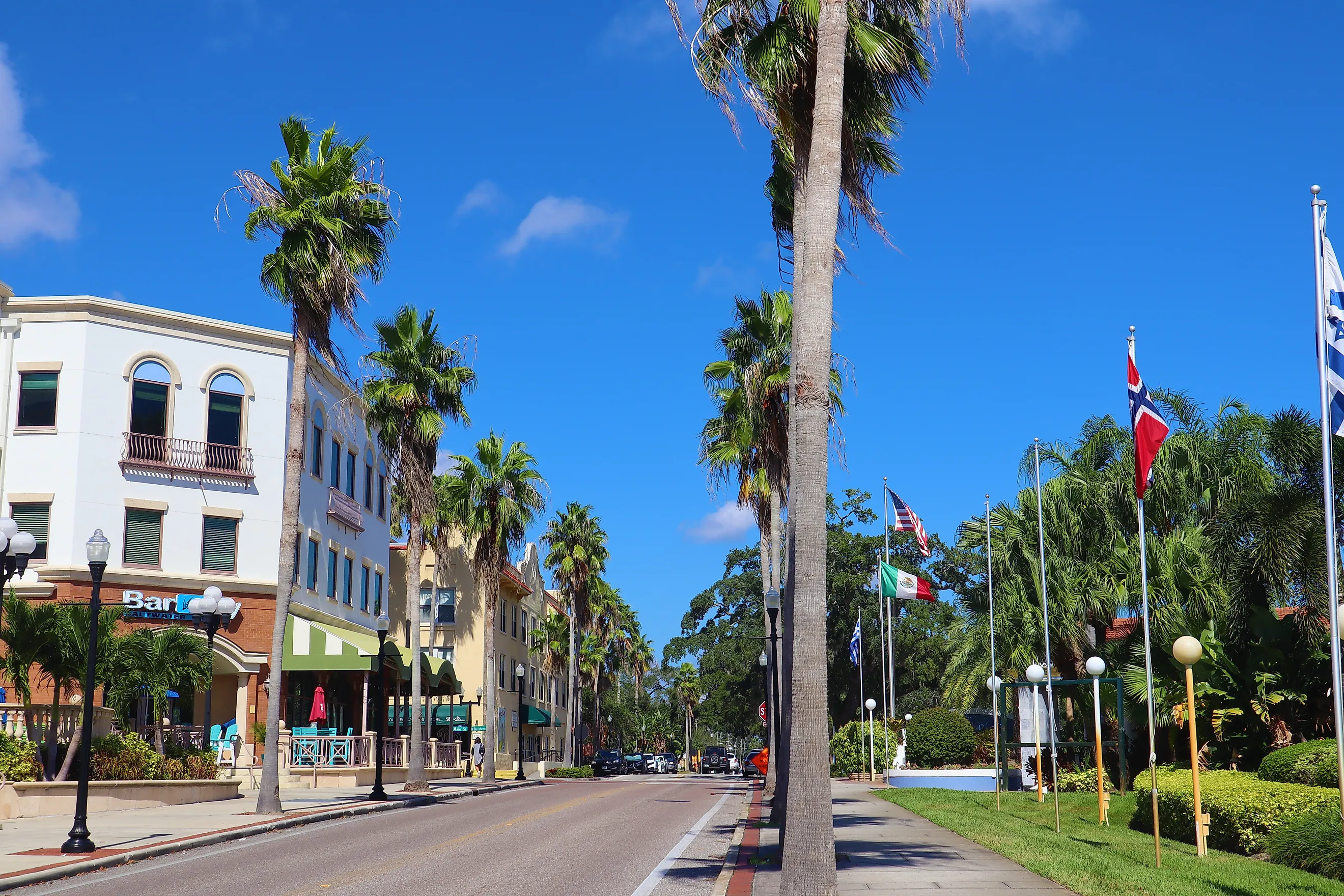
Brick-paved sidewalks and moss-draped oaks line Main Street in Safety Harbor, a downtown that USA Today once ranked among the ten best in the country. The corridor sits directly across from Safety Harbor Resort and Spa, built over the mineral springs that Spanish explorer Hernando de Soto, by local tradition, named Espiritu Santo Springs in 1539, believing their natural waters possessed sacred curative powers. Shops, galleries, and craft breweries fill the storefronts, and a Sunday farmers market gathers around the gazebo at John Wilson Park at the western end of downtown. Waterfront Park extends the walk to the edge of Old Tampa Bay, where a boardwalk and pier draw manatee sightings most mornings, and the Safety Harbor Museum houses artifacts from the Tocobaga people who once lived along the same shoreline.
Crystal River, Florida

North Citrus Avenue carries downtown Crystal River along the edge of Kings Bay, a springs-fed waterway that draws hundreds of manatees each winter when Gulf temperatures drop. Seafood restaurants line the waterfront within sight of the working fishing docks, and local outfitters send kayak and snorkel tours out toward Three Sisters Springs from launch points a short walk from Main Street storefronts.
Murals celebrating the town's manatee population cover several building facades downtown, turning a walk through the shopping district into an informal outdoor gallery. Crystal River Archaeological State Park preserves pre-Columbian burial mounds within a few minutes' drive, while Kings Bay Park itself offers a public kayak launch and fishing pier steps from downtown cafes. The Florida Manatee Festival takes over the district each January with boat tours, live music, and vendor booths that spill across several downtown blocks.
The Character Beneath The Storefronts
Across five states, these downtowns share a habit of building around whatever defined the local economy first, whether that meant a lighthouse platted before the streets around it, a sugar port on a bayou, or a spring once mistaken for a fountain of youth. Fishing fleets, phosphate depots, and syrup mills gave several of these towns their earliest reason to exist, and their Main Streets still carry that working history in restored depots, dockside restaurants, and family businesses that outlasted the industries that built them. What unites Rockport's galleries, Abbeville's French-style square, and Crystal River's manatee murals is a refusal to trade that inherited character for anything more generic. A Gulf Coast road trip built around these 11 towns reveals a region defined as much by its small-town commercial districts as by its beaches.