11 Main Streets Where Spain Comes Alive
Spanish street life runs on a schedule that catches most outsiders off guard. The good streets are half empty at seven in the evening and impossible at eleven. Lunch is a two-hour event that starts at two, dinner rarely begins before nine, and the stretch in between belongs to the paseo, the evening walk that exists for no reason other than being outdoors among other people. What follows are eleven streets across Spain built entirely around that habit, each one a place where the crowd is the attraction rather than the architecture. Several are loud, most involve food standing up, and one of them has bulls running down it every July.
This list stays deliberately in the cities. Spain's quiet medieval main streets, and the small towns people actually move to, are a separate pleasure and a separate article.
How To Read A Spanish Street
Two conventions explain most of what you will see. The first is that you are meant to move. A tapas crawl means one drink and one bite per bar, then out the door, and staying put for three rounds marks you as a foreigner immediately.
The second is that mess is a compliment. In the older bars of La Rioja and Castile, napkins and shrimp shells go on the floor, and the depth of the drift tells you how good the place is. Nobody minds. It gets swept at closing.
Calle Laurel, Logrono

If Spain has one street that is purely about eating, this is it. Calle Laurel runs about 200 meters through the old quarter of Logrono, narrow enough in places to touch both sides, and it holds more than 50 pincho bars.
The rule here is specialization. Most bars make one thing well and expect you to order it and leave. Bar Soriano serves grilled mushrooms and essentially nothing else. Elsewhere on the street you order the cojonudo, a quail egg with chorizo and piquillo pepper on a slice of bread. Locals call the circuit la senda de los elefantes, the elephant path, which is a joke about how people walk by the end of it.
Calle 31 de Agosto, San Sebastian

The name is a date, and the date is why the street exists. On August 31, 1813, during the siege of San Sebastian, the city was sacked and burned. Almost the entire old town went. This street, then called Calle La Trinidad, was the only one left standing.
It now holds one of the densest concentrations of pintxo bars in the Basque Country, running between the Church of San Vicente at one end and the Basilica of Santa Maria del Coro at the other. La Vina, about halfway along, is responsible for the burnt Basque cheesecake that spent the last decade colonizing restaurant menus worldwide.
Every year on the anniversary the bars go quiet and the street fills with candles for a memorial procession, then goes back to work.
Calle Estafeta, Pamplona

For 51 weeks a year, Estafeta is a narrow shopping street in the old town of Pamplona. For the other one, it is the longest straight section of the running of the bulls.
During San Fermin, which runs from the sixth of July to the fourteenth, six fighting bulls come up this street at eight in the morning. The balconies rent for serious money. The rest of the year you can walk the route in about ten minutes and eat very well doing it, which is arguably the better experience and definitely the safer one.
Gran Via, Madrid

Madrid drove Gran Via through the middle of its own old town starting in 1910, demolishing more than 300 buildings and 14 streets to do it. The result is the closest thing Spain has to a boulevard built for spectacle.
The stretch around Callao is where the musical theaters cluster, which is why people call it the Spanish Broadway. Come at eleven at night and it is brighter and busier than it was at noon.
Calle Cava Baja, Madrid

The counterweight to Gran Via, and only a short walk from it. Cava Baja curves through La Latina following the line of the old medieval wall, which is why it bends the way it does.
It is the tapas street Madrilenos actually use. Sunday is the day: the Rastro flea market winds down around two in the afternoon and empties directly into these bars, and the street stays packed until evening. Order vermut on tap and do not sit down.
La Rambla, Barcelona

The most famous street on this list and the most argued about. La Rambla runs roughly a mile from Placa de Catalunya down to the harbor, and it was a seasonal watercourse before it was a promenade, which is why it slopes and why the name is plural in Catalan.
Locals will tell you it belongs to tourists now, and they are largely right about the middle section. The Boqueria market halfway down is still worth the crowd, and the side streets either side of it are where the city actually eats. Treat La Rambla as the spine and leave it often.
Calle Sierpes, Seville

Sierpes is pedestrian, curving, and barely wide enough for two people to pass a shop window, which is exactly what makes it work. It has been Seville's main commercial street for centuries.
Two moments define it. In summer, awnings are strung between the buildings overhead to shade the whole length of the street, turning it into a tunnel of filtered light. During Semana Santa, the processions come through and the crowd density becomes genuinely extraordinary. Seats along the route are inherited within families.
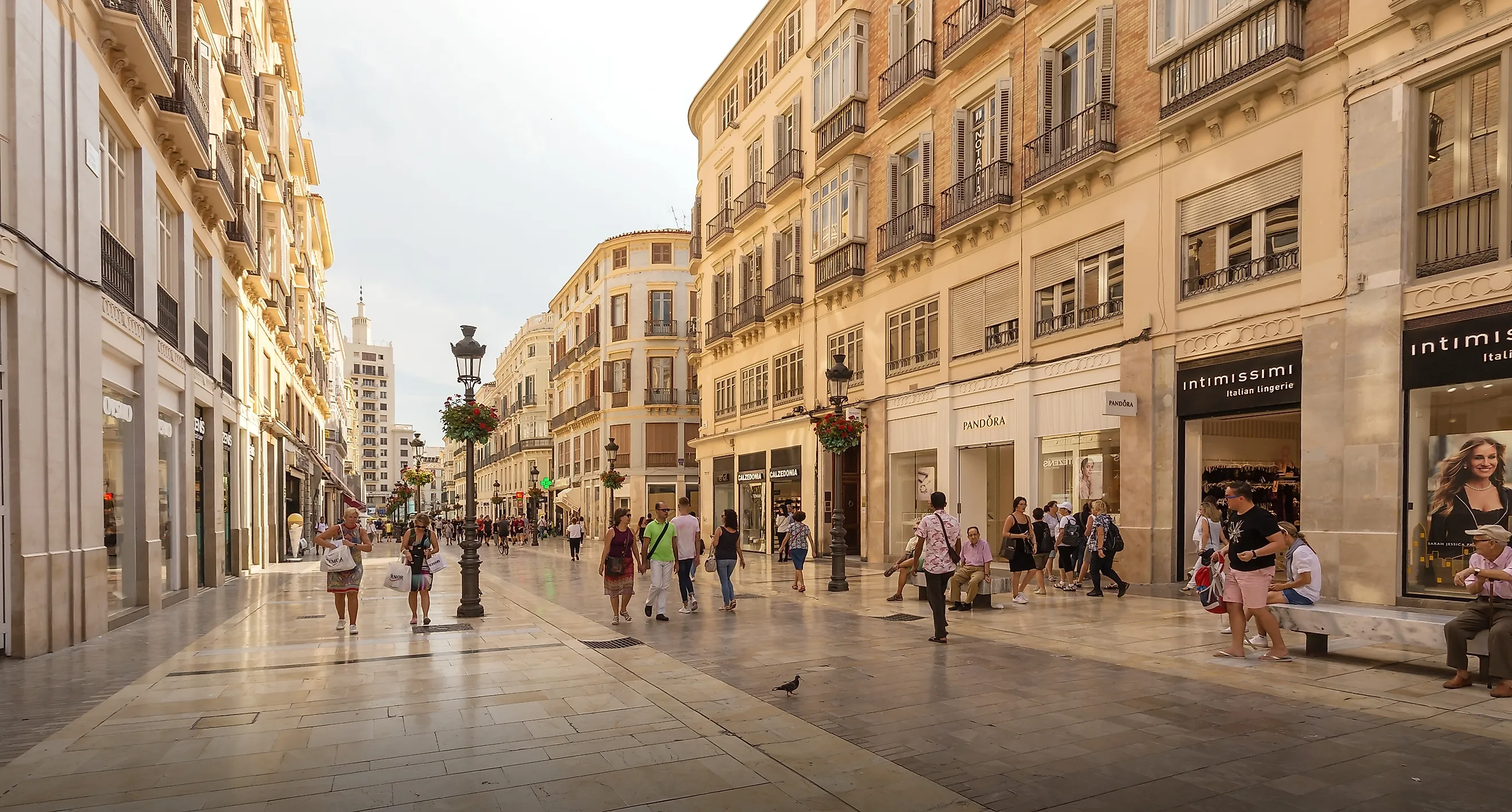
Calle Marques de Larios, Malaga

Larios opened in 1891 and was built wide, straight, and marble-paved, which makes it the most formal street here and the one that transforms most completely.
In August, the Feria de Malaga takes over the center and the daytime version spills along Larios with sherry, live sevillanas, and people dancing in the street before lunch. In December the city hangs an overhead light installation along the whole length and runs it as a timed show, and the crowd standing still to watch it blocks the street nightly for a month.
Calle Elvira, Granada
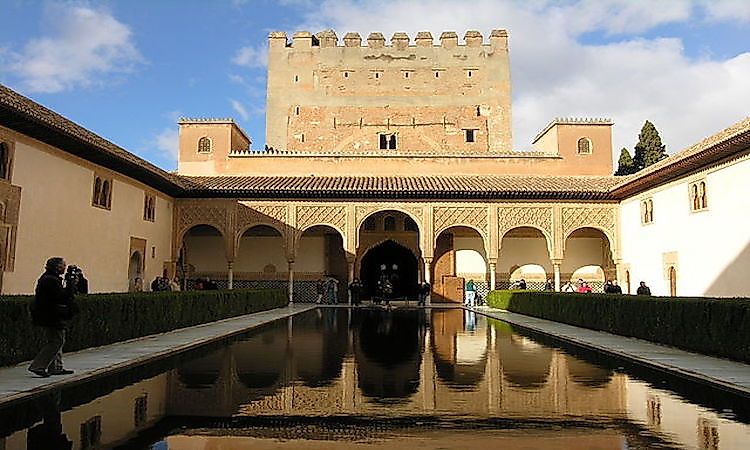
Calle Elvira runs from the old Moorish gate of the same name along the base of the Albayzin, and it is the entry point to the tea houses of the Caldereria.
Granada also holds the best deal in Spanish street eating. The city keeps the old convention of a free tapa with every drink, and not a bowl of olives either. Order a beer and something cooked arrives with it. Four rounds is dinner. The practice has faded across most of Spain and survives here, in Jaen, and in Leon.
Rua do Franco, Santiago de Compostela

This street has an unusual advantage: everyone arriving on it has just walked several hundred miles.
Rua do Franco runs from beside the cathedral and it is where the Camino de Santiago effectively ends, in a line of seafood restaurants with pulpo and percebes in the windows. The atmosphere is specific and hard to fake. On any given evening the tables hold people who met three weeks earlier in a different province and will not see each other again.
Calle Caballeros, Valencia

Caballeros is the main artery of the Barrio del Carmen and it is Valencia's late street, which in a country this nocturnal is saying something. Things do not properly begin until midnight.
It also sits in the middle of the loudest week in Spain. During Fallas in March, neighborhood associations build enormous satirical sculptures across the city, set off deafening daytime firework displays called mascletas, and burn everything they built on the final night. It is the closest thing on the calendar to La Tomatina for sheer civic abandon. The Carmen is at the center of it.
Timing It Right

The mistake visitors make on all eleven of these is arriving too early and concluding the street is overrated.
Nine at night is the floor for dinner almost everywhere on this list, later in Madrid and Valencia. Sunday lunchtime is the best window for Cava Baja. August empties Madrid and fills the coast, so Gran Via in August is a strange, quiet experience. And if the specific goal is a street at maximum volume, aim at a date: San Fermin in July, Feria de Malaga in August, Fallas in March, Semana Santa in spring.
Go at the right hour and none of these need any recommendation beyond the noise coming around the corner.