11 Best Places To Live In Sweden In 2026
Sweden hands newcomers a rare deal on healthcare and schooling and trains that run on time. American movers tend to picture Stockholm and stop there. The eleven cities below each solve the where-to-live question a different way. Some run on a single industry. Others lean on a university or a lake. What follows sorts them by the kind of life each one actually offers.
Stockholm

Sweden's largest job market lives here, and it splits neatly in two. Corporate and government offices cluster in Norrmalm, the dense commercial core just north of the water. The tech and telecom work sits a few miles north in Kista Science City, home to Ericsson and a dense band of IT firms. Stockholm spreads across fourteen islands, so getting a feel for the city means learning which island does what. Sergels Torg, the sunken central square, is where the metro lines meet and the crowds pass through. A short walk east, Östermalms Saluhall has sold fish, cheese, and game under one grand roof since 1888. Djurgården, an entire island of parkland and museums, sits close enough to reach on foot from downtown. The catch is cost: rents and home prices here run higher than anywhere else in the country, and the housing queue for a rent-controlled apartment can stretch for years.
Gothenburg

Volvo runs through Gothenburg the way Ford runs through Detroit. Both the truck-building Volvo Group and Volvo Cars are headquartered here, and the port that made the city Sweden's biggest is still its busiest. That industrial base has drawn engineers and their families for generations, and the old shipyard land on the north bank of the Göta älv has been rebuilt into Lindholmen Science Park, now a hub for automotive and tech firms.
The city rewards people who want a working port and a slower street life in the same place. Haga, the cobblestoned old quarter, is where locals line up at Café Husaren for a cinnamon bun the size of a dinner plate. Slottsskogen, the sprawling central park, comes with free-roaming animals and a small zoo. The residential districts of Majorna and Linnéstaden put trams, cafés, and west-side jobs within easy reach. Gothenburgers have a reputation for being warmer and less formal than Stockholmers, and the lower housing costs don't hurt either.
Malmö

Live in Malmö and you can work in another country by lunch. The Øresund Bridge carries a 35-minute train straight into Copenhagen, which means thousands of residents earn Danish salaries while paying Swedish rents. That single link shapes the whole city, drawing commuters toward the transit corridors that feed the bridge.
Triangeln station connects the residential neighborhoods to the center and the airport line in one stop. In the old town, Lilla Torg fills its cobbled square with restaurant tables from morning on, and the stepped-gable Malmö City Hall has anchored the square since the 1540s. Down by the central station, Malmö Live pairs a concert hall and convention center under a tower that has become the district's landmark. Malmö is also Sweden's most international big city, with a large immigrant population and the cheaper housing that pulls young families out of pricier Stockholm.
Uppsala

Founded in 1477, Uppsala University is the oldest in the Nordic countries, and the city still organizes itself around it. Add Akademiska sjukhuset, one of Sweden's largest teaching hospitals, and you get an economy built almost entirely on education, medicine, and research. Housing demand concentrates near the center and along the Fyris River, and most people get around by bike.
Walkways trace the Fyris between the university buildings and the shops downtown, meeting at Stora Torget, the main square. Above it all rises Uppsala Cathedral, begun in the late 13th century and, at 118 meters (389 feet), the tallest church in the Nordic countries. Uppsala sits about 40 minutes by train from Stockholm, close enough that a share of residents commute to the capital while keeping a smaller city's costs and pace.
Lund

Students make up a huge share of Lund, and it shows on every street. Lund University sits beside Ideon Science Park, the research cluster that spun out Bluetooth and a generation of Swedish tech startups. Demand for housing runs high year-round among students and the scientists and engineers who stay on after graduating.
The medieval core radiates out from Lund Cathedral, a twin-towered Romanesque church whose astronomical clock still draws a small crowd twice a day when its figures parade. The university's Botaniska trädgården offers a free botanical garden a few blocks from the center. Nearby, the open-air museum Kulturen preserves whole streets of period Swedish buildings you can walk through. Lund is also a quick train hop from Malmö, so the Copenhagen job market is in reach without living in the bigger city.
Linköping

If you build airplanes for a living, you already know Linköping. Saab designs and assembles its Gripen fighter jets here, and the aerospace and defense work anchors the local economy. Linköping University feeds the pipeline with research and a steady stream of graduates, many of whom settle in the residential districts between the campus and the plants.
For weekends, Gamla Linköping recreates a 19th-century Swedish town in dozens of relocated wooden buildings, complete with working shops. The centrally located park Trädgårdsföreningen puts lawns and old trees within a short walk of downtown apartments. Linköping delivers high-skill engineering jobs at a cost of living well below Stockholm's, which is the trade a lot of transplants are looking for.
Växjö

Växjö has staked its identity on going green, and it has the record to back it up. The city calls itself the "greenest city in Europe" and has run its heating and much of its power on local biomass for decades. Jobs here center on public services, education, and clean-tech industry, with the municipal government and Linnaeus University among the largest employers. A chain of lakes wraps the town, and many residents live within cycling distance of campus.
Water sets the pace more than any street grid does. Lake Trummen sits right at the edge of the center, with a swimming beach and a walking loop that locals use year-round. The Sjöpromenaden path system links the lakes with seating and open water views. Downtown, Storgatan gathers the shops and cafés along one main street. Just south of the core, Teleborg Castle, a turreted manor from 1900, doubles as a hotel and event space.
Helsingborg

Denmark is a 20-minute ferry ride away, close enough to see across the water on a clear day. Helsingborg sits at the narrowest point of the Øresund strait, and the constant ferry traffic to Helsingør has made cross-border life routine. Many residents work locally in logistics, retail, and at the busy freight port, while others commute by boat and train toward Copenhagen.
The city tilts toward its waterfront. Knutpunkten ties trains, buses, and the Denmark ferries together in a single terminal at the harbor's edge. Above the old town stands Kärnan, a square medieval keep that is all that remains of the city's original castle. Kullagatan, one of Sweden's oldest pedestrian shopping streets, runs through the center, and the waterfront Dunkers Kulturhus rotates art exhibitions and concerts. Helsingborg offers coastal living and a foot in two countries without the price tag of the region's biggest cities.
Jönköping

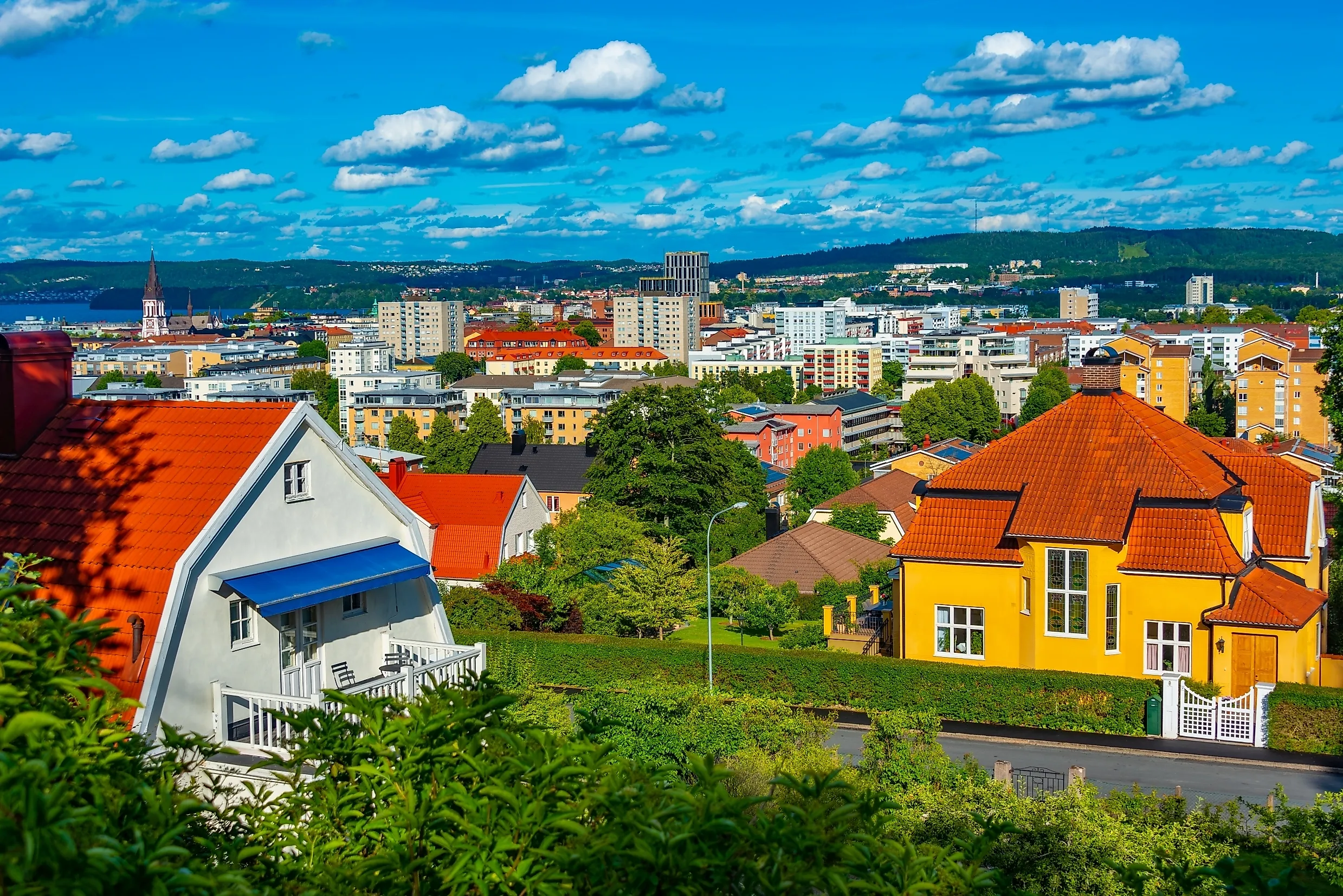
At the southern tip of Lake Vättern, Sweden's second-largest lake, Jönköping grew up as a distribution town where the country's main routes converge. Its economy runs on logistics, manufacturing, and public administration, with Husqvarna, the centuries-old maker of chainsaws and mowers, rooted nearby. That mix keeps the city steady and its housing markedly cheaper than the big metros.
Life here stays close to the water and a few central streets. Paths along Jönköping's harbor connect the center to the lakeshore. Östra Storgatan carries the main run of shops and cafés through downtown. Just south, a trail rings Lake Munksjön with green space minutes from the apartments. Jönköping suits people who want a mid-sized city where work, errands, and a lakeside walk all fit inside the same afternoon.
Umeå

The largest city in northern Sweden is younger than the ones down south, in every sense. Umeå University, founded in 1965, and Norrlands universitetssjukhus together employ much of the city and pull in students by the tens of thousands, giving Umeå one of the youngest populations in the country. Housing demand stays strongest around the campus and along the Ume River. Winters here are long and dark, with real snow from December into April, so this is a place for people who don't mind the cold.
Along the Umeälven, walking and cycling paths link bridges, parks, and benches that stay in use even in deep winter. Rådhusesplanaden, the main downtown avenue, lines up cafés, shops, and transit stops, and runs near Umeå Centralstation for trains south to Stockholm. On the riverbank, the contemporary art museum Bildmuseet ties the cultural scene to the university that drives the city. Umeå also delivers genuine northern nature, with the northern lights overhead on clear winter nights.
Visby

Visby is a UNESCO World Heritage site wrapped inside a 13th-century stone wall, which is not a sentence most towns can claim. On the Baltic island of Gotland, its economy leans on tourism, island administration, and seasonal work that peaks hard every summer. Inside the ring wall, narrow cobbled lanes and medieval stone houses keep daily life on foot. Beyond the walls, the town thins into quieter neighborhoods: family homes in Furulund, apartments and summer places near the coast at Snäck, and the more workaday streets and schools of Gråbo.
The pace shifts between the packed old town and the calm around it. Stora Torget, the main square, stays busy with cafés and shops, including the well-liked Eden Tapas & Bar where locals gather for dinner. Just outside the walls, Almedalen Park opens onto green waterfront lawns that host the country's biggest political week each summer. The Gotland Museum, near the old town, holds the island's Viking silver hoards and picture stones. Visby fits people who want a small, history-soaked place and don't mind that half the year is very quiet and reaching the mainland means a ferry or a flight.
Finding Your Version of Sweden
The through-line across these eleven cities is that Sweden doesn't ask you to pick between a career and a life. A software engineer weighing Kista against Lindholmen, a researcher choosing between Uppsala and Lund, a family trading Stockholm rents for a lake in Jönköping: each is buying into the same welfare state, the same schools, the same healthcare, just at a different price and pace.
For an American, the real decision is rarely which city ranks highest. It is whether you want the cross-border hustle of the Øresund, the industrial steadiness of the west coast, the student energy of a university town, or the long quiet winters of the north. Sweden has a version of itself for each of those answers.