12 Most Charming Towns In Illinois
On August 21, 1858, Abraham Lincoln and Stephen Douglas drew an estimated 12,000 people to the central square of Ottawa for the first of seven debates that defined that year's Illinois Senate race. The Ottawa square is still there, marked by the Lincoln-Douglas Debate Memorial Plaza. Roughly 90 miles northwest, Galena's downtown looks much as it did when Ulysses S. Grant accepted a job at his father's leather store there in 1860, the year before the Civil War broke out. The twelve Illinois towns below each carry a similar kind of preserved past, anchored variously on Lincoln-era politics, Mississippi River commerce, Mormon settlement, Dutch immigration, the state's oldest college, and a film set that became a town tradition.
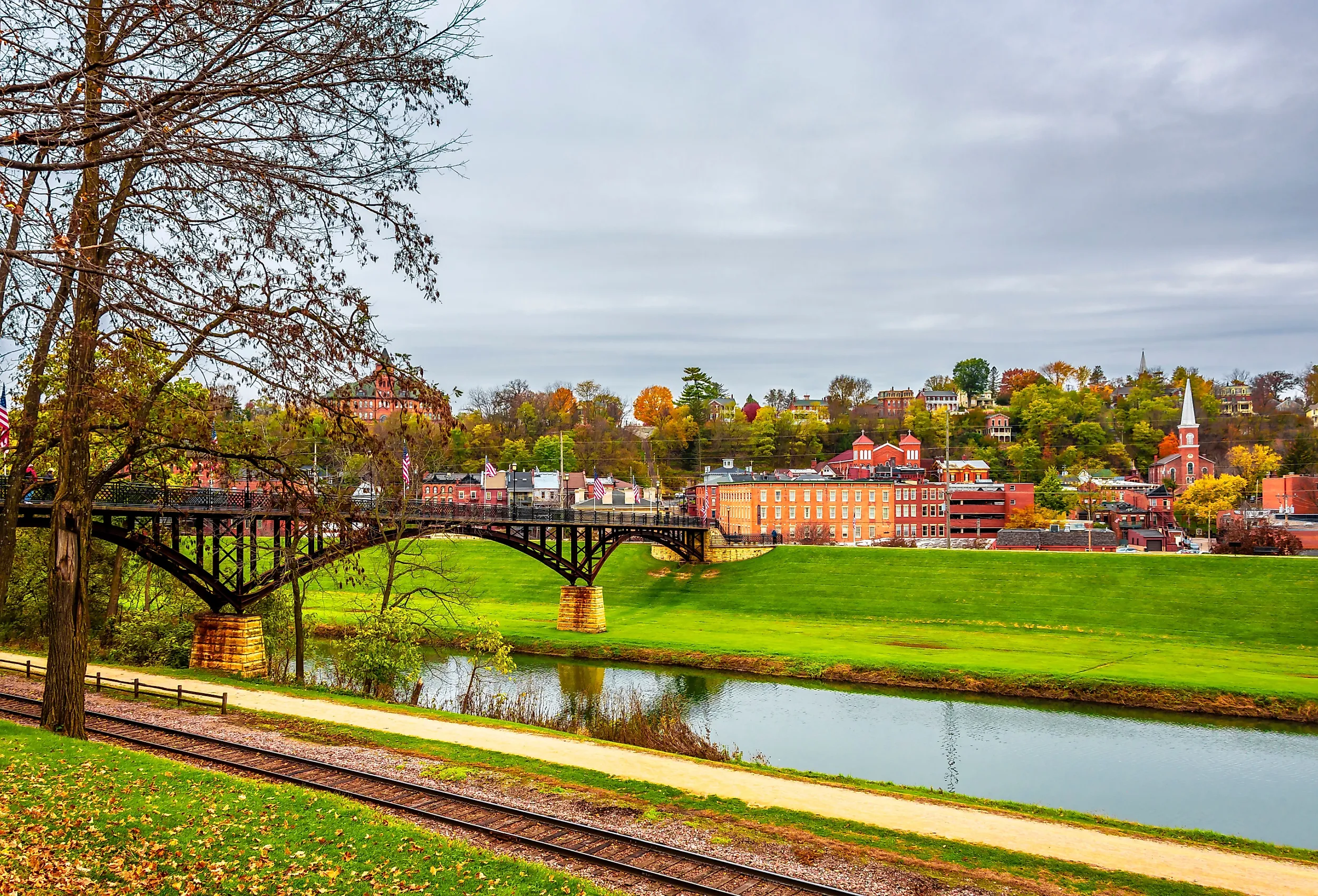
Galena

Galena, the seat of Jo Daviess County in Illinois's far northwest corner, takes its name from the lead-bearing mineral that built the town. The Galena River, a Mississippi tributary, carried lead ore down to the river trade through the 1830s and 1840s, making Galena one of the wealthiest towns in early Illinois. The wealth froze the architecture in place. About 85 percent of the town centre, more than 800 buildings, is listed on the National Register of Historic Places, the highest concentration of any town in Illinois.
Ulysses S. Grant moved to Galena in 1860 to clerk in his father's leather-goods store, then returned in 1865 after the Civil War; his home on Bouthillier Street, donated to him by the citizens of Galena, is now a state historic site. Other surviving 19th-century buildings include the Old Market House (1845), the Dowling House (1826, the oldest home in Galena), the Belvedere Mansion, and the Elihu B. Washburne Home. The Galena/Jo Daviess County History Museum on Bench Street covers the lead-mining era, Grant, and the steamboat trade.
Woodstock

Woodstock, 50 miles northwest of Chicago in McHenry County, stood in for the fictional Punxsutawney, Pennsylvania, in the 1993 Bill Murray film Groundhog Day. The town has leaned into the connection. Every February 2, Woodstock hosts a multi-day Groundhog Days celebration on the town square, including a sunrise prognostication ceremony, walking tours of the film's locations, and a costumed reenactment of the movie's key scenes. The town square itself, surrounded by the 1857 Old McHenry County Courthouse and the 1890 Woodstock Opera House, was named one of the National Trust for Historic Preservation's "Dozen Distinctive Destinations" in 2007.
The Opera House runs a year-round programme of theatre, music, and dance. Other annual events include the Fair Diddley arts and crafts fair in June, the Mozart Festival in late summer, and the Lighting of the Square at the start of December.
Nauvoo

Nauvoo, in Hancock County on a wide bend of the Mississippi River, was the largest Mormon settlement before the church's expulsion to Utah. Founded by Joseph Smith in 1839, the town grew to roughly 12,000 residents by 1845, briefly rivalling Chicago in size. After Smith's killing in nearby Carthage in June 1844 and the subsequent forced exodus of most Mormon residents in 1846, Nauvoo emptied out and was partially resettled by French Icarian utopians and then by German immigrants. Today's population is just over 900.
The Nauvoo Historic District, restored by the Church of Jesus Christ of Latter-day Saints starting in the 1960s, includes the rebuilt Nauvoo Temple (originally completed 1846, destroyed 1848, rebuilt 2002), the Joseph Smith Homestead, the Mansion House, the Red Brick Store, and the Brigham Young Home. Horse-drawn carriage tours of the district leave from the visitor centre. The 148-acre Nauvoo State Park sits at the southern end of town along the river, with camping, the Nauvoo State Park Museum, and the annual Nauvoo Grape Festival on Labor Day weekend, a tradition tied to the area's 19th-century French viticulture.
St. Charles

St. Charles is part of the Tri-Cities area along the Fox River in Kane County, 40 miles west of Chicago. The town slogan, "Pride of the Fox," refers to the 202-mile river that bisects the centre of town. The downtown straddles the river, with shops, restaurants, and the 1926 Arcada Theatre (now a live music venue) on the east side, and the historic Hotel Baker (1928) and a foot-and-bike trail system on the west.
The St. Charles History Museum on Main Street covers the town's 1830s founding by Read Ferson and the Fox River milling era. The Kane County Flea Market, held the first weekend of each month at the county fairgrounds, has run continuously since 1967 and is one of the largest in the Midwest. Other annual events include the Scarecrow Festival in October and the Festival of the Fox in June.
Ottawa

Ottawa, the seat of LaSalle County, sits at the confluence of the Fox and Illinois Rivers in north-central Illinois. On August 21, 1858, Washington Square here hosted the first of seven Lincoln-Douglas debates, drawing roughly 12,000 people for a three-hour exchange on slavery and the Kansas-Nebraska Act. The square is now Ottawa's Lincoln-Douglas Debate Memorial Plaza, with sculptures of both candidates in the positions they would have held during the debate.
The downtown holds the 1856 Reddick Mansion (Italianate, now a museum and the LaSalle County Historical Society headquarters), the Fisher-Nash-Griggs House, and the Ottawa Historical and Scouting Heritage Museum, which holds artefacts from the first Boy Scout troop chartered in Illinois. Ottawa also serves as the northern gateway to Starved Rock State Park, eight miles south, the most-visited state park in Illinois with 18 named canyons and seasonal waterfalls in the sandstone bluffs above the Illinois River.
Fulton

Fulton sits directly across the Mississippi River from Clinton, Iowa, in Whiteside County. The town was settled in the 1830s by Dutch immigrants and named for steamboat inventor Robert Fulton, whose vessels worked the river above and below the town through the mid-19th century. The Dutch identity remains visible: the centrepiece of the riverfront is the De Immigrant Windmill, a 90-foot working grain mill built in the Netherlands, shipped to Fulton in pieces, and dedicated in 2000. The adjacent Windmill Cultural Center documents the Dutch settlement of the area and the construction of the windmill.
The first weekend of May each year, Fulton hosts the Dutch Days Festival with traditional dancing, food, and a parade. Other attractions include the Lock and Dam 13 viewing area three miles north of town, the Martin House Museum, Heritage Canyon (a recreated 19th-century mining village), and Morrison-Rockwood State Park ten miles east, which has camping and fishing at Lake Carlton.
Quincy

Quincy, the seat of Adams County, sits on 100-foot limestone bluffs above the Mississippi River in west-central Illinois. The bluff-top location and the river crossing made Quincy a major Underground Railroad station before the Civil War; the Dr Richard Eells House, now a museum, served as one of the most active stops in the state. The sixth Lincoln-Douglas debate was held at Quincy's Washington Park on October 13, 1858.
The downtown's German Quarter, also called the South Side German Historic District, contains a dense concentration of 19th-century brick brewery and tradesman houses built by Quincy's substantial 1840s and 1850s German immigrant population. The Villa Kathrine, a 1900 Moorish-style mansion overlooking the river, now serves as Quincy's visitor centre. The Quincy Museum on Maine Street is housed in another 19th-century mansion. The Dogwood Parade in early May and the Q-Fest concert series in summer are the largest annual events.
Lebanon

Lebanon, in St Clair County about 25 miles east of St Louis, was founded in 1814 and is centred on McKendree University, the oldest college in Illinois. Established as the Lebanon Seminary in 1828 by Methodist pioneers and renamed in 1830 after Bishop William McKendree, the first American-born bishop of the Methodist Church, McKendree was chartered as a college in 1835. Abraham Lincoln, then a freshman state legislator, was among the legislators who voted in favour of the charter. The university now enrols around 1,960 students.
The Lebanon Historic District covers most of the original 19th-century town centre, including the 1830 Mermaid House Hotel, where Charles Dickens stayed in 1842 during his American tour. The Emerald Mound and Village Site on the town's edge preserves prehistoric Mississippian-culture earthworks dating to roughly 1000 to 1400 CE. Downtown Lebanon's brick main street, lined with antique shops and small restaurants, was repaved with original 19th-century brick in a 1990s restoration project.
Arthur

Arthur straddles the line between Douglas and Moultrie counties in east-central Illinois and serves as the commercial centre of the largest Old Order Amish settlement in Illinois. The Arthur Amish community, established in 1865 by families who moved from Pennsylvania and Ohio, now numbers around 4,500 people across roughly 100 square miles around the town. Horse-drawn buggies share the country roads with cars; the rural landscape outside town is dotted with Amish farms, schoolhouses, and small shops.
Visitor stops include the Homestead Bakery, Beachy's Bulk Food, the Shady Crest Farm Market, and the Yoder Bargain Store, all run by Amish or formerly-Amish families. Roselen's Coffee and Delights on the main street is a non-Amish bakery-cafe that has become a community gathering spot. The annual Arthur Cheese Festival on Labor Day weekend, the CIBR BBQ Cookoff in summer, and the Strawberry Jam Festival in June draw crowds well beyond the local population.
Geneva

Geneva, the seat of Kane County, sits on the Fox River 36 miles west of downtown Chicago and was settled in 1835 by James and Charity Herrington. The downtown has more than 160 specialty shops, boutiques, and restaurants concentrated along Third Street, the historic commercial spine. The Fox River Trail and the Illinois Prairie Path both pass through town, drawing cyclists and walkers on weekends.
The Fabyan Windmill, a 68-foot Dutch-style smock mill originally built around 1850 near Elmhurst and moved to Geneva by Colonel George Fabyan in 1914, sits on the west bank of the Fox River south of town. The adjacent Fabyan Villa, a Frank Lloyd Wright-redesigned house from 1907, is now a Forest Preserve museum. The Geneva History Museum on Third Street covers the town's settlement and the role of Fabyan's Riverbank Laboratories during World War I, when the lab housed America's first dedicated cryptanalysis program. Annual events include the Geneva Arts Fair in July, Swedish Days in June, and the Festival of the Vine in September.
Mount Carroll

Mount Carroll, the seat of Carroll County in Illinois's far northwest corner, is named for Charles Carroll of Carrollton, the longest-lived signer of the Declaration of Independence. The Mount Carroll Historic District covers the original downtown, the residential blocks immediately south, and the campus of the former Shimer College, a small liberal-arts school that operated in Mount Carroll from 1853 to 1979 before relocating to Waukegan and eventually Chicago. The campus is now the Campbell Center for Historic Preservation Studies, a graduate-level training centre for museum conservators and historic-preservation specialists.
The Mount Carroll post office holds an oil-on-canvas mural by Irene Bianucci, painted in 1941 under the Treasury Section of Fine Arts program (commonly confused with WPA art, though it was a separate program). The Timber Lake Playhouse, three miles east, opened in 1962 and runs a summer stock season of Broadway musicals and plays. The town's best-known attraction, though, is Raven's Grin Inn, a converted 1870s mansion that has run as a year-round haunted house attraction since 1987 under proprietor Jim Warfield, a former carpenter and storyteller.
Princeton

Princeton, 100 miles southwest of Chicago and the seat of Bureau County, is built around a mile-long commercial main street that runs north to south, with the Bureau County Courthouse anchoring the southern end and the 1911 Amtrak depot at the north. The town was a major Underground Railroad station before the Civil War; the Owen Lovejoy Homestead on East Peru Street, home of the abolitionist congressman Owen Lovejoy (brother of murdered abolitionist editor Elijah Lovejoy), is now a museum, with documented connections to runaway slaves who passed through Princeton on the way north.
The downtown holds the Bureau County Historical Society Museum, the 1882 Apollo Theater, and the Matson Public Library, built in 1913 with Andrew Carnegie funds. The Homestead Festival, held the last weekend in August at the Lovejoy Homestead grounds, runs traditional crafts demonstrations, a Civil War encampment, and music. Two covered bridges, the Red Covered Bridge (1863) and the Captain Swift Bridge, sit in nearby Bureau County and are among the few surviving 19th-century covered bridges in Illinois.
Twelve Towns, Twelve Different Anchors
What ties these towns together is mostly population and what divides them is everything else. Galena anchors on lead mining and Grant; Nauvoo on Joseph Smith and the early Mormon church; Lebanon on McKendree's two centuries of teaching; Ottawa on Lincoln, Douglas, and the politics of 1858; Quincy on its bluff-top river-crossing role in the Underground Railroad; Fulton on Dutch settlement and the working windmill; Arthur on the largest Old Order Amish settlement in the state; Geneva on Fabyan's eccentric estate and the wartime laboratory there; Woodstock on a Bill Murray film and a town square that has decided to celebrate it; Mount Carroll on a haunted house and a defunct college; and Princeton on the Lovejoy brothers and a thousand-yard main street. Each one rewards a different kind of visit.