11 Adorable Small Towns in North Carolina to Visit
The first Pepsi was mixed at a New Bern drugstore in the 1890s, and the spot is still marked downtown. Since 2007, the Edenton waterfront has held the last screw-pile lighthouse on the North Carolina sounds. A wooden toy horse has served as Tryon's official mascot since 1928, keeping the same downtown corner. White squirrels are common enough in Brevard that the town protects them by ordinance, while the state's official Fourth of July celebration has belonged to Southport since the 1790s. They are small, walkable, and a little eccentric, and once you have spent an afternoon in one, you tend to remember it.
Beaufort

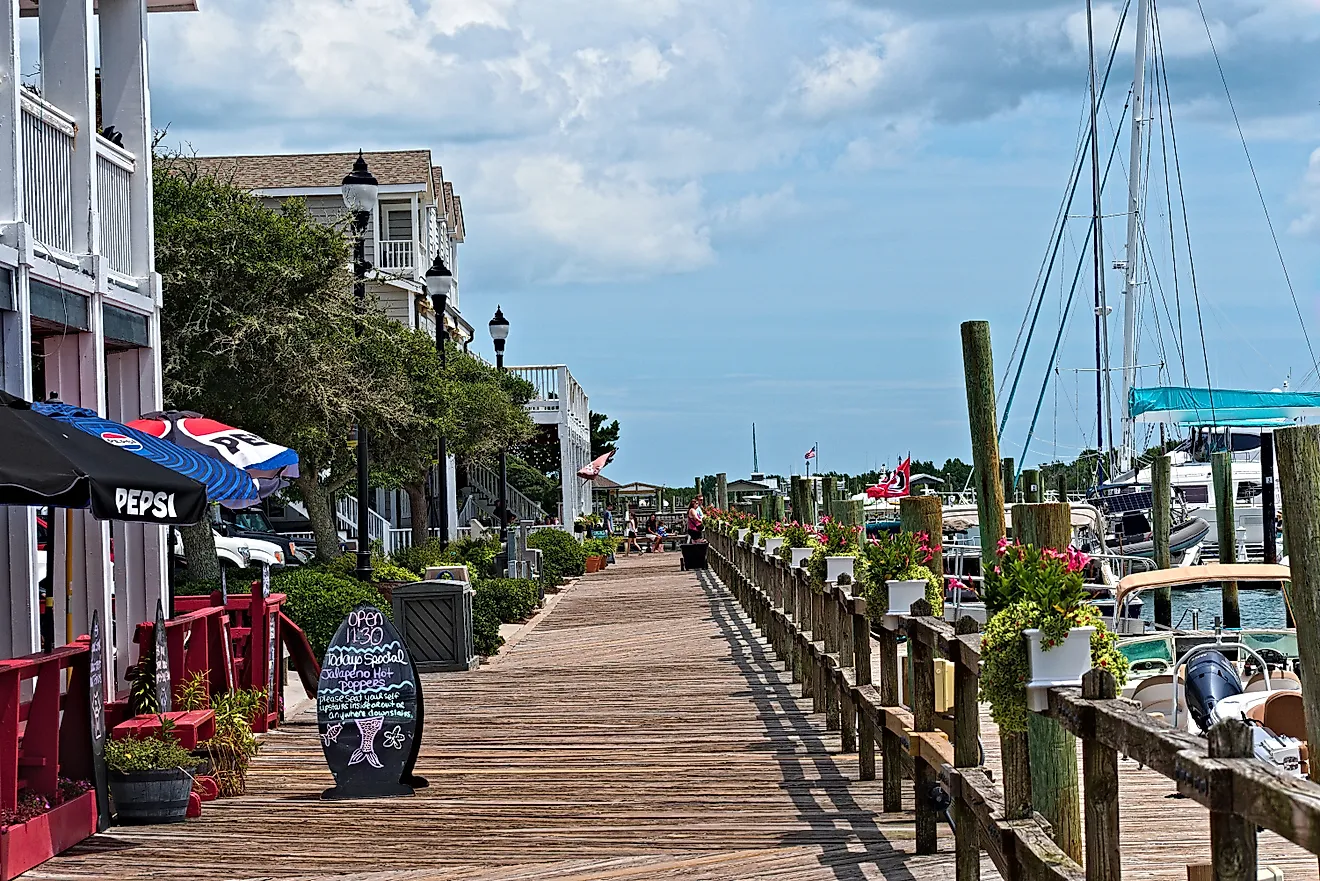
Beautiful summer day on the boardwalk waterfront in Beaufort.
Beaufort is one of North Carolina's oldest towns, a port laid out in the early 1700s on the central coast. Its boardwalk along Front Street looks across Taylor's Creek to the Rachel Carson Reserve, where a herd of wild horses grazes the salt marsh in plain view of the restaurants. Budget Travel readers voted Beaufort America's Coolest Small Town in 2012, and the compact historic district still backs up the billing.
The town leans into its seafaring past at the North Carolina Maritime Museum, which displays artifacts recovered from Blackbeard's flagship Queen Anne's Revenge, run aground off the inlet in 1718. A few blocks inland, the Old Burying Ground holds graves dating to the 1700s, among them the often-repeated tale of a girl buried in a keg of rum. Down on the water, charter boats run out to the barrier islands and the wild ponies of Shackleford Banks, and the catch comes straight off the docks.
Blowing Rock

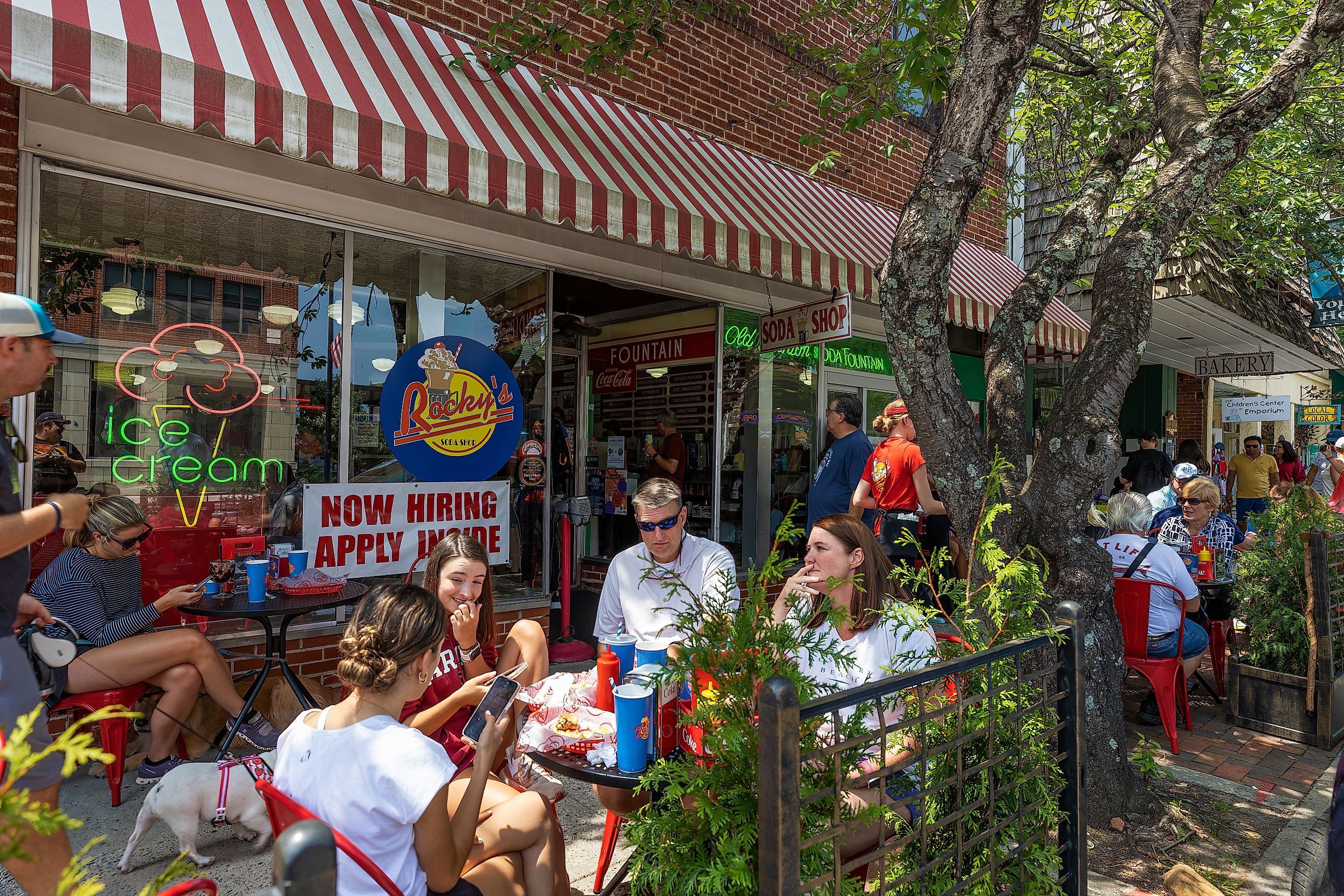
A gift store in Blowing Rock, North Carolina. Editorial credit: J. Michael Jones / Shutterstock.com.
Blowing Rock takes its name from a cliff above the Johns River Gorge in the Blue Ridge Mountains, where the wind sweeps up the rock face so steadily that light objects thrown over the edge can blow back, and snow sometimes appears to fall upward. The overlook opened to visitors in 1933, making it one of the oldest attractions in the state. The town itself sits around 4,000 feet up, high enough to stay cool when the Piedmont swelters.
Just north of downtown, Moses H. Cone Memorial Park spreads across a 3,500-acre estate on the Blue Ridge Parkway, with carriage trails looping past Bass Lake and a turn-of-the-century manor that now houses a craft center. Back on Main Street, galleries, candy shops, and old-line restaurants stay busy through the summer and fall, and the small park at the center fills with families on weekends. It is the rare mountain town you can cover entirely on foot.
Edenton

Edenton sits on the north shore of the Albemarle Sound and served as one of North Carolina's first colonial capitals, holding the seat from 1722 until New Bern took over in the 1740s. The waterfront is the heart of town, anchored by the 1886 Roanoke River Lighthouse, the last surviving screw-pile lighthouse on the Carolina sounds, which was moved to the Edenton shore in 2007. From the boardwalk, the view opens out over the broad, shallow sound.
A short walk covers the rest of the historic district, including the 1767 Chowan County Courthouse, a National Historic Landmark and one of the oldest courthouses still in use in the country. The Historic Edenton State Historic Site ties the colonial buildings together with guided tours that start at the visitor center. Quiet streets, Georgian and Federal houses, and long water views have earned Edenton a regular place on lists of the South's prettiest towns.
Hendersonville

Hendersonville is the heart of North Carolina's apple country, and Henderson County grows the large majority of the state's apples. That harvest takes over downtown every Labor Day weekend for the North Carolina Apple Festival, a four-day street fair on Main Street that ends with the King Apple Parade. Orchards and cider stands line the roads leading out toward the mountains.
The historic Main Street District curves in a gentle S through tree-lined blocks of shops and restaurants, one of the largest downtowns in the western part of the state. The Henderson County Heritage Museum fills the restored 1905 courthouse at the top of Main, and a few miles out, the Historic Johnson Farm preserves a former tobacco farm that took in summer boarders by the 1920s. Pisgah National Forest and DuPont State Forest, both under half an hour away, put waterfalls within easy reach.
Hillsborough

Hillsborough, North Carolina
Hillsborough was founded in 1754 and ranks among North Carolina's oldest towns, with a downtown small enough to walk in an afternoon. The Eno River runs along its edge, and the paved Riverwalk follows the water as part of the statewide Mountains-to-Sea Trail, passing the remains of old textile mills. Just outside downtown, the Historic Occoneechee Speedway Trail loops around a dirt track that hosted stock car races between 1948 and 1968.
Two house museums anchor the town's architecture: Ayr Mount, a Federal-style home built in 1815 with a wooded Poet's Walk along the river, and the Burwell School, a former girls' academy whose history includes Elizabeth Keckly, enslaved on the property before she bought her freedom and became Mary Todd Lincoln's dressmaker. The compact center has also drawn a notable community of writers over the years, and its galleries open their doors for a Last Friday art walk most of the year. Between the colonial streets and the working river, Hillsborough offers more to see than its size suggests.
New Bern

New Bern was founded in 1710 by Swiss and German settlers at the meeting of the Neuse and Trent Rivers, making it the second-oldest town in North Carolina. Its centerpiece is Tryon Palace, the reconstructed colonial governor's residence and the colony's first permanent capitol, with formal gardens and costumed interpreters on the grounds. The surrounding historic district holds blocks of restored homes and the adjacent North Carolina History Center.
The town is also where Pepsi-Cola was invented: pharmacist Caleb Bradham mixed the first batch at his downtown drugstore in the 1890s, and a re-created version of the pharmacy still stands on Pollock Street. The New Bern Firemen's Museum, set in a 1920s fire station, keeps antique engines and the city's firefighting history. Boutiques line Middle and Pollock Streets, and Union Point Park opens onto the water where the two rivers meet.
Southport

Southport sits at the mouth of the Cape Fear River, where it empties into the Atlantic, and the water sets the pace of the town. The shaded streets of live oaks and 19th-century houses have made it a frequent film location, but its biggest draw is the North Carolina Fourth of July Festival, the state's official Independence Day celebration. The tradition traces back to the 1790s and now pulls in tens of thousands each summer for the parade, the waterfront fireworks, and the boat flotilla.
Much of the festival centers on Waterfront Park and the grounds of Fort Johnston, one of the oldest fort sites in the state. The Old Brunswick County Jail and the Southport branch of the North Carolina Maritime Museum fill in the local history the rest of the year. Originally called Smithville, the town took its current name in the 1880s when it set its sights on becoming a major port, an ambition the railroads never quite delivered.
Sylva

Sylva announces itself with a staircase: 107 steps climb from Main Street to the 1914 Jackson County Courthouse, a domed Neo-Classical building often called the most photographed courthouse in North Carolina. It stopped hearing cases in the 1990s and now holds the county library, along with a small museum and a gallery. The climb pays off with a view straight back down Main Street to the ridgelines beyond.
That Main Street is walkable and full of bookstores, antique shops, and a cluster of craft breweries. Just south of town, the American Museum of the House Cat shows a retired professor's decades-long collection of feline art and artifacts, with proceeds going to a local no-kill shelter. Western Carolina University sits ten minutes away in Cullowhee, and the Tuckasegee River and the trails of Pinnacle Park keep anglers and hikers busy nearby.
Tryon

Tryon grew up as a railroad and resort town in the foothills, and horses have shaped it ever since. The Tryon Riding and Hunt Club dates to the 1920s, the Tryon Horse Show is among the oldest in the country, and the oversized toy horse known as Morris has stood as the town mascot on Trade Street since 1928. The international equestrian center in nearby Mill Spring has since added world-level competition to that long tradition.
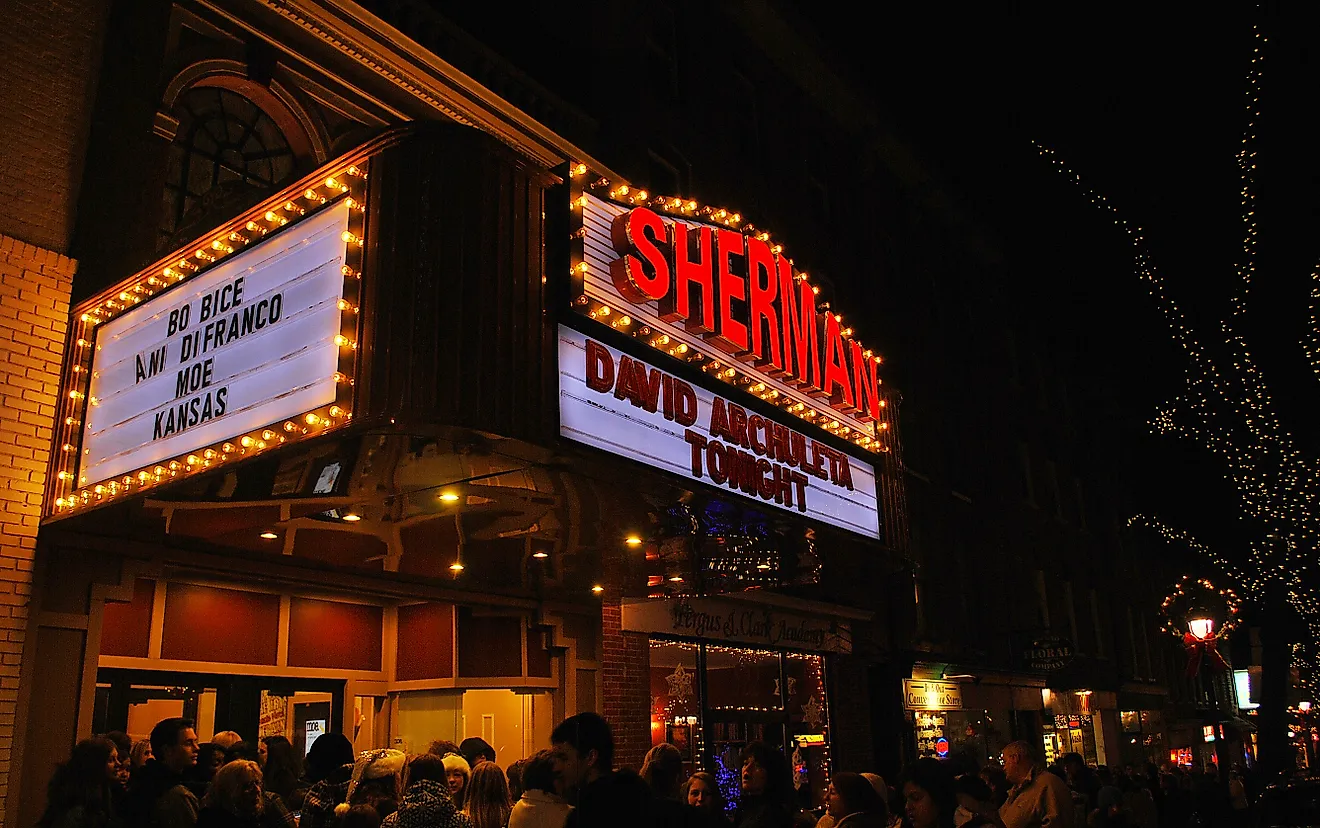
Tryon is also the birthplace of Nina Simone, born Eunice Waymon here in 1933; a bronze sculpture honors her at Nina Simone Plaza downtown, a short walk from her childhood home. The Tryon Fine Arts Center anchors the cultural side with music, theater, and gallery shows, while Harmon Field hosts smaller equestrian events and community festivals. A few blocks of independent shops, galleries, and a vintage movie theater fill out a downtown you can see in an hour.
Washington

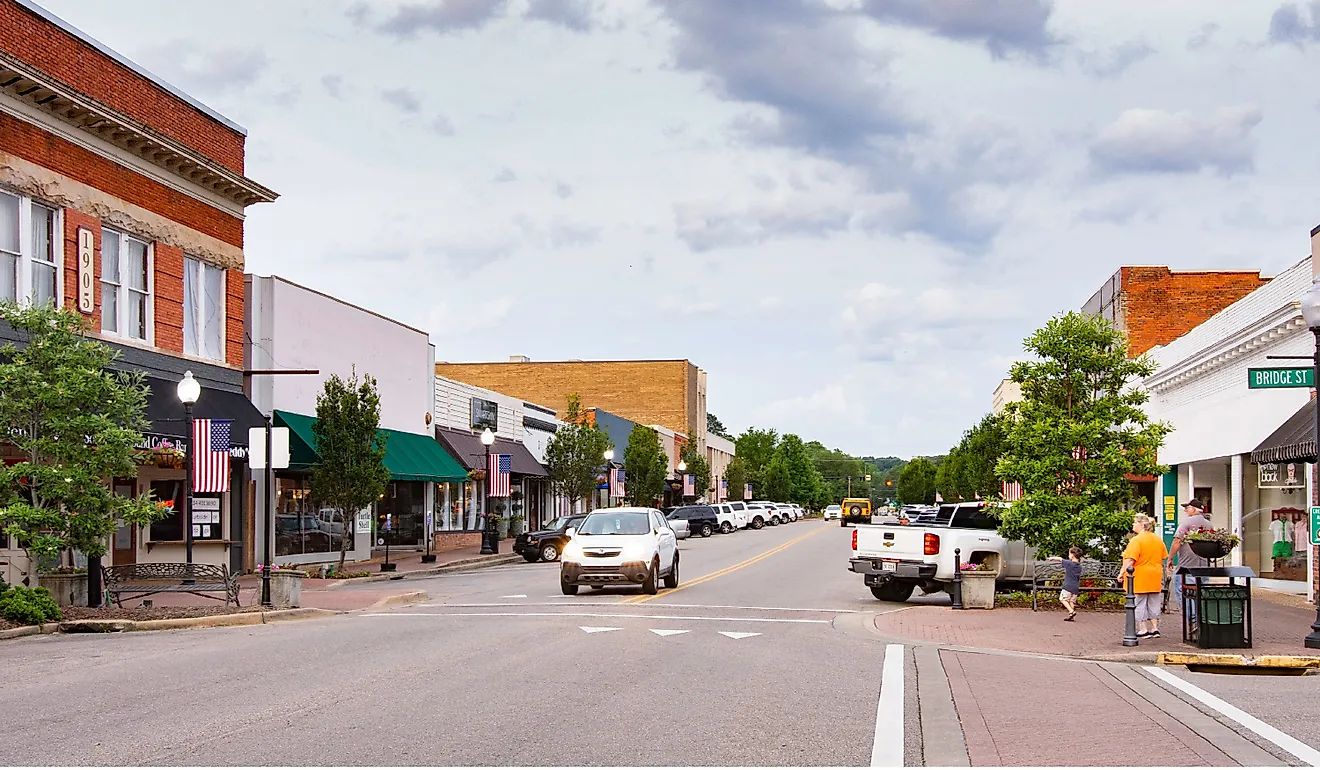
Downtown businesses, Washington, North Carolina. Image credit Wileydoc via Shutterstock.com
Washington was renamed in 1776 to honor George Washington, the first town in the country to carry his name, which is why locals still call it the Original Washington. It sits on the north bank of the Pamlico River, and the waterfront and its boardwalk are the center of things. A pair of 19th-century fires spared a number of homes from the late 1700s and 1800s, which still line the surrounding blocks.
The North Carolina Estuarium explains the ecology of the Tar-Pamlico estuary across more than 200 exhibits and runs free pontoon-boat tours on the river in the warmer months. Downtown, the restored 1913 Turnage Theatre, now run by the Arts of the Pamlico, hosts films, concerts, and stage productions. Main and Water Streets fill in around them with galleries and restaurants, including Bill's Hot Dogs, a bare-bones counter locals have treated as an institution for decades.
Brevard

Brevard anchors a county that calls itself the Land of Waterfalls, with hundreds of falls in the surrounding Pisgah National Forest and DuPont State Forest. The town is just as well known for its white squirrels, descendants of a pair that escaped an overturned carnival truck in the 1940s; they are protected by local ordinance, and downtown throws a White Squirrel Festival over Memorial Day weekend. Brevard College and Silvermont Park are two of the more reliable places to spot them.
The Brevard Music Center has drawn students and audiences to its summer concerts since 1936, filling the warm months with chamber music, orchestral programs, and opera. The 1917 Silvermont Mansion, now a community center and local-history museum, sits on an eight-acre park near downtown, and the Transylvania Heritage Museum covers the county's settlement and industry. Oskar Blues opened its East Coast brewery here in 2012, with a taproom a short ride from the forest trails.
The Takeaway
What ties these towns together is not a single look or region but a habit of doing one thing distinctly well. Beaufort guards a colonial harbor, Brevard counts its white squirrels, Washington keeps the first version of a famous name, and Sylva sends visitors up a courthouse staircase for the view. None of them require a long itinerary or a tourist script; most reward an unhurried day of walking, a meal, and a local museum or trail. For anyone who already lives in the state, they make the case that the best weekend is often the nearest one.