5 Cities With The Most Skyscrapers In The World
Every big city has a skyline, but a handful have gone genuinely vertical, stacking up so many towers that the horizon disappears behind them. This list ranks the five cities with the most skyscrapers over 200 meters tall, and a quick note on the word "tallest" is in order: this is a count of towers, not a measure of how high any one of them reaches. A city can win here with a forest of 250-meter buildings and no record-breaker at all. The order shifts as cranes come down and new ones go up, but the current leaders are not especially close to being caught.
1. Shenzhen, China

Shenzhen has more skyscrapers over 200 meters than any other city on Earth, which is remarkable for a place that was mostly a cluster of fishing and farming villages in 1980. Then China named it the country's first Special Economic Zone, and the cranes never really left. Today the city of roughly 17 million holds more than 460 buildings above 150 meters, and the pace of that climb is hard to overstate: most of these towers went up within a single working career.
The headliner is the Ping An Finance Center, which tops out just under 600 meters and ranks among the tallest buildings in the world. Not far off is KK100, a 100-story tower reaching about 442 meters. Neither existed when many of the city's residents were born, which is roughly the whole point of Shenzhen.
2. Dubai, United Arab Emirates

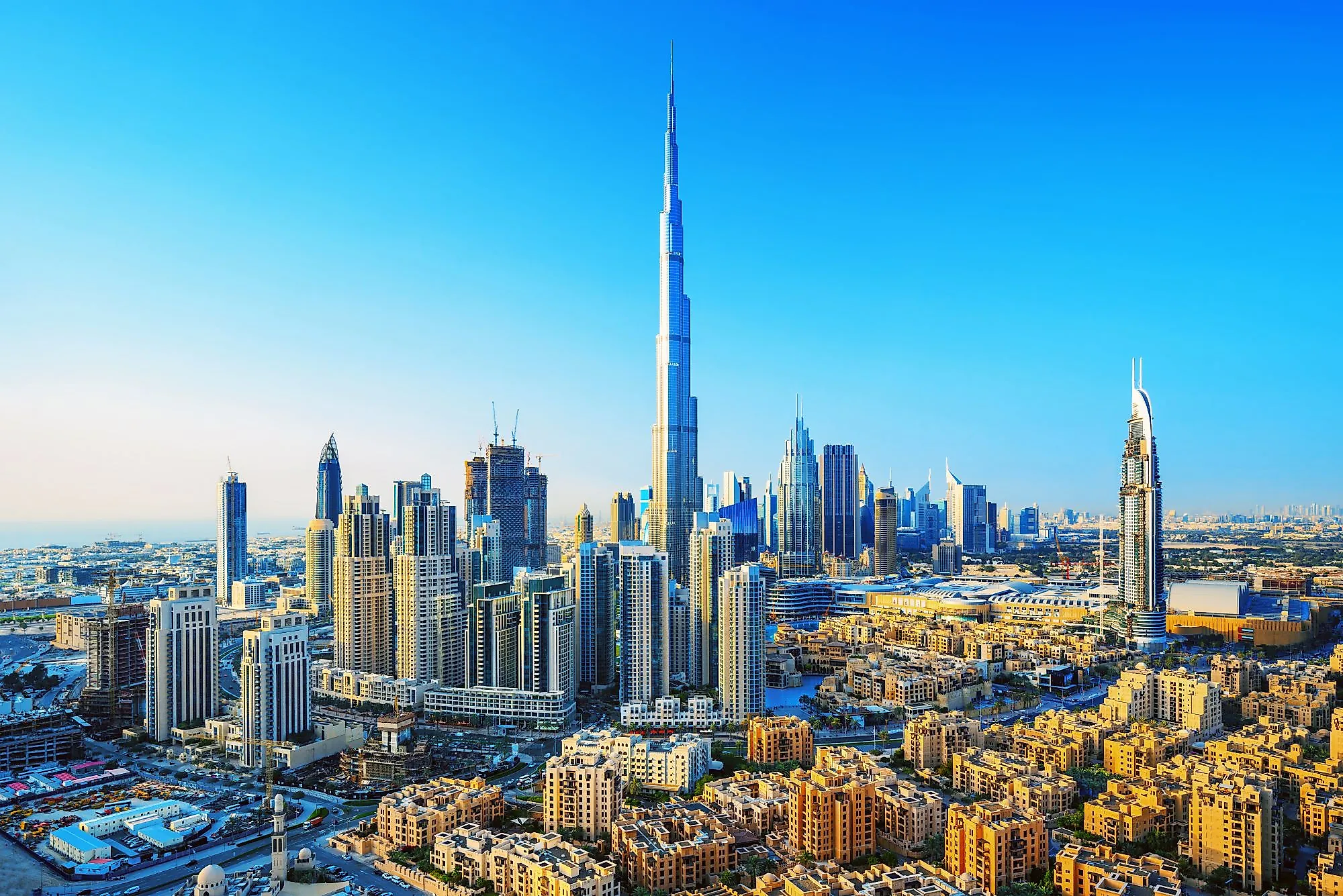
Dubai, the United Arab Emirates' largest city, sits second on the list, which is a fitting place for a city built to make an impression. On the edge of the Persian Gulf, it turned a stretch of desert into a wall of glass towers in about fifty years, and the star is impossible to miss. The Burj Khalifa is the tallest building in the world, opened in 2010 at 828 meters.
To grasp how much it dominates its home city, consider that Dubai's next-tallest towers do not even reach the Burj Khalifa's halfway mark. The building is less a part of the skyline than the reason people look at it. Home to about 3.5 million residents, Dubai keeps adding towers at a rate that suggests it has no intention of settling for second place forever.
3. Hong Kong, China

Here is where definitions start to matter. Lower the bar to 150 meters and Hong Kong is the undisputed skyscraper capital of the world, with 569 such buildings, more than anywhere else. Raise it to 200 meters and it slips to third. Either way, this city of some seven million is stacked almost impossibly tight, its towers wedged onto a sliver of buildable land between steep hills and Victoria Harbour.
The tallest is the International Commerce Centre at 484 meters, followed by the Bank of China Tower at 367 meters and the 78-story Central Plaza. On many evenings, dozens of harbor-front buildings light up in a coordinated show called the Symphony of Lights, reflected across the water. It is the only skyline on this list that is also, technically, a nightly performance.
4. New York City, United States

The only non-Asian city in the group, New York City is where the skyscraper was more or less invented, and it held the title of most skyscrapers on Earth until Hong Kong overtook it in the early 2000s. Home to about eight million people, it still has more than 300 buildings over 150 meters, most of them packed onto the island of Manhattan.
Its towers double as a timeline of the form. The Empire State Building (1931) rises 381 meters, the Chrysler Building (1930) reaches 318 meters, and One World Trade Center (2014) stands 541 meters near the site of the former Twin Towers. Between them sit almost a century of blueprints, which is something the newer cities on this list cannot claim yet.
5. Shanghai, China

Rounding out the list is China's largest city, a port of more than 24 million whose modern skyline is mostly the work of the last three decades. The centerpiece is the Shanghai Tower, completed in 2015, which coils 632 meters into the sky. It is the tallest building in China and the third-tallest in the world, behind only the Burj Khalifa and Kuala Lumpur's Merdeka 118.
The tower has company. The Jin Mao Tower reaches 420 meters, and the 101-story Shanghai World Financial Center rises 492 meters, the three standing close enough together in Pudong to form one of the most recognizable clusters anywhere. It is a skyline that did not exist in living photographs from the early 1990s, when the same riverbank was mostly low-rise and farmland.
The View From the Top
These five cities took very different routes to the same crowded horizon: Shenzhen and Dubai raced up in a single generation, Hong Kong squeezed its towers onto almost no land, New York wrote the original rulebook, and Shanghai rebuilt its skyline from the riverbank up. What none of them can claim is the title the ranking might imply. The count rewards quantity, not altitude, so the "tallest" city here is really the busiest one, and on that measure Shenzhen is not done building.