10 Best Cities To Retire In Germany
Münster retirees run errands by bicycle on the Promenade, a car-free ring around the old city. Dresden seniors book opera nights at the Semperoper and walk home along the Elbe meadows. A pension stretches far in Chemnitz, where apartments average about €1,800 per square meter. Freiburg puts Black Forest day hikes at the end of the Höllentalbahn rail line. Every pick across Germany keeps markets and green space within easy reach of home.
Münster

Münster and Osnabrück were the sites of the signing of the Peace of Westphalia, which ended the Thirty Years' War in 1648. Today, Münster is often called the bicycle capital of Germany. Its cycling network and population of about 315,000 make it easy for active seniors to get around. The flat Westphalian landscape helps, and the 4.5-kilometer (2.8-mile) Promenade, a tree-lined ring reserved for walkers and cyclists, circles the old town and its Domplatz market. Nearby, the Aasee, completed in the 1930s, offers sailing, waterside restaurants, and level paths. History buffs may stop by the Mühlenhof Open-Air Museum, which includes 30 historic Westphalian farmhouses, workshops, and village buildings relocated from across the region. Art lovers can stop by the Kunstmuseum Picasso, the only Picasso museum in Germany, with a collection centered on his lithographs and graphic works.
Dresden

Dresden has a population of roughly 570,000 residents. It was first mentioned in written records in 1206, when it appeared as a small trading settlement. A typical day can include a slow tram ride along the Elbe, a stroll through the baroque Zwinger courtyard, and coffee at a quiet café in the Neustadt. The riverside meadows, the Elbwiesen, give retirees an easy, car-free green space for walking, picnics, or watching locals go about their day. Distinctive leisure activities include the Semperoper and the Staatsoperette, where long-running opera and operetta seasons make it easy to build a regular "performance night" into the week. The Kunsthofpassage courtyards make for another easy outing, with their quirky "singing" drainpipes and small studios. The city's senior advisory offices publish walking-trail guides, transition tips for new retirees, and cultural programs for older residents.
Chemnitz

Chemnitz, with just under 250,000 inhabitants, takes its name from the river, whose Slavic root is associated with stone. The city is appealing if priorities include space, affordability, and a quieter environment. Housing costs and everyday expenses are among the lowest in major German cities, which leaves more room in a pension for hobbies and small trips. For example, average asking prices for apartments sit around €1,800 per square meter, well below the rates in Germany's priciest markets. Seniors can drop by the Museum Gunzenhauser, set in a former savings bank built between 1928 and 1930 by Fred Otto, a landmark of New Objectivity architecture. Inside, the collection has more than 3,000 works from the 20th century, anchored by one of the world's largest holdings of Otto Dix paintings and drawings. Each visit reveals a different corner of German Expressionism or New Objectivity, with Schmidt-Rottluff's bold color fields hanging near Jawlensky's meditative heads.
The State Museum for Archaeology Chemnitz (SMAC) gives retirees a distinctive museum visit that feels nothing like a typical city museum. Set inside the former Schocken department store, it holds more than 6,000 archaeological objects tracing human settlement in the region, beginning with Paleolithic hunters and ending in early industrial Saxony. Accessibility is excellent with lifts, tactile guides, seating areas, and hearing-assistance systems, making the museum comfortable for visitors with varied mobility or sensory needs. Seniors can check out the Kunstsammlungen am Theaterplatz, which sits directly on Theaterplatz, across from the opera house and St. Petrikirche. Inside, the galleries lean toward 19th- and early 20th-century painting and sculpture, with strong Saxon and German collections.
Essen

Essen is ideal for retirees who like the idea of living in a former industrial heartland that has reinvented itself into a green, cultural city. It has a population of over 500,000 and, due to its central location in the Ruhr, is referred to as the Ruhr's "secret capital." Day-to-day life can revolve around the Zollverein Coal Mine Industrial Complex, now a UNESCO-listed cultural park with level walking routes. The preserved Shaft XII, designed by Fritz Schupp and Martin Kremmer, a monumental red-steel structure, is the centerpiece. The old coal-washing plant now houses the Ruhr Museum, with panoramic elevators and accessible galleries that trace the region's natural and industrial history.
For nature lovers, the Baldeneysee, the city's signature lake, becomes an easy path for walking or e-biking, with small marinas and waterside cafés. Grugapark, a roughly 70-hectare green world, holds the Gradierwerk, a salt-air graduation tower that offers a spa-like breathing experience on a slow loop. The open-air stage hosts concerts, and the sculpture collection includes works by Henry Moore, Auguste Rodin, and Alfred Hrdlicka.
Freiburg im Breisgau

Freiburg, home to roughly 237,000 residents, is located near the southwestern foothills of the Black Forest on the Dreisam River. The city has one of the warmest climates in the country, and its "Lange Rote" sausage stands are a local tradition. Leisure time naturally extends into the Schlossberg, where forested trails and gentle viewpoints are reachable directly from the city center, and into the nearby Black Forest via the Höllentalbahn train for day hikes that don't require a car. The Vauban district, known for its sustainable housing and community gardens, offers a distinctive neighborhood feel where retirees can join local initiatives or simply enjoy the calm, low-traffic environment.
Seniors can visit the Freiburg Minster, whose 116-meter (381-foot) openwork Gothic tower was once called "the most beautiful tower on earth" by Jacob Burckhardt. The structure took over 300 years to build, and the bell is over 750 years old. The tower carries 91 individually designed gargoyles and survived the Second World War intact. At the heart of the city, Münsterplatz becomes one of the easiest daily pleasures for a retiree in Freiburg. The broad, stone-paved square turns into a lively market most mornings, with stalls selling fresh produce, flowers, cheeses, and regional specialties.
Leipzig

The city has a population of over 633,000 and is located about 150 km (93 mi) southwest of Berlin. The city has been a trade city since the days of the Holy Roman Empire, and the Leipzig Trade Fair traces its roots back more than 850 years. After the Second World War, the city became a major urban center in East Germany and played a significant role in the fall of Communism in Europe, mainly through protests and demonstrations.
One of the unique attractions seniors can visit is the Old Stock Exchange (Alte Handelsbörse) on Leipzig's Naschmarkt. Built in the late 17th century in early Baroque style, it sits just steps from the bustle of the Market Square. It burned out in a 1943 air raid, was rebuilt by 1962, and today hosts a variety of concerts, lectures, and events. Because it stands at the edge of the Naschmarkt, retirees can pair an event there with coffee on the compact plaza and a look at the Goethe memorial, which has stood there since 1903. Another special historical attraction is the Old Trade Fair (Alte Messe) District. Its halls hosted the technical exhibitions of the Leipzig Trade Fair from 1920 until 1991. The fair moved to new grounds north of the city in 1996, and the old halls now house research institutes, educational institutions, and small businesses.
Lübeck

The city has around 220,000 residents and is located near the Bay of Lübeck. Lübeck's UNESCO-listed Old Town offers a retiree a compact island of medieval streets, brick-gothic churches, and quiet courtyards. Seniors can move through a district that has kept its 12th-century street plan, and its unmistakable skyline of seven copper-green spires. Retirees can follow the same paths merchants once used, drifting from the Koberg quarter with its medieval ensemble of St. Jakobi and the Hospital of the Holy Spirit, down toward the Trave.
Lübeck's Museum Harbor is located along the Untertrave, where restored wooden sailing ships line up. The benches at Drehbrückenplatz, a favorite lookout, offer a front-row view of the old ships shifting with the tide, along with the lightship Fehmarnbelt and the Lisa von Lübeck, a reconstructed Hanseatic carrack. The Holsten Gate is one of the most significant historical landmarks in the city. Its red-brick Gothic gateway is inscribed CONCORDIA DOMI FORIS PAX ("Harmony within, peace outside"), a motto reflecting Lübeck's self-image as a Hanseatic city.
Regensburg

Regensburg, historically known in English as Ratisbon, is home to more than 150,000 inhabitants. The first settlements in the area date back to the Stone Age, and a Roman fort was built around 90 AD. Its Old Town survived the Second World War, making it one of Germany's best preserved medieval cityscapes.
The most prominent landmark is St. Peter's Cathedral, often described as the only purely Gothic cathedral in Bavaria, with twin spires that rise above the medieval streets. Construction took over 350 years, as it was paused around 1520 when funds ran out, and the towers could not be completed. The church was still usable, with half the height of the spires, and was only completed in 1869. Inside, the colorful stained glass windows from the 13th and 14th centuries shine magnificently on a sunny day. The famous Regensburger Domspatzen boys' choir adds a layer of living tradition. Nearby, the bishop's courtyard showcases unique exhibits from almost 1,000 years of church history.
Seniors may enjoy the Stone Bridge in town, as construction began in 1135. It was often considered a "wonder of the Middle Ages" and carries nine centuries of history. It is over 300 meters (about 1,000 feet) in length and offers views of the legendary Danube River, Old Town rooftops, and the twin spires of St. Peter's Cathedral. At the bridge's highest point sits the Bruckmandl, the small stone figure who, according to legend, watched the cathedral's towers race skyward during a builders' bet. The history continues at the Old Town Hall, a cluster of medieval and early-modern buildings featuring a 55-meter (180-foot) tower that has watched over the city since the 1200s. Its pale stone and late-Gothic structures are guarded by the carved figures Schutz and Trutz. Inside, the Reichssaal was once the meeting place of the Perpetual Diet, where political conversations shaped early modern Europe.
Heidelberg

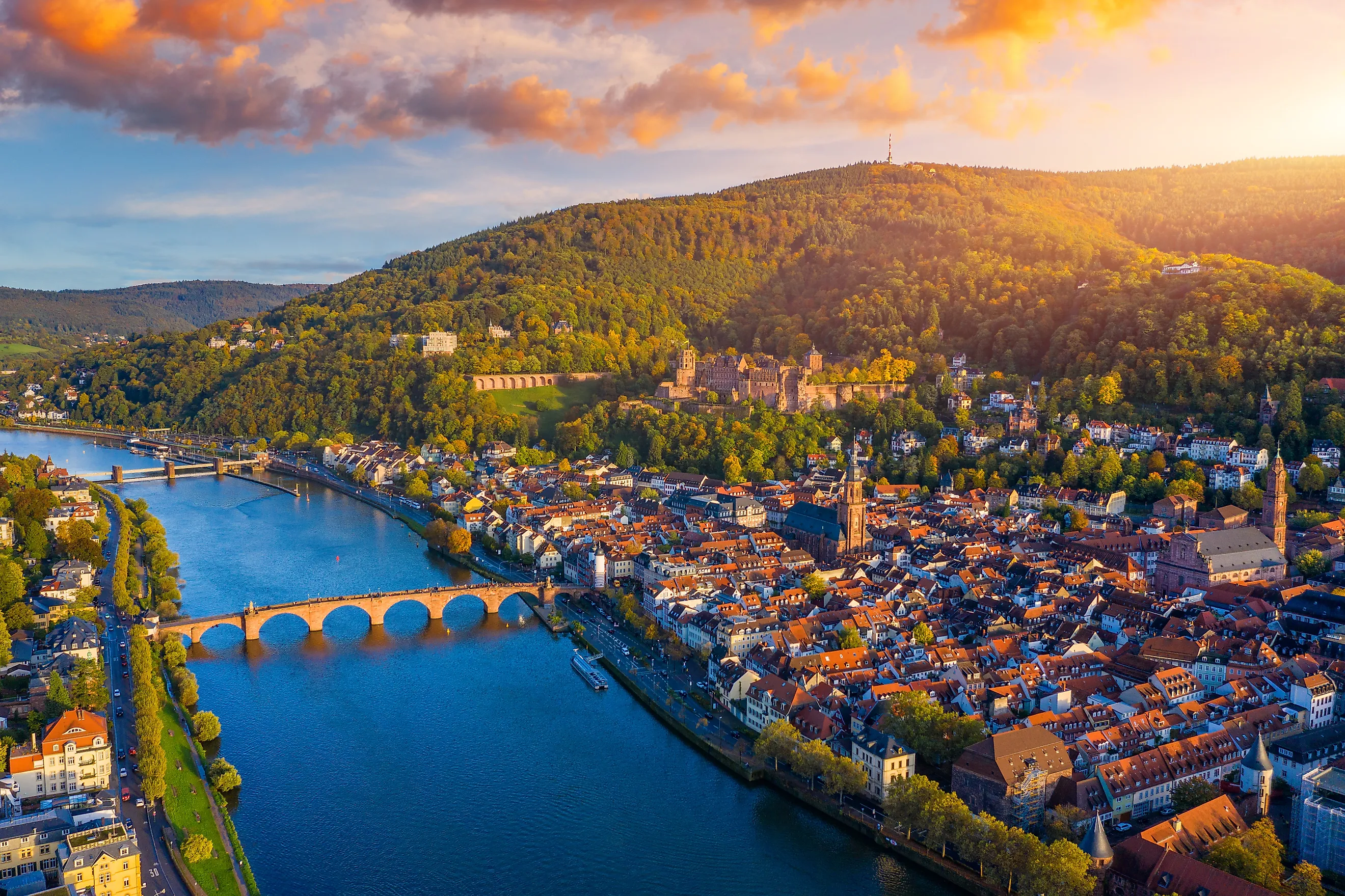
Heidelberg has a population of about 160,000 and sits on the Neckar River about 78 km (48 mi) south of Frankfurt. Seniors can visit Heidelberg Castle, which sits above the old town. Around a million visitors tour the castle each year, and since the early 19th century, the palace has been a symbol of German Romanticism. Once at the top, level paths lead through the Hortus Palatinus terraces, which were once a Renaissance showpiece but are now a serene garden. The Barrel Building, with its 220,000-liter wine cask called the Great Heidelberg Tun and the sculpted façade of Friedrich's Wing, draws wine lovers year-round.
One of the signature natural landmarks is the Philosophers' Walk. A sun-warmed hillside path creates a microclimate so mild that pomegranates, lemons, bamboo, palms, cypress, and loquat grow in the open air. Historical figures such as Goethe and Hölderlin walked the same path. The ascent via the Schlangenweg ("Snake Path") is steeper, winding through terraced vineyards and shaded stretches. Because the trail is just 800 meters from the tram and bus stops, it remains accessible to active seniors. Retired academics especially may enjoy the Heidelberg University Library. As one of Germany's oldest university libraries, with over six million items across its central and branch collections, it offers high ceilings, warm light, and reading rooms. The library provides training and advisory services, a helpful reference desk, and easy access to digitized historical holdings, including manuscripts and rare prints.
Hanover (Hannover)

The city has over half a million inhabitants and lies at the confluence of the River Leine and its tributary, the Ihme. The Hanover Fairground hosts numerous trade fairs and is one of the largest in the world. It also hosts the Hanover Marksmen's Festival (Schützenfest Hannover), the largest marksmen's festival in the world. Hannover's Neues Rathaus (New Town Hall) was completed in 1913 and said to have been "paid for in cash." The Wilhelmine-era structure rises on more than 6,000 beech piles, which contrasts beautifully with the soft lawns of the Maschpark surrounding it. The building still houses the Lord Mayor's office, political chambers, exhibitions, and the Bürgerbüro. Retirees often drift through the Platz der Menschenrechte, renamed from Trammplatz in 2024, linger on the benches facing the façade, or step inside to see temporary displays.
There is also the Maschsee, created as an urban lake in the 1930s. It has become Hannover's favorite wide, flat path for walking, cycling, and jogging. Those who enjoy being on the water can rent rowing boats or pedal boats. The city's Herrenhäuser Gärten hosts summer events, including live orchestras, and is one of Europe's best-preserved baroque gardens. Just across the way, the Berggarten holds more than 12,000 plant species.
A Retirement Lifestyle in Germany
The strongest retirement cities in Germany share a shape: mid-sized populations, historic centers built before cars, and transit that removes the need for one. Pensions go further where housing stays modest, and days fill faster where a market square or a lakeshore sits ten minutes from the front door. Each city here delivers that balance in its own way, with enough amenities to keep life interesting and few of the pressures that come with the country's largest metros. The right fit comes down to which routine sounds most like home.