8 Northern Ireland Towns Where Time Stands Still
Northern Ireland's smaller towns hold their history close, in working linen mills, bars that have not changed their fittings in a century, and stone circles older than written record. Omagh sits at the gateway to the Ulster American Folk Park, where the streets and cottages of the 18th and 19th centuries have been rebuilt to walk through. Banbridge keeps the sets, props, and costumes of "Game of Thrones" under one roof at its studio tour. Warrenpoint guards a 16th-century tower house and a granite castle still lived in by the same family after three hundred years. The eight towns below reward anyone who likes the past close enough to touch.
Limavady

The name says it before anything else does. Limavady comes from the Irish for "leap of the dog," after a wise hound that, in local legend, carried word back to the O'Cahan family who once held this stretch of the River Roe. The town grew rich on linen and whiskey, and the harder side of that prosperity is preserved at the Limavady Workhouse Museum. Its Poor Union building served the destitute from 1842 to 1932, and guided tours walk through the dormitories and work rooms where that life played out. Above town, the Binevenagh Area of Outstanding Natural Beauty rises to a basalt escarpment; the climb up Binevenagh Mountain opens onto the North Atlantic, and the cliffs run all the way down to the sea. Roe Valley Country Park tells a quieter story of local pride. It became one of the first protected forests in Ireland because the townspeople raised the money to buy it themselves and keep it from being cleared. Walk the river through the woodland and an old linen mill still stands among the trees. Afterward, Frank Owens' Bar has poured drinks since 1852 and kept most of its original fittings while it did.
Omagh

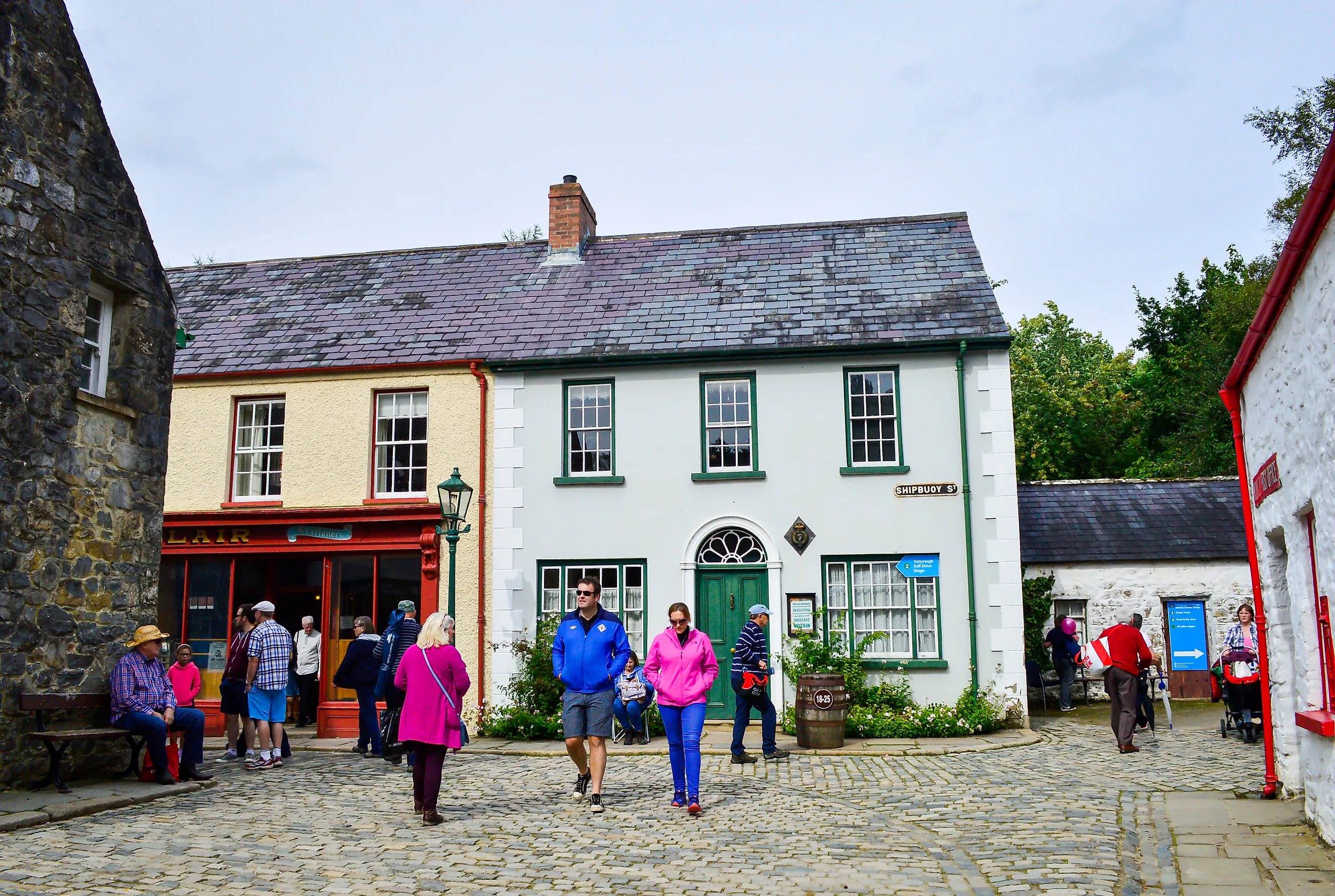
Two rivers, the Drumragh and the Camowen, meet in the middle of Omagh and join to form the Strule. The name means "the sacred plain," and the town became a market center in the 17th century, with the Sperrin Mountains and their lakes and valleys at its back. The oldest thing near Omagh is also the strangest. The Beaghmore Stone Circles, about half an hour away, are a Bronze Age complex of seven low circles, ten stone rows, and a dozen cairns, raised somewhere between roughly 2000 and 1200 BC; flint tools found beneath them have been carbon-dated centuries earlier still. Some of the rows align with the rising and setting sun, and faint marks on a few stones have been compared to Ogham, the earliest Irish writing. Closer to town, the Ulster American Folk Park reconstructs a 19th-century village from original and replica buildings, tracing the lives of Ulster people at home and the new lives they built in North America after emigrating in the 18th and 19th centuries. Broderick's Bar and Lounge, the town's oldest, has served since 1937, with leather chairs and velvet couches near the fire.
Portadown

The River Bann runs straight through Portadown, which took shape in the 17th century and grew over the next two hundred years on agriculture, linen, and whiskey. Eight miles north, on the shore of Lough Neagh, Oxford Island Nature Reserve occupies a peninsula laced with forest trails and lakeshore paths, with bird hides, a children's play park, and a café. On the edge of town, Ardress House is a 17th-century farmhouse that kept some of its original furnishings and paintings; in autumn the working farmyard offers tractor rides and apple-picking in the orchard. Back in the center, McConville's has poured Guinness for 150 years behind a wooden interior so intact that the decade outside the door stops mattering. Live music most weekends does the rest.
Banbridge

A bridge built across the River Bann in 1712 gave Banbridge both its crossing and its name, twelve miles southeast of Portadown. Linen made it prosper, and St. Patrick's Church marks the town's older history; the church itself dates to the 19th century, while the graveyard and the older church wall beside it go back to the 17th. The oddest piece of engineering in town is the Downshire Bridge, known locally as "The Cut." Built in the 19th century, it carries a roadway over a deep central trench dug through the main street, sparing horses the steep climb that used to make them faint; some accounts call it the first flyover bridge in Europe. Banbridge is also where the props, costumes, and rebuilt interiors of "Game of Thrones" now live, at the studio tour that outlasted the series. Come in summer and BuskFest fills the streets, a free international competition that turns street performers of every age loose across the town.
Warrenpoint

Warrenpoint sits on Carlingford Lough at the southern edge of Northern Ireland, watched over by Narrow Water Keep, a 16th-century tower house built as a military fort with three floors of chambers and later put to industrial use in the 18th century. Just beyond it, Narrow Water Castle has belonged to the same family for more than three centuries; their home was the 17th-century Mount Hall next door before the 19th-century granite castle replaced it. Each July the family opens the interiors and eight acres of gardens for tours, and a two-bedroom apartment on the grounds can be booked, with access to the gardens, equestrian center, and surrounding woods. Behind the town rise the Mourne Mountains, which hold the highest peaks in Northern Ireland. The Men of the Mournes walking tour climbs through streams and valleys while the guide recounts the history of the men who dug the tunnels and cut the stone, with routes graded for different distances and difficulty. Summer brings two festivals, Wake the Giant and the Warrenpoint Loughside Festival, both built around food, music, and the town itself.
Comber

Scottish settlers founded Comber in the 17th century, and it grew through the 19th and 20th on linen, whiskey, and flour and corn mills. The town sits at the head of Strangford Lough, the largest sea lough in the United Kingdom, and on its shore the WWT Castle Espie reserve runs trails through wetland and woodland alive with birds. St. Mary's Parish stands on the site of a 12th-century Cistercian abbey; the present church dates to 1840, the graves around it reach back to the 17th century, and the stained glass inside traces the history of Comber and the country around it. The church grounds host the Comber Farmers' Market on the first Thursday of each month, with local produce, flowers, and baking. The town saves its proudest celebration for the potato: each June the Comber Earlies Food Festival honors the regional crop with food, drink, and live music.
Holywood

Monks settled here in the 7th century, and the town that grew around them still carries their mark. The Holywood Priory Church stands on that early monastic site and keeps the ruins of a 12th-century Augustinian abbey; the 19th-century tower once belonged to the town's main church, and the cemetery holds notable names, among them the physicist Sir Joseph Larmor. The centerpiece is stranger. Holywood's maypole, planted at the crossroads in the middle of town, is the only surviving maypole in Ireland, and local legend traces it to 1700, when a shipwrecked Dutch crew is said to have raised the broken mast in thanks for the townspeople's help. When the railway reached the coast in the 19th century, Belfast's merchant class built their houses here. The North Down Coastal Path begins in Holywood and runs sixteen miles along the shore and through parks, passing Grey Point Fort, a coastal battery preserved from 1907 with its two 23-foot guns still in place. Golfers can add the Royal Belfast Golf Club, founded in 1881 and the oldest course in Ireland.
Larne

Trade made Larne, and the sea still defines it. The railway arrived in the 19th century and turned the eastern coastal town into a busy port, which it remains, carrying goods and passengers across to Scotland and England. The Chaine Memorial Tower, a granite beacon shaped like an Irish round tower and standing about 90 feet, was completed in 1888 to honor the man who built up the harbor. At the start of the Antrim Coast Road, the Blackcave Tunnel, or "The Black Arch," was carved straight out of the cliff; beside it, "The Devil's Churn" drops by staircase toward the sea between two jutting rocks, where the waves work the cave into the churning sound that feeds one of Larne's ghost stories. Portmuck Harbour looks back across the water to Scotland and out to seals and dolphins, and nearby Sandy Bay offers a beach and a boardwalk. In town, Ann's Pantry has baked for more than fifty years; the soda breads and sausage rolls are the reason to stop.
Where the Past Stays Close
What links these eight towns is not scenery but continuity. The linen mills, the workhouse, the family castle, the maypole, and the bars that still look as they did a hundred years ago are not staged for visitors; they are simply still here, doing more or less what they always did. That is the difference between a town that displays its history and one that has never quite let go of it. In the smaller towns of Northern Ireland, the past is not behind glass. It is the building you walk into for a pint.