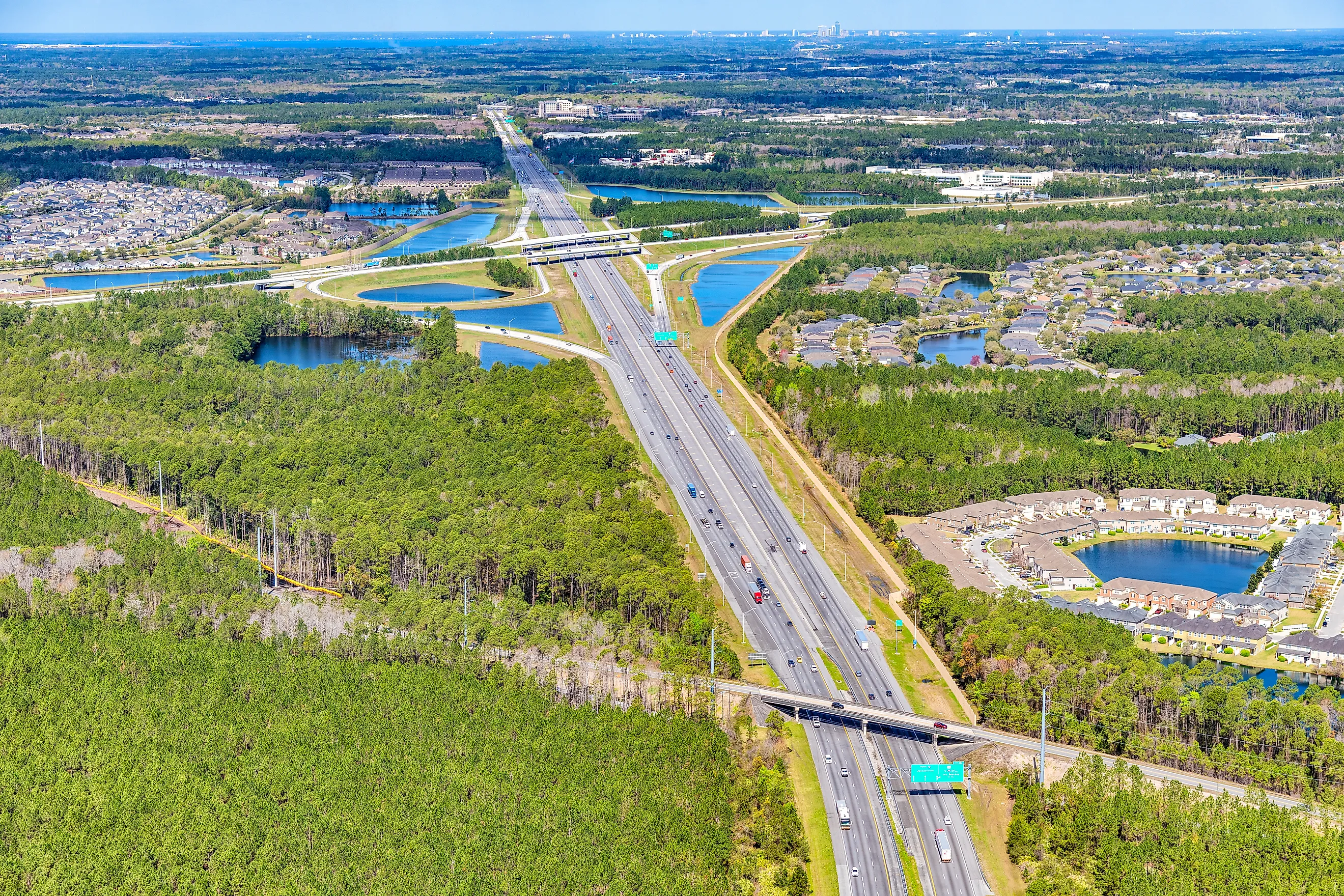
The Interstate 95 Runs Through The Most States
Drive the length of the East Coast and the "Welcome to" signs come fast. Interstate 95 passes through 15 states, more than any other highway in the country. It even nicks a corner of Washington, D.C.
The longest highways in the country actually cross far fewer states than this one. The reason is geography, since the 13 original colonies became small states stacked along the coast. The rest runs through old toll roads and famous bridges, down to one gap that stayed open until 2018.
Fifteen States and a Corner of Washington, D.C.

Northbound from Miami, I-95 crosses Florida, Georgia, South Carolina, North Carolina, and Virginia, then continues through Maryland, Delaware, Pennsylvania, New Jersey, New York, Connecticut, Rhode Island, Massachusetts, New Hampshire, and Maine. The highway touches the District of Columbia only on the Woodrow Wilson Bridge over the Potomac River, where about 300 feet of the western span passes over the southernmost tip of the District. The bridge's west abutment sits in Alexandria, Virginia, and most of its length lies in Maryland, which makes it the only bridge in the country that crosses into three state-level jurisdictions. The bridge carries well over 200,000 vehicles a day on I-95 and the Capital Beltway. Replacement spans opened in 2006 and 2008, rising 70 feet above the river at the draw. The added height was expected to cut ship openings to about 60 a year, down from about 260.
I-95 Crosses All 13 Original Colonies

All 13 original colonies lie on I-95, with New Hampshire at the northern end of the group and Georgia at the southern end. Maine, which was part of Massachusetts until 1820, and Florida are the other two states. The states that grew out of the colonies are small by national standards, so a highway running the length of the coast crosses state lines often, and the crowding is heaviest in the Northeast. Between the Potomac River and the Piscataqua River on the Maine line, I-95 passes through nine states in about 550 miles.
I-90 runs about 552 miles in Montana alone, roughly the distance I-95 takes to cross all nine of those states. The longest Interstate covers more than 1,500 miles across its first five states, Washington, Idaho, Montana, Wyoming, and South Dakota. It ends in Boston with 13 states, two fewer than I-95.
The Shortest State Segments Run Under 25 Miles

New York's share of I-95 is only about 23.5 miles, and it begins on the George Washington Bridge over the Hudson River. That span is the world's busiest motor vehicle bridge, and it carried more than 104 million vehicles in 2019. Its two decks hold 14 lanes, more lanes than any other suspension bridge. The highway then follows the Trans-Manhattan Expressway across upper Manhattan and the Cross Bronx and Bruckner expressways through the Bronx before picking up the New England Thruway toward Connecticut. Delaware's segment is almost identical in length, about 23 miles, beginning on the Delaware Turnpike, which opened in 1963, before it turns into the Wilmington Expressway through Wilmington, the state's largest city. The shortest state segment belongs to New Hampshire. The state has about 16 miles of the Blue Star Turnpike between the Massachusetts line at Seabrook and the Piscataqua River Bridge into Maine, with a single toll point in Hampton.
Florida and Maine Have the Longest Stretches

The two states that were not among the original 13 hold the two longest segments of I-95. Florida has about 382 miles and Maine about 303, which together account for roughly 685 miles, more than a third of the route.
Traffic thins out considerably at the northern end in Maine. Near Houlton, traffic averages between 2,000 and 4,000 vehicles a day, fewer than the Wilson Bridge carries in about half an hour. The last exit in the United States meets the eastern end of US 2, and past the border crossing at Houlton, the same road becomes New Brunswick's Route 95.
The southern terminus is a partial interchange with US 1 near the Vizcaya Metrorail station in Miami. Heading north, the highway stays close to the Atlantic coast, passing Fort Lauderdale and Daytona Beach before it reaches Jacksonville, where Interstate 10, the southernmost coast-to-coast Interstate, has its eastern end.
Old Turnpikes Became Long Pieces of I-95

In Virginia, the Richmond-Petersburg Turnpike opened in 1958 with a 70-cent toll for its full 35 miles, and it later became part of I-95 between those two cities. Much of the route had a similar start. When Congress created the national Interstate system in 1956, several toll roads along the corridor were already open, including the New Jersey Turnpike, the Maine Turnpike, whose first section between Kittery and Portland opened in 1947, and New Hampshire's turnpike, dedicated in 1950. Connecticut's section was built largely on its existing turnpike, and Connecticut, New York, and Delaware had all completed their shares of I-95 by 1968.
Tolls are still collected on the Maine, New Hampshire, Delaware, and New Jersey turnpikes. They ended on the Connecticut Turnpike in 1985 and on the Richmond-Petersburg Turnpike in 1992, and remnants of the Virginia toll booths are still visible just past the I-85 interchange.
A Gap in New Jersey Lasted Until 2018

A gap in Florida, between West Palm Beach and Fort Pierce, sent drivers onto Florida's Turnpike or US 1 until I-95 opened there in December 1987. The missing link in New Jersey lasted another 31 years.
That gap dates to 1982, when an inland link called the Somerset Freeway, planned between Hopewell Township and I-287 in Piscataway, was canceled amid opposition from residents along the Princeton corridor and concern that it would pull traffic and revenue off the New Jersey Turnpike. I-95 coming from Pennsylvania ended abruptly at US 1 in Lawrence Township and turned into I-295. From the north, the I-95 designation followed the New Jersey Turnpike south and stopped at the Pennsylvania line.
The fix was built in Bucks County, Pennsylvania, where I-95 passed over the Pennsylvania Turnpike without a connection, partly because federal rules at the time barred federal money from paying for interchanges with toll roads. Two flyover ramps opened on September 22, 2018, and I-95 was rerouted onto the turnpike and across the Delaware River into New Jersey, making it continuous between Miami and Houlton for the first time.
Toll roads shaped both ends of that history. Turnpikes in New Jersey, Maine, and New Hampshire were already carrying traffic when the Interstate system began, so long stretches of the corridor mostly needed a new route number. The same toll money later stalled the finish, because New Jersey Turnpike revenue was part of the case against the Somerset Freeway, and the federal ban on funding toll-road interchanges left I-95 crossing the Pennsylvania Turnpike for years with no ramps. The Bucks County interchange became the last project financed under the Federal-Aid Highway Act of 1956. The route that reaches more states than any other was finished 62 years after the law that launched it.